Learning Outcomes
This article outlines key location-specific pre-contract searches and enquiries concerning flood risk and mining activities, including:
- Purpose, procedures, and implications of flood and mining searches in property transactions.
- Indicators for when flood and mining searches are necessary based on property location, title, and history (including mines and minerals reserved out of the title).
- Information provided by core searches and reports: CON29DW (water and drainage), environmental and dedicated flood reports, CON29M (coal mining), and specialist searches for tin, limestone, brine, and clay extraction.
- Practical implications of adverse results for insurance (including limits of Flood Re), lender requirements, value/marketability, structural safety, and development potential.
- Follow-up actions and further due diligence: targeted enquiries, specialist surveys (flood risk or mining/structural), build-over consents, and adoption/maintenance liabilities.
- Reporting to client and lender in accordance with the UK Finance Mortgage Lenders’ Handbook, including search currency and insurability from exchange.
- Common confusions between local authority searches and location-specific searches, and the limits of desktop risk-screening products.
SQE1 Syllabus
For SQE1, you are required to understand the purpose and practical application of key pre-contract searches and enquiries, specifically focusing here on those related to flood risk and mining history, with a focus on the following syllabus points:
- Identifying when flood and mining searches are appropriate based on property location and history.
- Understanding the information revealed by standard reports (e.g., CON29DW, Environmental Searches, CON29M, Coal Authority reports).
- Assessing the implications of identified flood risks (e.g., on insurance, value, lending) and mining hazards (e.g., subsidence, structural stability).
- Advising clients on the results and necessary further actions or precautions.
- Recognising the solicitor's duty of care in relation to these searches.
- Appreciating lender expectations on search currency (typically no more than six months at completion) and insurability at exchange.
- Knowing when to commission specialist flood or ground stability reports and how to incorporate their outcomes into advice and contractual strategy.
Test Your Knowledge
Attempt these questions before reading this article. If you find some difficult or cannot remember the answers, look more closely at that area during your revision.
-
Which search form specifically includes enquiries about drainage and water connections to a property?
- a) LLC1
- b) CON29
- c) CON29DW
- d) CON29M
-
A CON29M search would be most relevant for a property located in which type of area?
- a) An area known for coastal erosion
- b) A designated conservation area
- c) An area with a history of coal mining activity
- d) An area prone to surface water flooding
-
True or false? A standard environmental search report will always definitively state whether land is legally designated as 'contaminated land' under the Environmental Protection Act 1990.
Introduction
Beyond the standard searches applicable to nearly all property transactions, certain location-specific risks necessitate further investigation. Flood risk and the legacy of past mining activities represent significant potential hazards that can affect a property's value, structural integrity, insurability, and suitability for a buyer's intended use. Solicitors must identify when these risks are relevant and conduct appropriate searches and enquiries to advise clients properly. This article examines the key searches related to flood and mining risks, the information they provide, and the practical implications of their findings for conveyancing practice, particularly in the context of advising clients and satisfying lender requirements.
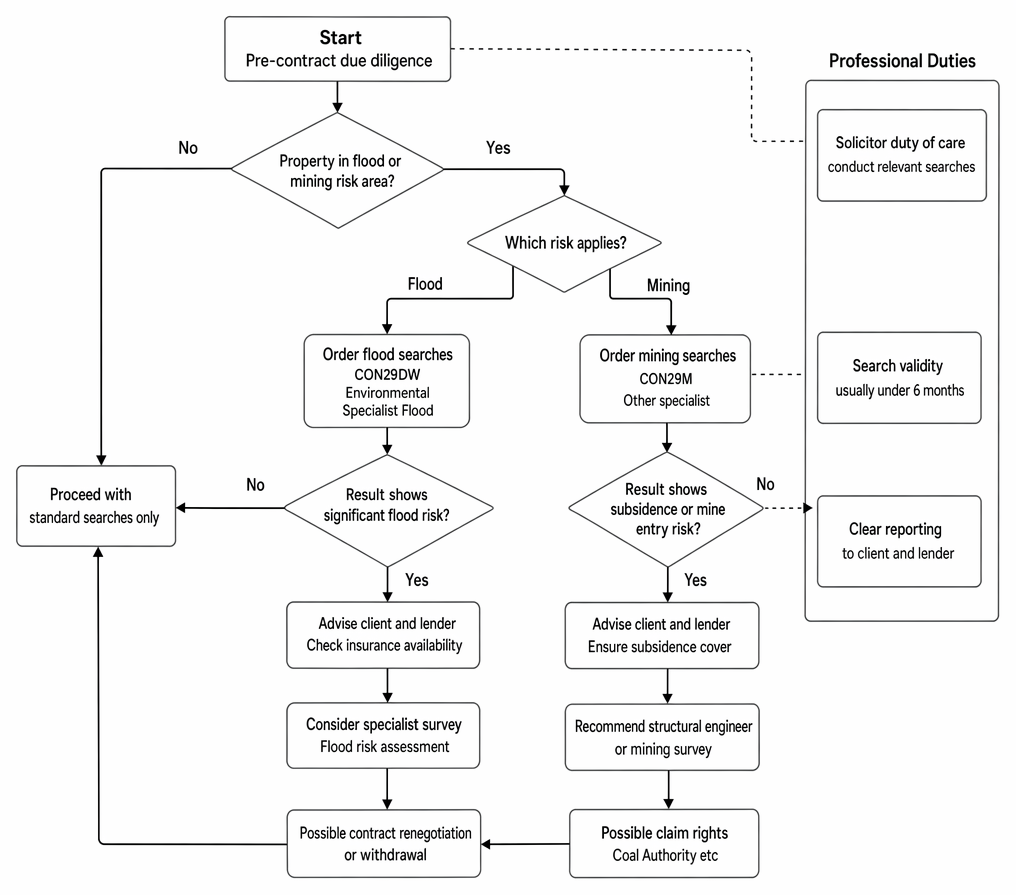
Pre-contract due diligence for flood and mining risks, including relevant searches, consequences of adverse results, and associated professional duties.
The principle of caveat emptor places the onus on the buyer to discover defects or constraints that impact use, enjoyment, marketability and lending. A prudent approach layers together what the seller knows (pre-contract enquiries), what public bodies record (local and water authority searches), and what risk-modelling and authoritative datasets reveal (environmental/flood and mining searches). Where risk is identified, steps such as specialist surveys, insurance enquiries and targeted contractual management are often decisive in determining whether the transaction proceeds.
Flood Risk Searches
Investigating flood risk is a critical part of pre-contract due diligence, particularly given the increasing frequency and severity of flooding events attributed to climate change. Failure to adequately assess and advise on flood risk can have severe consequences for the buyer and potential liability for the solicitor.
Purpose and Importance
The primary purpose of flood searches is to identify the likelihood and potential severity of flooding from various sources affecting the property. This information is important because:
- Physical damage to structures and contents can be substantial, and even non-structural flooding can require costly remediation and extended vacancy.
- Insurance availability, premium levels and excesses can be affected; many lenders require confirmation that buildings insurance can be obtained on reasonable terms from exchange.
- Value and marketability may be impaired by current or modelled risk, recorded past events, or expensive premiums/excesses, impacting resale prospects.
- Lender requirements typically expect the borrower’s solicitor to identify material flood risk, to report significant findings, and to confirm insurability in accordance with the UK Finance Mortgage Lenders’ Handbook.
Key Term: Flood Risk Assessment
An evaluation, often included in environmental or specialist flood reports, of the likelihood and potential impact of different types of flooding on a specific property, usually categorised into risk levels (e.g. low, moderate, high).
Types of Flood Risk
Solicitors should be aware of the different types of flood risk that can affect a property:
- River (fluvial) flooding when watercourses exceed capacity and overtop.
- Coastal flooding from tides and storm surges.
- Surface water (pluvial) flooding from intense rainfall overwhelming drainage and ponding in low-lying or impermeable areas.
- Groundwater flooding when a raised water table intersects ground level, affecting basements and below-ground structures.
- Sewer flooding when combined or foul sewers surcharge during heavy rainfall or due to blockages and misconnections.
- Reservoir failure risk (low likelihood but significant consequence) in areas downstream of large impoundments.
A single site can be at low risk from rivers but moderate or higher for surface water or groundwater; desktop reports therefore segment sources and provide a composite overview.
Key Flood Searches and Reports
Several searches provide information relevant to flood risk:
- CON29DW (water and drainage): confirms connections to public sewers and water, the location/proximity of public sewers and mains, recorded sewer flooding incidents, and whether any build-over consents exist or are needed.
- Environmental search: many desktop environmental reports include screening for river, coastal, surface water, groundwater and sometimes reservoir risk, typically with a traffic-light risk rating and recommendations for next steps.
- Specialist flood risk reports: where screening indicates moderate/high risk or the property lies in an obviously sensitive location (riverside, coast, low-lying basin), a dedicated property-specific flood report provides mapped datasets, historical flood records, flood defence presence/standard of protection, residual risk (overtopping/breach), and tailored commentary.
Key Term: CON29DW
A drainage and water search sent to the statutory undertaker to confirm connections to public water and sewers and to reveal information such as the location of public sewers and any recorded sewer flooding affecting the property or locality. Key Term: Environmental Search
A desktop report combining national and local datasets to indicate potential contaminated land liability and, commonly, to screen for flood and ground stability risks, giving risk ratings and recommendations.
Specialist providers often draw on Environment Agency/Natural Resources Wales datasets for flood zones, defences and susceptibility, plus surface water modelling. The presence of flood defences may reduce annual probability but does not eliminate residual risk; the effect on insurance therefore depends on the overall picture and insurers’ underwriting rules.
Key Term: Flood Re
A government-backed reinsurance scheme supporting household insurers to offer affordable flood cover for eligible residential properties. Broadly, it does not apply to properties built after 1 January 2009, most leasehold blocks, buy-to-lets held as a business, or commercial properties.
Alongside desktop reports, location-adjacent searches can supplement understanding:
Key Term: Canal and River Trust/Environment Agency/Natural Resources Wales search
A search where property adjoins a canal or river, revealing liabilities for maintaining waterways, banks or towpaths, boundary ownership, adverse rights, and sometimes contextual flooding information.
Follow-up enquiries and practical checks
Where a desktop or specialist report flags risk:
- Raise targeted enquiries of the seller (TA6 for residential/CPSE for commercial) about any previous flooding, dates, causes, extent, and insurance claims/availability.
- Advise early contact with insurers to obtain indicative terms, premiums and excesses. Emphasise that disclosure of previous flooding is mandatory.
- For basements or below-ground structures in groundwater-prone areas, consider a surveyor’s review of waterproofing and drainage measures.
- Where the CON29DW shows a public sewer running within the plot, check for any build-over agreement and advise on restrictions.
Key Term: Build Over Agreement
Consent from the water company allowing construction over/near a public sewer subject to conditions, often needed to validate insurance and to avoid risk of structural/flooding problems.
Interpreting Flood Search Results
When flood risk is identified, the solicitor must:
- Report to client and lender: explain the type(s) of risk, severity, and consequences, including insurability and lender appetite. For mortgage cases, ensure lender-specific reporting obligations are satisfied.
- Advise on insurance: prompt the client to obtain quotes for buildings insurance including flood cover and to confirm any excesses/limitations. Flood Re eligibility may assist some owner-occupied homes but is unavailable for many newer or non-residential properties.
- Recommend further action: commission a specialist flood report if only a screening search has been done, and consider a flood specialist or surveyor’s site visit to recommend mitigation (e.g. flood doors, non-return valves, raised services).
- Consider contractual implications: ensure the client is aware that under standard conditions risk often passes to the buyer on exchange; insurance must commence from exchange. Sellers rarely accept liability for future flooding, but results may be a price negotiation point.
- Evaluate development potential: proximity to flood zones and floodplain designation may affect future extension or redevelopment prospects and could trigger a requirement for a planning flood risk assessment.
Worked Example 1.1
You act for a buyer purchasing a riverside cottage in England. The standard environmental search reveals a moderate risk of river flooding and a low risk of surface water flooding. The seller's Property Information Form states they are unaware of any past flooding. The buyer is obtaining a mortgage.
What further steps should you advise the buyer to take?
Answer:
You should advise the buyer of the identified moderate river flood risk and its potential impact on insurance availability/cost and property value. You must report the findings to the lender. Advise the buyer to:
- Make immediate enquiries with insurers regarding the availability and cost of buildings insurance including flood cover.
- Consider commissioning a specialist flood risk report for a more detailed assessment.
- Discuss the findings with their surveyor, if one has been instructed.
- Ensure buildings insurance will be in place from exchange given the standard allocation of risk. Depending on the insurance situation and the detailed report, the buyer may wish to reconsider proceeding or attempt to renegotiate the price, although the seller is unlikely to accept responsibility for future flood risk.
Worked Example 1.2
A buyer is purchasing a coastal house completed in 2015. A specialist flood report indicates a high risk of coastal flooding mitigated by defences, with significant residual risk in extreme events. The buyer intends to obtain a residential mortgage.
How should you frame your advice on insurance and lending?
Answer:
Explain that while defences reduce probability, residual risk remains. Advise the buyer to obtain quotes for buildings insurance including flood cover and confirm any high excesses. Flood Re will not be available because the property was built after 1 January 2009 and the buyer should not rely on it. Report the risk and insurability to the lender and confirm insurance will be in place from exchange. If insurance is unavailable on reasonable terms, the lender may decline to lend and the buyer will need to reconsider proceeding or re-negotiate.
Mining Searches
Historical mining activity across England and Wales presents potential risks to property stability due to ground movement (subsidence). Identifying these risks through appropriate searches is important, especially in known former mining areas.
Purpose and Relevance
Mining searches aim to identify whether a property is located in an area affected by past, present, or future mining activities (primarily coal, but also others like tin, limestone, clay, and brine). The key concern is the risk of ground instability and subsidence caused by underground workings or mine entries (shafts and adits).
Key Term: Subsidence
The gradual caving in or sinking of an area of land, often caused by underground mining activities removing support for the surface above.
Identifying mining-related risks is important for:
- Structural safety: ground instability may compromise foundations, walls and drainage.
- Insurability: subsidence cover is commonly available but often subject to higher premiums/excess and can be restricted where active risk persists.
- Mortgageability: lenders may require confirmation of adequate insurance and may decline to lend if material, unresolved instability is identified.
- Development potential: historic workings/mine entries can constrain extension or new foundations and may necessitate specialist engineering solutions.
Types of Mining and Relevant Searches
- Coal mining: the most widespread risk in England and Wales.
Key Term: CON29M
The official coal mining search (usually through the Coal Authority), revealing past underground and opencast workings, proposed future workings, mine entries (shafts/adits), any subsidence damage claims, and licences within the vicinity.
A CON29M typically identifies:
- Whether the property is in a coalfield and the extent/type of past workings.
- Known mine entries (often giving proximity and status such as capped/treated).
- Notices of hazards or remedial works.
- Past or current coal mining subsidence claims and outcomes.
Key Term: Mine Entry
A shaft or adit providing access to underground workings. Proximity to an entry can materially increase ground stability risk and may restrict building works.
Other mining activities may require dedicated searches depending on location:
- Tin mining (Cornwall, Devon, Somerset) via specialist providers.
- Limestone extraction (notably in parts of the West Midlands such as Dudley, Sandwell, Walsall, Wolverhampton, Telford & Wrekin) via local authority or specific providers.
- Brine/salt extraction (primarily Cheshire) where a search may be made with or referencing the Cheshire Brine Subsidence Compensation Board.
- Clay extraction (Cornwall, Devon, Dorset) through specialist associations.
Where title reveals mines and minerals reserved to a third party, assess any rights of entry and support reservations which may affect the surface owner and raise specific enquiries. A search of the index map can assist in identifying whether mineral rights are registered under a separate title.
Key Term: Index Map Search (SIM)
A Land Registry search of the index map to identify registered titles affecting an area, including separate mineral titles or cautions against first registration.
Impact of Mining Search Results
Positive results indicating nearby mining activity or subsidence risk require careful consideration:
- Report to client and lender: explain nature and proximity of workings or mine entries, any recorded subsidence claims, and the overall stability assessment. Lenders may impose conditions or decline lending on particularly high-risk sites.
- Insurance: confirm that the buyer can obtain buildings insurance including subsidence cover (and whether mining-related subsidence is included/excluded and the excess).
- Further investigation: consider engaging a mining surveyor or structural engineer where CON29M or other mining searches indicate higher risk, especially if mine entries are within close proximity or if there are known shallow workings.
- Claims and remedies: in coalfield areas, the Coal Authority has a statutory role in addressing subsidence damage from coal mining.
Key Term: Coal Mining Subsidence
Subsidence damage caused by coal mining activity, for which the Coal Authority generally has statutory responsibilities to repair damage or compensate under relevant legislation.
Raising enquiries when mines/minerals are reserved
If the register or deeds show mines/minerals excluded from the title, raise targeted enquiries:
- Who holds the mineral rights and what rights of entry/support exist?
- Have such rights ever been exercised and was compensation paid?
- Are there proposals or recent applications to exercise such rights?
- Has the property suffered subsidence, landslip or heave, and if so, what remediation/claims occurred?
Key Term: Environmental Search
(See above) Many environmental reports include a ground stability screen drawing on British Geological Survey and former mining datasets that can flag non-coalrelated mining hazards.
Worked Example 1.3
You act for the buyer of a house in Nottinghamshire. The title investigation reveals no specific mineral reservations. A CON29M search reveals past underground coal workings nearby (last worked 70 years ago) and one recorded mine entry 150 metres away. No subsidence claims are recorded for the property itself, but claims were made on neighbouring properties 10 years ago.
How should you advise the buyer?
Answer:
Advise the buyer about the past mining activity and nearby mine entry. Explain the potential, albeit possibly low, risk of future subsidence, highlighting the past claims on neighbouring properties. Recommend that the buyer:
- Ensures their proposed buildings insurance policy specifically covers subsidence, including that caused by coal mining, and understands any excess applied.
- Instructs their surveyor (if any) to pay particular attention to any signs of existing structural movement and consider a mining engineer’s opinion if concerns remain.
- Appreciates that older, deep workings often present reduced current risk but that recorded claims nearby indicate a susceptibility in the locality. Report the findings to the mortgage lender, who may require confirmation of adequate insurance or further technical assurance.
Worked Example 1.4
A registered freehold title in the West Midlands excludes “all mines and minerals together with rights of entry to work and win the same.” The property is in Sandwell. No coal is indicated on CON29M, but the local area is known for limestone extraction.
What searches and enquiries are appropriate, and what are the implications?
Answer:
In addition to CON29M, commission a limestone mining search with the relevant local authority/provider because local instability can arise from historical limestone workings. Consider an environmental search with ground stability screening and raise enquiries on whether mineral rights have been exercised, any recorded subsidence, and any compensation. If mineral rights are registered separately, a SIM search can identify the mineral title holder. Report risks to the lender; advise on insurance for subsidence and consider a structural survey where searches indicate risk. Note that rights of entry within the reservation could, in principle, be exercised, although this is uncommon in urbanised areas and would normally trigger compensation.
Practical Considerations
Timing and Validity of Searches
Pre-contract searches, including flood and mining searches, should ideally be carried out as early as possible in the transaction after receiving instructions and funds from the buyer. Search results have a limited shelf-life; lenders typically require searches to be no more than six months old at the date of completion. If completion is delayed, searches may need refreshing to maintain lender compliance and to ensure information remains current.
Reporting to Client and Lender
Present search outcomes clearly, distinguishing screening results from property-specific assessments, and set out implications for:
- Insurability and insurance costs/excesses.
- Lender willingness to lend and any potential conditions.
- Value, marketability and future resale.
- Structural integrity and the need for further surveys.
- Development and alteration potential (e.g., planning flood risk assessment requirements or constraints from mine entries).
Where risk is moderate/high, include practical mitigation options and any costs/timescales so the buyer can make an informed decision. Provide timely reports to lenders, complying with their handbook requirements on search currency and insurability from exchange.
Exam Warning: Do not confuse location-specific searches like CON29M (mining) or specialist flood reports with the standard CON29 (enquiries of local authority) or LLC1 (local land charges) searches. While CON29 might reveal some related information (e.g., contaminated land notices), it does not replace the need for specific flood or mining searches where the location warrants them. Ensure you identify the correct search needed for the specific risk identified in a scenario.
Further, a negative reply to a local authority question about contaminated land does not preclude environmental risk; only a dedicated environmental search assesses likely liability and flood/ground stability screening.
Revision Tip: Focus on the practical consequences of adverse search results. For SQE1, understanding why a flood risk or past mining activity matters to the buyer (impact on value, insurance, safety, lender willingness) and what action the solicitor should advise is more important than memorising the precise contents of every possible search report. Remember also to consider Flood Re limitations and that new-build or commercial properties often fall outside the scheme, making early insurance enquiries important.
Key Point Checklist
This article has covered the following key knowledge points:
- Flood and mining searches are location-specific pre-contract enquiries essential for due diligence in relevant areas.
- Flood searches screen multiple sources of risk (river, sea, surface water, groundwater, reservoir, sewer) and may require specialist property-level reports; key searches include CON29DW, environmental reports and dedicated flood reports.
- The presence of flood defences reduces probability but does not remove residual risk; insurers and lenders evaluate the whole risk picture, and insurance must generally commence at exchange.
- Flood Re provides support in some residential cases but excludes many newer or non-domestic properties; early insurance enquiries are essential.
- Mining searches assess risks from coal and other extraction (tin, limestone, brine, clay). The CON29M (coal) is the core search in coalfield areas; other searches are location-specific.
- Results indicating mine entries, shallow workings or recorded claims may necessitate further engineering assessment; ensure subsidence cover is available and report to the lender.
- Mines/minerals reserved out of the title may carry rights of entry/support; raise specific enquiries and consider a SIM search where minerals may be registered separately.
- Solicitors have a duty of care to identify the need for these searches, interpret results, and advise clients on insurability, lender requirements, mitigation, and potential renegotiation or withdrawal.
- Searches should be undertaken promptly and remain valid for lender purposes (typically within six months of completion).
Key Terms and Concepts
- Flood Risk Assessment
- CON29DW
- Environmental Search
- Flood Re
- Canal and River Trust/Environment Agency/Natural Resources Wales search
- Build Over Agreement
- CON29M
- Mine Entry
- Index Map Search (SIM)
- Subsidence
- Coal Mining Subsidence