Learning Outcomes
This article explains the function and limits of pre-contract enquiries of the seller in the context of caveat emptor, clarifying what the buyer must investigate independently and what may properly be asked of the seller. It outlines the structure and core content of the standard residential and commercial enquiry frameworks (TA6 and CPSE), including how they address occupiers, boundaries, easements and other rights, planning and building regulation compliance, services, environmental and flood risks, disputes, and insurance. It examines the legal effect of replies, distinguishing accurate, qualified, and incomplete answers, and highlights when a duty arises to update replies where circumstances change before exchange. It discusses how misrepresentation principles and the Standard Conditions of Sale/Standard Commercial Property Conditions interact to determine available remedies, focusing on when rescission is realistically available and when damages or price adjustment are more likely. It details the practical steps solicitors should take to avoid misstatements and manage risk in SQE1-style scenarios, such as verifying client information against documents, raising targeted property-specific enquiries, advising on occupiers and overriding interests, and considering indemnity insurance or further investigation where significant planning, building regulation, environmental, or title-related concerns are identified.
SQE1 Syllabus
For SQE1, you are required to understand pre-contract enquiries of the seller, with a focus on the following syllabus points:
- The principle of caveat emptor and the buyer’s duty to investigate
- The seller’s obligations when replying to pre-contract enquiries
- The legal consequences of inaccurate or misleading replies (misrepresentation)
- The use and content of standard forms (e.g., TA6 for residential, CPSE for commercial)
- The practical impact of pre-contract enquiries on risk allocation and contract formation
- Occupiers and overriding interests; verifying who is in occupation
- Planning and building regulation compliance and enforcement risk
- The distinction between pre-contract enquiries and requisitions on title (including completion information and undertakings)
- Managing environmental and location-specific risks (e.g., flood, mining, chancel liability)
Test Your Knowledge
Attempt these questions before reading this article. If you find some difficult or cannot remember the answers, look more closely at that area during your revision.
- What is the legal effect of a seller’s inaccurate reply to a pre-contract enquiry?
- Which standard form is typically used for pre-contract enquiries in residential property transactions?
- Does the seller have a general duty to disclose all defects in the property?
- What is the main legal principle that places the burden of investigation on the buyer?
Introduction
Pre-contract enquiries of the seller are part of the buyer’s due diligence. They are designed to elicit information unlikely to be revealed just by title investigation or a basic inspection. In residential transactions, a TA6 Property Information Form is typically completed by the seller, and the buyer’s solicitor may add tailored questions. In commercial transactions, CPSE enquiries provide a structured set of questions with supplements to address transaction types (e.g., sales subject to existing tenancies or new leases).
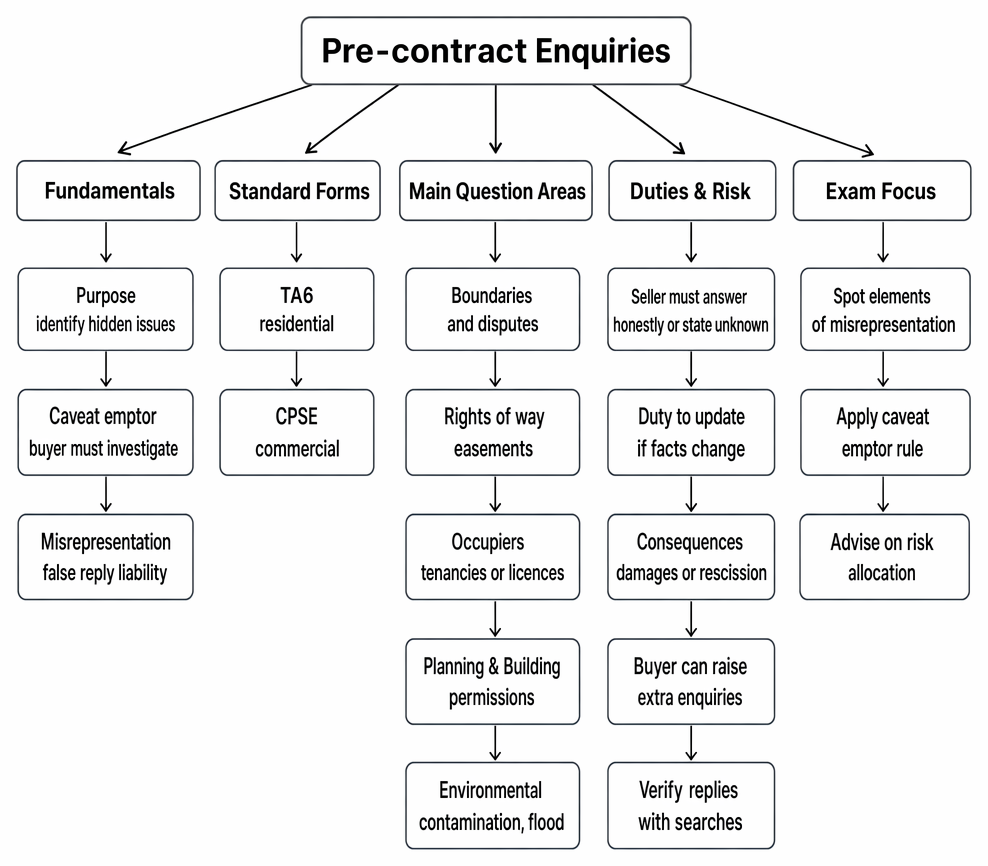
Pre-contract enquiries of the seller are presented by reference to caveat emptor, standard forms, principal subject-matter, and legal consequences of replies.
Pre-contract enquiries do not replace the buyer’s own investigations or searches (local authority, water and drainage, environmental, flood, etc.). They complement them by obtaining first-hand information from the owner/occupier, which the buyer may reasonably rely upon when deciding to proceed.
The Principle of Caveat Emptor
Property transactions in England and Wales are governed by the rule of caveat emptor—let the buyer beware. The buyer must investigate title and the property and cannot rely on the seller to volunteer defects.
Key Term: caveat emptor
The legal rule that the buyer is responsible for investigating the property and bears the risk of undiscovered defects.
Practically, caveat emptor means thorough investigation of title (official copies or epitome), searches (LLC1/CON29, CON29DW, environmental, flood), and raising bespoke enquiries of the seller where risk is identified (e.g., highways adoption, rights benefiting the land, compliance with consents). The buyer should also inspect the property and consider a survey. Many overriding interests (actual occupation, certain legal easements) are best spotted by careful questioning and physical inspection.
The Seller’s Duty and Misrepresentation
There is no general duty on a seller to disclose defects. However, if the seller answers an enquiry, the reply must be accurate and not misleading. The seller should only answer within their actual knowledge (and after reasonable checking where the question invites it). If information changes before exchange, a previously true representation can become false; the seller should correct it promptly.
Key Term: misrepresentation
A false or misleading statement of fact made by one party to another, which induces the other party to enter into a contract.
Actionable misrepresentation requires a false statement that induces the contract. Remedies are shaped by both the common law/Misrepresentation Act 1967 and the property contract. Under the Standard Conditions of Sale (SCS) or Standard Commercial Property Conditions (SCPC), rescission is typically limited to fraud/recklessness or substantial differences in quality/quantity/tenure from what was represented; otherwise damages may be payable where the misdescription materially affects value. In practice, many disputes are resolved by damages or a price adjustment rather than rescission, but the facts and contract terms are decisive.
A qualified answer (e.g., “not so far as the seller is aware”) is acceptable only if true. This phrase implies the seller has not uncovered any adverse facts within their knowledge after reasonable checking. Blanket disclaimers cannot avoid liability for misrepresentation where a statement is in fact false or misleading.
Standard Forms: TA6 and CPSE
The TA6 Property Information Form is used in protocol residential transactions. It captures practical information not apparent from the register or a simple viewing: boundaries, disputes, notices, alterations, consents, guarantees, utilities, flooding, insurance claims, and occupiers.
Key Term: TA6 Property Information Form
A standard questionnaire completed by the seller in residential property transactions, covering boundaries, disputes, alterations, guarantees, and other key matters.
Commercial transactions use CPSE forms, which are modular and may include supplemental enquiries depending on the asset and deal type (e.g., occupational leases, environmental issues, major works).
Key Term: Commercial Property Standard Enquiries (CPSE)
A set of standard forms used in commercial property transactions to obtain detailed information from the seller about the property.
For both frameworks, sellers should review documents before replying: planning permissions and building regulation approvals, NHBC or professional warranties for new builds/recent construction, consents for alterations (e.g., FENSA for replacement windows where applicable), service crossing arrangements, and any insurance claims or subsidence history. Sellers should avoid guesswork; if the answer is unknown, say so, and the buyer can then decide whether further evidence is needed.
Main Areas Covered by Pre-contract Enquiries
Pre-contract enquiries typically cover:
- Boundaries, disputes, neighbour issues, notices, and claims
- Rights benefiting and burdening the land (e.g., rights of way, support, services)
- Occupiers and tenancies (past/current), licences, or informal arrangements
- Planning permissions, building regulations compliance, listed building consent
- Alterations, additions and evidence of approvals; warranties and guarantees
- Environmental matters (contamination, notices), flooding risk/history, insurance claims
- Adoption/maintenance of roads and verges; services crossing the property
- Chancel repair risk, mining (coal, brine, limestone), canals/riverbank liabilities (where relevant)
The buyer’s solicitor should tailor extra enquiries to the property and context. Examples include asking for copies of planning/ building control completion certificates and confirmations about road adoption or contributions, querying any mines and minerals reservations, and clarifying rights relied upon by the seller (to ensure they are legally adequate for the buyer’s intended use).
Legal Effect of Replies
A reply is a representation. If it is false or misleading, and the buyer relies on it, the buyer may seek rescission or damages. Under SCS/SCPC, rescission is usually limited to fraud/recklessness or substantial differences in what is being bought; otherwise damages are likely to be the principal remedy for material misdescription. Where the misstatement is minor or non-material, only limited redress may be available.
Sellers can and should qualify answers honestly. “Not so far as the seller is aware” is suitable where the seller has no knowledge after reasonable checking. If the seller has documentation, it should be consulted before answering (e.g., planning decision notices, completion certificates, warranties). If the seller learns that a previous answer has become inaccurate, they should correct it prior to exchange to avoid liability.
In residential transactions, be alert to occupiers. The TA6 asks about who lives at the property. Any non-owning adult occupier with potential rights must confirm they will vacate and release rights on completion; lenders often require written consent to avoid overriding interests arising from actual occupation. Where the property is tenanted, the seller must disclose the tenancy and ensure the contract reflects the sale subject to the tenancy, supplying copies of the agreement and relevant compliance documents (e.g., deposit protection where applicable).
Worked Example 1.1
A buyer asks the seller whether any disputes exist with neighbours. The seller replies “no,” but in fact there is an ongoing boundary dispute which the seller forgot to mention. After completion, the buyer discovers the dispute and suffers loss.
Answer:
The seller’s reply was inaccurate. The buyer may have a claim for misrepresentation, as the seller’s answer induced the buyer to proceed with the purchase.
Worked Example 1.2
The seller completes the TA6 form and states that all necessary planning permissions were obtained for an extension. In reality, no building regulations approval was obtained. The buyer discovers this after completion when the local authority serves an enforcement notice.
Answer:
The buyer may be able to claim damages or rescind the contract for misrepresentation, as the seller’s reply was misleading and the buyer relied on it.
Worked Example 1.3
The TA6 indicates “no flooding.” The seller experienced flash surface water flooding two summers ago and made an insurance claim, but regards it as minor and forgets to disclose it.
Answer:
If the omission induced the buyer to proceed, it is likely an actionable misrepresentation. Under the Standard Conditions, rescission would usually require fraud/recklessness or a substantial difference in the property’s quality/tenure; otherwise damages for material misdescription may be awarded. In practice, evidence of the claim and the flood context (and any premium impacts) would be relevant to damages.
Worked Example 1.4
A seller answers “not so far as the seller is aware” to whether the property benefits from a legally sufficient vehicular right of way. In fact, there is only a pedestrian right of way; the seller never checked the wording of the grant and assumed vehicles were allowed.
Answer:
The phrasing implies no adverse facts are known after reasonable checking. Where the seller could readily verify the grant’s terms (e.g., consulting the register or deed), failure to do so may render the qualified answer misleading. If the buyer relied on a vehicular access representation, the buyer may seek damages or rescission, subject to the contract conditions and the extent of the deficiency.
Practical Areas Where Additional Enquiries Are Sensible
- Rights benefiting the land: Enquire whether they are sufficient for the intended use (e.g., vehicular access “at all times and for all purposes”), confirm any maintenance contributions, and request copies of deeds providing the rights.
- Highways and adoption: Confirm whether the road fronting the property is maintained at public expense and whether verges/pavements are adopted; if not, clarify private maintenance arrangements and any planned adoption contributions.
- Planning/building regulation compliance: Ask for all decisions, plans and completion/regularisation certificates. Listed buildings require listed building consent; note that listed building breaches carry no time limit for enforcement.
- Environmental/flood: Consider desktop environmental and flood risk searches. Ask for any contamination or flood history and insurance claims. Where risk exists, a specialist report may be prudent.
- Services crossing land: Ascertain whether pipes/cables for neighbouring properties cross the land and whether there are legal rights and obligations (e.g., rights of entry for repairs).
- Occupiers: Clarify who occupies. Ensure any adult occupiers agree to release rights and vacate on completion. For tenanted property, obtain the tenancy documentation and compliance evidence.
Process and Roles
Seller’s solicitor: obtains title documents; prepares the contract package; asks the client to complete TA6 (and Fittings and Contents Form), verifies obvious points where documents exist (e.g., planning permissions, building control certificates), and cautions against speculation. If the title is mortgaged, they will later undertake to redeem the mortgage on completion (via completion information and undertakings), but that is a pre-completion step distinct from pre-contract enquiries.
Buyer’s solicitor: investigates title, submits searches, reviews TA6/CPSE replies and answers, raises requisitions on title where appropriate (distinct from general enquiries), and drafts property-specific enquiries to fill gaps or probe risks.
Qualified Answers and Updating
Where a seller does not know an answer, they should say so. To avoid accidental misrepresentation, the seller should refrain from guessing and, where the question sensibly invites it, check readily available records (e.g., their planning approval file, NHBC certificate, or insurance correspondence). If circumstances change (for example, a new notice is served) before exchange, the seller should correct previous replies. A duty to correct arises because a true statement can become false with new facts; leaving it uncorrected risks misrepresentation.
Occupiers—Take Care
Non-owning adult occupiers may have rights arising from actual occupation which could bind a buyer. The buyer’s solicitor should strongly check the TA6 occupiers answer and, if needed, require occupiers to sign an acknowledgement to vacate and release any rights on completion. Where a lender is involved, it will normally require adult occupiers to sign consent to avoid a risk to its security.
Planning and Building Regulations
Planning permission (Town and Country Planning Act 1990) and building regulation compliance are separate regimes. Some works may be permitted development; others require express permission. Breaches: planning enforcement is subject to time limits, but some breaches (e.g., listed building consent) have no time limit, and building control can seek regularisation or injunction where required. Enquiries should ask the seller to confirm permissions/approvals and supply copies. If approvals are absent, regularisation or indemnity insurance may be discussed; however, the buyer must understand the limits of any insurance (e.g., it will not improve unsafe works).
Environmental and Flood Risks
Under the Environmental Protection Act 1990 contaminated land liabilities can fall on the current owner, not only the original polluter. CPSE enquiries include environmental issues; TA6 queries flooding and insurance claims. Ask for known contamination notices, past usage risks, flood incidents, and insurance claim details. The buyer can commission a desktop environmental search and, where indicated, a specialist survey. Flood cover for most residential properties is available under Flood Re, but some property types are excluded; insurance terms and premiums matter when assessing risk.
Commercial Variations
CPSE enquiries are more extensive than TA6: boundaries, rights, condition, utilities, fire safety, planning/building regulations, environmental, occupiers/employees, insurance, and disputes. Transaction-specific supplements (e.g., where occupational leases exist) require copies of leases, service charge data, rent schedules, and compliance information. Replies must be accurate; qualified answers should reflect best knowledge after reasonable inquiry.
Insurance and Indemnity
Where investigation identifies a historic technical risk (e.g., missing building control certificate for legacy works) that cannot be feasibly regularised, parties sometimes agree indemnity insurance. Insurance can manage enforcement risk but does not cure the breach; insurers often bar contact with authorities post-policy inception. Firms advising on insurance must comply with financial services regulation and use the professional firms exemption where appropriate.
Exam Warning: If a seller is unsure about an answer, they should check before replying. Guessing or omitting material facts can lead to liability for misrepresentation, even if the omission was not intentional. If facts change before exchange (for example, a planning enforcement notice is served), correct the reply promptly; a failure to do so can turn an initially accurate answer into a misrepresentation. Distinguish pre-contract enquiries from requisitions on title and from pre-completion “completion information and undertakings”.
Revision Tip: Review TA6 and CPSE forms and understand how they dovetail with searches and inspections. Practise drafting property-specific enquiries (e.g., the sufficiency of rights for a planned change of use, evidence of building regulation approvals, highways adoption status) and advising on appropriate further steps (e.g., regularisation or indemnity insurance).
Key Point Checklist
This article has covered the following key knowledge points:
- The buyer is responsible for investigating the property (caveat emptor).
- The seller is not obliged to disclose defects but must answer enquiries honestly and accurately, and correct replies if circumstances change before exchange.
- Replies to pre-contract enquiries are treated as representations; inaccurate replies may result in a claim for misrepresentation. Remedies are shaped by SCS/SCPC and may be limited to damages unless fraud/recklessness or substantial difference is shown.
- Standard forms (TA6 for residential, CPSE for commercial) structure enquiries and should be supplemented with property-specific questions.
- Pre-contract enquiries commonly cover boundaries, rights, occupiers, planning permissions, building regulations, environmental and flood matters, services, and highways adoption.
- Occupational issues require care: identify occupiers, tenancies, and obtain appropriate consents/releases to avoid overriding interests.
- Pre-contract enquiries are distinct from requisitions on title and from pre-completion completion information and undertakings.
Key Terms and Concepts
- caveat emptor
- misrepresentation
- TA6 Property Information Form
- Commercial Property Standard Enquiries (CPSE)