Learning Outcomes
This article covers civil appeals procedures in England and Wales, including:
- Appeal routes and the correct destination by court and judge, and filing at the appropriate appeal centre
- When permission to appeal is required, who can grant it, and the statutory/CPR criteria applied
- Core steps to commence an appeal: appellant’s notice (N161/N164), fees, service, skeleton arguments, and bundles
- Time limits for filing and serving, extensions of time, and consequences of delay
- Principal grounds of appeal: “wrong” decisions and serious procedural or other irregularity; scope of review vs rehearing
- Standards of appellate scrutiny for law, fact, and discretion; introducing new evidence on appeal
- Applications for stays pending appeal, security conditions, and practical case management
- Use and timing of respondent’s notices to uphold or vary outcomes
- Restrictions on second appeals and assignment to the Court of Appeal
- Appeals to the Supreme Court, certification of points of general public importance, and leapfrog routes
SQE2 Syllabus
For SQE2, you are required to understand civil appeal procedures from a practical viewpoint, with a focus on the following syllabus points:
- The routes of civil appeals for different courts and judges (County Court, High Court, Court of Appeal, Supreme Court)
- The rules regarding permission to appeal and time limits
- The main grounds on which civil appeals may be made
- How to correctly commence and respond to a civil appeal
- Completion and content of appellant’s and respondent’s notices (including when to seek to uphold the outcome on different grounds or to cross‑appeal)
- Filing at the appropriate appeal centre and service requirements
- Appeal documentation: skeleton arguments, transcripts, and appeal bundles
- Scope of appeals: review vs rehearing; standards of appellate scrutiny (fact, law, discretion)
- Stays pending appeal; extensions of time; costs on appeal
- Second appeals and transfers/assignment to the Court of Appeal
- Leapfrog appeals to the Court of Appeal and the Supreme Court
- Fresh evidence on appeal and when it may be admitted
Test Your Knowledge
Attempt these questions before reading this article. If you find some difficult or cannot remember the answers, look more closely at that area during your revision.
- After losing in the County Court before a district judge, in which court and before what level of judge is the first appeal heard?
- When is permission to appeal required in civil cases, and who can grant it?
- What is the typical time limit for filing an appeal against a High Court decision?
- What are the two principal grounds on which a civil appeal may be brought?
Introduction
During civil litigation, a party dissatisfied with a court’s decision may—if appropriate—seek to appeal. Appeals are subject to strict rules on the level of court, judge, time limits, and grounds to be used. Understanding the appeal framework is essential for correct advice and for successfully progressing or resisting appeals. Civil appeals are governed principally by CPR Part 52 and associated Practice Directions, together with the Access to Justice Act 1999 (particularly on destination and transfers of appeals) and the Administration of Justice Act 1969 (for certain leapfrog appeals). The overriding objective and proportionality continue to guide case management at the appellate stage.
Key Term: appeal
An application to a higher court (or judge) to review and reconsider the decision of a lower court (or judge). Key Term: appellant
The party who is bringing the appeal. Key Term: respondent
The party defending the original decision (responding to the appeal). Key Term: permission to appeal
The formal requirement that most civil appeals require prospective authorization (“permission”) from either the lower court or the appeal court. Key Term: appeal notice
The formal document filed by the appellant to commence the appeal and set out the grounds relied upon. Key Term: grounds of appeal
The legally recognized reasons for challenging the lower court’s decision on appeal. Key Term: respondent’s notice
A document by which a respondent indicates an intention to uphold the decision for different/additional reasons or to seek variation of the order. Key Term: skeleton argument
A concise written outline of a party’s submissions, identifying issues, propositions of law, and the authorities relied upon. Key Term: stay of execution
A court order suspending enforcement of the judgment or order pending appeal or further order. Key Term: appeal centre
A designated court office where appeals within/from the County Court and within the High Court must be filed and processed. Key Term: leapfrog appeal
An appeal which “jumps” an intermediate appellate tier (e.g., from High Court direct to the Supreme Court, or from a lower court direct to the Court of Appeal) in limited circumstances. Key Term: second appeal
A further appeal after one appeal has already been determined; subject to a stricter statutory test.
Appeals System: Structure and Basic Principles
Court Hierarchy and Appeal Routes
Civil appeals generally lie to the next highest level of court (or judge) in the judicial hierarchy. The destination for an appeal depends on both the court and the seniority of the judge who made the original decision. The Access to Justice Act 1999 and the Destination of Appeals framework, together with CPR Part 52 and Practice Directions, determine the correct forum. Filing must be made in the appropriate appeal centre when required.
Typical Civil Appeal Destinations
- Appeals from a district judge in the County Court are heard by a circuit judge in the County Court.
- Appeals from a circuit judge in the County Court go to a High Court judge.
- Appeals from a procedural judge or district judge in the High Court (e.g., case management judge) are heard by a High Court judge.
- Appeals from a High Court judge are heard in the Court of Appeal (Civil Division).
- Appeals from the Court of Appeal are heard in the Supreme Court (subject to further permission—see below).
- Intellectual Property Enterprise Court: appeals from a district judge go to an Enterprise Judge; appeals from an Enterprise Judge go to the Court of Appeal.
Within the County Court and High Court, appeals must be brought in the appropriate appeal centre. Venue may be different from the appeal centre if directed by the designated civil judge (County Court) or by the heads of Division for High Court appeals.
Worked Example 1.1
Radha loses a trial before a district judge in the County Court and believes the judge has made a serious factual and legal error. To whom should she appeal, and in which court will the appeal be heard?
Answer:
Radha's appeal will be to a circuit judge sitting in the County Court (at the same location, unless transferred). She will be the appellant, and the opposing party will be the respondent.
Permission to Appeal
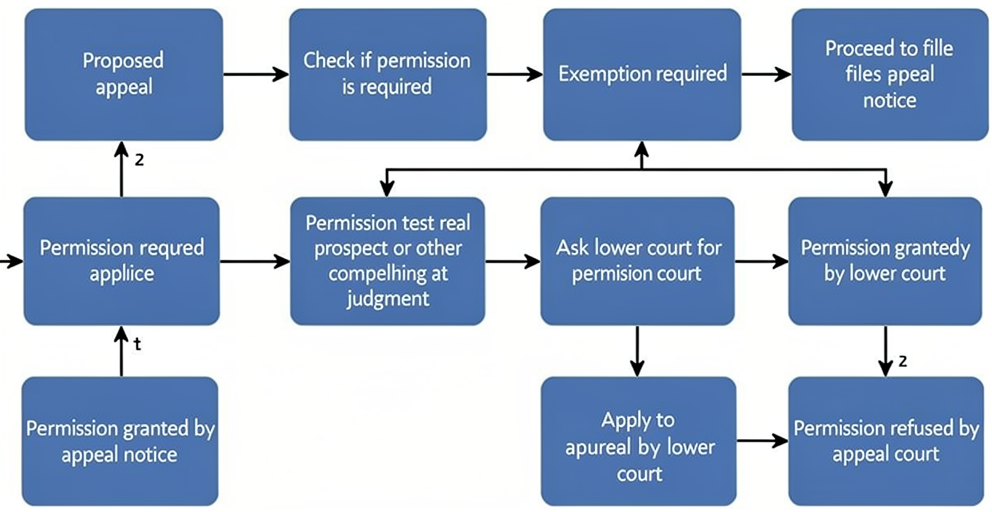
Permission to appeal is assessed by exemption, lower-court application, and appeal-court renewal before filing the appeal notice.
General Requirement
Most civil appeals require permission to appeal, unless specifically exempt (such as certain committal orders, refusals of habeas corpus, secure accommodation orders under section 25 Children Act 1989, and specified insolvency/bankruptcy decisions made by particular judges). Permission can be granted by either the lower court (at or shortly after judgment) or by the appeal court on application.
Permission acts as a filter to deter unmeritorious appeals and to conserve appellate resources. Where permission is granted, it may be limited to particular issues and may be subject to conditions (for example, payment into court).
Criteria for Permission
Permission is granted only where:
- There is a real prospect that the appeal will succeed; or
- There is some other compelling reason why the appeal should be heard (for example, an important legal point, conflicting first-instance decisions, or a serious procedural irregularity).
If permission is refused by the lower court, the appellant may renew the application to the appeal court. Applications to appeal courts other than the Court of Appeal are commonly determined on paper without a hearing. If an appeal court refuses permission on paper, there is often a short window to request an oral renewal unless the application is certified as totally without merit, in which case no oral renewal is permitted.
Worked Example 1.2
Lee is dissatisfied with a circuit judge’s decision in the County Court. He seeks permission to appeal, but the circuit judge refuses it. What can Lee do?
Answer:
Lee may apply directly to the appeal court (a High Court judge) for permission to appeal. The appellant’s notice filed in the appeal court must set out concise grounds and be filed within the time limit. The permission application will usually be decided on paper, with any oral renewal only if allowed by the rules and not marked totally without merit.
Commencing an Appeal: Procedure and Time Limits
Appeal Notice
To start an appeal, an appellant's notice must be filed in the appeal court (and, where applicable, at the correct appeal centre). The notice identifies the decision challenged, the grounds of appeal, whether permission is sought (if not already granted), and requests any necessary orders (e.g., a stay of execution). The prescribed forms are:
- Form N161 for most County Court/High Court appeals and appeals to the Court of Appeal
- Form N164 for small claims appeals
The notice must be accompanied by the appropriate fee (or a fee remission application) and supporting documents. Appellants should file and serve a concise skeleton argument as early as possible, ideally with the notice.
Exam Warning: Many appeals are lost due to missing time limits or procedural errors in filing—always verify deadlines and court requirements immediately at judgment or upon receipt of the written order.
Time Limits
- A notice of appeal from a County Court or High Court decision must usually be filed within 21 days of the date of the decision, unless the lower court orders a different period.
- Applications for permission to appeal from Court of Appeal decisions to the Supreme Court must usually be made within 28 days.
- The appellant’s notice must then be served on each respondent no later than 7 days after filing.
- A respondent intending to uphold the decision on different grounds or to seek variation should file a respondent’s notice generally within 14 days of service of the appellant’s notice.
Late appeals require an application for an extension of time. The court considers the length of and reasons for the delay, the merits of the proposed appeal, prejudice to the respondent, and the interests of justice. Prompt action at the earliest opportunity is critical.
Required Documents and Bundles
Skeleton arguments are required from both appellant and respondent. They should:
- Identify the issues, the propositions of law, and the specific passages relied on in each authority
- Remain concise, cross-referenced to the bundle, and filed early enough to assist case management
Transcripts of the judgment and any relevant hearings should be obtained promptly. If a full transcript is unavailable, a judge-approved note of reasons may suffice, particularly for small claims.
As soon as practicable, and within 35 days of filing the appellant’s notice, the appellant must file an appeal bundle containing only documents relevant to the appeal. Typically included are:
- The appellant’s notice and any respondent’s notice
- The parties’ skeleton arguments
- The order under appeal and any order granting/refusing permission with reasons
- Any track allocation order
- A transcript of judgment or approved note of reasons
- As relevant: statements of case, key applications, earlier orders, a chronology, and any witness statements that directly bear on the issues in the appeal
Stays Pending Appeal
Filing an appeal does not automatically stay enforcement of the order under appeal. A separate application for a stay of execution should be made, usually first to the lower court at judgment or promptly thereafter, and if necessary to the appeal court. The court will weigh the merits of the appeal, whether refusing a stay would render the appeal nugatory, prejudice to the respondent, and the overall justice of the case. Stays can be made conditional (e.g., upon payment into court or provision of security).
Worked Example 1.3
Samir loses at trial in the High Court. He believes the judge misunderstood key evidence but did not make any legal errors. Is this a good ground for appeal?
Answer:
Only if the misinterpretation of evidence led the judge to a decision that was “wrong,” as opposed to being a finding open to the judge on the facts. Appeal courts are slow to overturn primary factual findings unless plainly wrong or unsupported. Where the complaint is about the exercise of discretion, the appellant must show an error of principle, consideration of irrelevant factors, failure to consider relevant factors, or a decision outside the reasonable ambit.
Worked Example 1.4
Nadia files her appellant’s notice 10 days late due to a delay in obtaining the approved transcript. What should she do, and what will the court consider?
Answer:
Nadia must apply for an extension of time supported by evidence explaining the delay and showing prompt steps taken to obtain the transcript. The court will consider the length and reasons for delay, the merits of the appeal, prejudice to the respondent, and whether granting an extension accords with the interests of justice.
Worked Example 1.5
Ayman wins at first instance. The appellant challenges the decision. Ayman thinks the order can be upheld on an alternative legal basis that the judge did not accept. What should Ayman file?
Answer:
Ayman should file a respondent’s notice within the relevant time limit, indicating his intention to uphold the order on different grounds (and, if seeking to vary any part of the order, specifying the variation sought), with a skeleton argument supporting those reasons.
Grounds of Appeal
Civil appeals are not simply a rehearing of the case; appeals are intended to review potential errors. The two main grounds of civil appeal are:
- The lower court was wrong (in law, fact, or the exercise of discretion); or
- The lower court’s decision was unjust due to a serious procedural or other irregularity.
“Wrong” encompasses misapplication of legal principles, incorrect interpretation of contracts or statutes, plainly wrong factual findings, and errors in the exercise of discretion. A “serious procedural or other irregularity” includes, for example, a failure to give parties a fair opportunity to address key points, a failure to give adequate reasons, or significant case management errors that undermine the safety of the result.
Scope of appellate review:
- Law: the appeal court will correct legal errors.
- Findings of primary fact: significant deference is shown; intervention is rare unless the finding is plainly wrong or unsupported.
- Discretion: interference only where the judge erred in principle or reached a decision outside the range of reasonable responses.
At the appeal hearing, a party may not rely on matters not contained in their notice unless the court gives permission. The appeal court may draw any inference of fact justified by the evidence before the lower court.
New Evidence on Appeal
Generally, new evidence is not permitted on appeal unless special circumstances apply and the interests of justice require it. The familiar considerations include whether:
- The evidence could not with reasonable diligence have been obtained for use at trial
- It would have an important (likely decisive) influence on the result
- It is apparently credible
These factors guide, but do not rigidly control, the court’s discretion under CPR Part 52.
Worked Example 1.6
The appellant discovers an important document after judgment which, on its face, supports an alternative causation analysis. It existed at the time of trial but was not located despite targeted searches. Can it be used on appeal?
Answer:
Possibly. The appellant must show reasonable diligence was exercised, that the new evidence would likely have an important impact on the outcome, and that it is credible. The appeal court retains discretion and will also consider finality and prejudice.
Permission to Appeal to the Supreme Court ("Leapfrog" or "Second Appeals")
An appeal to the Supreme Court from the Court of Appeal is permitted only if:
- The Court of Appeal or the Supreme Court certifies that the appeal raises a point of law of general public importance; and
- Permission to appeal is granted by the Court of Appeal or the Supreme Court.
A leapfrog appeal from the High Court to the Supreme Court (bypassing the Court of Appeal) is possible in rare cases under the Administration of Justice Act 1969. A High Court judge may grant a certificate where the case raises a point of law of general public importance (for example, concerning statutory construction or where the court is bound by binding higher authority), and the Supreme Court then decides whether to grant permission. Leapfrogging can save time and costs where only the Supreme Court can resolve the controlling legal issue.
Separately, under the Access to Justice Act 1999, the Head of Civil Justice (or the relevant court) can direct that an appeal be assigned to the Court of Appeal where it raises an important point of principle or practice or there is some other compelling reason for that court to hear it.
Worked Example 1.7
A High Court judge dismisses a claim but states they are bound by a previous Supreme Court decision. The losing party seeks to go straight to the Supreme Court. What must happen?
Answer:
The party must obtain a leapfrog certificate from the High Court judge confirming that the case raises a point of law of general public importance and then obtain permission from the Supreme Court. Only then can the appeal bypass the Court of Appeal.
Other Important Issues
New Evidence on Appeal
Generally, new evidence is not permitted on appeal unless special circumstances apply; for example, if it could not have been obtained with reasonable diligence for use at the trial and may have an important impact on deciding the appeal justly.
Costs on Appeal
The appeal court may make any order as to costs it thinks fit. The usual rule is that the unsuccessful party pays the successful party’s costs of the appeal, but the court has discretion and will take conduct and other factors into account. Costs can be assessed on the standard or indemnity basis depending on conduct. Permission applications may attract costs consequences; wholly unmeritorious or abusive attempts risk adverse or even wasted costs orders.
Stays, Enforcement and Interim Relief
- No automatic stay arises from filing an appeal. Apply for a stay promptly.
- The court may condition any stay upon the appellant providing security or paying sums into court.
- If the order under appeal includes mandatory steps (e.g., delivery up of goods), the court will focus on whether compliance before the appeal would render the appeal nugatory and whether hardship can be mitigated by conditions.
Hearing Format and Case Management
Appeal courts actively manage appeals. Permission decisions are typically made on paper by a single judge. If permission is granted, timetables will be set for skeleton arguments, bundles, and authorities. Appeals are generally limited to a review rather than a full rehearing, unless justice requires otherwise for a particular category of appeal. Oral evidence is rarely permitted.
Worked Example 1.8
The trial judge orders immediate possession of commercial premises. The defendant files an appellant’s notice and asks for a stay. What factors will the court consider?
Answer:
The court will consider the merits of the proposed appeal, whether refusing a stay would render the appeal nugatory (e.g., loss of the premises cannot be adequately remedied), prejudice to the claimant (e.g., ongoing losses), and the overall justice of the case. Conditions such as payment of occupational rent or security may be imposed.
Second (Further) Appeals
Where a case has already been appealed once (e.g., to a circuit judge or the High Court), a second appeal to the Court of Appeal is tightly restricted. Permission may only be granted if the appeal would raise an important point of principle or practice or there is some other compelling reason for the Court of Appeal to hear it. This is a stricter test than for first appeals and reflects the policy of finality. Even if that threshold is met, the court considers overall fairness and the overriding objective when deciding whether to grant permission.
Only the Court of Appeal can grant permission for second appeals of this kind; the lower courts have no jurisdiction to grant it.
Worked Example 1.9
Dev’s claim is dismissed by a district judge. He appeals to a circuit judge and loses again. He wants to appeal to the Court of Appeal arguing that the judge’s exercise of discretion on relief from sanctions was wrong. Is that sufficient?
Answer:
Not by itself. For a second appeal, Dev must show that the appeal raises an important point of principle or practice or that there is another compelling reason for the Court of Appeal to hear it. Mere disagreement with discretionary evaluation usually will not satisfy the test.
Reopening Final Appeals
Final determinations of appeals are reopened only in the most exceptional circumstances and where necessary to avoid real injustice, there is no alternative effective remedy, and the circumstances are exceptional. Permission is required, and there is no entitlement to an oral hearing unless directed.
The Appeal Court’s Powers
The appeal court has all the powers of the lower court. It may:
- Affirm, set aside, or vary any order or judgment
- Order a new trial or hearing, or refer issues back to the lower court
- Draw any inference of fact that is justified on the evidence
- Make orders for interest and costs
Where a civil claim was tried with a jury, the Court of Appeal may vary damages rather than ordering a new trial.
Revision Tip: On the SQE2, always identify: (1) the original judge/court; (2) the appropriate court and judge for appeal; (3) timing, permission requirements, and correct procedure. Always consider whether a stay is needed and whether a respondent’s notice is required to uphold on different grounds.
Key Point Checklist
This article has covered the following key knowledge points:
- Appeals are generally to the next most senior judge or court in the hierarchy—the specific route depends on the original judge and court. Certain specialist routes (e.g., IPEC) apply.
- Most civil appeals require permission, either from the original judge or the appeal court. Permission is granted only for a real prospect of success or some other compelling reason.
- Appeals must be started within strict time limits (usually 21 days); the notice must then be served promptly (usually within 7 days). Respondents have short windows (often 14 days) to file a respondent’s notice if needed.
- Appeals are generally limited to a review; the court will rarely admit new evidence and is slow to disturb primary factual findings or discretionary decisions.
- Grounds of appeal are limited: that the lower court was “wrong,” or that the decision was unjust due to serious procedural or other irregularity.
- Filing must be at the appropriate appeal centre using the prescribed forms. Skeleton arguments and properly prepared appeal bundles are expected.
- Filing an appeal does not itself stay enforcement; a separate, prompt application for a stay is needed and may be subject to conditions.
- Second appeals are strictly limited to important points of principle or practice or other compelling reasons. Only the Court of Appeal can grant permission.
- Appeals to the Supreme Court require certification of a point of law of general public importance and permission. In rare cases, leapfrog appeals may bypass an intermediate appellate tier.
- The appeal court has wide powers, including to vary orders, order retrials, and make costs and interest orders.
Key Terms and Concepts
- appeal
- appellant
- respondent
- grounds of appeal
- permission to appeal
- appeal notice
- respondent’s notice
- skeleton argument
- stay of execution
- appeal centre
- leapfrog appeal
- second appeal