Learning Outcomes
This article explains the procedural options and strategic considerations when responding to a civil claim, including:
- Identifying the defendant’s initial response options—full or partial admission, acknowledgement of service, defence and counterclaim—and when each is appropriate
- Completing and using key documents such as admission forms, acknowledgements of service, defences, counterclaims, and requests for further information
- Calculating and complying with strict CPR time limits and relevant practice directions, and understanding the procedural and costs consequences of non-compliance
- Recognising when default judgment may be entered and applying the correct procedure, grounds, and evidence to seek to set aside such judgments
- Evaluating the strategic implications of early decisions, such as extending time via acknowledgement of service, contesting jurisdiction, and making admissions with or without payment proposals
- Applying the requirements for statements of truth in pleadings and assessing their impact on credibility, costs, and potential sanctions
- Managing discontinuance and settlement effectively through notices of discontinuance, consent orders, and Tomlin orders, and understanding the associated costs and tactical consequences
- Sequencing procedural steps logically to protect the defendant’s position while advancing an effective and compliant defence strategy
SQE2 Syllabus
For SQE2, you are required to understand the procedural steps, time limits, and strategic considerations for responding to a civil claim under the Civil Procedure Rules, with a focus on the following syllabus points:
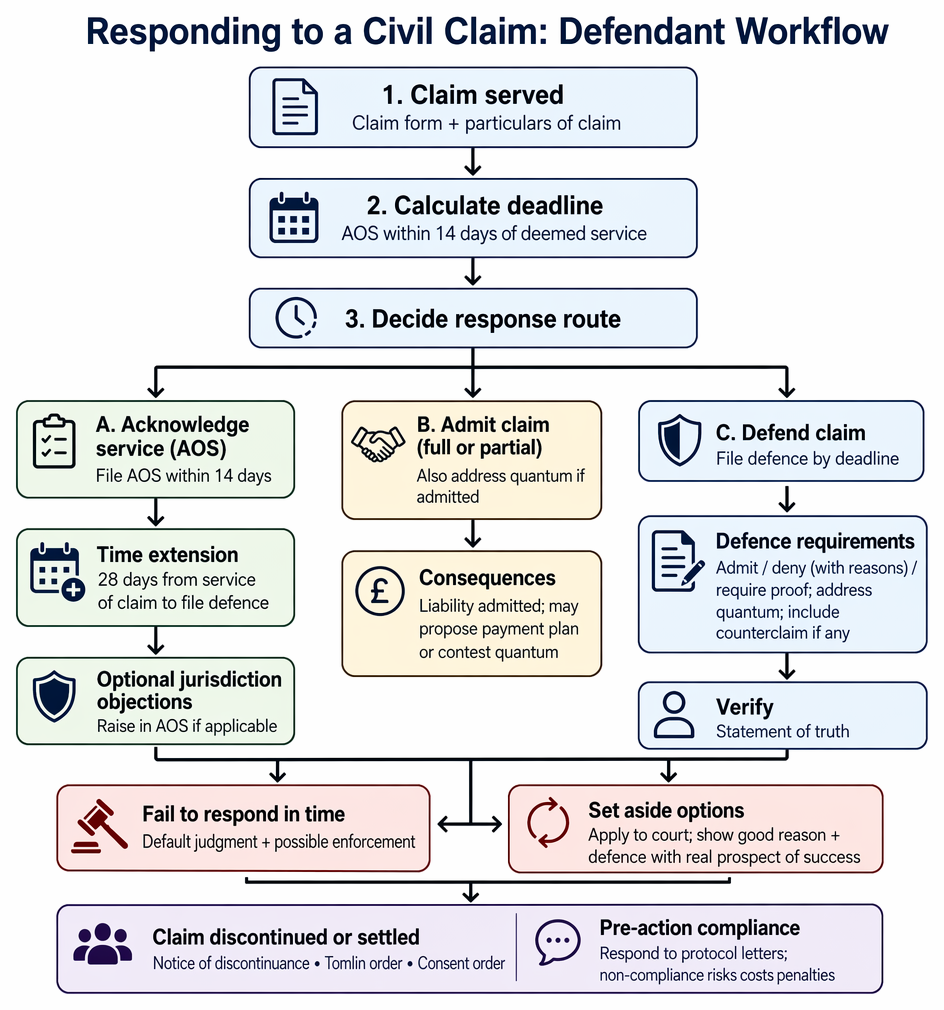
Default judgment after non-response may be set aside on mandatory or discretionary grounds, sometimes subject to costs or timetable conditions.
- the regulatory options and procedural steps for a defendant when served with a claim form and particulars of claim, including full or partial admission, acknowledgement of service, and defence
- the technical requirements and legal implications of full and partial admissions, including the consequences of proposing payment schedules or contesting quantum
- the precise calculation and application of time limits for responding to claims, as established by the Civil Procedure Rules, and the effect of deemed service
- the circumstances, contents, and effect of filing an acknowledgement of service, including the strategic extension of time and the raising of jurisdictional objections
- the drafting, verification (statement of truth), and detailed content required for a valid and effective defence, including approaches to admitting, denying (giving reasons), and requiring proof of allegations, and the inclusion of counterclaims
- the legal and procedural consequences of failing to respond within time, leading to default judgment and potential enforcement, as well as the process and grounds for applying to set aside such judgment
- the procedural options available to a claimant or parties if the claim is to be discontinued or settled—including use of notices of discontinuance, Tomlin orders, and consent orders
- the importance of responding to protocol letters and complying with pre-action requirements, as failure to do so can result in costs penalties or other adverse orders later in the proceedings
Test Your Knowledge
Attempt these questions before reading this article. If you find some difficult or cannot remember the answers, look more closely at that area during your revision.
- What three initial procedural options does a defendant have when served with a claim form and particulars of claim?
- What can a claimant do if the defendant does not respond to the claim within the required period?
- If the defendant files an acknowledgement of service, how long do they then have to file a defence?
- What information must be included in a defence?
Introduction
When a defendant is served with civil proceedings, immediate and careful attention must be given to calculating deadlines and selecting the appropriate procedural response. Civil procedure in England and Wales is driven by the overriding objective—that cases are handled justly, fairly, and at proportionate cost—and enables courts to enforce compliance, manage litigation proactively, and ultimately sanction parties for failure to act. Upon receipt of the claim form and particulars of claim (whether separately or together), defendants must act in strict accordance with the Civil Procedure Rules (CPR) and any relevant Practice Directions.
Key Term: admission
A formal statement by the defendant accepting (in full or part) the claim brought by the claimant. Key Term: acknowledgement of service
Formal notice filed by a defendant confirming receipt of the claim and intention to respond, extending the time to file a defence or, if desired, to contest jurisdiction. Key Term: defence
The defendant’s formal response to the particulars of claim, setting out for each allegation whether it is admitted, denied (including reasons), or requires proof. Key Term: default judgment
A judgment obtained by the claimant when the defendant fails to file an acknowledgement of service or defence within the required time.
Timely and accurate response at this stage is essential. The options available shape the future direction of the litigation and directly affect the defendant’s ability to dispute liability, quantum, jurisdiction, and costs. Ignoring action at this stage, or responding incorrectly, may result in the claimant obtaining a default judgment, potentially leading to enforcement action or adverse costs consequences.
Responding to a claim: the main options
Once the claim form and particulars of claim are deemed served, the defendant faces a procedural crossroads, governed by CPR Parts 10, 14, and 15. The primary procedural options are:
Option 1: Admission If the defendant wholly accepts the claim or accepts liability for part only, they should promptly complete the relevant admission form contained in the response pack. For a specified sum, the form allows the defendant to offer immediate payment or payment by instalments and to provide information concerning their means and proposals. For an unspecified amount, the defendant may accept liability, leaving the quantum to be determined by the court or to be negotiated with the claimant.
Full and partial admissions have different procedural and financial consequences. For example, if only part of the sum is admitted, the particulars of the admission and proposed payment must be clarified, and the claimant is entitled to respond—accepting the offer, requesting court consideration, or continuing with the dispute for the remainder.
Option 2: Acknowledgement of service A defendant uncertain whether to defend, or who needs extra time to investigate or prepare a full defence (perhaps due to being overseas, illness, or complexity in instructions), can file an acknowledgement of service (CPR Part 10) within 14 days of deemed service of the particulars of claim. This extends the period for serving a defence to 28 days from deemed service of the particulars of claim and also preserves the right to dispute the court’s jurisdiction or serve an application for a stay.
This step does not admit, deny, or otherwise prejudice the defendant’s substantive position but buys additional time for further investigation, client meetings, or legal advice. If the defendant wishes to dispute the court’s jurisdiction, an acknowledgement of service must be filed and a separate Part 11 application made within the appropriate time period.
Option 3: Defence To dispute the whole or specified parts of a claim, the defendant must file a substantive defence within the applicable time limit. The defence addresses each allegation in the particulars of claim by:
- admitting,
- denying (clearly stating reasons), or
- not admitting (requiring the claimant to prove the allegation).
Denials must be substantiated with reasons—bare denials are insufficient and can result in the defence being struck out (CPR 16.5; see also summary judgment risks). Where the defendant’s account diverges from that put forward by the claimant, the alternative version of events must be clearly stated. Furthermore, where the defendant disputes quantum in a money claim, they are generally taken to require proof unless express admission to the sum is made.
A defence may also include a counterclaim (see below), particular statutory or contractual defences (such as limitation or exclusion clauses), or set out matters of mitigation or contributory negligence if relevant.
Time limits to respond
The time for responding is calculated strictly by reference to the deemed date of service (see CPR 2.8, 6.14, 6.26):
- Within 14 days of deemed service: file an admission, acknowledgement of service, or a defence.
- If an acknowledgement of service is filed: the deadline to file a defence is extended to 28 days from the deemed date of service of the particulars of claim.
- Extension by agreement: the parties may agree a further extension of up to 28 days for serving a defence. For any longer extension, court permission is required, and the request must be notified to the court (CPR 15.5).
Calculation of days uses the "clear days" rule; the day of service and the day of the event itself are generally excluded, which is especially important when calculating weekends and public holidays.
Particular attention must be paid to situations where particulars of claim are served separately from the claim form. In this scenario, time limits run from deemed service of the particulars of claim, not from service of the claim form.
Key Term: time limit
The mandatory period for procedural action. Failure to comply may result in adverse consequences, including judgment in default.
Consequences of non-response
Failure to respond within the required period has immediate and potentially severe procedural consequences. Most significantly, the claimant may apply for judgment in default under CPR Part 12. In specified money claims, this means the defendant becomes liable to satisfy the full amount claimed, with added costs and interest. In unspecified claims, the court will enter judgment for liability and schedule a further hearing ("disposal hearing") to assess damages.
Judgment may be entered administratively (without a hearing) unless there is an explicit dispute or requirement for judicial decision (such as in relation to an injunction, or if the case falls into one of the excluded categories—e.g., certain claims under the Consumer Credit Act).
A default judgment does not generally signify judicial acceptance of the claimant’s position—it is simply a procedural consequence of non-engagement by the defendant. Its effects, however, are immediate and enforceable.
Setting aside default judgment
A defendant subject to a judgment in default is not without remedy but must act without delay. Applications to set aside default judgment (under CPR Part 13) can be based on two principal grounds:
- Mandatory: The judgment was entered irregularly—i.e., contrary to the rules or before the expiry of the time limit for responding, or where a response had already been filed. Here, the court must set aside the judgment as a matter of course.
- Discretionary: The defendant demonstrates a "real prospect of successfully defending the claim" or provides another good reason, such as being deprived of an opportunity to respond for reasons outside their control (e.g., being abroad, hospitalisation).
Promptness is critical; courts will closely scrutinise any delay and may refuse to grant relief if the applicant has not acted swiftly upon learning of the default judgment. In exercising discretion, the court will also consider the interests of justice, prejudice to the parties, and the overall aim of ensuring cases are dealt with efficiently under the overriding objective.
Key Term: setting aside default judgment
The process by which a defendant applies for a court order to nullify a default judgment so proceedings can continue, typically after the defendant failed to respond but has valid grounds or a real defence.
After hearing an application to set aside default judgment, the court may:
- set aside the judgment outright (often with directions on future conduct);
- set it aside but attach conditions (such as payment into court, or compliance with a timetable); or
- refuse to set aside, leaving the judgment and enforcement standing.
Costs will follow the outcome; if the default judgment was wrongly entered, the claimant may be ordered to pay the defendant’s costs for having to apply. If the application is successful on discretionary grounds, the order may be costs in the case or may require the defendant to pay some costs for the initial failure to respond.
Filing a defence
In drafting a defence, the defendant must engage directly with the particulars of claim. Each and every allegation should be addressed, specifying whether it is:
- admitted (express acceptance);
- denied (with clear and reasoned explanation of the basis for denial);
- neither admitted nor denied (in which case the claimant is required to prove the allegation).
Where denying an allegation, it is necessary for the defence to explain why and, if another account is asserted, to state the defendant’s own version of events. Blanket, unexplained denials can be struck out for lack of particularity.
Where quantum or specific allegations of loss are disputed, the defendant must either admit, deny with explanations, or require strict proof, and can, if appropriate, provide alternative calculations or explanations for any sums or items disputed.
The defence must also identify and articulate any affirmative defences—such as a limitation period, illegality, non-compliance with contract prerequisites, or exclusion clauses—supported by factual and legal grounds. Additionally, if the defendant alleges that the claimant has failed to mitigate their loss or was itself in breach, this too should be included.
A defence is only deemed valid and effective if it is verified by a statement of truth (CPR Part 22; Practice Direction 22). The statement of truth must be made by the defendant or a person properly authorised, confirming their belief in the contents' accuracy. This requirement is essential and failure to include or sign a statement of truth renders the defence liable to be struck out or disregarded by the court, with further cost or contempt consequences possible.
Key Term: statement of truth
A formal declaration verifying the accuracy of a statement of case or other document, signed by a party or their legal representative.
Where the defence includes a counterclaim (see below), this is usually incorporated into the same document as the defence, clearly demarcated and verified by a separate statement of truth.
If further detail or clarification of points in the particulars of claim is necessary for the defence, the defendant may make a "request for further information" under CPR Part 18, requiring the claimant to supply additional particulars in writing.
Counterclaim
It is open to the defendant to raise a counterclaim against the claimant in the same document as the defence if brought at the initial response stage; no permission is required to file a counterclaim alongside the defence, as long as it is properly pleaded and supported by factual grounds.
A counterclaim typically arises where the defendant alleges an entitlement to damages or other relief based on the same set of facts (or related facts) that underlie the claimant’s cause of action. The counterclaim is treated as a separate claim procedurally and, once made, the claimant must serve a defence to counterclaim (usually within 14 days of service unless extended by agreement or court order).
Where a defendant seeks to introduce additional parties or against third-party "absentees," permission of the court may be required, and strict procedural requirements apply.
Disputing jurisdiction
If the defendant intends to challenge the jurisdiction of the English courts to deal with the claim, or argues that the court should not exercise its jurisdiction, they must file an acknowledgement of service within 14 days and then submit an application to dispute jurisdiction within 14 days thereafter (CPR Part 11). The application must be supported by evidence and, unless successful, does not stay the applicable time limit for filing a substantive defence, so this process must be managed carefully to avoid the risk of default judgment.
Discontinuance and settlement
At any stage after service of proceedings, a claimant may choose to discontinue all or part of the claim. This is generally effected by serving a notice of discontinuance on all parties. If there are multiple claimants, the consent of all is required, except with the court’s permission. Upon discontinuance, the claimant is typically liable for the defendant’s standard basis costs incurred up to the date notice was served (CPR 38).
Settlement may be formalised at any stage by use of a consent order or, when confidentiality or more complex terms are required, a Tomlin order. Consent orders are most appropriate where straightforward terms are required (including for payment or dismissal of the proceedings), while Tomlin orders can stay (pause) proceedings on agreed terms set out in a confidential schedule. Tomlin orders are especially useful to allow parties to revisit court directly if terms are breached, enabling cost-effective enforcement.
A Part 36 offer can also be used for settlement purposes, with significant costs consequences for the party who fails to accept a reasonable offer that is subsequently beaten at trial.
Worked Example 1.1
A claim form and particulars of claim are served on Sara on 1 April. Sara disputes the claim but will be away for two weeks from 3 April. What should she do to preserve her position?
Answer:
Sara should immediately file an acknowledgement of service within 14 days of service, extending the time to file a defence from 14 to 28 days. This gives her extra time to prepare while ensuring she does not risk default judgment.
Worked Example 1.2
Tom is served with a claim for £10,000. He agrees he owes £4,000, but disputes the rest. What should he do to respond?
Answer:
Tom should return the admission form admitting £4,000 and file a defence disputing the balance within the time limit. The claimant may accept the partial admission or proceed with the defended amount.
Worked Example 1.3
A defendant, LMG Ltd, is served with a claim form and particulars of claim alleging breach of contract relating to late delivery of goods. LMG disputes the entire claim and needs witness evidence from employees who are abroad, which will take time to gather. Can the defendant obtain an extension of time for defence?
Answer:
Yes. LMG Ltd should first file an acknowledgement of service within 14 days of deemed service to extend the time for defence to 28 days. If even further time is needed, it may agree a maximum of a further 28 days’ extension with the claimant, making a total of 56 days from service. Any request for a longer extension must be made to the court before the time limit for defence expires.
Worked Example 1.4
A claim is discontinued after service of the claim form. Who pays the costs?
Answer:
Generally, the claimant is liable to pay the defendant’s costs incurred up to the date on which notice of discontinuance was served, unless the parties or the court order otherwise.Exam Warning: Failing to respond within the specified period leads to default judgment, which is difficult and costly to set aside. Time limits must be carefully diarised.
Revision Tip: For every question on responding to a claim, identify what documents have been served, when, and calculate all relevant deadlines before considering options.
Key Point Checklist
This article has covered the following key knowledge points:
- Defendants must choose a response—admit, acknowledge service, or defend—upon service of a civil claim.
- Each option has specific procedural requirements and potential strategic consequences, with admission (full or partial) requiring the completion of the dedicated form and potentially supporting financial evidence.
- Acknowledgement of service extends the deadline for filing a defence and is necessary if the defendant wishes to contest jurisdiction or requires additional time.
- The defence must address every allegation in the particulars of claim, include sufficient factual and legal detail, and be accompanied by a proper statement of truth.
- Time limits for responding are mandatory, calculated according to CPR rules on deemed service and clear days; failure to comply enables the claimant to apply for default judgment.
- Judgment in default may be set aside only if promptly challenged, and then only if specific grounds are met; discretionary relief depends on demonstrating a real prospect of defending the claim or another compelling reason.
- Counterclaims and additional claims (e.g. against third parties) are available but must be properly pleaded and generally incorporated within the defence.
- Discontinuance and settlement—whether by notice of discontinuance, Tomlin order, or consent order—bring key procedural and costs consequences, often placing liability for costs on the discontinuing party.
- Effective management at the response stage is essential to upholding rights, avoiding adverse judgments, and ensuring the court’s overriding objective is complied with throughout.
Key Terms and Concepts
- admission
- acknowledgement of service
- defence
- default judgment
- setting aside default judgment
- statement of truth
- time limit