Learning Outcomes
This article covers drafting principles and quality control to ensure accuracy, certainty, and enforceability of legal documents, including:
- Identifying and applying the core principles of accurate contract drafting, from party descriptions to operative clauses
- Understanding the requirements for certainty and enforceability under English law and how courts interpret unclear terms
- Drafting clear, unambiguous provisions, consistent definitions, and objective standards to reduce risk and ambiguity
- Structuring documents logically with coherent headings, numbered clauses, and cross‑references that aid interpretation
- Detecting and correcting common defects: vagueness, omissions of material terms, inconsistent terminology, and technical errors
- Implementing robust quality control processes—proofreading, substantive checks, legal validation, peer/supervisor review, client confirmation, and version management
- Ensuring compliance with statutory formalities for particular instruments (e.g., leases, guarantees, land transactions) to avoid invalidity
- Anticipating and managing the consequences of poor drafting, including disputes, unenforceability, and litigation exposure
- Applying these drafting and review techniques to SQE2 scenarios to produce predictable, enforceable outcomes for clients
SQE2 Syllabus
For SQE2, you are required to understand practical drafting principles and quality control measures that ensure accuracy, certainty, and enforceability of legal documents, with a focus on the following syllabus points:
- the requirements for accurate, clear, certain, and enforceable legal drafting in practice
- identification and correction of ambiguity, error, and legal defects in draft documents
- consequences of poor drafting (e.g., unenforceability, disputes, litigation)
- best practices in contract and legal document review, including quality control procedures
Test Your Knowledge
Attempt these questions before reading this article. If you find some difficult or cannot remember the answers, look more closely at that area during your revision.
-
Why is certainty of terms essential for the enforceability of a contract under English law?
-
Which of the following may lead a contract or clause to be found unenforceable?
- a) vagueness as to key obligations
- b) failure to record parties accurately
- c) ambiguous payment terms
- d) all of the above
-
What type of drafting error is most likely to cause a "void for uncertainty" outcome?
-
State two practical steps a solicitor should take before finalising a contract to minimise drafting error.
Introduction
Drafting legal documents for clients—whether contracts, settlements, board minutes, or advice—requires more than legal knowledge. It requires rigorous attention to detail, clarity of language, and processes that safeguard accuracy and enforceability. Poor drafting can ruin deals, lead to expensive disputes, or cause a contract to be declared void. This article sets out the essential principles of drafting and controlling quality to produce documents that deliver certainty and enforceability for clients.
The Principles of Effective Legal Drafting
The test for good legal drafting is whether the agreement will be interpreted and enforced by courts as the parties intend. Three objectives underpin this goal: (1) accuracy, (2) certainty, and (3) enforceability.
Accuracy
Correct information and legal terms are the basis of enforceable drafting. Errors in parties' names, dates, obligations, or technical specifications can create ambiguity or risk invalidity. Always use parties’ full legal names and capacities, and include company numbers for UK entities. If a party’s legal status matters (e.g., plc, limited, llp), include it consistently. For cross‑border parties, note the governing corporate law and principal place of business where relevant. Ensure figures, currencies, and units are coherent and, if both words and figures are used, cross‑check both.
Key Term: accuracy
The requirement that every factual and legal element of a legal document matches the true intentions, instructions, and circumstances, with no mistakes or omissions.
Certainty
A contract (or any legal document) must be sufficiently clear so that a court can determine exactly what has been agreed. Vague or "agreements to agree" are generally unenforceable. An “agreement to negotiate” or “to use best endeavours to reach agreement” on essential terms risks unenforceability (see Walford v Miles [1992] 2 AC 128). Where a term requires further agreement (e.g., price, scope, completion criteria), provide a clear mechanism that will objectively determine the term (e.g., expert determination, market indices, defined formulae).
Key Term: certainty
The condition that the terms and obligations in a legal document are expressed precisely enough that a reasonable third party (such as a court) can determine the parties' intentions and enforce the agreement. Key Term: enforceability
The property of a contract, clause, or other legal instrument that makes it legally binding and capable of being upheld by a court.
Clear Legal Language
Language should be free from ambiguity, jargon (unless explained), or any words with multiple possible meanings. The same term must carry the same meaning throughout the document. Prefer short sentences and verbs over abstract nouns; avoid archaic expressions (“hereby”, “heretofore”, “aforesaid”) unless necessary. Use the active voice to identify the “doer” of each obligation. Avoid “should” for obligations—“shall” or “must” is clearer and conveys binding commitment. Be cautious with passives: “Notice shall be served” obscures who must serve it; write “The Seller shall serve notice”.
Key Term: ambiguity
The existence of two or more possible interpretations of a word, phrase, or provision in a legal document, leading to uncertainty about parties' rights or obligations.
Consistency and Structure
Use the same terms consistently for the same meaning. Definitions should be listed and accurately used. The structure of the document must be logical, sequential, and clearly divided into numbered clauses and headings. Recitals can aid context but should not contradict or substitute operative provisions. Introduce operative clauses clearly (“IT IS AGREED AS FOLLOWS:”), and ensure cross‑references align after any editing. Avoid mixing terms such as “buyer/purchaser” or “vendor/seller” unless both are defined and used consistently.
Key Term: defined term
A word or phrase given an agreed special meaning in the contract, typically capitalised and set out in a definitions clause, to ensure consistent interpretation in the document.
Enforceability
Only valid obligations, clearly described, can be enforced. For example, if a material term is missing or insufficiently certain, the contract may be void for uncertainty. Statutory requirements for particular contracts (e.g., leases, guarantees, land transactions) must be met. Guarantees generally require writing and signature; dispositions of interests in land require writing and correct execution. Consider consumer protections: in consumer contracts, terms must be fair and transparent under the Consumer Rights Act 2015; attempts to exclude liability for death or personal injury caused by negligence are prohibited (see Unfair Contract Terms Act 1977, s.2). Third party rights may arise if intended under the Contracts (Rights of Third Parties) Act 1999—state clearly whether and which third parties may enforce.
Key Term: void for uncertainty
A contract or provision that is so unclear or incomplete that a court cannot enforce it. Key Term: commencement date
The contractual date on which performance starts; distinct from the date of the agreement and best defined in the contract to avoid confusion.
Dates, Times, and Effective Dates
Distinguish the “date of the agreement” from the “commencement date” or “effective date”. If dates drive obligations (renewals, deadlines, termination), specify whether a stated date is inclusive (“on or before”) or exclusive (“before”). Avoid “midnight” ambiguities—use “23:59 [UK time] on [date]” and, for cross‑border transactions, specify the time zone. Write months in words to avoid US/UK numeric format confusion.
Quality Control in Drafting
Even experienced lawyers make drafting errors. Quality control is therefore essential, especially when working under time pressure.
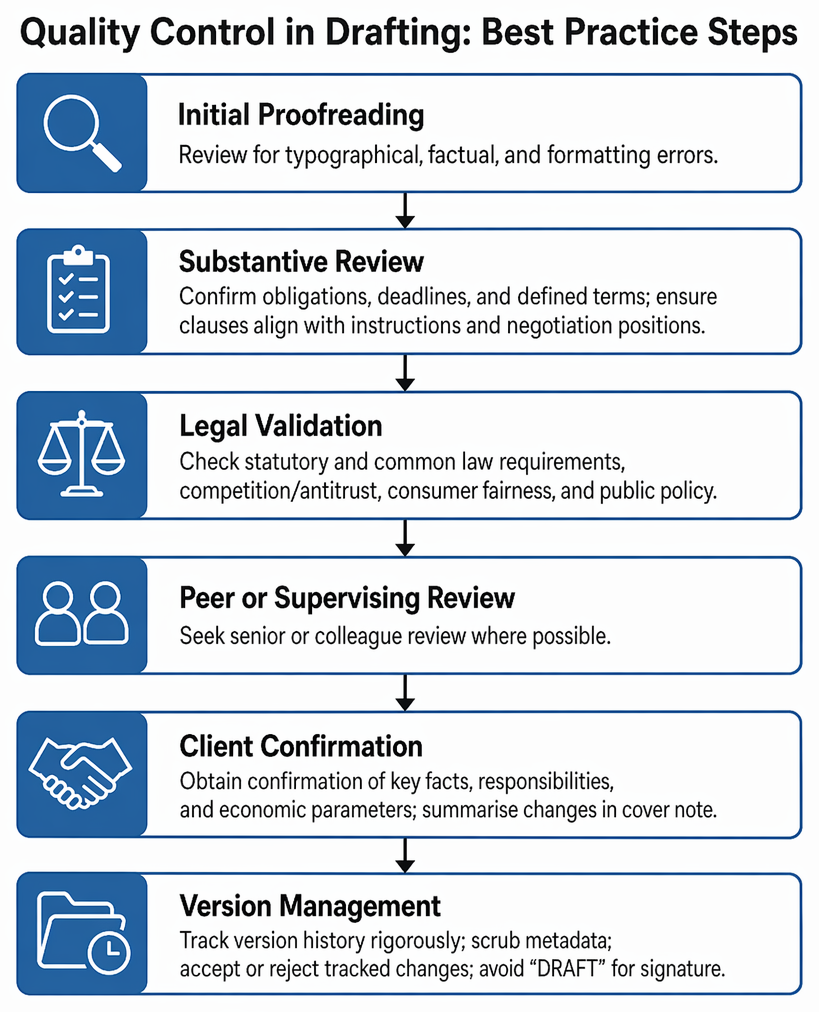
Clause review stages indicate how certainty, objective wording, and statutory formalities affect enforceability and the risk of invalidity.
Best Practice Quality Control Steps
- Initial proofreading: review for typographical, factual, and formatting errors before sending out.
- Substantive review: confirm each obligation, deadline, and defined term is correctly used, and that clauses align with clients’ instructions and negotiation positions.
- Legal validation: check statutory and common law requirements, competition/antitrust constraints, consumer fairness, and public policy issues.
- Peer or supervising review: seek senior or colleague review where possible.
- Client confirmation: obtain confirmation of key facts, responsibilities, and economic parameters; summarise changes in a cover note.
- Version management: track version history rigorously; scrub metadata; accept or reject tracked changes; avoid circulating drafts marked “DRAFT” for signature.
Proofing and Formatting Focus
- Remove draft labels and metadata before finalising.
- Check figures against words if both are used; choose one approach to reduce errors.
- Verify clause numbering and cross‑references after edits.
- Test that defined terms appear where intended (“Defined Term” used exactly).
- Ensure schedules and attachments are incorporated expressly and align with main terms.
- Use consistent styles for headings, numbering, currencies, dates, and time zones.
Common Causes of Drafting Defects
- Vagueness: Use of unclear or general wording.
- Omissions: Leaving out a material term (e.g., price, parties).
- Inconsistency: Using different words for the same meaning or terms that contradict each other.
- Ambiguity: Wording that admits two or more meanings.
- Technical errors: Misdescribing legal status or entities, incorrect clause referencing, or failing to comply with statutory formalities.
Formalities and Execution
Ensure correct execution for the instrument type. For deeds, follow Companies Act 2006 requirements for corporate execution (e.g., signature by two directors, or a director and company secretary, or a director with witness, as permitted), or correct overseas company methods. Be cautious about signing signature pages separately from the agreement; for deeds and land contracts, the Law Society guidance is to avoid detached signature pages and circulate complete documents only. Electronic signatures are generally valid under English law if the usual elements of contract formation are present and the signatory intends to authenticate; ensure the signing platform’s audit trail is retained.
Typical Legal Risks From Poor Drafting
Worked Example 1.1
The contract states: "Supplier shall deliver goods as soon as possible." Supplier fails to deliver within two months; Buyer claims breach.
Answer:
The term "as soon as possible" is vague. A court may refuse to enforce any delivery deadline—risking buyer's claim failing. This is a classic void-for-uncertainty scenario, as "as soon as possible" gives no clear standard.
Worked Example 1.2
A settlement agreement describes "John Smith, director of ABC Ltd," as a party. In fact, John Smith is not a director of ABC Ltd, and the party intended to be ABC Ltd itself. The wrong John Smith signs.
Answer:
The error in describing the parties can cast doubt on who is bound. If this is not corrected, the agreement may not be enforceable against the correct company, creating serious legal risk.
Worked Example 1.3
A licence states: “The Licensee may sell the Assets and/or buy the Shares.”
Answer:
“And/or” is notoriously ambiguous, especially in lists with more than two options. Clarify whether one, the other, or both are permitted. E.g., “The Licensee may: (a) sell the Assets; or (b) buy the Shares; or (c) do both.” This avoids dispute over whether one action is conditional on the other.
Worked Example 1.3
An MSA says “Contract renews on the anniversary of the agreement date”, but the date line at the top is left blank. Parties later disagree when the renewal occurred.
Answer:
Leaving the agreement date blank risks arguments about commencement and renewal. Insert the date of the agreement and define “Commencement Date” expressly (e.g., “the date on which the last party signs”), then tie renewals to the defined term.
Worked Example 1.4
A services agreement provides: “X should pay £500 within 30 days.” X pays late and claims no binding obligation existed.
Answer:
“Should pay” is not apt for binding obligations; courts may construe it as aspirational. Use “shall” or “must” for payment obligations: “X shall pay £500 within 30 days of the Invoice Date.”
Worked Example 1.5
A consumer terms page hides a significant auto‑renewal clause in dense text and uses technical jargon.
Answer:
Under the Consumer Rights Act 2015, terms must be fair and transparent. Significant terms should be prominent and clearly explained. Hiding impactful auto‑renewal terms risks a finding of unfairness and unenforceability.
Managing Ambiguity and Risk
Ambiguous drafting can lead to disputes, costs, and in some cases, a court declining to enforce the agreement. Later negotiated "fixes" may be expensive or unachievable if relations sour. Avoid:
- Compound connectors: be precise with “and” and “or”. If multiple permissions exist, tabulate options or state “any or all of” to clarify.
- “And/or”: use structured alternatives; courts and practitioners often criticise its use.
- Passive constructions: identify who must do each act to avoid hidden obligations.
- Ejusdem generis traps: after listing specific items, “other cause” may be read as “other cause of the same kind.” Draft expressly to include or exclude different categories.
- Undefined industry jargon: if a term has a special trade meaning, define it.
Key Term: and/or
A connector sometimes used to cover both the conjunctive and disjunctive; often produces ambiguity. Prefer listing options clearly (e.g., “any or all of X, Y and Z”).
The Role of Precedents and Templates
Precedent documents and firm templates are an essential starting point—but must always be reviewed and tailored to the client's facts and legal needs. Never copy blindly—legal context, up-to-date law, and party details must match the new transaction. If multiple documents are related (main agreement and schedules or ancillary assignments), state their relationships, priority, and which definitions apply across them. Avoid importing old boilerplate that conflicts with current law (e.g., consumer fairness standards, competition law constraints) or current practice (electronic signatures, time zones).
Pre‑contract Documents: Binding or Not
Heads of Terms, Letters of Intent, and Term Sheets can be binding or non‑binding in whole or part. Label clearly (“subject to contract” where appropriate), state which provisions, if any, are intended to be binding (e.g., confidentiality, exclusivity), and avoid vague commitments to agree later. If parties intend to progress to a detailed contract, include objective mechanisms and timetables.
Electronic Drafting and Exchange
When exchanging drafts electronically, remove tracked changes and metadata to avoid disclosing internal discussions. Use version naming conventions and store audit trails. For signing, use recognised e‑sign platforms or clearly record intention in email exchanges; retain execution evidence for later enforcement.
Revision Tip: Before finalising a client document, pause and proofread every term for clarity, defined meaning, and practical workability. Use checklists and consider a second pair of eyes.
Exam Warning: For SQE2 style drafting or contract-drafting stations, you must proactively identify and correct ambiguity, error, missing parties, or legally defective clauses. Do not assume templates are legally valid without scrutiny.
Summary Table: Key Drafting Risks and Outcomes
| Drafting Risk | Consequence | How to Control |
|---|---|---|
| Vagueness or ambiguity | Clause unenforceable; dispute arises | Define terms; use objective wording |
| Missing material term | Contract void or not binding | Use checklists; review statutory needs |
| Wrong party described | Contract unenforceable or ineffective | Double-check all names and capacities |
| Contradictory clauses | Dispute over intention; litigation | Proofreading; consistent terminology |
| Copying old precedents | Old law or requirements missed | Tailor fully; check law is current |
| Passives and “should” | Hidden obligations; non‑binding | Use active voice; “shall/must” |
| Time zone/midnight | Deadline disputes | Specify 23:59 and time zone |
| Unfair consumer terms | Term unenforceable | Make significant terms prominent |
Key Point Checklist
This article has covered the following key knowledge points:
- The core objectives in drafting legal documents are accuracy, certainty, and enforceability.
- Certainty is essential for court enforcement; vague or ambiguous clauses risk being void for uncertainty.
- Clear language, consistent use of terms, and precise party descriptions are critical.
- Quality control steps (proofreading, peer review, legal checks) reduce errors and litigation risk.
- Handle dates and time zones explicitly; distinguish agreement date and commencement date.
- Use defined terms consistently and avoid “and/or,” passives, and “should” for obligations.
- Ensure execution formalities are complied with (e.g., deeds, land contracts, guarantees), and be careful with detached signature pages.
- Use precedents carefully, always tailoring and checking them for the current transaction.
- Failure to follow these principles may lead to invalid contracts, disputes, and professional negligence risk.
Key Terms and Concepts
- accuracy
- certainty
- enforceability
- ambiguity
- defined term
- void for uncertainty
- commencement date
- and/or