Learning Outcomes
This article sets out drafting principles and quality control for legal documents, including:
- The purpose of proofreading and its role in accuracy, risk reduction, and client care
- A structured proofreading workflow (content and mechanics passes, checklists, and line-by-line review)
- Common causes and types of drafting errors (typographical mistakes, numbering and cross-references, dates, defined terms, archaic language, passive voice)
- Targeted checks for dates, parties, recitals, definitions, schedules/annexes, and boilerplate clauses
- Language and style choices that affect legal effect (active voice, “shall” vs “should”, clarity around “and/or”)
- Precision in deadlines and time zones (inclusive/exclusive dates, avoiding “midnight”, naming the relevant time zone)
- Techniques for efficient error correction and ensuring consistency after amendments (tracked changes, field updates, control reads)
- Version control fundamentals (clear file naming, change logs, clean and marked circulation, metadata removal)
- Controls to prevent wrong-version execution (final-for-signature PDFs, page counts, checksum/unique identifiers, avoiding detached signature pages)
- Verification of execution formalities and finalisation (engrossment, counterparts, and compliance with section 44 of the Companies Act 2006)
SQE2 Syllabus
For SQE2, you are required to understand the best practices for producing accurate, complete, and professional legal documents, with a focus on the following syllabus points:
- the purpose and process of proofreading in legal drafting
- typical errors found in legal documents and how to identify them
- techniques for systematic and efficient error-checking
- the principles of version control and recording changes or amendments
- best practices for collaborating and submitting final drafts
Test Your Knowledge
Attempt these questions before reading this article. If you find some difficult or cannot remember the answers, look more closely at that area during your revision.
- What is the primary objective of proofreading in the context of legal drafting?
- Identify three typical types of error that commonly occur in legal documents.
- Explain the importance of version control when reviewing and amending drafts.
- What is a practical method for recording changes and ensuring only the correct draft is signed?
Introduction
Drafting legal documents for SQE2 requires absolute attention to detail and quality control. The standard expected of a solicitor is high: you must ensure your documents are clear, free of typographical and structural errors, and accurately reflect the client’s instructions. Proofreading and version control are critical components that underpin reliability and professionalism in legal drafting. They are also risk controls: many claims against legal professionals arise not from misunderstanding the law but from preventable process failures—wrong dates, misnamed parties, corrupted cross-references, or signing the wrong version. Good habits in checking and document management reduce those risks and support compliance with professional obligations (including the duties of honesty, integrity and not misleading others).
Test Tip: In SQE-style questions on Proofreading and version control, identify the legal test, the triggering fact, and the consequence before choosing between similar answer options.
The Importance of Proofreading in Legal Drafting
Proofreading is the systematic review of your draft to catch and correct errors before the document is finalised. It is an essential stage in the drafting process, often the difference between a competent and an inadequate legal document. Effective proofreading improves legal validity, interpretive certainty and client care.
Key Term: proofreading
Proofreading is the careful examination of a draft to check for and correct errors in spelling, grammar, content, formatting, and cross-references before finalisation. Proofreading is not just a cursory glance. It requires structured checking to ensure every relevant section is accurate, legible, and compliant with the client’s requirements and the law.
Proofreading also mitigates substantive risk. For example, a missing date at the head of an agreement can create disputes about when obligations commence or terminate. Likewise, confusing the date of the agreement with a defined commencement or effective date can misalign performance obligations and remedies. Robust checks reduce these hazards.
Common Causes of Drafting Errors
Errors in legal drafting arise from several sources. Awareness is the first step to their prevention:
- Rushing to meet deadlines and failing to review the draft in detail.
- Poor note-keeping of instructions or amendments.
- Multiple authors or editors creating confusion in the text.
- Over-reliance on "copy and paste" from precedents without adapting to the present case.
- Inadequate attention to document formatting and numbering.
- Failure to update automated cross-references after edits.
- Not reconciling defined terms with their usage throughout the document.
- Using outdated precedents or failing to verify statutory references and execution formalities.
The types of errors found vary, but typically include:
- Typographical mistakes and autocorrect errors.
- Inaccurate or inconsistent numbering of clauses and paragraphs; wrong use of “clauses” vs “sections” in schedules.
- Incorrect cross-references (e.g. referring to a clause that does not exist).
- Repeated or omitted words, clauses, or schedules.
- Outdated organisational details, party names, or addresses.
- Dates left blank, dates written ambiguously (e.g. numeric month/day confusion), or confusion between agreement date and commencement/effective date.
- Inconsistent use of defined terms (capitalisation, variant spellings, or using the term with a different meaning).
- Ambiguous connectors (“and/or”; unclear use of “and” vs “or”).
- Archaic or legalistic wording that obscures meaning or alters legal effect (e.g. “should” where “shall” is intended).
- Passive constructions that hide who must do what (which can create ambiguity over obligations or permissions).
Systematic Proofreading: How to Check Effectively
Proofreading should be considered a structured task, not a passive process. Apply the following steps for all legal documents, particularly for SQE2 assessments:
-
Read the entire document slowly, line by line. Reading aloud can help catch missing or repeated words and clumsy phrasing.
-
Make at least two passes, each with a different focus:
- a “content pass” for instructions, parties, dates, consideration, obligations, conditions precedent/subsequent, remedies, governing law and jurisdiction, third-party rights, and survival of clauses; and
- a “mechanics pass” for spelling, grammar, numbering, definitions, cross-references, formatting, headings and pagination.
-
Use a checklist that covers:
- spelling and grammar (watch for comma splices, misuse of “that/which”, overlong sentences);
- party details (full legal names, registered numbers for companies, correct registered offices);
- clause numbering and sub-paragraph structure;
- formatting of headings (consistent style) and that headings do not affect interpretation unless intended;
- dates and timing, including whether deadlines are inclusive or exclusive, clarity around “midnight”, and time zones when relevant;
- defined terms (capitalisation, single definitive meaning, and consistent use);
- cross-references (update automated cross-references and verify manually);
- schedules/annexes (exist, are complete, and are incorporated correctly);
- signatures/execution (method of execution appropriate to the party and document type).
-
Cross-check all cross-references and defined terms. Ensure each is correct and consistent. Use your word processor’s cross-referencing tools but remember to update fields after edits and still confirm accuracy.
-
If the document was prepared using multiple drafts, compare the current version to the previous draft to confirm all intended changes are present and correct. Ensure no accidental reversions.
-
Double-check standard “boilerplate” clauses, such as notices, governing law/jurisdiction, entire agreement, third-party rights, amendment, assignment, waiver, severance, costs, and counterparts, for accuracy and relevance.
Key Term: boilerplate clause
A boilerplate clause is a standard provision commonly found in legal documents, such as governing law, severance, or notices clauses. Key Term: cross-reference
A cross-reference is a reference in the document directing the reader to another clause, schedule, or annex within the document.
What to Check Specifically: Dates, Parties, Recitals and Definitions
- Dates:
- Write the month as a word to avoid ambiguity (e.g. 12 January 2025 rather than 12/1/2025).
- Never leave the agreement date blank at signature. A missing head date can cause disputes as to when obligations start and when renewal/termination triggers occur.
- Distinguish clearly between “date of this agreement” and any defined “Commencement Date” or “Effective Date”.
Key Term: commencement date
The commencement date is the defined date on which performance under the agreement starts, which may be different from the date the agreement is signed. Key Term: effective date
The effective date is the date specified for the agreement to take legal effect; it may be the same as or different from the date of signature.
-
Parties:
- Use the full legal names (including “Limited”, “Plc”, “LLP” etc.) and include the registered number for companies; registered numbers reduce identity risk even if names change.
- State the registered office for UK companies.
- Where two related entities are together a single “Party”, draft that status clearly and address joint and/or several liability within the operative provisions.
-
Recitals:
- Keep to statements of background fact or carefully framed statements of intention (e.g. “are willing to”).
- Avoid wording that suggests the parties have already agreed binding terms if they have not (to prevent arguments about unstated binding obligations).
- Label recitals clearly (e.g. “RECITALS” or “BACKGROUND”) and separate them from operative provisions. If listing multiple recitals, consider using A, B, C numbering to avoid confusion.
-
Definitions:
- Ensure each defined term is necessary and used consistently in its defined sense.
- Avoid giving a definition that also creates obligations—use the operative clauses for rights and duties.
- Treat “unless the context requires otherwise” with caution; courts use it sparingly.
- Capitalise defined terms consistently, and check definitions that cross-refer to clauses or schedules.
Key Term: defined term
A defined term is a word or phrase given a specific meaning in a contract, usually capitalised and applied consistently throughout the document.
Language, Grammar and Style Checks that Affect Legal Effect
- Use “shall” for obligations and avoid “should” which can read as advisory rather than binding.
- Prefer active voice to specify the party responsible for an action (“X shall serve notice…”) and avoid passive constructions that obscure responsibility (“Notice shall be served…”).
- Avoid “and/or” unless truly necessary and consider whether a disjunctive (or) or conjunctive (and) is intended; if options are complex, tabulate to remove ambiguity.
- Keep sentences clear and reasonably short, using plain English. Avoid archaic terms (e.g. aforesaid, hereinafter, forthwith). Replace with modern equivalents where possible.
- Watch for common grammar pitfalls (comma splices; misuse of “that/which”; double negatives). Use punctuation to clarify meaning, not to ornament prose.
Dates and Time: Precision Matters
- Specify whether a deadline is inclusive or exclusive (e.g. “on or before 3 December 2026” vs “before 3 December 2026”).
- Avoid “midnight” (there are two per day). Prefer “23:59 [time zone/city] on [date]”.
- Name the time zone clearly (e.g. “23:59 (UK time)”) and avoid ambiguous abbreviations; consider daylight saving time implications.
Avoiding Structural Ambiguity in Clauses
- Be careful with “subject to” where you intend “without prejudice to”. Using “subject to” may subordinate or disapply a general obligation in the presence of a specific one.
- Where granting multiple permissions or imposing multiple obligations, clarify whether they are cumulative or alternatives. Use list labels (a), (b) and linking phrases (e.g. “or both”) to remove doubt.
Efficient Error Correction Techniques
When an error is identified:
- Correct it immediately in the draft, but keep a record if the correction is material or agreed with another party.
- Ensure the same correction is applied throughout the document if relevant (e.g. a name, date, or defined term appearing in multiple places).
- Where amendments are made following feedback or comments (coloured pen or track changes), verify that all requested changes have been implemented and clearly marked.
- After significant edits, re-run numbering and update cross-references; then do a short “control read” of the affected sections in context to ensure the change does not produce new inconsistencies.
Key Term: tracked changes
“Tracked changes” is a word-processing feature that marks insertions, deletions and moves, enabling reviewers to see and accept or reject edits transparently. Key Term: metadata
Metadata includes hidden document information (author, revision history, tracked changes, comments) that may be visible to recipients unless removed from the final version.
Worked Example 1.1
You finish drafting a tenancy agreement and during review notice that the rent amount appears as £950 in the summary table, but as £900 in clause 4. What should you do?
Answer:
You must amend the document so the rent is stated consistently throughout, confirm which figure is correct according to client instructions, and proofread the whole document again for consistency. This prevents any ambiguity or dispute at a later stage.
Worked Example 1.2
A clause reads: “Subject to clause 2, the Supplier shall supply 10 crates of beer every month. In December the Supplier shall supply two crates of champagne.” You intended the champagne to be in addition to beer in December. Is this correct?
Answer:
No. “Subject to clause 2” implies clause 2 can override clause 1 in December, potentially disapplying the beer obligation that month. Replace with “Without prejudice to clause 1, in December the Supplier shall supply two crates of champagne” to make the December obligation cumulative.
Version Control: Managing Multiple Drafts and Amendments
Version control is the process of managing and recording changes made to a document during drafting and negotiation. It is essential in legal practice to prevent mistakes, disputes, or signing of an incorrect document.
Legal drafting version-control workflow showing amendment consolidation, review of tracked changes, approval confirmation, circulation of the current draft, finalisation, and archiving.
Key Term: version control
Version control is the management and recording of each draft and amendment of a document, with clear identification of the current approved version.
Robust version control ensures all changes are traceable, only current text is relied upon, and the final document is free from tracked changes and comments. Good version control is also important for audit trails and professional accountability.
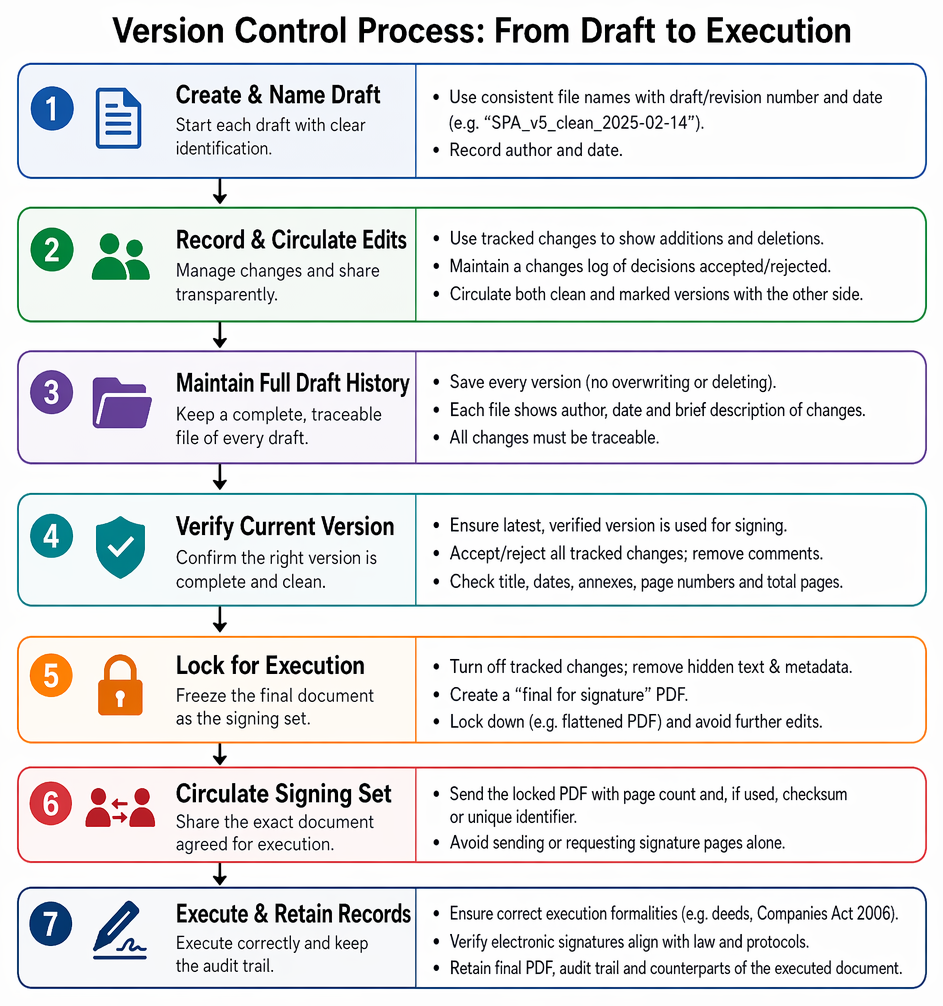
All changes to the draft must be traceable. This can be achieved by:
- Using clear document names and including draft/revision numbers and dates (e.g. “SPA_v5_clean_2025-02-14” and “SPA_v5_marked_2025-02-14”).
- Maintaining a complete file of every draft, marked with author, date and a brief description of changes.
- Employing software tools, such as tracked changes, to show additions and deletions.
- Circulating both a clean and a marked version when sharing edits with the other side.
- Ensuring that only the most recent, verified version is used for signing and submission (and locking it down technically, e.g. as a flattened PDF for execution where appropriate).
- Keeping a short “changes log” to capture decisions accepted/rejected across rounds, especially where multiple counterparties comment.
Key Term: engrossment
The engrossment is the final version of a document prepared for execution, in the precise form the parties will sign. Key Term: counterparts
Counterparts are identical copies of a document, each signed separately by different parties; together they constitute one agreement.
Typical Version Control Problems
Errors in version control risk serious professional consequences. Common pitfalls include:
- Amending and circulating an outdated draft (e.g. v4 instead of v5).
- Losing track of which party’s amendments have been added or omitted.
- Failing to review or accept/reject tracked changes before finalising and sending the document.
- Retaining comments or hidden text in the final signed version.
- Accidental execution of an old or incorrect draft.
- Returning a signature page detached from the agreed content, creating scope for dispute about what was signed.
- Misnaming files so parties execute different texts, or omitting page numbering so completeness cannot be verified.
Controls to Prevent Wrong-Version Execution
-
Adopt strict file naming, date stamping and access control to ensure the “signing set” is uniquely identified.
-
Use a checklist before execution:
- document title and date boxes correct and complete;
- defined “Commencement Date”/“Effective Date” aligned to commercial deal;
- annexes/schedules attached and complete;
- tracked changes off; comments removed; metadata scrubbed;
- page numbers and total pages visible (e.g. “Page 3 of 24”).
-
Circulate a “final for signature” PDF with checksum or unique identifier; avoid altering content thereafter.
-
Avoid sending or requesting signature pages alone. If exceptional circumstances require it, incorporate a clear process (e.g. agreed form attached to completion email; confirmations that the signature page relates to that specific PDF hash).
Key Term: execution
Execution is the process by which a document is signed (and, where required, witnessed) so that it becomes legally binding.
Also verify execution formalities for the specific document type and parties. For example, deeds require specific signing methods and witnessing; companies may sign under section 44 of the Companies Act 2006 (two authorised signatories or one director and a witness). Ensure electronic signature processes align with applicable law and any agreed signing protocols.
Worked Example 1.3
You are finalising an employment contract and receive amendments from the client. You update the main draft, but a colleague sends an unamended earlier draft for execution. The document is signed and returned. What should be your response?
Answer:
As soon as the error is discovered, you must notify all parties immediately. Arrange for the correct, amended contract to be executed. Explain—in writing—how the mistake occurred, and review your version control procedures to prevent recurrence.
Worked Example 1.4
The counterparty emails two documents: “final.docx” (with no visible redlines) and “final_clean.pdf”. On opening “final.docx” you discover hidden tracked changes. Which document should be used for execution?
Answer:
Neither should be used until you have verified that there are no unresolved tracked changes or comments. Accept/reject all changes in the Word file; generate a clean, locked PDF from the verified version; and agree with the counterparty, in writing, that this exact PDF (with page count and, if used, checksum) is the agreed form for execution. Remove all metadata and ensure both parties sign the same file.
Practical Tips for Proofreading and Version Control
- If time allows, review your draft the following day with fresh eyes.
- Print out the document and review on paper, as some errors are missed when viewing on-screen.
- Read aloud to catch missing words, duplicated phrases and awkward syntax.
- If collaborating, consolidate all amendments into a single, controlled document and maintain a changes log.
- Remove draft legends, internal references, tracked changes, comments and metadata before sending the final version.
Additional targeted checks from professional practice:
- Figures and words: where both are used for sums (e.g. “£100,000 (one hundred thousand pounds)”), ensure they match.
- Cross-references: update automated references and verify by spot-checking. After structural edits (moving, splitting or deleting clauses), assume cross-references need review.
- Headings and numbering: ensure sequence integrity; consider including headings in numbering (e.g. “4. PAYMENTS”) for readability, but confirm that interpretation clauses disapply headings for construction unless intended.
- Schedules and annexes: check that all referenced attachments exist, are complete, and are expressly incorporated.
- Boilerplate: verify that notices, governing law and jurisdiction, entire agreement, third-party rights, amendment, assignment, waiver, severance, costs, counterparts and priority clauses are present, appropriate and consistent.
- Language clarity: favour short sentences; avoid archaic jargon; eliminate ambiguous connectors; use tabulation when listing alternatives to avoid confusion over “and”/“or”.
- Inclusive/exclusive dates and time zones: draft precisely. Replace “midnight” with “23:59 [City/Time zone]”.
- “Subject to” vs “without prejudice to”: use accurately to avoid unintentionally disapplying core obligations.
Key Term: engrossment
The engrossment is the executed-form document, i.e. the final “clean” version prepared for signature by all parties. Key Term: counterparts
Counterparts allow parties to sign separate but identical copies of the same document so that, together, they constitute one agreement.
Worked Example 1.5
A share purchase agreement states at the top: “This Agreement is made on [•].” The parties sign but the date is never inserted. The SPA defines “Completion Date” as “30 days after the date of this Agreement.” What is the risk?
Answer:
The missing date risks disagreement about when obligations start, when completion is due and whether termination or renewal rights have accrued. The absence of a clear agreement date can lead to significant disputes. Insert the date contemporaneously with execution, or define the “Commencement Date/Effective Date” clearly in the body and ensure it is populated before signing.
The Role of Quality Control in Client Care and Professional Practice
High-quality drafting is fundamental to professional client care. Errors or poor record-keeping may lead to:
- Disputes between parties as to the meaning or agreed terms.
- Loss or delay of transactions if mistakes are not caught prior to signing.
- Damage to your professional reputation or possible claims of negligence.
Instilling rigorous proofreading and version control habits at the trainee stage is essential preparation for legal practice and passing SQE2. Process discipline (accurate file notes, audit trails of drafts, and transparent tracked changes) supports ethical practice. Never conceal amendments. Ensure the final executed document reflects the parties’ agreed position and contains no hidden edits or comments. Where deadlines are tight, quality control is even more important: build time into your project plan for an independent check or at least a second, focused pass.
Key Term: proofreading
Proofreading is the structured review for errors in a draft prior to finalisation and execution.Revision Tip: Take extra care with cross-references and clause numbering if you have moved clauses during amendments—misnumbering is a frequent error.
Key Point Checklist
This article has covered the following key knowledge points:
- The purpose of proofreading is to detect and correct all errors before finalising a legal document.
- Common errors include typographical mistakes, inconsistent numbering, inaccurate cross-references, ambiguous dates/times and inconsistent defined terms.
- Systematic checking using staged passes, a checklist and reading line by line improves accuracy.
- Language choices affect legal meaning: prefer active voice, avoid “should” for obligations, and draft clear “and/or” alternatives.
- Version control is critical; ensure only the latest, correct draft is signed or submitted and that all tracked changes/metadata are removed.
- Adopt file naming, change logs and controlled circulation to avoid signing the wrong version.
- Execution formalities and sign-off packs (engrossment and counterparts) must be verified carefully.
- Amendments should be clearly recorded, and only one verified draft should be used as the primary document.
- Poor proofreading or version control may lead to legal disputes, client dissatisfaction, or liability for mistakes.
Key Terms and Concepts
- proofreading
- boilerplate clause
- cross-reference
- version control
- commencement date
- effective date
- defined term
- tracked changes
- metadata
- engrossment
- counterparts
- execution