Learning Outcomes
This article explains research planning and methods for using legal databases and effective search techniques, including:
- Planning a clear research strategy tailored to the legal issue and required source type
- Distinguishing subscription databases (Westlaw, LexisLibrary, Practical Law) from free sources (legislation.gov.uk, BAILII, EUR-Lex) and understanding their limitations
- Constructing precise queries with Boolean operators, proximity connectors, field-restricted searches, truncation, and exact phrases
- Refining results using filters and editorial indexing (Subject/Keyword), and applying jurisdiction, court level, and date limits
- Assessing authority, accuracy, and currency; preferring authoritative report series and using neutral citations appropriately
- Confirming legislative status, commencement, amendments, geographical extent, and point-in-time versions across platforms
- Tracking subsequent judicial history with citators and Case Analysis to determine whether a case remains good law
- Locating and selecting authoritative case reports and optimal citations for practice and assessment
- Recording a reproducible research trail (platforms, search strings, filters, citations, update checks, timestamps) to support supervision and audit
- Applying these techniques to common scenarios, such as employment confidentiality searches, verifying outdated commentary, and using Hansard under Pepper v Hart
SQE2 Syllabus
For SQE2, you are required to understand the importance of effective legal research and demonstrate the ability to plan and execute searches using electronic databases, with a focus on the following syllabus points:
- understanding the importance of online and printed sources for legal research in legal practice
- choosing appropriate sources depending on the type of information needed
- formulating effective keyword searches and using Boolean logic
- evaluating sources for authority, accuracy, and currency
- recording your research process and results clearly
- understanding and using case and statute citations, including neutral citations
- using citators (e.g., Case Analysis, Current Law Case Citator) to check whether a case remains good law
- confirming legislation status (in force, commencement, amendments) and using point-in-time versions
- making judicious use of free sources (e.g., legislation.gov.uk, BAILII, EUR-Lex) and recognising their limitations
Test Your Knowledge
Attempt these questions before reading this article. If you find some difficult or cannot remember the answers, look more closely at that area during your revision.
- What are the key differences between searching a legal database and searching the open internet for legal information?
- How can you ensure that information found in a legal database is up to date and authoritative for your research?
- Name and describe the basic Boolean search operators you would use to refine your database queries.
- What specific steps should you take to record your legal research trail for use by a supervisor or colleague?
Introduction
Effective legal research is a fundamental aspect of practical legal work for SQE2. Your performance in research tasks is assessed on your ability to identify, search, and evaluate relevant sources using appropriate methods. This article outlines best practices for planning research, using legal databases efficiently, and recording your process for SQE2.
Key Term: legal database
An organised collection of primary and secondary legal sources, typically searchable using advanced tools and available via subscription. Key Term: open web legal source
Publicly accessible online legal material, not behind a subscription or authentication wall. Key Term: primary source
Original, authoritative sources of law: legislation and case law. Key Term: secondary commentary
Explanatory material (e.g., textbooks, encyclopedias, journal articles) that discusses and analyses the law but is not itself law. Key Term: neutral citation
A court-assigned citation identifying a judgment without reference to a report series (e.g., [2023] UKSC 10).
Online Legal Research: Sources and Access
Legal information is primarily accessed through electronic databases, paid subscription services, and open legal websites. Understanding the distinction—and the limits of each—is critical.
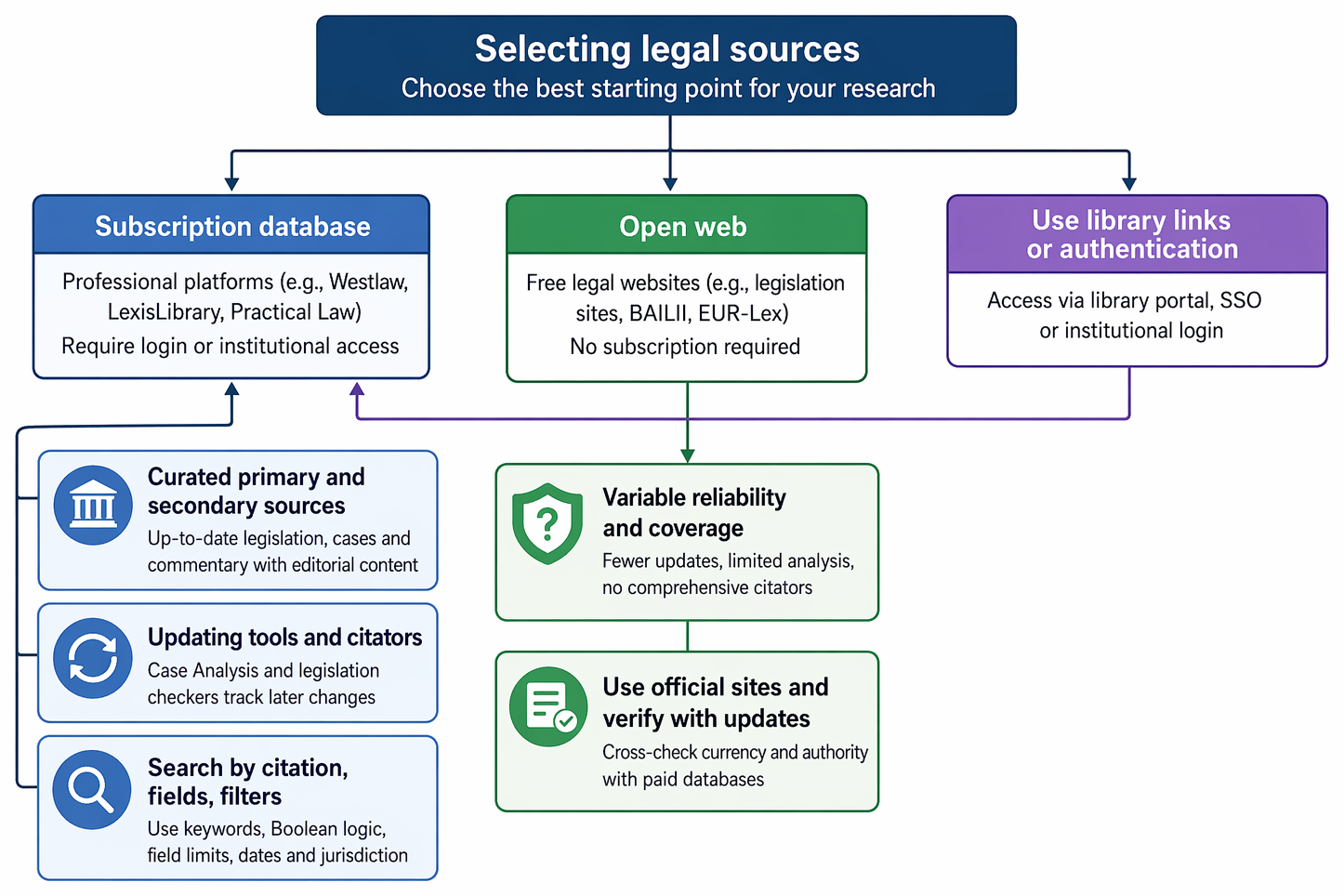
Legal research source pathways separate authenticated subscription services with curated materials and updating tools from open websites requiring authority and currency checks.
Subscription Databases vs. the Open Web
Subscription databases like Westlaw, LexisLibrary, and Practical Law provide curated, up-to-date legal material with search functions designed for legal professionals. Key features include links between primary and secondary sources, updating tools, citators, and the ability to search by citation, keyword, party name, subject, and date. The ICLR-authoritative Law Reports are available within both Westlaw UK and LexisLibrary, whereas the All England Law Reports are available in LexisLibrary but not in Westlaw UK. Westlaw UK includes the Weekly Law Reports and extensive specialist series, plus powerful Case Analysis linking to alternative reports and later judicial treatment.
Free sources provide useful access to primary law:
- legislation.gov.uk offers Acts and statutory instruments (with point-in-time views and “Changes to Legislation” notices).
- BAILII publishes judgments quickly and is valuable for recent, unreported decisions.
- EUR-Lex provides EU treaties, legislation, and case law.
Free sources lack some “value-added” features found in subscription platforms: comprehensive citators, editorial analysis, integrated commentary, and sophisticated indexing. For professional research, use both free and subscription sources and always confirm currency and authority.
Access Considerations
Subscription resources usually require authentication (institutional, username/password, or IP address verification). Many universities use Shibboleth single sign-on, enabling off-campus access through library links so you retain personalisation features (saved searches, alerts). Always use library portals to ensure you are recognised and to access full content. If you move between platforms in one session (e.g., Justis to Westlaw), single sign-on may carry your credentials across seamlessly.
Planning Your Legal Research
Failing to plan a legal research strategy leads to missed sources, wasted time, and poor results.
Formulating a Clear Research Query
Start by identifying:
- What information is required for the specific legal issue at hand.
- The applicable area of law and the type of source needed (legislation, case law, or commentary).
- The search terms, synonyms, and legal concepts likely to appear in authoritative materials.
Plan your route:
- Define scope and urgency.
- Identify likely sources (e.g., Westlaw Cases for judicial treatment; Lexis Legislation for consolidated statutes; Halsbury’s Laws for an overview and key references).
- Decide whether you need jurisdictional filters, date limits, or court levels.
Key Term: keyword search
An electronic database query using one or more targeted terms relevant to the legal topic, often employing connectors or operators.
Worked Example 1.1
Scenario: You are tasked with finding recent cases addressing "confidentiality" within employment law.
Answer:
Start in Westlaw UK “Cases”. Run "confidentiality AND employment" in Free Text, then switch to the “Subject/Keyword” field so results reflect editorial keywords, improving precision. Filter by jurisdiction (England and Wales), court level, and date (e.g., last 5 years). If results are broad, add terms like "dismissal" or "breach of confidence", and sort by relevance. Use Case Analysis to review later treatment and link to authoritative reports.
Techniques for Effective Searching
Understanding how databases structure and index documents is fundamental for successful searching. Databases tag words by fields (title, parties, court, subject keywords), enabling field-restricted searches and proximity operators to control where and how terms appear.
Key Term: Boolean search
A database search using logical connectors such as AND, OR, NOT to combine or exclude terms and control the precision of results. Key Term: proximity operator
A search connector that requires terms to appear near each other (e.g., within a specified number of words, same sentence, or same paragraph). Key Term: truncation
The use of a wildcard character to retrieve multiple word endings from a root (e.g., neglig* to find negligent, negligence).
Boolean Operators
Boolean operators combine or limit search terms, controlling which documents are returned.
Search Operators Cheat Sheet
| Operator | Function | Example |
|---|---|---|
| AND | Results must contain both terms | contract AND misrepresentation |
| OR | Results must contain either term | guarantee OR indemnity |
| NOT | Exclude results with the second term | arbitration NOT employment |
| "..." | Exact phrase search | "defective goods" |
| * or ! | Wildcard for root/truncated word | neglig* (finds negligent, negligence, etc.) |
| w/5, /5 | Terms appear within 5 words of each other | trustee w/5 breach |
Different databases use distinct symbols for truncation and proximity—consult their help section as needed. For example, Westlaw UK supports /n, /s, /p proximity; LexisLibrary uses W/n, W/S, W/P. Quotation marks enforce phrases on most platforms. Be aware that connectors like NOT (or AND NOT) can over-exclude; use sparingly and as the last connector in a search string.
Filtering and Field-Specific Searches
Most legal databases allow searching within fields (e.g., party names, citation, title) and filtering by court, date, jurisdiction, practice area, or report series. Use Westlaw’s “Subject/Keyword” for cases to apply editorial indexing, and apply court filters to prioritise appellate authority. In legislation databases, use title searches and point-in-time filters to retrieve the version in force when a case was decided.
Adapting Your Search
- Begin broadly; refine iteratively by adding keywords, switching to subject/keyword fields, and applying proximity.
- Consider alternative terminology and synonyms, including broader and narrower expressions.
- Where a concept spans areas (e.g., “right to silence”), use database topic lists or editorial hierarchies to select the most relevant subject terms.
Worked Example 1.2
Scenario: You find an article online discussing UK discrimination law, published in 2014. Should you rely on it for advice?
Answer:
Treat it as background only. Check whether relevant statutes have been amended or case law has evolved since 2014. Use Westlaw UK “Case Analysis” and LexisLibrary “Legislation” with citators (“Is it in force?” and “Legislation Analysis”) to verify the current position. If any update affects the article’s propositions, do not rely on it.
Worked Example 1.3
Scenario: You have a neutral citation [2021] EWCA Civ 120 and need an authoritative report and status of the case.
Answer:
In Westlaw “Cases”, search by neutral citation without brackets. Open Case Analysis, review “Where Reported” for Law Reports or Weekly Law Reports links, and note any All England equivalents in Lexis. Use “Cases citing this case” to see whether it has been applied, distinguished, or overruled. Prefer the Law Reports where available when citing in court or formal writing.
Worked Example 1.4
Scenario: You must confirm whether s.4A of an Act is in force for England and Wales and when it commenced.
Answer:
In Westlaw “Legislation”, search the Act title and open s.4A. Use the “Overview Document” and “Legislation Analysis” for commencement, amendments, and related cases. In LexisLibrary, use “Find out more” > “Is it in force?” and the Halsbury’s Statutes Citator. Cross-check on legislation.gov.uk using the section page and the “Changes to legislation” box; use “Point in time” to view historic versions if needed.
Worked Example 1.5
Scenario: Interpreting ambiguous statutory wording, you suspect ministerial statements clarify the legislative intent.
Answer:
Pepper v Hart permits use of Hansard where the wording is ambiguous/obscure and a clear ministerial statement addresses the mischief. Identify the Bill stages from Current Law Statutes Annotated or legislation.gov.uk, then locate debates in Hansard. Extract the relevant ministerial statement and assess whether it clearly supports the interpretation. Use with caution and only where the conditions are met.
Assessing Source Reliability: Authority, Accuracy, and Currency
For every research result, you must assess whether the information is reliable before relying on it in legal problem-solving or client advice.
Key Term: authority (legal research)
The recognised legal status or official nature of a source—whether it is primary law, officially published, or cited by courts. Key Term: currency (legal research)
The extent to which a legal source or statement reflects the law as currently in force or as interpreted by the courts.
Critical Considerations
- Is the document primary law (legislation or binding case law) or secondary commentary?
- For cases, prefer authoritative report series (Law Reports) where available; neutral citations identify the judgment, but the Law Reports are typically cited in court where the case appears there. If the case is reported in multiple series, choose the most authoritative and ensure your citation reflects that.
- Use citators and Case Analysis to check subsequent judicial history: applied, approved, distinguished, overruled, reversed, etc.
- Confirm the legislative status: whether provisions are in force, commencement date(s), amendments, repeals, and geographical extent.
- Free sources are helpful but may not incorporate all amendments immediately; always verify using subscription databases or official update tools.
Key Term: citator
A tool that records subsequent judicial consideration of a case or legislative provision and links to summaries and references (e.g., Westlaw Case Analysis; Current Law Case Citator; Halsbury’s Statutes Citator).
Beyond cases and statutes, ensure journal articles are from reputable publishers and check recency. Use Legal Journals Index on Westlaw or indexes like HeinOnline to locate commentary and confirm its authority.
Worked Example 1.6
Scenario: A client sends you a blog explaining “right to silence” and its impact in criminal evidence.
Answer:
Verify the position using Halsbury’s Laws and authoritative commentary, then find relevant legislation (e.g., Criminal Justice and Public Order Act 1994) and cases using Westlaw/Lexis. Check whether any provisions or leading authorities have been amended or clarified. Treat the blog only as a prompt; rely on primary law, citators, and recognised commentary.
Recording Your Research Trail
Accurate records are essential. Note:
- The database/resource name and exact section used (e.g., Westlaw, Cases; Lexis, Legislation).
- All search terms, connectors, and filters applied (including proximity and field restrictions).
- Date and time of searches; any point-in-time settings.
- Full citations for all statutes, cases, or articles relied on; prefer authoritative report series.
- The updating process performed (citator consulted, legislation analysis check, “Changes to legislation” viewed, and the date last checked).
This protects you if advice is later questioned and enables colleagues to reproduce or extend your research.
Worked Example 1.7
Scenario: You have researched an unfair dismissal confidentiality issue for an employment matter and need a research note for your supervisor.
Answer:
Record: (1) Platforms used (Westlaw Cases Subject/Keyword; Lexis Legislation; Halsbury’s Laws). (2) Search strings (e.g., Subject/Keyword: “confidentiality” AND “employment”; Free Text: “breach of confidence” /10 employment). (3) Filters (England and Wales; appellate courts; last 5 years). (4) Key cases with authoritative citations and subsequent treatment via Case Analysis. (5) Statutory sections with commencement and amendment notes; point-in-time versions checked. (6) Date/time of searches and citator checks. (7) Any commentary relied on (with publication details). Conclude with the current position and how the sources support your advice.
Practice and Exam Technique: Common Errors
Exam Warning: Omitting clear records of your search steps, using imprecise or overly broad search terms, or reading outdated sources are common errors that may lead to incorrect or poorly supported conclusions in the SQE2 exam.
Common pitfalls include:
- Relying solely on general web search results; insufficient authority or currency.
- Failing to use subject/keyword fields and proximity operators, leading to noisy results.
- Citing transcripts or less authoritative series when Law Reports are available.
- Not checking subsequent judicial history, leading to reliance on overruled or distinguished reasoning.
- Assuming legislation.gov.uk text is always fully consolidated; not checking “Changes to legislation”.
- Omitting point-in-time checks when advising on historic law.
Revision Tip: Always check the help section of each database for search syntax, truncation, and proximity operators. Save your search history and download key results for reference.
Key Point Checklist
This article has covered the following key knowledge points:
- The difference between subscription legal databases and open web sources, and the advantages/limitations of each
- The value of planning a research strategy: defining clear objectives, choosing sources, and keywords
- Use of Boolean operators, proximity, field searches, filters, and alternative terms to improve search results
- How to evaluate the authority, accuracy, and currency of legal materials found, including using citators and authoritative report series
- How to confirm legislative status (in force, commencement, amendments) and use point-in-time views
- The importance of recording every search, source, and update step as part of your research trail
Key Terms and Concepts
- legal database
- open web legal source
- primary source
- secondary commentary
- keyword search
- Boolean search
- proximity operator
- truncation
- authority (legal research)
- currency (legal research)
- neutral citation
- citator