Learning Outcomes
After studying this article, you will be able to identify and use definition–example–contrast information patterns in TOEFL Reading passages. You will recognize how these patterns help clarify meaning, provide supporting evidence, and show differences in written English. You will develop skills to efficiently spot marked definitions, match given examples to key concepts, and distinguish contrast relationships tested in Reading comprehension questions.
TOEFL iBT Syllabus
For TOEFL, you are required to understand definition–example–contrast organizational patterns and use them to answer reading comprehension questions. For revision, focus on these syllabus points:
- Identify when an author introduces and explains a key term or concept through explicit definition and supporting sentences.
- Recognize when illustrative examples are presented to clarify or expand an idea or definition.
- Detect contrast patterns in text, including signal words and the function of contrasting information.
- Use recognition of these patterns to interpret, organize, and paraphrase major ideas and supporting details in reading passages.
Test Your Knowledge
Attempt these questions before reading this article. If you find some difficult or cannot remember the answers, look more closely at that area during your revision.
- Which signal words commonly indicate a contrast pattern between TWO ideas in academic English?
- How can examples in a paragraph help you understand a definition you do not know?
- If a question reads, "According to the passage, what is meant by the term 'ecosystem'?" and the paragraph lists scientific facts and an illustrative scenario, what information pattern does this demonstrate?
Introduction
In TOEFL Reading, effective information mapping means recognizing how writers organize facts and ideas to aid understanding. Three key information mapping patterns tested in the exam are: definition, example, and contrast. These structures help you efficiently locate main ideas, notice supporting evidence, and make critical distinctions between concepts.
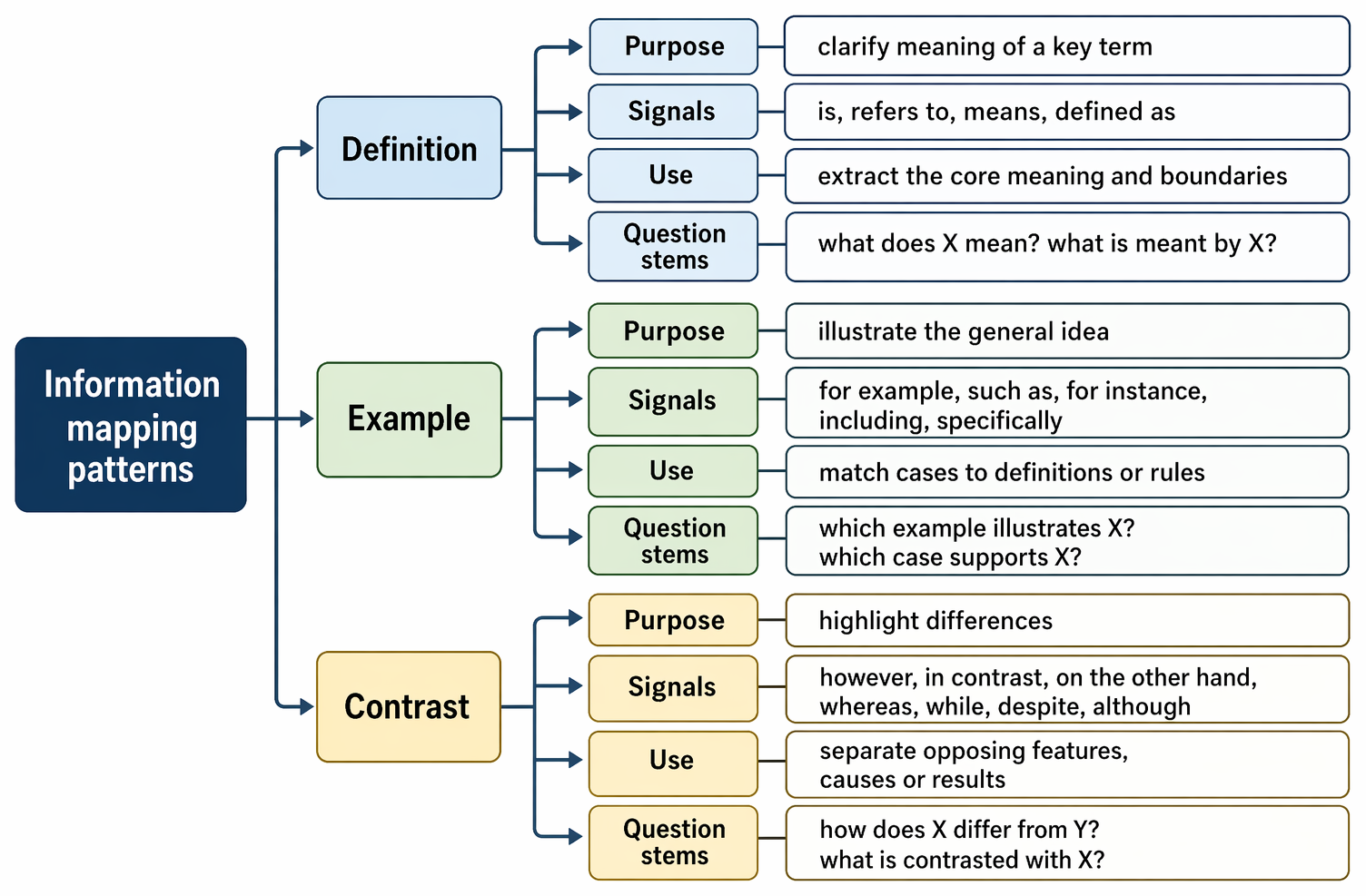
Definition, example, and contrast structures are organized by communicative purpose, lexical signals, interpretive use, and corresponding question formulations.
Key Term: Information Mapping
The ability to identify how information is structured in a text, such as through definitions, examples, or contrasting statements, to support comprehension in reading.
Recognising Definition Patterns
A definition pattern introduces a key term or concept and explains its meaning, often using signal words like "is," "refers to," "means," or phrases such as "can be defined as." This pattern ensures that the meaning is made explicit for the reader.
Key Term: Definition Pattern
A way of organizing information in which a term or idea is presented, followed by its meaning, often using clear signal words or structures.
Writers may highlight the term in bold, italics, or brackets in TOEFL passages, though you must also notice less obvious definitions. Definitions are often followed by examples or further explanations for clarity.
Worked Example 1.1
Paragraph:
Cellular respiration is the process by which cells break down glucose to produce energy in the form of ATP. All living organisms rely on this cycle for survival and functioning.
Question: According to the paragraph, what is meant by "cellular respiration"?
Answer:
Cellular respiration means the energy-producing process in cells that breaks down glucose to form ATP, as directly defined in the paragraph.
Recognising Example Patterns
After a definition or concept, authors usually provide examples to make the abstract idea easier to understand. Examples can be signaled by phrases like "for example," "such as," "for instance," "including," or "specifically." They may also state a general idea in one sentence, then illustrate it with a real situation, data, or descriptive details in the next.
Key Term: Example Pattern
A structure in writing where a general statement or rule is followed by one or more specific cases meant to clarify or apply the general idea.
This pattern helps the reader see how a concept operates in practice or what it looks like in the real world.
Worked Example 1.2
Paragraph:
Photosynthesis is a process used by plants to convert light energy into chemical energy. For example, green plants use sunlight to produce food from carbon dioxide and water.
Question: What function does the second sentence serve in relation to the first?
Answer:
It provides an example to illustrate how photosynthesis is carried out by plants, clarifying the process in the first sentence.
Recognising Contrast Patterns
Contrast patterns highlight differences between two or more ideas, situations, or things. Signal words for contrast include "however," "in contrast," "on the other hand," "whereas," "while," "despite," and "although." Identifying contrast helps distinguish the unique features, problems, or advantages of one concept versus another.
Key Term: Contrast Pattern
A way of presenting information by showing how two or more things are different, typically using signal words to highlight the distinction.
Contrast structures are common in TOEFL passages that compare theories, results, time periods, or viewpoints.
Worked Example 1.3
Paragraph:
Allopatric speciation occurs when populations of a species are geographically separated, leading to divergence. In contrast, sympatric speciation happens without physical separation, often caused by genetic changes or resource use differences.
Question: What is the writer's purpose in mentioning both allopatric and sympatric speciation?
Answer:
The writer is using a contrast pattern to emphasize the difference between two types of speciation.Exam Warning: Many TOEFL Reading questions ask you to recognize or paraphrase the difference between two concepts, or to select the correct example supporting a definition. Do not confuse definition with example—definitions state meaning, while examples show how it works.
Revision Tip: While reading, underline signal words that introduce definitions, examples, or contrasts. Practice rewriting main points as "term—means..." or "Unlike X, Y..." to clarify structure.
Summary
Efficient reading in TOEFL means quickly finding how facts and ideas are arranged—often via definition, example, or contrast. Recognizing these patterns lets you better map passages, answer evidence/detail questions faster, and paraphrase information for short answer tasks.
Key Point Checklist
This article has covered the following key knowledge points:
- Recognize when a TOEFL passage uses definition, example, or contrast to organize ideas.
- Identify common signal words and structures for each pattern.
- Use definitions to understand key terms and focus evidence searches.
- Use examples to see how general concepts apply in specific situations.
- Spot contrasts to distinguish critical differences between theories, approaches, or situations.
- Apply information mapping skills to paraphrase and infer details during reading.
Key Terms and Concepts
- Information Mapping
- Definition Pattern
- Example Pattern
- Contrast Pattern