Learning Outcomes
After studying this article, you will be able to trace pronouns and reference words to their sources in TOEFL Reading tasks. You will practice following reference chains accurately, distinguishing between possible antecedents, and interpreting ambiguous references. You will also learn the most common traps in TOEFL reference questions and apply practical strategies for efficient, error-free answers.
TOEFL iBT Syllabus
For TOEFL, you are required to apply information mapping by tracking pronouns and other reference words to their logical antecedents in reading passages. For revision, focus on these syllabus points:
- Recognize reference words (e.g., pronouns, demonstratives) in academic reading passages.
- Find the noun or phrase (“antecedent”) to which each reference word refers.
- Trace reference chains where a pronoun refers to another pronoun or phrase, building a logical mapping.
- Handle ambiguities when a reference could refer to more than one noun or phrase.
- Apply scanning and elimination to connect reference words rapidly and accurately under time pressure.
Test Your Knowledge
Attempt these questions before reading this article. If you find some difficult or cannot remember the answers, look more closely at that area during your revision.
- What is the “antecedent” of a pronoun?
- If a TOEFL Reading passage includes the sentence “This discovery challenged scientists,” what type of word is “this” and how do you decide what it refers to?
- If two nouns are mentioned in a sentence before “it,” what methods can help you decide which noun “it” refers to?
- True or false: In TOEFL reference questions, the answer is always found in the sentence immediately before the pronoun.
Introduction
Many TOEFL Reading questions require you to map a pronoun or other reference word back to its original source, or antecedent. Because academic texts often contain long sentences with several candidates for each pronoun, being able to track reference chains is a key skill for exam success.
Key Term: Pronoun Reference
A pronoun or word (such as "they," "this," "those," or "such") used in a passage to refer back to a noun, noun phrase, or idea previously mentioned. Key Term: Antecedent
The specific noun, noun phrase, or idea to which a pronoun or reference word refers in a sentence or passage. Key Term: Reference Chain
A sequence where one reference word points to another reference, creating a logical path leading to the original noun or concept.
Properly interpreting reference chains lets you understand the relationships between ideas within academic texts, answer direct TOEFL Reading questions, and avoid common misinterpretations.
Tracking Pronoun and Reference Chains
TOEFL Reading passages often use pronouns and other reference words for coherence and clarity. These may include:
Antecedent resolution proceeds from ambiguity detection to agreement checking and, if necessary, evaluation of discourse logic and structural repetition.
- Personal pronouns: it, they, them, she, he, etc.
- Demonstratives: this, that, these, those
- Phrasal references: such a case, this phenomenon, the latter, the former, etc.
You must quickly identify what previous idea each of these refers to. Some questions may further test your ability to handle a chain of references (e.g., "it" refers to "the theory," which itself was introduced two sentences earlier).
Why Are Reference Chains Important?
Correctly tracking reference chains allows readers to:
- Avoid confusion between possible antecedents.
- Prevent misunderstanding of complex or technical passages.
- Maximize accuracy on TOEFL reference/click-to-refer questions.
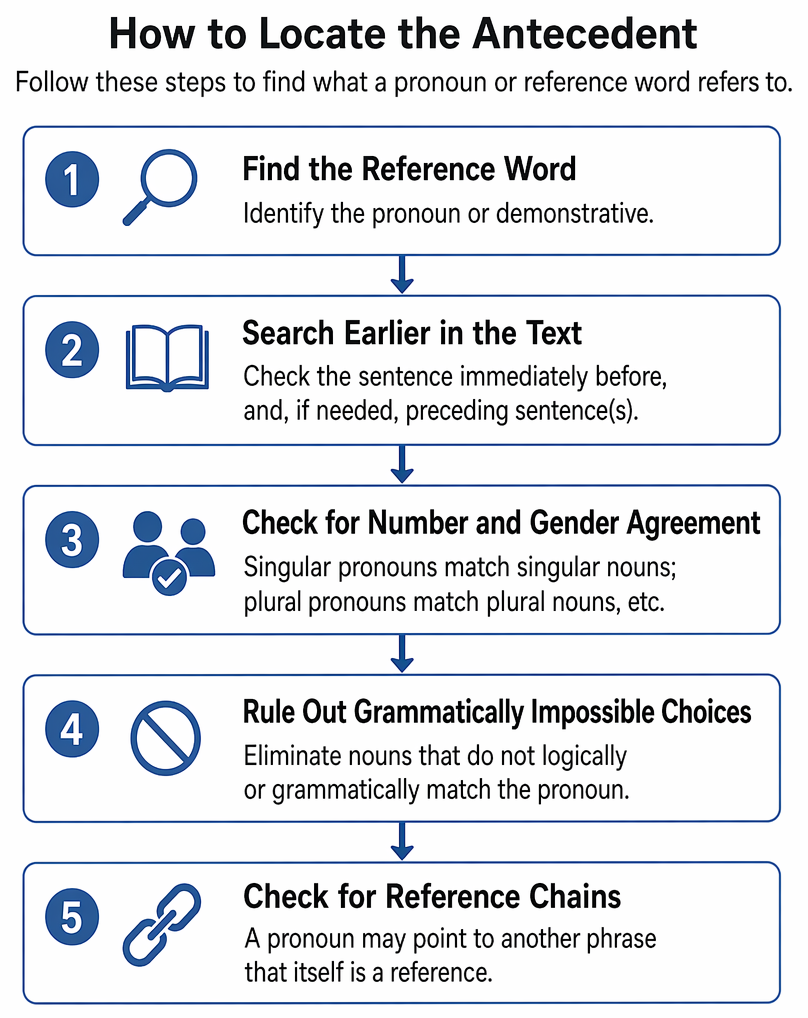
How to Locate the Antecedent
- Find the Reference Word Find the pronoun or demonstrative in the question or passage.
- Search Earlier in the Text Check the sentence immediately before, and, if needed, the preceding sentence(s) for likely antecedents.
- Check for Number and Gender Agreement A singular pronoun ("it") must refer to a singular noun; a plural pronoun ("they") matches plural nouns, etc.
- Rule Out Grammatically Impossible Choices Eliminate nouns that do not logically or grammatically match the pronoun.
- Check for Reference Chains Be alert for nested references: a pronoun may point to another phrase that itself is a reference.
Dealing with Ambiguity
Academic writing sometimes makes it difficult to see what a reference word refers to when multiple nouns are possible. In this case:
- Use the logical flow of the passage.
- Think about meaning: which noun makes sense as the referent?
- Check for noun repetition or parallel structure.
Key Term: Coherence
The way a text holds together by using reference words and other linking expressions to connect ideas logically and smoothly.
Worked Example 1.1
Read the following short passage and answer the reference question below.
In 1928, Alexander Fleming discovered penicillin in a laboratory in London. The antibiotic’s success was extraordinary, saving countless lives during the Second World War. Many doctors considered it a miracle substance. However, its wide use also led to a rapid increase in resistant bacteria. This was unexpected.
Question: In the final sentence, what does “This” refer to?
Answer:
“This” points to “a rapid increase in resistant bacteria”—that is, the unexpected event is the sharp rise in bacterial resistance, not the discovery itself or the previous sentences as a whole.
Worked Example 1.2
Read the text and answer the question below.
Recent studies have shown that regular exercise improves mental health. Physical activity reportedly helps reduce anxiety, boost self-esteem, and even prevent depression. These benefits are supported by a growing body of scientific evidence.
Question: In the final sentence, what does the word “These” refer to?
Answer:
“These” refers to the listed mental health improvements: reduced anxiety, boosted self-esteem, and depression prevention.
Worked Example 1.3
Review the excerpt and answer the following.
The sharp increase in sea levels has been attributed to various causes. Scientists believe that global warming is a primary factor; others argue volcanic activity may play a role. Many also consider the melting of polar ice caps important, yet this is often contested by experts. They have raised several objections.
Question: Who does “They” refer to in the last sentence?
Answer:
“They” refers to “experts” mentioned in the previous sentence.Exam Warning: A common error is to confuse which noun a reference word points to, especially when there are several possible nouns. Always check for agreement in number and meaning, and avoid picking the nearest noun unless it truly matches logically and grammatically.
Revision Tip: When practicing with TOEFL passages, highlight each pronoun or demonstrative. Draw an arrow to its likely antecedent. If a reference chain exists, map it step by step. This trains you to follow links quickly in the exam.
Summary
Tracking reference chains helps you understand connections between ideas and answer TOEFL Reading questions on pronouns and coherence. Accurate mapping prevents misinterpretation and boosts your reading score.
Key Point Checklist
This article has covered the following key knowledge points:
- Explain the definition and function of reference words and antecedents in TOEFL texts.
- Apply efficient search strategies to find antecedents of pronouns and demonstratives.
- Identify reference chains where pronouns refer to earlier references, not just direct nouns.
- Spot and avoid ambiguous references by using logic, grammar, and context.
- Practice with TOEFL-style questions to build reliable mapping skills for the exam.
Key Terms and Concepts
- Pronoun Reference
- Antecedent
- Reference Chain
- Coherence