Learning Outcomes
After studying this article, you will distinguish clearly between reporting opinions and facts when integrating sources in TOEFL Reading, Listening, Speaking, and Writing tasks. You will know how to correctly attribute statements, paraphrase source content, and accurately select evidence or viewpoints when asked to integrate or summarize academic material in TOEFL exam responses.
TOEFL iBT Syllabus
For TOEFL, you must demonstrate the ability to accurately integrate information from reading and listening sources, making clear distinctions between facts and opinions. For revision, focus on these syllabus points:
- Identify statements of fact versus those that express opinions or interpretations in academic sources.
- Attribute information from readings or lectures accurately using appropriate reporting phrases.
- Paraphrase both factual content and viewpoints without distortion.
- Clearly separate your own opinions from those presented in provided material.
- Integrate evidence and viewpoints as required by exam prompts, ensuring proper reporting style and source distinction.
Test Your Knowledge
Attempt these questions before reading this article. If you find some difficult or cannot remember the answers, look more closely at that area during your revision.
- What is a key difference in how you should report an author’s opinion compared to a reported fact in a TOEFL Integrated Writing response?
- Which reporting phrase signals that you are presenting someone else’s viewpoint, not your own?
- True or false: On TOEFL, failing to distinguish facts from opinions when summarizing source material may lead to a loss of points.
Introduction
Academic English at university level requires the skill to accurately represent information from sources. TOEFL tasks often demand you to summarize, compare, or integrate ideas from readings and lectures. It is essential to know if the information you present is a fact or an opinion, and to report each one clearly, using proper attribution and phrasing.
Key Term: Fact
A statement that can be checked and confirmed by evidence or direct observation; it describes something that is objectively true. Key Term: Opinion
A belief, judgement, or interpretation that reflects an individual’s or group’s viewpoint and cannot be conclusively verified. Key Term: Reporting Phrase
Words or expressions used to indicate that information is taken from another source, helping to make clear whether it is the author’s opinion or factual content.
Reporting Facts and Opinions in TOEFL Responses
The TOEFL exam frequently requires you to summarize material or explain relationships between sources. Accurately quoting, paraphrasing, and combining information depends on your ability to tell facts apart from opinions and to signal this difference to the reader.
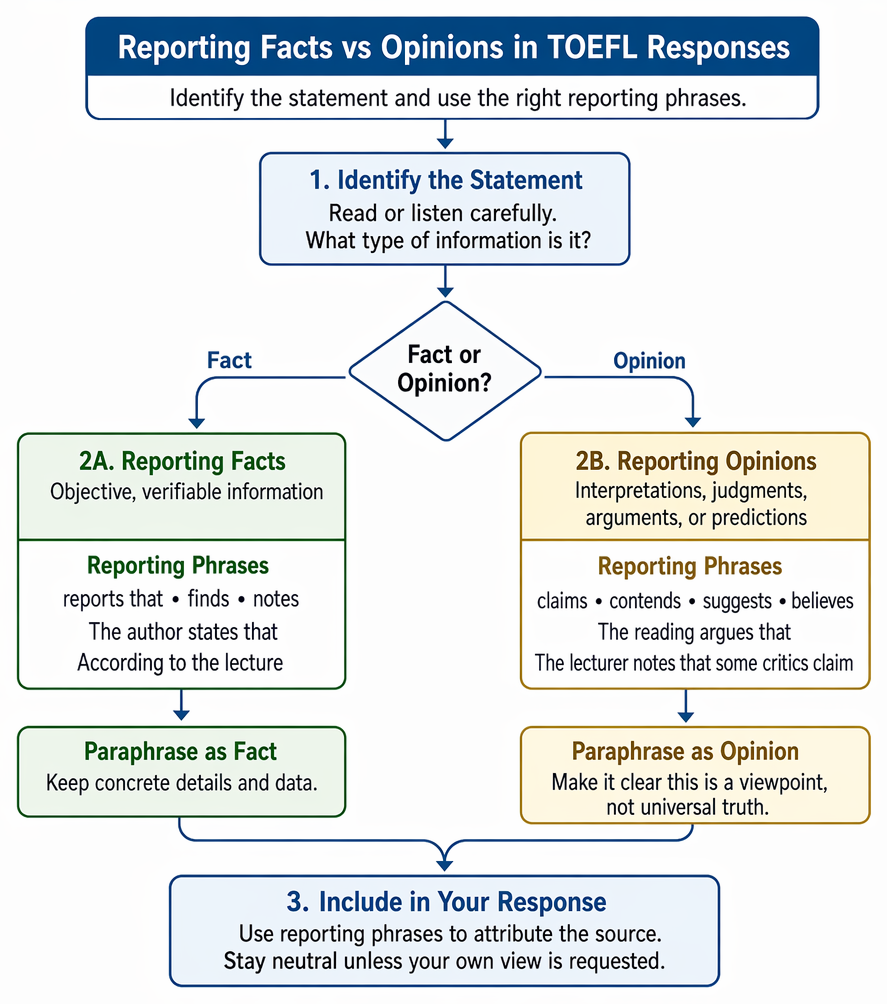
Reporting expressions are divided into factual reporting verbs, opinion-reporting verbs, and attribution formulas for reading and lecture sources.
Identifying Facts and Opinions
Facts can be checked or measured, such as “Mercury is the closest planet to the sun.” Opinions express evaluation or argument, for example, “Mercury is the most interesting planet in the solar system.” In TOEFL passages, lectures, and discussions, many statements are clearly facts (dates, measurements, definitions), while others offer interpretations, judgments, or predictions.
Using Reporting Phrases
Reporting phrases clarify if you are stating a fact or expressing a source’s opinion. Use phrases like “The author states that,” “According to the lecture,” or “The reading argues that” when introducing points from the source. Use “claims,” “contends,” “suggests,” or “believes” to indicate opinions. Objective facts can be introduced with “reports that,” “finds,” or “notes.”
Key Term: Attribution
The act of indicating where a piece of information, idea, or statement originates, by naming the source or speaker.
Paraphrasing and Summarizing
Proper paraphrasing involves expressing source content in your own words while accurately reflecting whether the information is factual or interpretative. For factual paraphrase, maintain concrete details. For opinions, ensure it is clear you are relaying a viewpoint, not a universal truth.
Distinguishing Your Views From Source Content
TOEFL Integrated Tasks expect you to relay information without adding your own judgment unless specifically required. Use reporting phrases to keep your response neutral and focused on what was said in the reading or lecture. Only add your opinion in the “Academic Discussion” or “Independent Speaking/Writing” tasks, and then signal it with phrases such as “In my view” or “I believe.”
Worked Example 1.1
Read the passage and answer the question that follows.
Passage: Scientists studying urban green spaces have observed that city parks are associated with improved air quality and decreased local temperatures. Some researchers argue that increasing green areas is essential for sustainable city development, while others caution that park expansion may not address all environmental issues.
Question: In your own words, report both a fact and an opinion from the passage, clearly distinguishing between them.
Answer:
A reported fact: The passage notes that scientists found city parks are linked to improved air quality and lower temperatures. A reported opinion: The passage says some researchers argue that increasing green areas is essential for sustainable city development, which is an opinion.
Worked Example 1.2
You hear this in a TOEFL lecture:
“Although hybrid vehicles reduce emissions, some critics claim they are less cost-effective overall.”
What reporting phrases and structure should you use to include both the fact and the opinion in your summary?
Answer:
Use: “The lecturer explains that hybrid vehicles reduce emissions (fact), but also notes that some critics claim these vehicles are less cost-effective overall (opinion).”Exam Warning: Many exam responses lose points because the writer summarizes everything as fact, failing to identify which statements are opinions or arguments. Always use clear reporting phrases to avoid misrepresentation.
Revision Tip: Practice recognizing reporting phrases in academic texts and lectures. Make a list of phrases for introducing facts and ones for introducing opinions, and use them correctly in your TOEFL practice essays.
Summary
Distinguishing between facts and opinions when integrating sources is required for TOEFL success. Use precise reporting phrases, accurate paraphrasing, and proper attribution so your reader knows whose idea you are presenting and what type it is.
Key Point Checklist
This article has covered the following key knowledge points:
- Recognize the difference between facts (objective) and opinions (interpretive or evaluative).
- Attribute all reported material from readings and lectures using appropriate reporting phrases.
- Use “states,” “notes,” or “reports” for factual content; use “claims,” “argues,” or “contends” for opinions.
- When paraphrasing, preserve the type of content—do not present opinions as facts or vice versa.
- In TOEFL tasks, keep your own views separate from source material unless the prompt asks for your opinion.
Key Terms and Concepts
- Fact
- Opinion
- Reporting Phrase
- Attribution