Learning Outcomes
After completing this article, you will be able to identify and summarise the essential points from TOEFL reading and listening sources, combine information accurately, and paraphrase main ideas in your own words. You will also learn to structure integrated responses clearly, select only the most relevant details, and avoid common pitfalls such as copying language or including personal opinions.
TOEFL iBT Syllabus
For TOEFL, you are required to demonstrate source combination and summarising when responding to tasks combining reading and audio. For revision, focus on these syllabus points:
- Recognise and extract central arguments or ideas from reading passages and lectures.
- Paraphrase key points using your own language, not direct copying.
- Combine information from reading and audio to create a concise, well-organised summary.
- Select supporting details that are strictly relevant to main ideas.
- Structure integrated writing and speaking responses clearly, with reference to both sources.
- Refrain from inserting personal opinion, unless the TOEFL task specifically instructs otherwise.
Test Your Knowledge
Attempt these questions before reading this article. If you find some difficult or cannot remember the answers, look more closely at that area during your revision.
- What is required when the TOEFL task instructs you to “summarise the main points from both the reading and the lecture”?
- How should you handle minor details or examples in your integrated responses?
- Why is paraphrasing important when integrating sources on the TOEFL?
- Is it acceptable to include your own opinion when the task does not specifically ask for it?
Introduction
In the TOEFL iBT integrated tasks, you must combine information from both reading passages and listening excerpts to respond effectively. This skill is critical for questions that require you to summarise, explain, or relate information from these sources. Accurate combination ensures a complete, clear, and high-scoring response.
Key Term: Integrated Response
A written or spoken TOEFL answer that requires information drawn from both a reading and listening source, combined into a clear summary or explanation. Key Term: Paraphrasing
Restating information from a source using your own words and sentence structures, rather than copying directly. Key Term: Summarising
Reporting only the main ideas or arguments from reading and audio, omitting details and personal views. Key Term: Supporting Detail
A fact, example, or explanation included in the source to clarify or strengthen a main idea; only relevant supporting details should be selected for summaries.
Source Combination and Summary
When a TOEFL integrated task instructs you to use information from both the reading passage and the audio, your aim is to identify the main ideas of each and to present them together in a concise form.
Relevant content for source-based summaries is divided into details to retain and details to exclude from the response.
You may be asked to:
- Summarise a lecture and show how it supports or undermines points from a passage.
- Explain how examples in a talk relate to a concept from the reading.
- Compare the arguments from reading and lecture.
In all cases, you are expected to avoid inserting your opinions or inventing information.
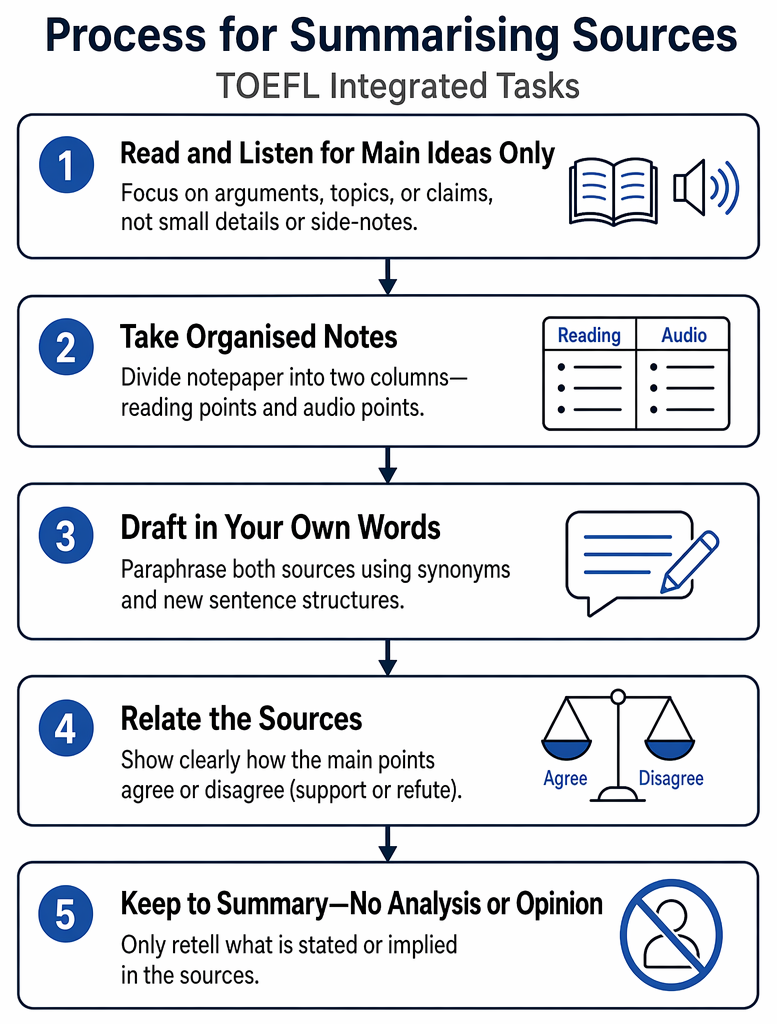
Process for Summarising Sources
- Read and Listen for Main Ideas Only: Focus on arguments, topics, or claims, not small details or side-notes.
- Take Organised Notes: Divide your notepaper into two columns, marking points from reading and audio separately.
- Draft in Your Own Words: Paraphrase both sources. Use synonyms and change sentence structure to avoid copying.
- Relate the Sources: If required, show clearly how the main points agree or disagree.
- Keep to Summary—No Analysis or Opinion: Only retell what is stated or implied in the sources.
Selecting Key Points
Integrated questions do not require a catalogue of every fact. Instead:
- Include only those details that are essential for understanding the central point.
- Omit minor examples or digressions except when specifically asked about them.
- If a lecture refutes or supports a specific reading point, include this relation in your summary.
Worked Example 1.1
Task: Listen to the following lecture and read the short passage. Summarise the main points from both sources and explain how the lecture casts doubt on the reading.
Reading Passage (summary): Some scientists argue that online courses are less effective than classroom learning. Reasons include the lack of face-to-face interaction, lower standards, and limited participation by top universities.
Lecture (key points): The lecturer disagrees, stating that online courses can be as rigorous as traditional ones, many professors participate in both, and the top universities have begun offering entire online degrees.
Sample Integrated Summary:
The reading claims that online courses are inferior to traditional classroom learning due to missing interactions, lower standards, and weaker university participation. In contrast, the lecture casts doubt on these points by explaining that online courses can be just as demanding, are taught by experienced professors, and now include full degrees from top-tier schools.
Answer:
This summary presents arguments from both sources and directly addresses their relationship, without personal comment or unnecessary examples.
Worked Example 1.2
Task: You will read a short passage about new energy sources, then listen to part of a lecture on the same topic. Summarise the lecture and explain how it supports or refutes the reading.
Reading Passage (summary): It is costly to develop wind energy for city electricity due to initial construction expense, land requirements, and unreliable wind patterns.
Lecture (key points): The lecture supports these points, providing evidence about high upfront costs, the need for large, open land near cities, and the need for backup systems during periods of no wind.
Sample Integrated Summary:
The lecture and the reading both identify the major challenges of developing wind energy for cities. The speaker agrees that high initial costs, land access, and unpredictable wind make large-scale development hard. Evidence from pilot studies is used to confirm each reading claim.
Answer:
This response only summarises what was stated in the reading and lecture, linking the main ideas without opinion or repetition.Exam Warning: On TOEFL, avoid including your own viewpoint or speculating about the topic unless the question specifically requires an opinion. Adding personal judgement where it is not asked will reduce your score.
Revision Tip: When taking notes, use two clear columns—one for reading points, one for audio—to help track and integrate only the main arguments in your summary.
Summary
Summarising sources on TOEFL integrated tasks means focusing only on major arguments or claims from the passage and lecture, paraphrasing these accurately, and clearly relating them as required. Use your own words and keep your summary concise, without personal comments.
Key Point Checklist
This article has covered the following key knowledge points:
- Explain the process of summarising main points from both reading and audio as required by TOEFL iBT.
- Use paraphrasing to express source ideas without copying.
- Select only the most important details and omit minor points in summaries.
- Present clear, concise summaries in integrated responses, with no personal judgement.
- Relate points from reading and audio to each other, if required by the question.
Key Terms and Concepts
- Integrated Response
- Paraphrasing
- Summarising
- Supporting Detail