Learning Outcomes
This article explains how organisations make pricing decisions using knowledge of price elasticity, relevant costs, and strategic positioning. You will learn to interpret the relationship between demand and price, identify costs that are relevant for short- and long-term decisions, and assess how competitive strategy shapes pricing choices. By the end, you should be able to apply these concepts to exam scenarios.
ACCA Advanced Performance Management (APM) Syllabus
For ACCA Advanced Performance Management (APM), you are required to understand how pricing strategy aligns with organisation strategy and influences performance, as well as how to apply relevant cost techniques to pricing decisions. Your revision should include:
- Price elasticity of demand and its effect on pricing decisions
- The identification and treatment of relevant and irrelevant costs in pricing
- How strategic positioning (cost leadership, differentiation, focus) guides pricing policies
- The use of pricing strategies in different market contexts (perfect competition, monopoly, oligopoly)
- The relationship between pricing, product lifecycle, and performance measures
- Threats of short-termism and misalignment between pricing tactics and long-term strategy
Test Your Knowledge
Attempt these questions before reading this article. If you find some difficult or cannot remember the answers, look more closely at that area during your revision.
-
What does a price elasticity of demand (PED) greater than 1 imply about a product's demand?
- a) Demand is perfectly inelastic
- b) Demand is price elastic
- c) Demand is unitary elastic
- d) Demand is price inelastic
-
If a company sets prices below relevant cost to gain market share, which ACCA syllabus risk must be considered?
- a) Improved operational efficiency
- b) Lack of strategic fit and potential losses
- c) Enhanced brand loyalty
- d) Perfect competition benefits
-
True or false? Only variable costs are relevant for pricing decisions in the short-term.
-
Briefly explain how a cost leadership strategy may affect the pricing strategy of a firm.
-
List two key differences between relevant and irrelevant costs in pricing decisions.
Introduction
Pricing strategy is critical in both strategic and operational decision making. Prices influence sales, profit, and perception of value. However, the “right” price requires understanding customer response (price elasticity), recognising which costs matter (relevant costs), and aligning actions to the business's chosen competitive strategy. Errors in these areas can undermine long-term objectives. This article outlines the essential concepts and practical applications for ACCA students.
Key Term: price elasticity of demand
The responsiveness of quantity demanded to a change in price, measured as the percentage change in quantity demanded divided by the percentage change in price.
PRICING STRATEGY: CORE CONCEPTS
Price Elasticity of Demand (PED)
A key factor in setting prices is understanding how quantity demanded changes with price changes.
If PED > 1, demand is elastic: lowering price increases total revenue. If PED < 1, demand is inelastic: increasing price increases total revenue. Firms must estimate PED for their products—this helps predict the impact of price changes on revenue and profit.
Key Term: relevant cost
A cost that will change as a result of a specific decision and should be considered when deciding between alternatives. Key Term: irrelevant cost
A cost that will not be affected by the decision at hand and should not influence the decision.
Worked Example 1.1
A software company assesses dropping its price from $50 to $40 per licence. This increases monthly sales from 1,000 to 1,300 units.
Question: Calculate the price elasticity of demand, interpret the result, and advise whether the price reduction is likely to increase total revenue.
Answer:
PED = (% change in quantity demanded) / (% change in price) % change in quantity = (1,300 - 1,000)/1,000 = 30% % change in price = (40 - 50)/50 = -20% PED = 30% / -20% = -1.5 The absolute value is 1.5 (>1), so demand is elastic. Reducing the price is likely to increase total revenue.
Relevant Costs for Pricing
Not every cost is relevant when making pricing decisions. Only costs that are future, cash-based, and incremental should be considered. Sunk costs (already incurred and cannot be recovered) and non-incremental fixed costs are irrelevant to such decisions.
Key Term: sunk cost
A cost incurred in the past that cannot be changed and should be ignored in decision making.
Identifying Relevant Costs
- Direct variable costs (e.g., materials, direct labour): Relevant
- Directly attributable incremental fixed costs: Relevant if the cost will only be incurred if the decision is taken
- Allocated general fixed costs: Usually irrelevant since they won't change due to the pricing decision
- Sunk costs: Irrelevant
Worked Example 1.2
A company has a marginal cost of $18 per unit, allocated fixed overheads of $7 per unit, and is considering a special order for 500 units at $22 per unit.
Question: Should the company accept the order if it has spare capacity?
Answer:
Only the marginal cost of $18/unit is relevant, as fixed overheads are unavoidable. Since $22 > $18, the order will increase profit by $4 per unit. Allocated fixed overheads are not relevant as they will be incurred whether or not the order is accepted.
Types of Pricing Strategies
Depending on its objectives and market conditions, an organisation can choose various pricing methods:
- Cost-plus pricing: Adding a markup to cost
- Market-based pricing: Setting prices based on competitors or customer willingness to pay
- Penetration pricing: Introducing at low price to gain market share
- Skimming: Introducing at high price for early adopters
Each method has different relevant costs and requires understanding of elasticity and strategic aims.
STRATEGIC POSITIONING AND PRICING POLICY
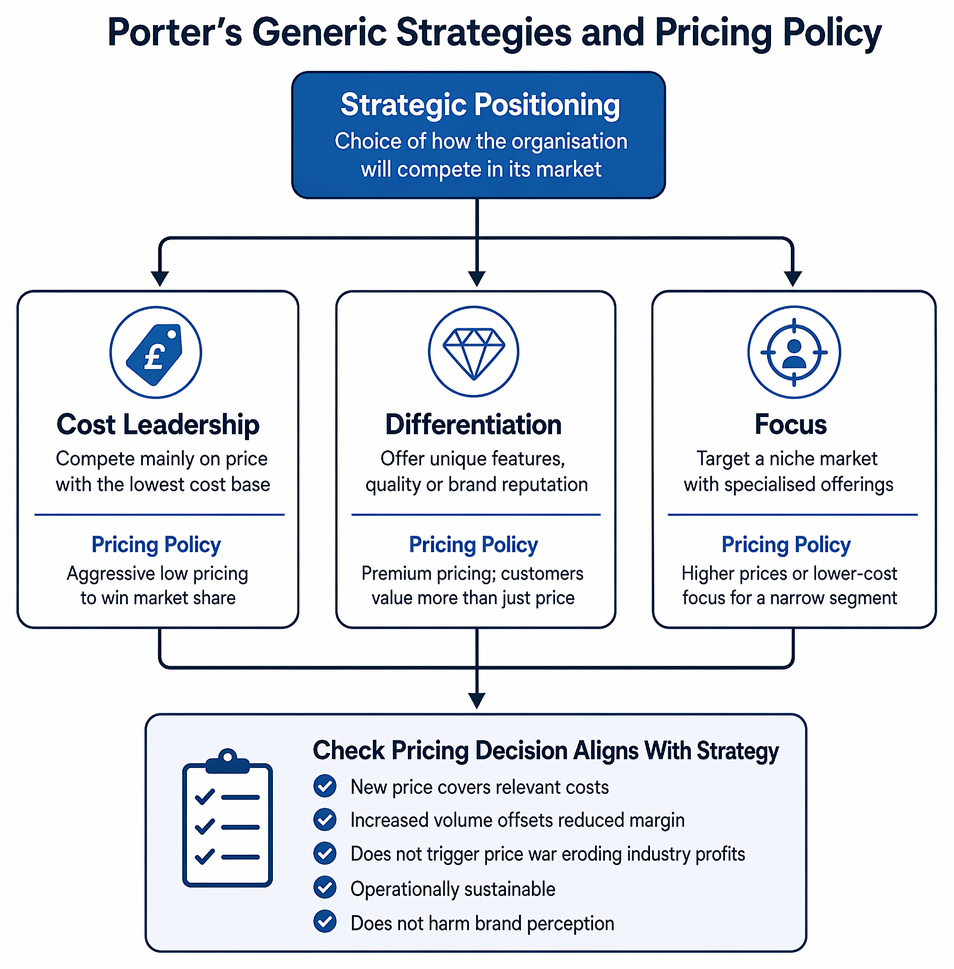
Pricing strategy should align with the organisation’s chosen strategic positioning.
Cost classification for decision making identifies relevant costs as future, cash, and incremental, while excluding sunk and non-incremental items.
Key Term: strategic positioning
An organisation's choice of how it will compete in its market, such as through cost leadership, differentiation, or focus.
Porter’s Generic Strategies and Pricing
-
Cost Leadership: Compete mainly on price, aiming for the lowest cost base. Typically uses aggressive pricing to win market share, often needing highly efficient operations and strict cost control.
-
Differentiation: Offer unique features, quality, or brand reputation. Allows premium pricing; customers value aspects other than just low price.
-
Focus: Target a niche market, possibly with higher prices due to specialised offerings or lower cost focus for a narrow segment.
Worked Example 1.3
A large supermarket chain follows a cost leadership strategy. It considers cutting cereal prices by 10% to compete with a new market entrant.
Question: What factors must the chain consider to ensure this price cut aligns with its strategic positioning?
Answer:
The chain must ensure that the new price covers relevant costs, that any increase in volume offsets profit lost on the lower margin, and that the move does not spark a price war eroding industry profits. It should also verify that this response is sustainable operationally and does not harm brand perception.
Product Life Cycle and Pricing
Product pricing approaches may change as products move from introduction to decline phase.
- Early stages may use price skimming or penetration
- Later stages often require lower prices to defend market share Relevant cost analysis helps ensure pricing supports lifecycle and strategy aims.
Strategic Risks
Short-term pricing (e.g., accepting contracts below total cost) can sometimes support entry or protect market position but may risk undermining profitability if not aligned with long-term strategic objectives.
Revision Tip: When answering exam questions on pricing, always identify both the relevant costs and the organisation's strategic positioning. Explain how pricing decisions support or threaten stated objectives.
Exam Warning: A common error is using all cost data in calculations, including sunk and irrelevant fixed costs. In your answer, clearly separate out and explain only those costs that will change with the decision.
Summary
Effective pricing decisions require understanding price elasticity, recognising and applying relevant cost information, and ensuring alignment with competitive strategy. Blindly using average total cost for pricing can result in missed opportunities or loss-making contracts. Consideration of market demand, strategic position, and lifecycle stage is essential for sustained performance.
Key Point Checklist
This article has covered the following key knowledge points:
- Define and interpret price elasticity of demand and its application to pricing decisions
- Identify relevant and irrelevant costs for pricing, including definitions of sunk and incremental costs
- Describe and choose pricing methods in light of elasticity, market structure, and strategic position
- Explain how Porter’s generic strategies affect pricing policy choices
- Apply relevant cost analysis to real-world pricing scenarios and justify decisions in context
- Recognise risks of misalignment between pricing actions and long-term strategy
Key Terms and Concepts
- price elasticity of demand
- relevant cost
- irrelevant cost
- sunk cost
- strategic positioning