Learning Outcomes
This article explains key inventory management techniques for the ACCA BT exam. You will learn how inventory affects business capacity and quality, the benefits and drawbacks of holding stock, and the main methods for achieving optimal inventory levels. The article analyses EOQ and JIT approaches, including their assumptions, calculations, and real-world implications. By the end, you should be able to apply these concepts, identify their impact on efficiency, and recommend appropriate strategies.
ACCA Business and Technology (BT) Syllabus
For ACCA Business and Technology (BT), you are required to understand how inventory control techniques support business operations, efficiency, and financial performance. In particular, you should focus your revision on:
- The reasons for holding inventory and the business risks of excess or insufficient stock
- The calculation and application of the Economic Order Quantity (EOQ) model for replenishment decisions
- The principles and practical features of Just-in-Time (JIT) inventory systems
- The relationship between inventory, production capacity, and quality
- The impact of inventory strategy on business performance and working capital management
Test Your Knowledge
Attempt these questions before reading this article. If you find some difficult or cannot remember the answers, look more closely at that area during your revision.
- List two reasons why a business might hold inventory and two risks of keeping too much or too little inventory.
- Which of the following is an assumption of the EOQ model?
- a) Variable demand
- b) Constant lead time
- c) Quantity discounts for large orders
- d) Uncertain order cost
- Name two benefits that a Just-in-Time (JIT) system offers over traditional inventory control methods.
- Briefly explain how effective inventory management links to production capacity and quality.
Introduction
Inventory control is central to business operations, influencing capacity, cost, and customer satisfaction. Deciding how much stock to keep affects efficiency and the ability to meet demand. Two main approaches are used: the Economic Order Quantity (EOQ) model, which aims to minimise total inventory costs, and Just-in-Time (JIT) systems, which focus on reducing waste by receiving goods only as needed. Understanding how these models work, and their effect on capacity and quality, is critical for ACCA students.
Test Tip: When revising Inventory control jit and eoq, connect each definition, method, or rule to the kind of question the assessment is likely to ask.
Reasons for Holding Inventory
Businesses keep inventory for several purposes:
- To ensure uninterrupted production or sales if demand fluctuates
- To benefit from supplier discounts or bulk ordering
- To safeguard against supply chain delays
However, inventory holding ties up cash, increases storage costs, and may increase the risk of items becoming obsolete or deteriorating.
Key Term: inventory
Goods and materials held by a business with the purpose of resale, production, or service provision.
Inventory, Capacity and Quality
Inventory interacts directly with a company's operational capacity:
- Capacity is the maximum output an organisation can achieve with its resources over a set period.
- If inventory is too low, production may halt, resulting in lost sales and underused capacity.
- Excess stock may mask inefficiency or quality issues and increase costs.
Key Term: capacity
The maximum level of output or activity that an organisation can sustain with available resources in a given period.
High stock levels may permit more flexibility but can lead to hidden defects, as problems are not detected until significant stock remains unsold.
Key Term: quality
The degree to which a product or service meets specified requirements and satisfies customer expectations.
**
Key Term: Economic Order Quantity (EOQ)
The order quantity that minimises the total cost of inventory—combining ordering and holding costs—while meeting demand.
**
Key Term: Just-in-Time (JIT)
An inventory system that aims to eliminate waste by receiving goods only when needed for production or sales, reducing stock levels as much as possible.
The Economic Order Quantity (EOQ) Model
The EOQ model is a classic tool used to determine how much inventory to order and how often. EOQ works under the following key assumptions:
- Demand is constant and known
- Lead time is fixed
- Ordering and holding costs are stable
The goal is to find the order quantity that minimises combined costs for ordering and holding inventory.
EOQ Formula
Where:
- = Annual demand (units)
- = Cost per order
- = Cost per unit per year to hold inventory
Worked Example 1.1
A business uses 12,000 units of a component annually. It costs £50 each time it places an order, and the annual inventory holding cost per unit is £2.
What is the EOQ and how many orders should the business place each year?
Answer:
Applying EOQ
- Place orders of 775 units each time.
- Place approximately 16 orders per year.
Advantages and Disadvantages of EOQ
| Advantages | Disadvantages |
|---|---|
| Quantifies optimal order quantity | Assumes precise, constant demand |
| Useful for stable, predictable items | Ignores quantity discounts |
| Can reduce total logistics costs | Doesn't account for supply uncertainty |
Exam Warning: EOQ is appropriate only where demand, lead time, and costs are reliable and predictable. For items with fluctuating demand or irregular supply, EOQ may not give optimal results.
Just-in-Time (JIT) Inventory Systems
JIT is an alternative to traditional inventory methods and is based on minimising or eliminating inventory altogether. Instead of stockpiling, JIT businesses rely on frequent, small deliveries tailored to production schedules.
Core Features of JIT
- Materials and components received "just in time" for use
- Close relationships with reliable suppliers
- Emphasis on zero defects and continuous improvement
Benefits of JIT
- Reduces storage and holding costs
- Improves cash flow as money is not tied up in stock
- Highlights quality and process problems quickly
Risks and Limitations of JIT
- High dependence on supplier reliability and delivery performance
- Susceptibility to supply chain interruptions
- Less buffer stock to absorb sudden demand surges
Worked Example 1.2
A manufacturer currently places monthly orders under an EOQ system. It decides to switch to JIT, arranging for weekly deliveries of only the materials required for that week's production.
List two likely effects of this change.
Answer:
- Inventory levels (and storage requirements) will decrease significantly.
- The business becomes more dependent on suppliers’ punctuality and quality, facing potential production delays if deliveries are late or defective.
Inventory Control and the Reorder Point
Regardless of the method, a business must decide when to reorder stock. The reorder point is calculated as:
Maintaining a buffer stock (or safety stock) provides extra security against supply delays or sudden demand spikes.
Inventory Systems, Capacity, and Quality in Practice
Well-managed inventory systems will:
- Support a smooth flow of goods, maximising productive capacity
- Minimise the risk of stockouts or production stoppages
- Help detect process or quality issues quickly (especially in JIT, since problems are exposed when inventory is low)
However, the best approach depends on product type, business size, demand predictability, and supplier reliability.
Worked Example 1.3
A retailer operates with high inventory to avoid stockouts, but finds unsold items are frequently marked down or discarded. What are the likely causes and potential solutions?
Answer:
High inventory ties up cash and increases risk of obsolescence and waste. Solutions include reviewing demand forecasts, adopting stricter reorder policies, or trialling elements of JIT or EOQ systems.
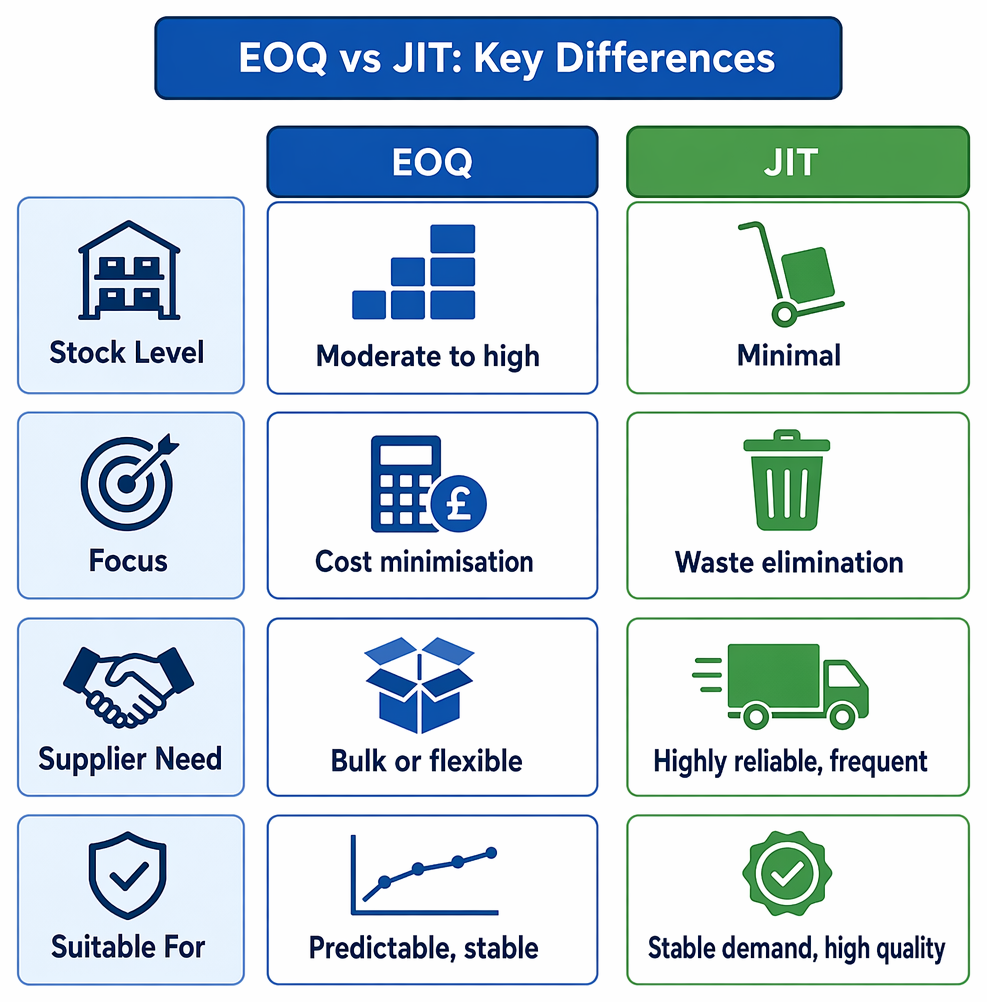
Summary Table: EOQ vs JIT
Inventory policy decision tree routes stable conditions to EOQ, variable lead times or volatile costs to hybrid periodic review, and reliable suppliers to JIT.
| Aspect | EOQ | JIT |
|---|---|---|
| Stock Level | Moderate to high | Minimal |
| Focus | Cost minimisation | Waste elimination |
| Supplier Need | Bulk or flexible | Highly reliable, frequent |
| Suitable For | Predictable, stable | Stable demand, high quality |
Key Point Checklist
This article has covered the following key knowledge points:
- Distinguish between reasons for holding inventory and the risks of excess or insufficient stock
- Calculate Economic Order Quantity (EOQ) and interpret its assumptions and limitations
- Explain Just-in-Time (JIT) principles and their effect on inventory control
- Discuss how inventory management impacts capacity and product/service quality
- Recognise the importance of aligning inventory strategy to business needs and market conditions
Key Terms and Concepts
- inventory
- capacity
- quality
- Economic Order Quantity (EOQ)
- Just-in-Time (JIT)