Learning Outcomes
After reviewing this article, you will be able to explain the importance of balancing ordering, holding, and stockout costs in inventory control for ACCA exams. You will identify how different cost components influence inventory decisions, calculate optimal order policies, and evaluate the financial impact of stockouts and excess inventory.
ACCA Foundations in Financial Management (FFM) Syllabus
For ACCA Foundations in Financial Management (FFM), you are required to understand inventory control concepts and their role in cost optimization. In particular, this article addresses:
- The role of inventory in financial management and working capital
- The impact of ordering, holding, and stockout costs on inventory decisions
- Calculation and interpretation of the Economic Order Quantity (EOQ)
- Recognition and management of the risk and cost of inventory shortages
- Application of inventory control decisions to improve financial performance
Test Your Knowledge
Attempt these questions before reading this article. If you find some difficult or cannot remember the answers, look more closely at that area during your revision.
-
Which inventory cost increases as more stock is held over time?
- a) Ordering cost
- b) Holding cost
- c) Stockout cost
- d) Purchase cost
-
What is the main objective of inventory control?
- a) To eliminate all stockouts
- b) To maximize inventory value
- c) To minimize the total of ordering, holding, and stockout costs
- d) To order as little as possible
-
State one financial consequence of frequent stockouts.
-
Explain briefly what the Economic Order Quantity (EOQ) represents.
Introduction
Inventory control ensures the right quantities of materials are available when required without incurring excessive costs. Businesses face a trade-off between ordering frequently (raising order costs), holding large quantities (increasing storage costs), and risking stockouts (leading to lost sales or production stoppages). Sound inventory policy involves balancing these costs to achieve an optimal inventory level, which is essential for efficient financial management and is directly examinable in ACCA assessments.
Key Term: ordering cost
The total expenses incurred each time an inventory order is placed, including administrative time, delivery charges, and processing documentation. Key Term: holding cost
The costs of storing and maintaining inventory, such as warehousing, insurance, spoilage, and the opportunity cost of capital tied up in stock. Key Term: stockout cost
The financial loss and operational impact that arise when inventory runs out and customer demand or production cannot be met. Key Term: Economic Order Quantity (EOQ)
The order quantity that minimizes the total cost of ordering and holding inventory over a set period.Test Tip: When revising Balancing ordering, holding, and stockout costs, connect each definition, method, or rule to the kind of question the assessment is likely to ask.
Exam Warning: Do not rely on keyword recognition alone; check the precise condition, exception, calculation step, or evidence the question requires.
THE COST ELEMENTS OF INVENTORY CONTROL
Controlling inventory efficiently requires you to recognize and quantify the main cost components.
Ordering Costs
Ordering costs are incurred every time a purchase or production order is made. They typically include:
- Processing purchase requisitions and orders
- Communication and documentation costs
- Goods receipt and inspection
- Delivery charges
Ordering frequently, in small lots, reduces inventory but increases the number of orders and hence total ordering cost.
Holding Costs
Holding costs are those directly associated with keeping stock in storage, plus indirect financial costs such as:
- Rent for warehouses or storage space
- Insurance against theft or damage
- Staff and equipment for handling inventory
- Utility expenses linked to storage
- Deterioration, obsolescence, and shrinkage
- Cost of capital tied up in inventory (lost investment income)
Larger average stock levels will increase total holding costs.
Stockout Costs
Stockouts occur when inventory is insufficient to satisfy demand. The consequences are both financial and reputational:
- Lost sales and customer goodwill
- Delayed production and idle labour
- Potential penalty charges or expedited shipping
- Emergency purchases at higher unit costs
The cost of a stockout is often difficult to measure but must not be ignored in decision-making.
THE INVENTORY COST TRADE-OFF
Achieving the lowest possible overall cost usually means compromising between ordering enough to reduce stockouts but not so much that holding costs rise sharply.
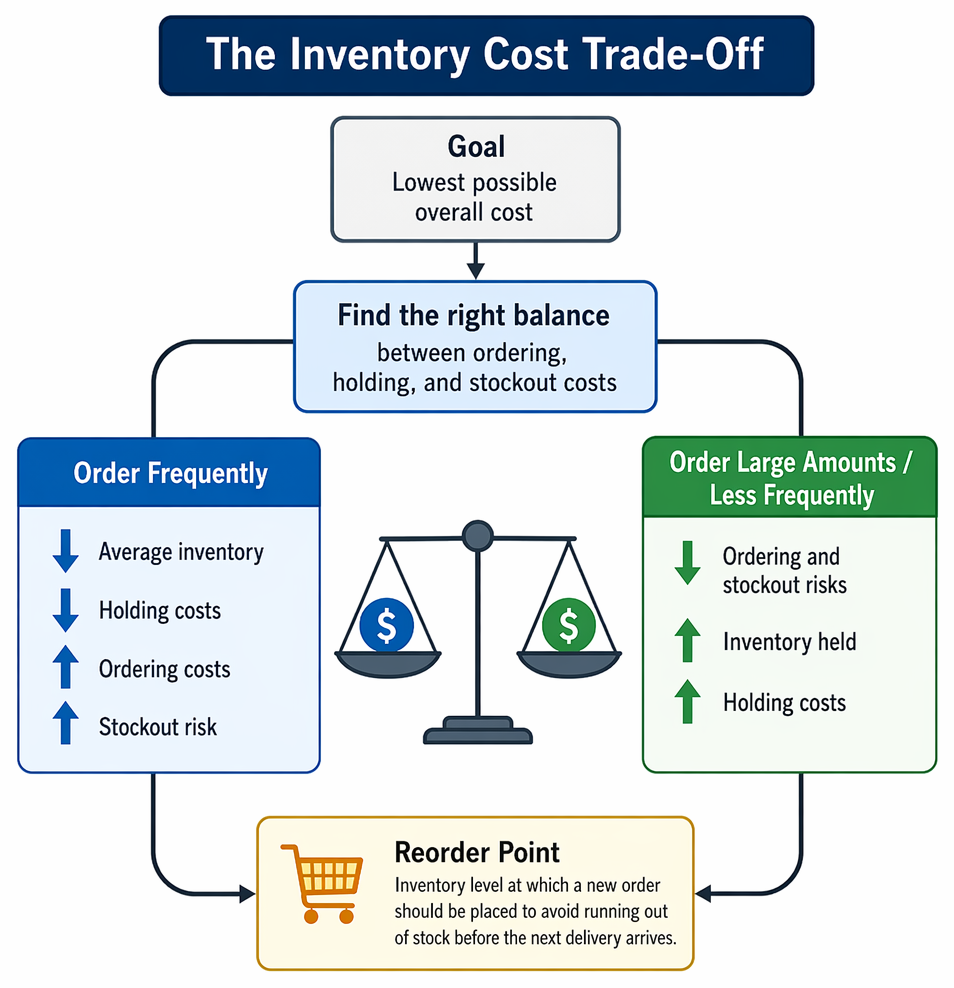
EOQ-based inventory policy links demand, ordering cost, and holding cost to order frequency, average inventory, reorder point, and cost review.
If a business places orders frequently, it lowers its average inventory and reduces holding costs, but pays more in ordering costs and faces a higher risk of stockouts. Ordering large amounts or less frequently reduces order and shortage risks but increases the cost of holding surplus stock.
Key Term: reorder point
The inventory level at which a new order should be placed to avoid running out of stock before the next delivery arrives.
ECONOMIC ORDER QUANTITY (EOQ): OPTIMIZING ORDER SIZE
The EOQ model helps to calculate the ideal order quantity to minimize total order and holding costs. It is based on the following basic formula:
Where:
- D = annual demand (units)
- S = cost per order
- H = holding cost per unit per year
The EOQ balances the benefits and costs of ordering and holding stock, ignoring stockout costs but providing a basis for sensible inventory control policies.
Worked Example 1.1
A business expects to sell 24,000 units of Product X per year. It costs $40 to place each order, and the annual holding cost per unit is $2.
Question: What is the EOQ, and how many orders should the company place annually?
Answer:
EOQ = √((2 × 24,000 × 40) / 2) = √(1,920,000 / 2) = √960,000 = 980 units (rounded) Number of orders per year = 24,000 units ÷ 980 units/order ≈ 25 orders
THE RISK AND COST OF STOCKOUTS
Despite best efforts, holding low levels of stock to save costs can result in running out of materials unexpectedly.
Implications of Stockouts
- Missed sales or production delays
- Additional expenses for urgent reordering
- Damaged customer relations or lost future business
Financial managers must weigh the visible savings in holding costs against less tangible—potentially much greater—stockout costs.
Worked Example 1.2
Company Y usually maintains low inventory to save space and funds. During a seasonal surge, it sold out of a key item and had to expedite a replacement order, incurring $1,200 in rush delivery costs and losing $800 in sales.
Question: What is the total measured stockout cost from this incident?
Answer:
Total stockout cost = $1,200 (expediting) + $800 (lost profit) = $2,000
Managing Stockout Risk
Businesses can mitigate stockout risk by:
- Setting minimum safety stock levels
- Adjusting reorder points considering lead time and consumption variability
- Factoring expected stockout losses into inventory decision models
INTEGRATING ALL COSTS IN INVENTORY POLICIES
To optimize inventory control, the company should calculate the total cost (ordering + holding + expected stockout) for different order quantities and policy choices. Selection of policy should minimize total costs, not just one component.
Key Term: safety stock
The extra inventory held to reduce the likelihood of stockouts caused by demand or delivery fluctuations.
Summary
Balancing the costs of ordering, holding, and stockouts is central to effective inventory control. The EOQ formula is an essential tool, but decisions must also consider the risk and potential cost of running short. Management's aim is to keep inventory costs as low as possible without impacting customer service or production efficiency.
Key Point Checklist
This article has covered the following key knowledge points:
- Explain the main inventory control costs: ordering, holding, and stockout
- Calculate and interpret Economic Order Quantity (EOQ)
- Identify the consequences and financial impact of stockouts
- Recognize the importance of safety stock and reorder points
- Apply inventory policy principles to minimize total inventory-related costs
Key Terms and Concepts
- ordering cost
- holding cost
- stockout cost
- Economic Order Quantity (EOQ)
- reorder point
- safety stock