Learning Outcomes
After reading this article, you will be able to explain the principles of inventory control using the EOQ model, calculate reorder levels and safety stock, and apply these concepts to real-world business scenarios. You will also be able to identify and avoid common mistakes, and understand how inventory management affects business costs and operational efficiency.
ACCA Foundations in Financial Management (FFM) Syllabus
For ACCA Foundations in Financial Management (FFM), you are required to understand inventory management techniques and their implications for business performance and financial reporting. In particular, focus your revision on:
- The purpose of holding inventory and its impact on business operations
- The Economic Order Quantity (EOQ) model—its calculation, assumptions, and uses
- The concept of reorder level and its practical calculation
- The role and calculation of safety stock in maintaining service levels
- The effects of inventory decisions on costs, risks, and cash flow management
Test Your Knowledge
Attempt these questions before reading this article. If you find some difficult or cannot remember the answers, look more closely at that area during your revision.
-
Which specific inventory control model is designed to minimize the total of ordering and holding costs?
- a) FIFO
- b) EOQ
- c) AVCO
- d) LIFO
-
A business consumes 400 units of a material per week, and the supplier takes 3 weeks to deliver. What is the reorder level?
- a) 400 units
- b) 1,200 units
- c) 4,800 units
- d) 100 units
-
What is the main reason for holding safety stock?
- a) To maximize ordering costs
- b) To eliminate inventory
- c) To protect against variability in demand or lead time
- d) To increase obsolete items
-
Briefly outline one limitation of the EOQ formula in practice.
Introduction
Efficient inventory control is essential for any business that holds stock. Ordering too much increases holding costs and risks obsolescence; too little leads to shortages, lost sales, and production stoppages. Businesses use structured approaches to balance these costs. Key techniques include the Economic Order Quantity (EOQ), reorder level, and safety stock. Together, these tools help determine how much to order and when, so that business needs are met at lowest cost.
Key Term: Economic Order Quantity (EOQ)
The order size that minimizes the total cost of ordering and holding inventory during a period.
INVENTORY CONTROL PRINCIPLES
Inventory control focuses on answering two essential questions: how much inventory should be ordered, and when should it be ordered? The goal is to meet operational needs while minimizing costs.
EOQ: The Optimum Order Quantity
The EOQ model provides a mathematical way to decide the most cost-efficient quantity to order each time. It strikes a balance between ordering costs (the administrative cost of placing orders) and holding costs (the costs of storing inventory).
Key Term: Ordering Costs
Expenses related to placing and receiving inventory orders, such as staff time, delivery charges, and paperwork. Key Term: Holding Costs
Costs for storing inventory, including warehousing, insurance, spoilage, and the opportunity cost of tied-up capital.
EOQ Formula
Where:
- = Annual demand in units
- = Cost per order
- = Annual holding cost per unit
Assumptions
EOQ assumes constant demand and lead time, immediate inventory replenishment, and no quantity discounts. In reality, these conditions may not always hold.
Worked Example 1.1
A company uses 2,400 units of a component per year. Each order costs $15 to place, and it costs $1.50 per unit per year to hold in inventory. What is the EOQ?
Answer:
Data:
units (rounded to nearest whole number).
Exam Warning: Always use the same time units (e.g., annual) for demand and costs in the EOQ calculation, or your answer will be incorrect.
REORDER LEVEL: WHEN TO PLACE AN ORDER
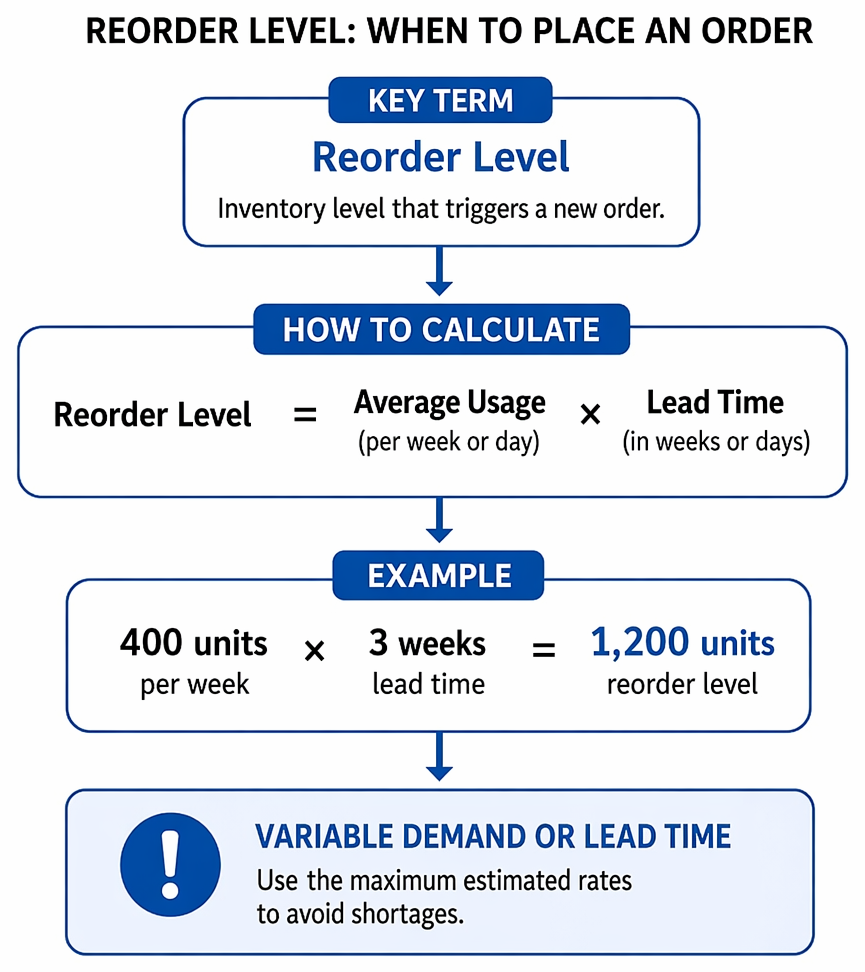
The reorder level is the stock threshold that triggers a new purchase order. The aim is to reorder in time for new stock to arrive before current stock runs out.
Economic order quantity analysis derives size from demand and cost inputs, then tests assumptions before using reorder levels or modified approaches.
Key Term: Reorder Level
The inventory level at which a new order should be placed to replenish stock before it is exhausted.
How to Calculate
Example
If a business uses 400 units per week and delivery from the supplier takes 3 weeks, reorder level = 400 × 3 = 1,200 units.
If demand or lead time is variable, firms use the maximum estimated rates to avoid shortages.
SAFETY STOCK: PROTECTING AGAINST UNCERTAINTY
Safety stock acts as a buffer against unexpected increases in demand or delays in supply. It reduces the risk of running out of stock.
Key Term: Safety Stock
Extra inventory held to protect against uncertainty in demand or supply lead time.
When to Use Safety Stock
- If demand per period or supplier lead time is unpredictable.
- When stockouts would cause major disruption or lost sales.
Calculating Safety Stock
There is no one formula, but a simple approach is:
Worked Example 1.2
A business uses between 350 and 450 units per week. Lead time is usually 2 weeks but can be up to 4. Calculate the minimum safety stock required.
Answer:
Maximum usage × maximum lead time = 450 × 4 = 1,800 units Average usage × average lead time = 400 × 2 = 800 units Safety Stock = 1,800 − 800 = 1,000 unitsRevision Tip: In exams, show your workings step by step when calculating EOQ, reorder levels, or safety stock. Label each clearly.
INVENTORY SYSTEMS IN PRACTICE
Many businesses use perpetual inventory systems to update stock levels in real time and trigger automatic reordering at reorder levels.
Good inventory management:
- Saves on storage costs
- Reduces stockouts and lost sales
- Releases cash tied up in excess inventory
However, over-reliance on fixed models like EOQ can be risky if demand patterns shift or suppliers are unreliable.
Worked Example 1.3
A retailer sells 6,000 units per year. Holding cost per unit is $2, order cost is $30. Deliveries take 2 weeks, and weekly demand varies between 100 and 140 units. What is:
- (a) The EOQ?
- (b) The reorder level?
- (c) The safety stock?
Answer:
(a)
units (rounded). (b) Average weekly demand = 6,000 / 52 ≈ 115 units. Reorder level = 115 × 2 = 230 units. (c) Max usage × max lead time = 140 × 2 = 280 Avg usage × avg lead time = 115 × 2 = 230 Safety stock = 280 − 230 = 50 units
Summary
Inventory control is about ordering the right quantity at the right time, at minimum total cost. The EOQ model calculates the best order size to minimize ordering and holding costs. The reorder level tells you when to place a new order, and safety stock protects against demand or supply uncertainty. Applying these methods supports smooth business operations and effective financial management.
Key Point Checklist
This article has covered the following key knowledge points:
- Define EOQ, reorder level, and safety stock in inventory management
- Calculate EOQ, reorder level, and safety stock using standard formulas
- Identify the purpose and typical assumptions of the EOQ model
- Apply reorder level and safety stock to avoid stockouts in variable demand/lead time situations
- Recognize limitations and risks of relying solely on mathematical inventory models
Key Terms and Concepts
- Economic Order Quantity (EOQ)
- Ordering Costs
- Holding Costs
- Reorder Level
- Safety Stock