Learning Outcomes
After reading this article, you will be able to explain why businesses perform inventory counts, compare physical inventory to accounting records, and identify typical causes of differences. You will be able to record inventory shortages, surpluses, damaged goods and write-downs using correct double-entry journal entries. You will also be able to calculate net realisable value (NRV), determine the amount of any write-down, and describe how these adjustments affect ledger balances and the trial balance.
ACCA Recording Financial Transactions (FA1) Syllabus
For ACCA Recording Financial Transactions (FA1), you must understand:
- how inventory is classified in the accounting system and why it is adjusted after a physical count
- how to prepare journal entries to record period-end adjustments (including inventory losses and write-downs)
- how double-entry postings affect ledger account balances and the trial balance
- how to identify and correct recording errors that cause inventory differences
- how supporting documents and basic controls reduce inventory recording errors and losses
Test Your Knowledge
Attempt these questions before reading this article. If you find some difficult or cannot remember the answers, look more closely at that area during your revision.
-
A business’s inventory account shows $18,750. A physical count values inventory at $18,100. Which journal records the adjustment?
- A. Dr Inventory $650, Cr Cost of sales $650
- B. Dr Cost of sales (or Inventory loss) $650, Cr Inventory $650
- C. Dr Purchases $650, Cr Inventory $650
- D. Dr Inventory $650, Cr Purchases $650
-
True or false? A write-down is recorded when inventory is missing from the storeroom.
-
Define net realisable value (NRV) and give the formula for a write-down amount when NRV is below cost.
-
Goods costing $4,000 can now be sold for $3,600, but selling costs will be $300. What is the write-down?
- A. $0
- B. $100
- C. $400
- D. $700
-
True or false? If the physical count is higher than the book value, the adjustment will normally credit inventory.
Introduction
Inventory counts (often called a stocktake) are a normal part of period-end routines. They give the business evidence of how much inventory it actually holds and whether the accounting records are reliable.
For FA1, you need to record the adjustments that follow from the count. Typical adjustments include recording missing or damaged goods and reducing inventory values when items can only be sold at a lower amount. These adjustments use straightforward double-entry journals, but marks are often lost through using the wrong debit/credit entries.
1. What an inventory count is and why it leads to adjustments
A business can only report meaningful accounting information if its inventory figure is realistic. Computer records may show what should be in the warehouse, but only a physical count confirms what is actually there at a point in time.
Key Term: Physical inventory count
A check of inventory quantities held, carried out by counting or measuring items in storage and comparing results to the accounting records. Key Term: Inventory shortage
A situation where the physical inventory count is less than the inventory shown by the records (a deficit that must be written off in the accounts).
If inventory is missing, damaged or obsolete, it no longer has the same economic value. The accounts must be adjusted so that the inventory asset is not overstated.
2. Understanding count differences (shortages and surpluses)
2.1 The basic comparison
You compare:
- Book inventory (what the ledger/system says you have), to
- Count inventory (what you physically have)
The difference will be either a shortage or a surplus. In exam questions, you will usually be given inventory values (not quantities) and asked for the journal entry.
Key Term: Inventory surplus
A situation where the physical inventory count is more than the inventory shown by the records (a surplus that increases the inventory asset).
2.2 Why differences happen
Common causes include:
- goods received but not recorded (or recorded but not received)
- goods issued or sold but not recorded
- recording errors (wrong item code, wrong quantity, duplication)
- theft, breakages, evaporation or spillage (often called shrinkage)
- incorrect cut-off around the count date (late deliveries, goods in transit)
In practice, differences should be investigated. In FA1 questions, you normally record the adjustment requested using the accounts named in the question.
3. Recording inventory losses and damage discovered at the count
3.1 Missing goods (shortages)
If inventory is missing, the business has lost an asset. You reduce the inventory asset and record an expense (often called cost of sales, inventory loss, or inventory shrinkage).
Typical double entry:
- Credit Inventory (asset decreases)
- Debit Expense (increases)
A simple journal format is:
| Account | Dr | Cr |
|---|---|---|
| Cost of sales / Inventory loss | X | |
| Inventory | X |
3.2 Damaged goods: write off or write down?
Damage may cause:
- a write-off (item has no value and should be removed completely), or
- a write-down (item still saleable, but only at a reduced value)
The accounting treatment depends on the value the business expects to recover from selling the item.
4. Write-downs to net realisable value (NRV)
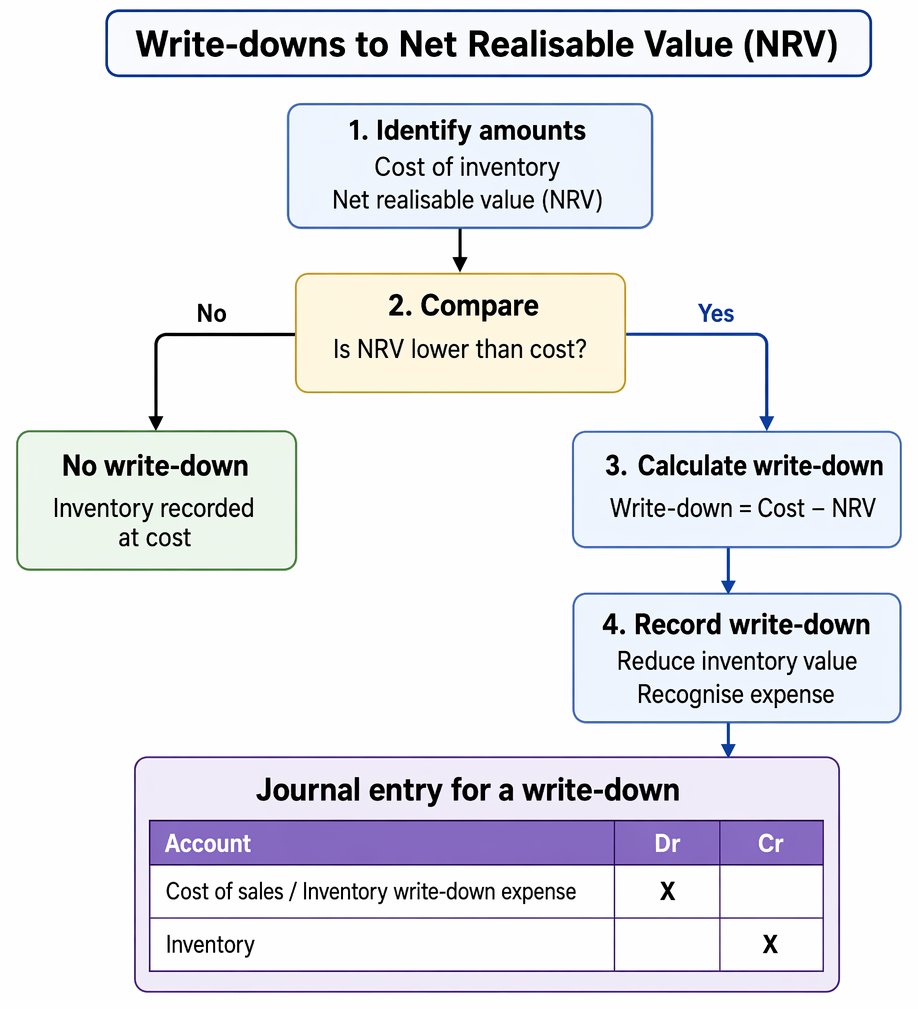
Physical count differences are linked to journal entries for inventory shortages, surpluses, damaged goods, and lower-of-cost-and-NRV adjustments.
4.1 The rule you apply
Inventory is measured at the lower of cost and net realisable value (NRV). If NRV is lower than cost, you reduce the inventory value and recognise an expense.
Key Term: Net realisable value (NRV)
The estimated selling price of inventory less any costs needed to complete and sell it. Key Term: Inventory write-down
A reduction in the recorded value of inventory to reflect that it will be sold for less than its cost (usually because of damage, obsolescence, or falling selling prices).
The write-down amount is:
4.2 Journal entry for a write-down
The entry mirrors a shortage because inventory is reduced and an expense is recorded:
| Account | Dr | Cr |
|---|---|---|
| Cost of sales / Inventory write-down expense | X | |
| Inventory | X |
5. Worked examples (typical FA1 exam style)
Worked Example 1.1
A business has inventory in the ledger at $26,500. At the period-end inventory count, inventory is valued at $25,900. The difference relates to missing goods.
Answer:
Journal to record the shortage: Dr Cost of sales (or Inventory loss) $600 Cr Inventory $600 This reduces the inventory asset by $600 and records an extra expense of $600.
Worked Example 1.2
Included in inventory is a batch of goods at cost of $4,000. Due to damage, the estimated selling price is now $3,600 and selling costs will be $300.
Answer:
Journal to record the write-down: Dr Cost of sales (or Inventory write-down expense) $700 Cr Inventory $700 The inventory value for this batch becomes $4,000 - 700 = $3,300.
6. Recording inventory surpluses
If the physical count is higher than the book value, inventory is understated. The adjustment increases the inventory asset, and the other side reduces an expense (or records income, depending on the accounts used).
Typical double entry (common in FA1):
- Debit Inventory (asset increases)
- Credit Cost of sales (expense decreases)
| Account | Dr | Cr |
|---|---|---|
| Inventory | X | |
| Cost of sales (or Inventory gain) | X |
If the surplus exists because a purchase invoice was never recorded, the “best” correction might involve purchases and payables. In many FA1 questions you are told to adjust inventory and cost of sales only—follow the instruction given.
Exam Warning: A frequent error is reversing the entry:
- Shortage / write-down: do not debit inventory. Inventory must go down, so it must be credited. Also watch for sales tax: inventory values used for financial reporting are normally recorded excluding recoverable sales tax (input tax is accounted for separately).
Revision Tip: Use a quick two-step check before writing the journal:
- Decide whether inventory (asset) must go up or down.
- Apply double entry: inventory up = debit; inventory down = credit. The other side goes to an expense (or a reduction of expense for surpluses).
Key Point Checklist
This article has covered the following key knowledge points:
- Inventory counts compare physical holdings to book records and often require period-end adjustments.
- Inventory shortages reduce the inventory asset and are recorded as an expense (often cost of sales or inventory loss).
- Inventory surpluses increase the inventory asset and usually reduce an expense (often cost of sales).
- Damaged inventory may be written off fully (no value) or written down (reduced value).
- NRV is selling price less selling costs; inventory is written down when NRV is below cost.
- A write-down is recorded by debiting an expense and crediting inventory.
- Inventory adjustments must be recorded net of recoverable sales tax where applicable.
Key Terms and Concepts
- Physical inventory count
- Inventory shortage
- Inventory surplus
- Net realisable value (NRV)
- Inventory write-down