Learning Outcomes
After reading this article, you will be able to explain how input VAT and output VAT are recorded in the ledger, and how they build up in the VAT control account. You will be able to calculate the net VAT payable or receivable for a period and post the payment or refund. You will also be able to reconcile the VAT control account to sales and purchase records, identify common causes of differences, and make simple correcting entries.
ACCA Recording Financial Transactions (FA1) Syllabus
For ACCA Recording Financial Transactions (FA1), you must understand:
- how VAT is recorded on sales and purchases from invoices and receipts
- how credit notes affect VAT and the ledger entries required
- how the VAT control account operates and how it is balanced
- how VAT returns are compiled from accounting records
- how to reconcile ledger balances to supporting records to identify errors and omissions
Test Your Knowledge
Attempt these questions before reading this article. If you find some difficult or cannot remember the answers, look more closely at that area during your revision.
-
A business issues a sales invoice for £2,000 plus VAT at 20%. Which entry records the VAT element?
- A. Debit VAT control £400
- B. Credit VAT control £400
- C. Debit Sales £400
- D. Credit Trade receivables £400
-
True or false? Input VAT is recorded when the supplier is paid, not when the purchase invoice is entered.
-
A VAT control account has total output VAT (credits) of £9,600 and total input VAT (debits) of £7,850 for the quarter. What balance is carried down, and is VAT payable or recoverable?
-
Which item is most likely to cause the VAT return to disagree with the VAT control account?
- A. A supplier statement received after month end
- B. A sales credit note posted to receivables but with no VAT entry
- C. A customer order form filed in the sales office
- D. A delivery note signed by the customer
Introduction
VAT creates two linked tasks for bookkeeping: (1) recording VAT correctly when you record sales and purchases, and (2) reporting the totals to the tax authority on a VAT return. In FA1, you are tested on the double entries and on your ability to check records.
The VAT control account is the link between day-to-day transactions (invoices, credit notes, petty cash claims) and the amount you pay over (or reclaim). Reconciling the VAT control account to your records is a practical control: it helps you spot missing documents, wrong amounts and incorrect VAT postings before a return is submitted.
VAT in bookkeeping: what gets recorded
Output VAT and input VAT
Key Term: Output VAT
VAT charged to customers on taxable sales. It increases the amount the business owes to the tax authority. Key Term: Input VAT
VAT charged by suppliers on purchases and expenses that can normally be reclaimed, subject to local rules and evidence.
For exam questions, treat output VAT as arising when you raise a sales invoice (credit sale) or take the cash for a cash sale. Treat input VAT as arising when you receive and enter a supplier invoice (credit purchase) or make a cash purchase.
VAT is recorded as part of the transaction entry: you split the gross amount into net and VAT. You do not wait until payment is made (unless you are told the business uses a cash accounting basis).
VAT invoices and evidence
Key Term: VAT invoice
A supplier’s invoice that shows the supplier’s VAT registration details, the VAT rate and the VAT charged. It is the usual evidence needed to reclaim input VAT.
If you cannot show a valid VAT invoice, input VAT may not be claimable. In exam questions, assume you can reclaim input VAT unless you are told otherwise.
Credit notes and VAT
Key Term: VAT credit note
A document issued to reverse or correct all or part of a previous invoice. It reduces the amount due and reduces the VAT previously recorded.
A sales credit note reduces output VAT (because you are no longer charging VAT on that part of the sale). A purchase credit note reduces input VAT (because you are no longer suffering VAT on that part of the purchase).
The VAT control account
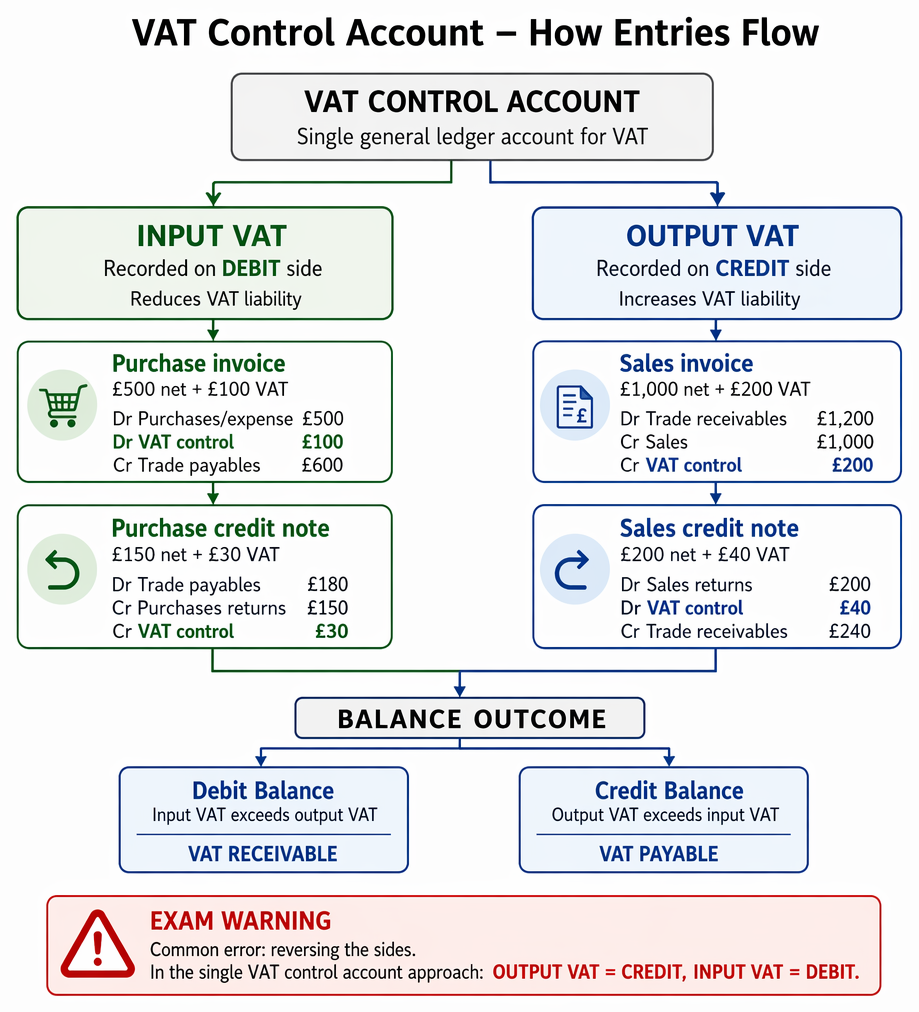
Output and input VAT postings are reconciled through the VAT control account against invoices and credit notes to determine the balance.
Key Term: VAT control account
A general ledger account that accumulates output VAT and input VAT. The balance represents VAT payable (credit balance) or VAT recoverable (debit balance) at a point in time.
How entries flow into the VAT control account
Most FA1 questions use one VAT control account:
- Output VAT is recorded on the credit side (it increases the liability).
- Input VAT is recorded on the debit side (it reduces the liability).
Typical entries (assuming VAT at 20%):
-
Sales invoice £1,000 net + £200 VAT Dr Trade receivables £1,200 Cr Sales £1,000 Cr VAT control £200
-
Purchase invoice £500 net + £100 VAT Dr Purchases/expense £500 Dr VAT control £100 Cr Trade payables £600
-
Sales credit note £200 net + £40 VAT Dr Sales returns £200 Dr VAT control £40 Cr Trade receivables £240
-
Purchase credit note £150 net + £30 VAT Dr Trade payables £180 Cr Purchases returns £150 Cr VAT control £30
Balancing the VAT control account
If output VAT exceeds input VAT for the period, the VAT control account tends to end with a credit balance (VAT payable). If input VAT exceeds output VAT, it tends to end with a debit balance (VAT receivable).
Exam Warning: A common error is reversing the sides: debiting VAT control for output VAT or crediting VAT control for input VAT. In the single VAT control account approach used in FA1, remember: output VAT = credit, input VAT = debit.
VAT returns and the payment/refund entry
Key Term: VAT return
A periodic report to the tax authority summarising output VAT and input VAT for the period and calculating the net VAT payable or recoverable.
The net VAT for a period is:
- If net VAT due is positive, you pay the tax authority.
- If net VAT due is negative, you expect a refund (or a credit against future VAT).
Clearing the VAT control account after the return
When the business pays the VAT due, you clear the liability:
- If VAT is payable (credit balance): Dr VAT control Cr Bank
If the business receives a VAT refund:
- If VAT is recoverable (debit balance): Dr Bank Cr VAT control
Reconciling VAT control to records
Key Term: VAT reconciliation
A check that the VAT control account agrees to the VAT totals from sales and purchase records for the same period, after allowing for valid timing differences and corrections.
Why you reconcile
A VAT return is built from many transactions. Even a small posting error (wrong VAT amount, missing credit note, duplicate invoice) can create the wrong VAT payment.
Reconciliation is also a control check. It helps you find errors early and correct them before submission and payment.
What you reconcile the VAT control account to
In FA1 questions, you usually reconcile to one or more of the following:
- sales invoices and sales credit notes (output VAT)
- purchase invoices and supplier credit notes (input VAT)
- cash book/cash sales records (output VAT on cash sales)
- petty cash records (input VAT on expenses paid in cash)
- the VAT return workings (totals for the period)
A practical reconciliation method (exam-friendly)
-
Fix the period: confirm the start and end dates of the VAT return period.
-
Total output VAT from records: add sales invoice VAT and subtract sales credit note VAT for that period (include cash sales VAT if relevant).
-
Total input VAT from records: add purchase invoice VAT and subtract supplier credit note VAT for that period (include cash purchases and petty cash VAT if relevant).
-
Calculate net VAT using and compare it to the VAT control account movement for the period.
-
Check the VAT control account for items that should not be in the return totals, such as:
- a payment to the tax authority posted inside the period (it clears the account but is not output/input VAT)
- a balance brought forward from a previous period if the last return has not been cleared
-
Investigate any difference and post correcting entries where needed.
Common reasons for differences
- A credit note was posted gross to sales returns or purchases returns with no VAT entry.
- An invoice was entered twice (duplicate posting).
- VAT was calculated using the wrong rate.
- Net and gross amounts were mixed up.
- Cash purchases or petty cash expenses with VAT were not posted to VAT control.
- An invoice was recorded in the wrong period (timing issue).
Worked Example 1.1
A business prepares its VAT return for the quarter. VAT is 20%. The following net totals (excluding VAT) relate to the quarter:
- Credit sales invoices: £30,000
- Sales credit notes: £2,000
- Cash sales: £5,000
- Credit purchases: £18,000
- Supplier credit notes: £1,000
- Petty cash expenses (VAT included in receipts): £600
Prepare the VAT totals and the VAT control account balance before paying the tax authority.
Answer:
Output VAT is charged on sales, reduced by sales credit notes:
Input VAT is charged on purchases, reduced by supplier credit notes, plus petty cash VAT:
Net VAT payable:
VAT control account (summary): debit input VAT £3,520, credit output VAT £6,600, so balance carried down is £3,080 credit (VAT payable).
Worked Example 1.2
At the end of a VAT quarter, the VAT control account shows a credit balance of £4,200. A check of the VAT records for the quarter gives net VAT due of £4,000.
Investigation finds a sales credit note for £1,200 gross was posted as: Dr Sales returns £1,200 Cr Trade receivables £1,200 (No VAT entry was made.)
Show the reconciliation and the correction required.
Answer:
The credit note includes VAT at 20%, so VAT on the credit note is: Gross £1,200 means net £1,000 and VAT £200 (because £1,000 + 20% = £1,200). Because the VAT was not debited to VAT control, output VAT has not been reduced. That makes the VAT control account £200 too high (liability overstated). Reconciliation: VAT due per VAT control: £4,200 Less: VAT on sales credit note not posted: £200 VAT due per VAT records/return: £4,000 Correcting journal: Dr VAT control £200 Cr Sales returns £200 (This moves the VAT element out of sales returns so sales returns become net, and VAT control is reduced.)Revision Tip: When reconciling, write down the rule: VAT return uses VAT on invoices/credit notes for the period. Then check whether your VAT control account contains anything else (payments, old balances, errors).
Key Point Checklist
This article has covered the following key knowledge points:
- VAT is recorded when invoices, receipts and credit notes are entered (not when they are paid, unless told otherwise).
- Output VAT is credited to the VAT control account; input VAT is debited.
- Sales and purchase credit notes reduce VAT: sales credit notes reduce output VAT; purchase credit notes reduce input VAT.
- The VAT control account balance shows VAT payable (credit) or recoverable (debit).
- Net VAT for a return period is calculated as .
- Paying VAT clears a credit balance in VAT control (Dr VAT control, Cr bank); a refund clears a debit balance (Dr bank, Cr VAT control).
- A VAT reconciliation compares VAT control to VAT totals from sales, purchases, cash and petty cash records and helps find posting errors.
Key Terms and Concepts
- Output VAT
- Input VAT
- VAT invoice
- VAT credit note
- VAT control account
- VAT return
- VAT reconciliation