Learning Outcomes
This article explains when and how property, plant and equipment (PPE) are recognised and measured under IAS 16, and the criteria for capitalising borrowing costs according to IAS 23. It outlines which costs qualify for capitalisation, when capitalisation must start and stop, and the correct treatment of both specific and general borrowings. After reading, you should be able to apply these rules and make appropriate decisions in ACCA Strategic Business Reporting (SBR) scenarios.
ACCA Strategic Business Reporting (SBR) Syllabus
For ACCA Strategic Business Reporting (SBR), you are required to understand and apply the recognition and measurement rules for PPE (IAS 16) and borrowing costs (IAS 23). Target your revision on these syllabus areas:
- Recognition and initial measurement of property, plant and equipment, including distinguishing capital from revenue expenditure
- Determining the cost of PPE, and understanding directly attributable costs
- Principles for capitalising borrowing costs: what constitutes a qualifying asset, when capitalisation starts and ceases
- Calculation and allocation of borrowing costs, including both specific and general loans
- Conditions for suspending and stopping capitalisation of borrowing costs
- Applying IAS 16 and IAS 23 rules to real-life exam scenarios and typical problem areas
Test Your Knowledge
Attempt these questions before reading this article. If you find some difficult or cannot remember the answers, look more closely at that area during your revision.
-
Which type of asset qualifies for the capitalisation of borrowing costs under IAS 23?
- a) All non-current assets
- b) All property, plant and equipment costing more than $10,000
- c) Assets that take a substantial period of time to get ready for use or sale
- d) Investment properties only
-
When must capitalisation of borrowing costs begin on the construction of a new headquarters under IAS 23?
- a) When the loan is approved by the bank
- b) When expenditure and borrowing costs are both incurred, and activities to prepare the asset for use have started
- c) As soon as the purchase contract is signed
- d) When payments are made to suppliers
-
What happens to borrowing costs incurred during an extended suspension of construction work?
- a) They are still capitalised
- b) They are suspended and expensed until construction resumes
- c) They are added to the asset’s cost regardless of suspension
- d) They are disclosed only in the notes
-
True or false? Routine repairs are included in the capitalised cost of PPE.
Introduction
Property, plant and equipment (PPE) are tangible items used in business operations over more than one period. IAS 16 explains how to determine which items qualify for recognition, what comprises their cost, and which expenditures should be capitalised. IAS 23 sets out when borrowing costs must be included as part of an asset's cost (capitalised) rather than expensed, and specifies the rules for both starting and ceasing this process. Misapplying these principles is a frequent source of examiner comment.
Key Term: property, plant and equipment (PPE)
Tangible items held for use in the production or supply of goods or services, for rental to others, or for administrative purposes, expected to be used during more than one period.Test Tip: When revising Capitalisation and cessation of borrowing costs, connect each definition, method, or rule to the kind of question the assessment is likely to ask.
Exam Warning: Do not rely on keyword recognition alone; check the precise condition, exception, calculation step, or evidence the question requires.
RECOGNITION AND INITIAL COST OF PPE
Recognition Criteria
An item is recognised as PPE when:
- It is probable that future economic benefits will flow to the entity
- Its cost can be measured reliably
Subsequent costs (such as maintenance or improvements) may be capitalised only if they meet these criteria.
Key Term: capital expenditure
Expenditure that results in the acquisition of, or improvement to, a non-current asset, expected to provide future economic benefits. Key Term: revenue expenditure
Expenditure that is not capitalised and is instead charged to profit or loss immediately, such as repairs or routine maintenance.
Components of Cost
The initial cost of PPE includes:
- The purchase price (net of trade discounts or rebates)
- Directly attributable costs to bring the asset to its intended use (e.g., installation, delivery, site preparation)
- Estimated costs of dismantling and removing the asset or restoring the site, if required
Costs that cannot be capitalised include administration costs, initial operating losses, staff training, and abnormal waste.
Key Term: directly attributable costs
Expenditure essential to bringing the asset into working condition for intended use.
Worked Example 1.1
An entity acquires a new machine for $120,000. The following additional costs are incurred: delivery $8,000, site preparation $12,000, test runs $2,000, staff training $3,500, and a refundable sales tax $7,000. What is the initial cost of the machine?
Answer:
Initial cost includes purchase ($120,000), delivery ($8,000), site prep ($12,000), and testing ($2,000). Staff training is excluded. The refundable sales tax is also excluded. The total cost of PPE is $120,000 + $8,000 + $12,000 + $2,000 = $142,000.
Exam Warning – PPE Costs
Do not include staff training, administration, or recurring maintenance when calculating the cost of PPE. Only costs directly attributable to bringing the asset to working condition may be capitalised.
CAPITALISATION OF BORROWING COSTS (IAS 23)
Borrowing costs refer to interest and other costs incurred in connection with borrowing funds. IAS 23 requires capitalisation only for qualifying assets.
Key Term: borrowing costs
Interest and other expenses incurred by an entity in connection with borrowing funds. Key Term: qualifying asset
An asset that necessarily takes a substantial period of time to get ready for its intended use or sale (e.g., large-scale construction or manufacturing).
When Does Capitalisation Start?
Capitalisation of borrowing costs begins when three criteria are met:
- Expenditure for the asset is being incurred
- Borrowing costs are being incurred
- Activities necessary to prepare the asset for intended use or sale are in progress
Cessation and Suspension
Capitalisation ceases when substantially all the activities necessary to prepare the asset for use or sale are complete. If construction is suspended for an extended period, capitalisation is also suspended during that interruption.
Worked Example 1.2
Lighthouse Ltd began constructing a factory on 1 February. Building costs are incurred, and a dedicated loan is drawn down. Actual construction suspends from June to September due to planning delays. For which periods should borrowing costs be capitalised?
Answer:
Capitalisation starts when both expenditure and construction commence. Borrowing costs are suspended June–September as activity has stopped. Capitalisation resumes when construction work restarts and ends when the asset is substantially ready for use.
Exam Warning – Borrowing Costs
Do not continue to capitalise borrowing costs during lengthy interruptions in construction. Only capitalise while active development is underway and expenditure is being made.
METHODS OF CALCULATING BORROWING COSTS
Specific vs General Borrowings
- Specific borrowings: If a loan is obtained specifically for a qualifying asset, the actual interest incurred (net of any temporary income from investment of unused funds) is capitalised.
- General borrowings: If construction is funded from a general pool of borrowings, use a weighted average capitalisation rate, applied to the accumulated expenditure.
Worked Example 1.3
Brent Ltd is building a warehouse costing $10 million. It has a specific loan of $6 million at 5% and general borrowings of $20 million at a weighted average 6%. During the year, $8 million of construction expenditure is incurred. How much interest should be capitalised?
Answer:
For the specific loan: capitalise the interest on $6 million at 5% = $300,000. For the remaining $2 million, apply the general borrowings rate of 6% ($2m × 6% = $120,000). Total capitalised interest is $420,000.
CESSATION OF CAPITALISATION
Borrowing cost capitalisation ends when substantially all the activities to prepare the asset for its use or sale are complete, even if minor work remains. No further borrowing costs are capitalised once ready for use, even if the asset is idle.
Worked Example 1.4
A hotel is completed on 1 December but does not open for guests until 1 February due to licensing delays. When should borrowing cost capitalisation stop?
Answer:
Capitalisation ends on 1 December when construction is substantially complete. Borrowing costs after this date are expensed.
SUMMARY TABLE: CAPITALISATION OF BORROWING COSTS
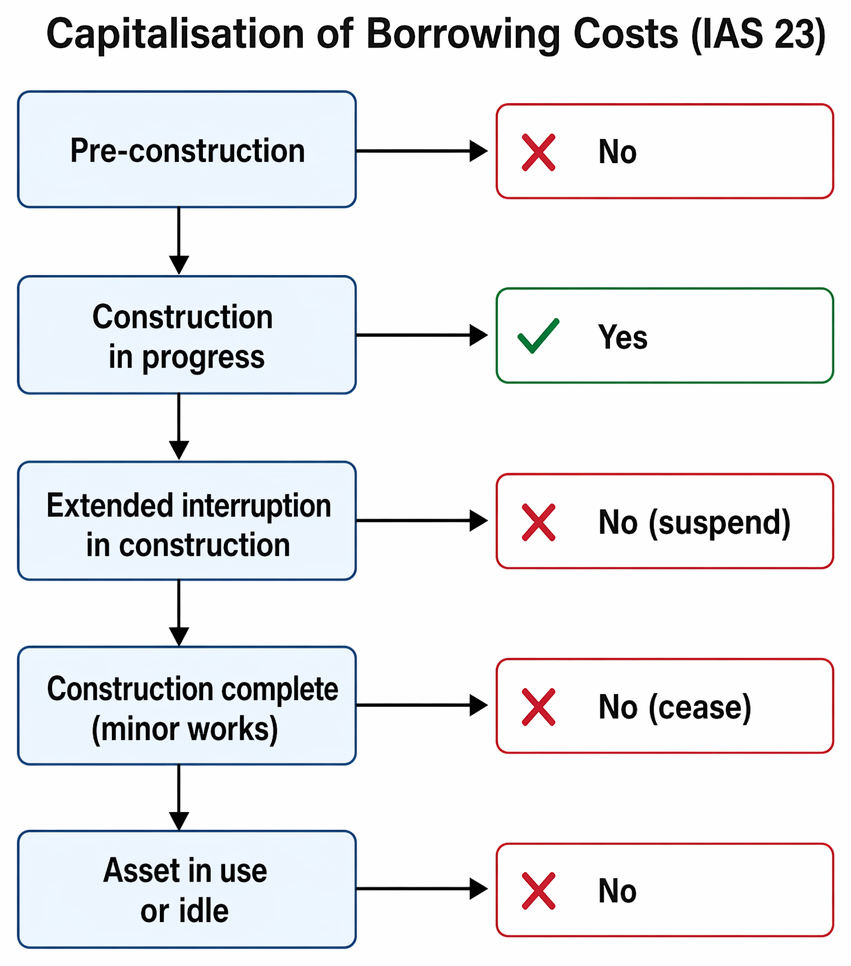
IAS 23 borrowing costs are allocated by capitalising actual interest on specific borrowings before applying a weighted average rate to residual expenditure.
| Stage | Capitalise Borrowing Costs? |
|---|---|
| Pre-construction | No |
| Construction in progress | Yes |
| Extended interruption in construction | No (suspend) |
| Construction complete (minor works) | No (cease) |
| Asset in use or idle | No |
Key Point Checklist
This article has covered the following key knowledge points:
- Recognise property, plant and equipment by applying IAS 16's criteria
- Identify directly attributable costs for inclusion in PPE's cost
- Differentiate between capital and revenue expenditure for non-current assets
- Define and identify a qualifying asset under IAS 23
- Determine when to start, suspend, and cease the capitalisation of borrowing costs
- Calculate borrowing costs for both specific and general borrowings
- Apply cessation rules for borrowing cost capitalisation in exam scenarios
Key Terms and Concepts
- property, plant and equipment (PPE)
- capital expenditure
- revenue expenditure
- directly attributable costs
- borrowing costs
- qualifying asset