Pollution and Human Health - Mesothelioma and asbestos
Learning Outcomes
- Explain why asbestos is dangerous mainly when fibers become airborne and are inhaled
- Identify what mesothelioma is and where in the body it usually develops
- Distinguish mesothelioma from asbestosis and asbestos-related lung cancer
- Understand why asbestos is treated as both an indoor air pollutant and an occupational hazard
- Describe why friable asbestos creates greater risk than intact asbestos-containing material
- Recall key facts about latency, disease burden, and major regulatory limits relevant to asbestos exposure
- Apply this content to AP Environmental Science questions about pollution, human health, and risk reduction
AP Environmental Science Syllabus
For the AP Environmental Science, you are expected to understand asbestos as a pollution and human health issue, with a focus on the following syllabus points:
Airborne asbestos fibers released from damaged materials can be inhaled and persist in mesothelial linings, increasing mesothelioma risk.
- Know that mesothelioma is strongly linked to asbestos exposure and most often affects the lining around the lungs
- Identify asbestos as an indoor air pollutant and as an occupational hazard in construction, shipbuilding, manufacturing, renovation, and demolition
- Explain how asbestos-containing material becomes dangerous when disturbed and fibers become airborne
- Understand the difference between friable and non-friable asbestos-containing material
- Distinguish mesothelioma from asbestosis and asbestos-related lung cancer
- Know that asbestos diseases often have a long latency period, commonly decades after exposure
- Recognise that all forms of asbestos are carcinogenic and that there is no known safe exposure level
- Understand basic risk reduction and regulation, including workplace exposure limits and prevention during removal or maintenance
Test Your Knowledge
Attempt these questions before reading this article. If you find some difficult or cannot remember the answers, look more closely at that area during your revision.
- Why is asbestos most dangerous when it is disturbed rather than simply present in a building?
- What is the difference between mesothelioma, asbestosis, and lung cancer?
- What do the terms pleura and peritoneum refer to?
- Why are asbestos-related diseases difficult to prevent and diagnose early?
- Why is friable asbestos a bigger hazard than intact non-friable material?
Introduction
Asbestos is one of the clearest examples in AP Environmental Science of a pollutant that connects environmental exposure, workplace safety, building materials, and long-term human health. It was widely used because it is durable, fire-resistant, and a very good insulator. Those same practical advantages led to large-scale exposure in homes, schools, factories, ships, and construction sites.
The exam often tests asbestos as an indoor air pollutant, but the deeper point is cause and effect. Asbestos is not mainly dangerous because it exists somewhere in a wall or ceiling tile. It becomes dangerous when tiny fibers are released into air, inhaled, and trapped in the body for years. That is what makes mesothelioma such a high-yield case study in pollution and human health.
Key Term: asbestos
A group of naturally occurring fibrous silicate minerals once widely used in insulation, fireproofing, roofing, tiles, and other building materials.
What mesothelioma is and how asbestos causes it
Mesothelioma is a cancer of the mesothelium, the thin lining around certain organs. It most commonly affects the lining around the lungs, but it can also affect the abdominal lining and, less commonly, other linings in the body.
Key Term: mesothelioma
A rare, aggressive cancer of the mesothelium, strongly linked to asbestos exposure.
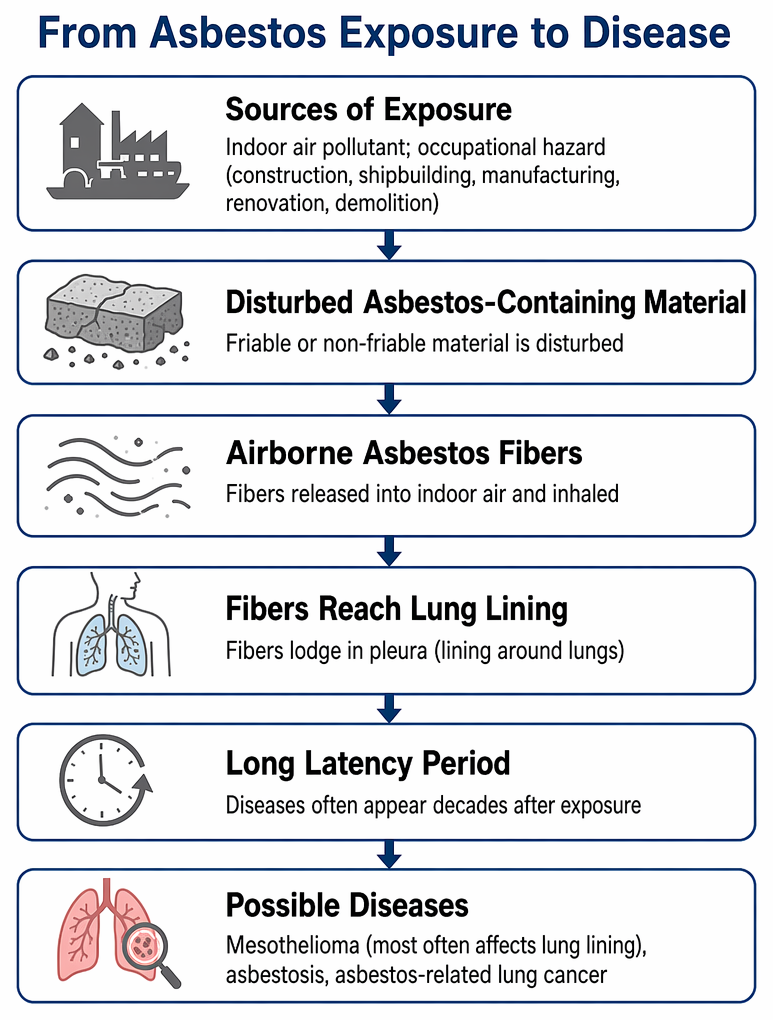
The basic causal chain matters more than memorizing isolated facts:
- asbestos-containing material is disturbed
- microscopic fibers become airborne
- fibers are inhaled, or less often ingested
- the body cannot easily remove them
- fibers remain lodged in tissue for years or decades
- disease develops, including mesothelioma
The textbook source states that inhaled or ingested asbestos fibers can become lodged in the lining of the chest or abdomen, where they remain because the body is unable to expel them effectively. Over time, tumors may develop. For APES purposes, that mechanism is enough. You do not need to invent a more detailed cell-biology explanation.
The most common form is pleural mesothelioma, which affects the lining around the lungs. Another major type is peritoneal mesothelioma, which affects the abdominal lining.
Key Term: pleura
The membrane lining the lungs and chest cavity.
Asbestos fibers can be inhaled or ingested and become lodged in these membranes because the body cannot expel them. The resulting cancer may develop after a delay of up to 58 years, so exam questions may link a historic occupational exposure with a later diagnosis affecting the peritoneum.
Key Term: peritoneum
The membrane lining the abdominal cavity.
This distinction is easy to miss under exam pressure. Students often assume mesothelioma means “lung cancer.” It does not. Mesothelioma is cancer of the lining, not of lung tissue itself.
The disease burden is substantial even though the cancer is rare compared with some others. The textbook notes about 3,000 new cases each year in the United States and roughly 43,000 mesothelioma deaths worldwide each year, with high rates in Australia, the United Kingdom, and the United States. Those high rates reflect heavy past industrial use of asbestos.
Symptoms may include shortness of breath, chest tightness, cough, and wheezing. These are non-specific symptoms, which is another reason diagnosis can be delayed. There is no cure.
Test Tip: If an APES question asks for the pollutant most closely associated with mesothelioma, choose asbestos, not ozone, particulates, radon, or tobacco smoke.
Why asbestos exposure happens in buildings and workplaces
Asbestos became common because it was cheap, durable, flexible, fire-resistant, and a good heat and electrical insulator. It appeared in insulation, brake linings, tiles, roofing shingles, drywall products, vinyl materials, and many other manufactured items.
That history explains why asbestos is still relevant even where use has been reduced or banned. Older buildings can still contain asbestos-containing material, often abbreviated as ACM. If those materials remain intact and undisturbed, the risk is often much lower. If they are cut, sanded, drilled, broken, or demolished, the danger rises sharply.
Key Term: asbestos-containing material (ACM)
Any material that contains asbestos fibers and can release them if damaged or disturbed.
Exposure can happen in two broad settings:
- indoor environmental exposure, such as in older homes, schools, offices, or public buildings
- occupational exposure, such as construction, demolition, renovation, shipbuilding, brake repair, insulation work, and industrial maintenance
Occupational exposure is especially high-yield because workers may disturb hidden asbestos repeatedly over long periods. But APES also frames asbestos as an indoor pollutant because many people spend most of their time indoors, and indoor pollutants can reach concentrations higher than outdoor ones.
The key idea is not simply “old buildings are dangerous.” The better explanation is:
- many older buildings contain ACM
- maintenance or renovation disturbs the material
- disturbance releases airborne fibers
- inhalation raises long-term disease risk
This is why improper removal can be worse than leaving intact material alone.
Friable asbestos, latency, and why this pollutant is hard to manage
Not all asbestos-containing material creates the same immediate risk. The most dangerous category is friable asbestos.
Key Term: friable asbestos
Asbestos-containing material that can be crumbled or reduced to powder by hand pressure, making fiber release into air more likely.
Friable material is more hazardous because it releases fibers more easily. Non-friable material may pose less immediate risk if it remains undamaged, sealed, and undisturbed. This is one of the most tested distinctions because it explains why asbestos risk depends on condition and handling, not just presence.
Students often make the mistake of saying, “Any building with asbestos is automatically dangerous at all times.” That is too simplistic. A better answer is:
- intact, sealed asbestos-containing material may release few fibers
- damaged or disturbed material releases many more fibers
- therefore risk depends strongly on whether fibers become airborne
Another major exam theme is latency.
Key Term: latency period
The time between exposure to a harmful substance and the appearance of disease.
Asbestos-related disease often appears decades after exposure. ATSDR commonly notes a latency of about 30 to 40 years, while the textbook states the lag can be as high as about 58 years for mesothelioma. This long delay matters for several reasons.
First, it makes cause and effect harder to detect. A person exposed in youth may not become sick until late adulthood. Second, it means a country can ban or restrict asbestos yet still see new cases for decades, because old exposures continue to produce disease. Third, it complicates diagnosis because symptoms such as cough or shortness of breath may be mistaken for many other conditions.
This also makes asbestos a good example of a chronic effect rather than an acute one. Acute effects follow short exposure to a high dose. Chronic effects follow long-term exposure or very delayed disease development. Mesothelioma fits the chronic pattern.
Test Tip: When asked why asbestos diseases are difficult to prevent or detect, mention the long latency period and the fact that symptoms may appear decades after exposure.
Mesothelioma compared with asbestosis and lung cancer
AP questions often reward students who can separate similar asbestos-related diseases rather than treating them as one condition.
Key Term: asbestosis
Chronic scarring of lung tissue caused by inhaling asbestos fibers.
Here is the clearest comparison:
| Disease | Main problem | Body area affected |
|---|---|---|
| Mesothelioma | Cancer | Lining of lungs, abdomen, or other organs |
| Asbestosis | Fibrotic scarring | Lung tissue |
| Lung cancer | Cancer | Lung tissue itself |
Mesothelioma is the “signature” asbestos cancer because asbestos is its main known cause. Asbestosis is not a cancer at all. It is scarring of lung tissue that makes breathing harder. Lung cancer is cancer in lung tissue and can have several causes, though asbestos exposure raises risk.
This leads to another subtle but important distinction: smoking and asbestos act together to greatly increase the risk of lung cancer, but smoking is not considered the main cause of mesothelioma in the same way.
That means students should avoid saying “smoking plus asbestos causes mesothelioma.” The more accurate statement is:
- smoking and asbestos strongly increase lung cancer risk together
- mesothelioma is strongly linked to asbestos exposure itself
This is the kind of precision that helps on FRQs.
There is also some variation among asbestos mineral types. Public-health summaries note that amphibole asbestos may carry a higher mesothelioma risk than chrysotile, but all forms are carcinogenic. For APES, the safest wording is that all forms of asbestos can cause mesothelioma and other serious disease.
Regulation, exposure limits, and practical prevention
Asbestos is regulated because exposure prevention is far more effective than trying to treat disease later. The most useful policy idea for APES is simple: stop fibers from entering air and being inhaled.
In the United States, asbestos is regulated as a hazardous air pollutant, and workplace exposure is controlled by OSHA limits. The standard workplace permissible exposure limit is:
- 0.1 fiber per cubic centimeter of air (f/cc) averaged over an 8-hour workday
There is also an excursion limit:
- 1.0 f/cc averaged over 30 minutes
These are legal exposure limits, not proof of a risk-free dose. Public health agencies emphasize that no safe exposure level is known.
For APES, you do not need to memorize every technical measurement rule, but knowing that regulation uses airborne fiber concentration and time-weighted averages can help explain how risk is managed.
Practical prevention includes:
- identifying asbestos-containing material before renovation or demolition
- avoiding unnecessary disturbance of intact material
- using trained abatement workers for removal
- containing dust and fiber release
- wearing appropriate protective equipment in workplaces
- following disposal and handling regulations
The prevention logic is direct:
- less disturbance means fewer airborne fibers
- fewer airborne fibers means lower inhalation risk
- lower inhalation risk means fewer long-latency diseases
One more point matters for exam reasoning. The EPA has asbestos rules tied especially to renovation and demolition because these are the situations in which fiber release becomes most likely. This links building policy directly to public health.
How asbestos fits bigger APES ideas about pollution and human health
Mesothelioma and asbestos sit at the meeting point of several AP Environmental Science themes.
First, this is a human health case study. A pollutant enters the body and causes severe long-term disease.
Second, this is a risk assessment and management example. Risk depends on exposure route, concentration, duration, and whether the material is disturbed.
Third, this is a case of indoor pollution. The exposure often happens inside buildings, where people spend much of their time.
Fourth, it is also about occupational exposure and environmental decision-making. Building materials that were once seen as useful later produced serious public-health consequences.
Finally, it shows why pollution control often happens too late. Asbestos was widely valued for insulation and fire resistance before its health effects were fully acted on at policy level. Because of the long latency period, the damage continues long after the period of heavy use.
For FRQ answers, a strong structure is:
- identify the pollutant and source
- explain the exposure pathway
- describe the health effect
- explain why prevention is difficult
- give a practical risk-reduction strategy
For example:
- source: older building insulation or tile
- pathway: disturbance releases airborne fibers
- effect: inhaled fibers can cause mesothelioma
- challenge: disease appears decades later
- solution: inspect before renovation and use trained abatement
That is much stronger than simply writing “asbestos is bad.”
Key Point Checklist
This article has covered the following key knowledge points:
- Asbestos is a group of fibrous silicate minerals once widely used in insulation, tiles, roofing, and fireproof materials
- Mesothelioma is a rare, aggressive cancer of the mesothelium, especially the pleura and peritoneum
- Mesothelioma is strongly linked to asbestos exposure
- Asbestos is most dangerous when asbestos-containing material is disturbed and fibers become airborne
- Inhalation is the main hazardous exposure pathway
- Friable asbestos is more dangerous than intact non-friable material because it releases fibers more easily
- Mesothelioma affects the lining of organs, not lung tissue itself
- Asbestosis is lung scarring, while asbestos-related lung cancer affects lung tissue
- Smoking greatly increases asbestos-related lung cancer risk, but this should not be confused with mesothelioma risk
- Asbestos-related diseases often have long latency periods of decades after exposure
- Older buildings, renovation, demolition, and maintenance create major exposure risks
- Prevention focuses on avoiding fiber release, controlling occupational exposure, and managing asbestos safely during building work
Key Terms and Concepts
- asbestos
- mesothelioma
- pleura
- peritoneum
- asbestos-containing material (ACM)
- friable asbestos
- latency period
- asbestosis