Pollution and Human Health - Ozone and respiratory health
Learning Outcomes
- Explain why ground-level ozone is a secondary pollutant rather than a primary pollutant
- Identify the role of NOx, VOCs, and sunlight in ozone formation
- Describe how ozone harms the respiratory system, including reduced lung function and asthma attacks
- Distinguish clearly between tropospheric ozone and stratospheric ozone
- Recognise which groups are most vulnerable to ozone exposure and why
- Apply AQI categories to public-health advice and exam-style scenarios
AP Environmental Science Syllabus
For the AP Environmental Science, you are expected to understand ozone and respiratory health, with a focus on the following syllabus points:
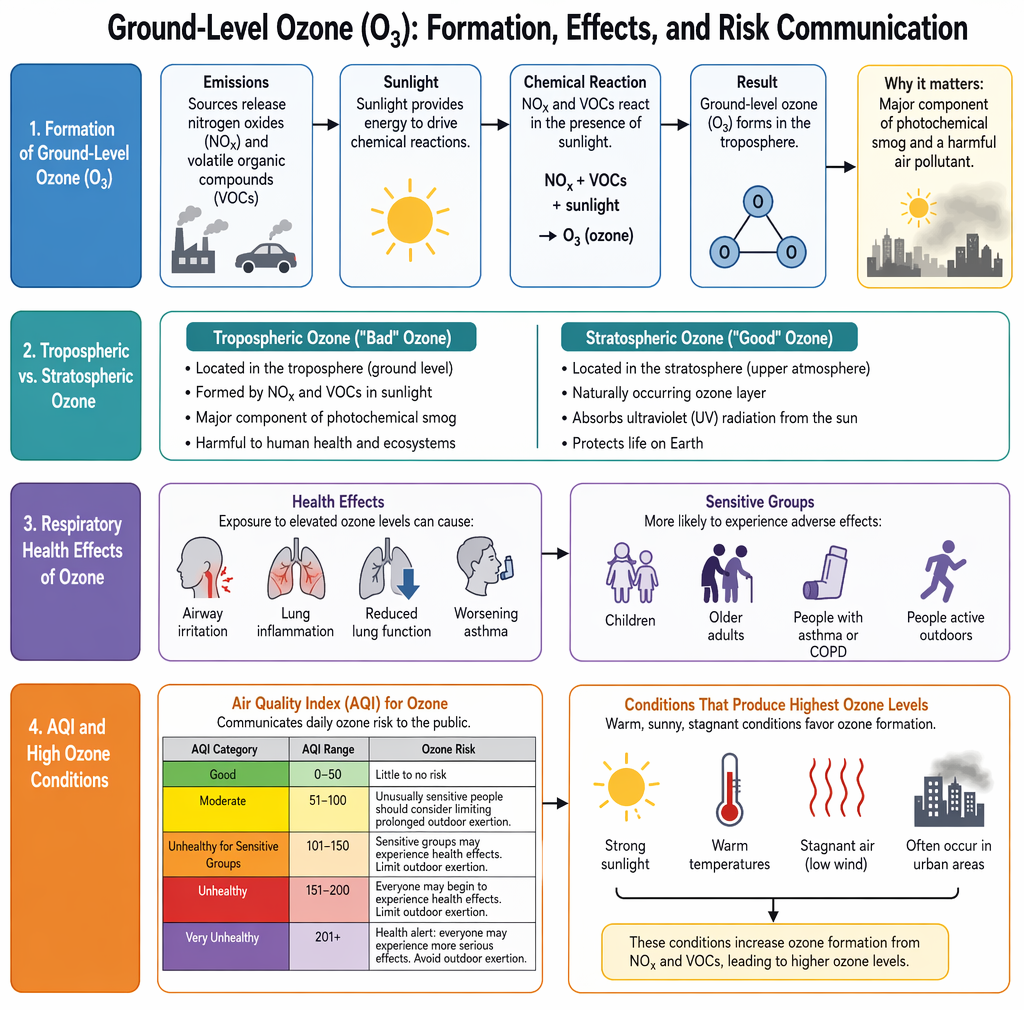
Tropospheric ozone develops through photochemical reactions of NOx and VOCs and is associated with airway irritation and impaired breathing.
- Know that ground-level ozone (O₃) is a secondary air pollutant
- Identify that ozone forms when nitrogen oxides (NOx) and volatile organic compounds (VOCs) react in the presence of sunlight
- Explain why ozone is a major component of photochemical smog
- Understand the difference between tropospheric ozone and stratospheric ozone
- Describe respiratory health effects including airway irritation, lung inflammation, reduced lung function, and worsening asthma
- Identify sensitive groups such as children, older adults, people with asthma or COPD, and people active outdoors
- Understand how the Air Quality Index (AQI) is used to communicate daily ozone risk
- Recognise why warm, sunny, stagnant conditions often produce the highest ozone levels
Test Your Knowledge
Attempt these questions before reading this article. If you find some difficult or cannot remember the answers, look more closely at that area during your revision.
- Why is ground-level ozone called a secondary pollutant?
- How do NOx, VOCs, and sunlight work together to form ozone?
- What are the main respiratory effects of ozone exposure?
- Why are children and outdoor athletes more vulnerable on high-ozone days?
- How is stratospheric ozone different from tropospheric ozone?
Introduction
Ozone is one of the most tested air-pollution topics in AP Environmental Science because it links atmospheric chemistry, human health, and public policy. Students often know that ozone is “bad,” but exam questions usually require more precision: which ozone, how it forms, and why it damages the lungs.
This topic sits at the overlap of Unit 7 and Unit 8. Ozone is formed in the atmosphere as part of photochemical smog, but it matters in Unit 8 because it affects human health directly. A strong answer must connect source gases, weather conditions, body systems, and vulnerable populations in one clear chain.
Key Term: ground-level ozone
Ozone (O₃) in the troposphere that forms from reactions involving NOx and VOCs in sunlight; it is a harmful air pollutant.
Ozone formation: why it is a secondary pollutant
A very common APES trap is confusing pollutants that are emitted directly with pollutants that form later in the atmosphere. Ground-level ozone is not usually released straight from tailpipes or smokestacks. Instead, it forms after other pollutants react.
Key Term: secondary pollutant
A pollutant formed in the environment from reactions involving primary pollutants rather than emitted directly.
The main starting ingredients are nitrogen oxides (NOx) and volatile organic compounds (VOCs). These come from sources such as motor vehicles, power plants, industrial combustion, solvents, gasoline vapour, and some industrial processes. In sunny conditions, these compounds react and generate ozone.
A simplified sequence looks like this:
- Vehicle and industrial emissions release NOx
- Other emissions release VOCs
- Sunlight provides the energy for photochemical reactions
- These reactions produce O₃ in the lower atmosphere
One reaction students are often expected to recognise is:
- NO₂ + UV light → NO + O
- O + O₂ → O₃
This matters because the oxygen atom released from nitrogen dioxide does not stay alone for long. It combines with oxygen gas to form ozone. That is why ozone levels often rise through the day as sunlight becomes more intense.
Key Term: nitrogen oxides (NOx)
A group of nitrogen-oxygen gases, mainly NO and NO₂, produced especially by high-temperature combustion and involved in smog and ozone formation.
In sunlight, NOx reacts with VOCs to produce ozone and peroxyacyl nitrates (PANs), linking vehicle and industrial emissions to photochemical smog. PANs are secondary pollutants that can travel away from their urban sources and irritate the eyes and respiratory system, so identifying VOCs is essential when explaining ozone-related health effects.
Key Term: volatile organic compounds (VOCs)
Carbon-containing compounds that easily enter the air and react with other pollutants to help form ozone and photochemical smog.
Cities tend to have stronger ozone problems because they combine three things: many emission sources, warm conditions, and strong sunlight. Stagnant air makes this worse because pollutants are not dispersed efficiently. That is why ozone pollution is often highest on hot, sunny, still days, especially in the afternoon or early evening.
Students also need to understand that ozone is part of photochemical smog, sometimes called brown smog. Ozone is not the only substance in smog, but it is one of its major harmful components.
Key Term: photochemical smog
Air pollution formed when sunlight drives reactions among NOx, VOCs, and oxygen, producing ozone and other harmful secondary pollutants.
Because sunlight drives these reactions most strongly during warm afternoons, ground-level ozone concentrations commonly peak later in the day and are higher in summer. This timing helps distinguish secondary pollutants such as ozone and PANs from substances released directly by vehicles.
Test Tip: If a multiple-choice question asks which pollutant is formed from reactions in sunlight rather than emitted directly, the answer is often ground-level ozone or PANs, not NO₂ or VOCs.
Why ozone damages the lungs and airways
Ozone is especially dangerous because it is a strong oxidant. In simple terms, it reacts readily with tissues in the respiratory system. When people inhale ozone, it irritates the lining of the airways and triggers inflammation.
Key Term: respiratory irritation
Inflammation or discomfort in the airways caused by inhaled pollutants, often producing coughing, throat irritation, or chest discomfort.
Short-term exposure can cause:
- coughing
- throat irritation
- chest tightness or chest discomfort
- wheezing
- shortness of breath
- pain with deep breathing
- reduced ability to exercise normally
The key physiological idea is that ozone causes airway inflammation and can narrow the air passages. This makes it harder to move air in and out of the lungs. Even if the exposure is brief, measurable drops in lung function can occur.
Key Term: reduced lung function
A decrease in the lungs’ ability to move air efficiently, often making deep breathing and exercise more difficult.
This is why ozone is not just an “unpleasant smell” issue. It changes how the respiratory system works. If lungs are inflamed, gas exchange becomes less effective and breathing feels more difficult. That is especially serious during exercise because the body needs more oxygen and ventilation increases.
Repeated or long-term exposure is also concerning. Evidence shows that ozone can contribute to ongoing airway injury and can reduce lung-function growth in children. Be careful not to overstate this. On APES, it is safest to say repeated exposure may contribute to chronic lung damage and reduced lung development, especially in children.
Ozone can also worsen existing disease. People with asthma may experience more frequent symptoms and more attacks. People with chronic bronchitis, emphysema, or COPD can also be affected more strongly because their respiratory systems are already under strain.
Key Term: asthma exacerbation
A worsening of asthma symptoms, such as wheezing, chest tightness, and shortness of breath, triggered by factors like air pollution.
The textbook material also notes broader health effects such as aggravation of cardiopulmonary problems, increased sensitivity to allergens, and suppression of immune function. For this subtopic, respiratory harm is the main exam focus, but linking ozone to increased susceptibility to respiratory infection is also useful.
Cause-and-effect chain you should be able to write:
- Ozone is inhaled
- Airway tissues become irritated and inflamed
- Airways narrow and lung function drops
- Breathing becomes harder
- Symptoms worsen, especially in people with asthma or COPD
Test Tip: In FRQs, do not stop at “ozone causes asthma.” Better wording is: “Ground-level ozone inflames the airways, reduces lung function, and worsens asthma symptoms or increases asthma attacks.”
Sensitive groups: who is most at risk and why
Not everyone is affected equally by ozone. APES questions often ask you to identify sensitive groups and explain their vulnerability.
The most important groups are:
- children and teenagers
- older adults
- people with asthma
- people with COPD, emphysema, or chronic bronchitis
- outdoor workers
- athletes and people doing strenuous outdoor exercise
Children are especially vulnerable for two reasons. First, their lungs are still developing. Second, they often spend more time active outdoors during the part of the day when ozone is highest. If a child is running around outside on a sunny afternoon, they are likely to inhale a larger dose than an adult resting indoors.
Outdoor workers and athletes are also high-risk groups, but for a different reason: dose. When people exercise or work hard outdoors, they breathe faster and deeper. That means more ozone reaches deeper into the lungs.
This is an excellent example of why environmental science is not just about concentration. Risk depends on both concentration and exposure. Two people can be in the same air, but the runner receives a larger effective dose than the person sitting still.
Older adults may be more vulnerable because they are more likely to have underlying respiratory or cardiovascular disease. People with asthma or COPD are vulnerable because they already have narrowed or inflamed airways, so any additional irritation produces a larger effect.
A careful exam answer might say:
- children are vulnerable because lungs are still developing and outdoor activity is common
- people with asthma or COPD are vulnerable because pre-existing airway disease makes irritation more harmful
- outdoor workers and athletes are vulnerable because deeper, faster breathing increases ozone intake
Ozone, AQI, and the “good ozone vs bad ozone” distinction
Students very often mix up the ozone layer with ozone pollution. APES examiners expect you to separate them clearly.
Key Term: tropospheric ozone
Ozone in the lowest layer of the atmosphere; harmful to health and a major part of photochemical smog.
A useful exam clue is that sunlight acting on nitrogen oxides and volatile organic compounds produces tropospheric ozone, while CFCs can reach the stratosphere and release chlorine that destroys ozone there. This contrast between pollution formation near the surface and ozone depletion higher in the atmosphere leads to the protective role described next.
Key Term: stratospheric ozone
Ozone in the stratosphere that absorbs harmful ultraviolet radiation and protects life on Earth.
Chemically, both are O₃. Functionally, they are very different because they are in different parts of the atmosphere.
- Stratospheric ozone is beneficial because it blocks harmful UV radiation
- Tropospheric ozone is harmful because humans breathe it
A good APES sentence is: “Good ozone is high up; bad ozone is down low.”
Ozone is also one of the pollutants included in the Air Quality Index (AQI), which gives daily public-health guidance.
Key Term: Air Quality Index (AQI)
A system used to report daily air quality and the related health risk from major air pollutants, including ozone.
Important AQI categories for ozone:
- 0–50 Good: little or no risk
- 51–100 Moderate: acceptable for most people; unusually sensitive people may notice minor symptoms
- 101–150 Unhealthy for Sensitive Groups: sensitive groups should limit prolonged or heavy outdoor exertion
- 151–200 Unhealthy: everyone may begin to feel effects
- 201–300 Very Unhealthy: health alert
- 301–500 Hazardous: emergency conditions
This matters because APES often links science to management. AQI is a public-health tool. On high-ozone days, people can reduce harm by changing behaviour:
- move exercise to the morning
- avoid strenuous afternoon outdoor activity
- keep sensitive groups indoors more often
- monitor local AQI reports
Morning is usually safer than afternoon because ozone tends to build as sunlight drives the reactions through the day.
A policy and management link is also useful here. The EPA ozone NAAQS health-based standard uses an 8-hour measure, with the current primary standard at 0.070 ppm, or 70 ppb. You do not always need that number for APES, but it can strengthen a higher-level response when discussing regulation.
Test Tip: If a question contrasts ozone depletion with ozone pollution, remember: ozone depletion is a stratosphere problem linked to UV exposure; ozone pollution is a troposphere problem linked to respiratory health.
Key Point Checklist
This article has covered the following key knowledge points:
- Ground-level ozone is a secondary pollutant, not a primary pollutant
- It forms when NOx and VOCs react in the presence of sunlight
- Ozone is a major component of photochemical smog
- Warm, sunny, stagnant conditions usually increase ozone formation
- Ozone irritates the airways and causes lung inflammation
- Short-term effects include coughing, throat irritation, wheezing, chest tightness, and shortness of breath
- Ozone exposure can cause reduced lung function
- It can worsen asthma and increase asthma attacks
- Sensitive groups include children, older adults, people with asthma or COPD, and people active outdoors
- Outdoor exercise increases exposure because breathing becomes faster and deeper
- Tropospheric ozone is harmful, while stratospheric ozone protects life from UV radiation
- The AQI helps communicate daily ozone risk and guide exposure reduction
Key Terms and Concepts
- ground-level ozone
- secondary pollutant
- nitrogen oxides (NOx)
- volatile organic compounds (VOCs)
- photochemical smog
- respiratory irritation
- reduced lung function
- asthma exacerbation
- tropospheric ozone
- stratospheric ozone
- Air Quality Index (AQI)