Learning Outcomes
This article explains GIPS disclosure, presentation, and reporting requirements for firms and pooled funds, including:
- Distinguishing required versus recommended disclosures and understanding how omissions affect GIPS compliance.
- Identifying which firm, composite, and pooled fund information must appear in every GIPS-compliant report.
- Determining the appropriate report type for different investors and products (composite GIPS report versus pooled fund GIPS report).
- Evaluating sample composite and pooled fund reports for completeness, diagnosing disclosure deficiencies, and proposing corrections in exam-style exhibits.
- Explaining how valuation methods, fees and expenses, benchmarks, leverage, derivatives, and significant events must be disclosed under the standards.
- Applying specific pooled fund reporting rules, including share-class selection, net-of-fees presentation, and fund-level risk and benchmark disclosure.
- Using a concise, checklist-driven approach to judge GIPS compliance, justify conclusions, and construct or critique example presentations under time pressure.
- Reinforcing links between the GIPS requirements and CFA Institute ethical standards on fair, accurate, and complete performance presentation.
CFA Level 3 Syllabus
For the CFA Level 3 exam, you are required to understand the detailed Global Investment Performance Standards (GIPS) requirements governing disclosure and presentation for both firms and pooled funds, with a focus on the following syllabus points:
- The core disclosure requirements and rationale for compliant GIPS reporting.
- Proper presentation format and treatment of performance data, policies, and caveats.
- Pooled fund reporting and the differences from traditional firm composite presentations.
- How to judge whether a performance presentation fairly, accurately, and completely represents a firm’s or manager’s record.
Test Your Knowledge
Attempt these questions before reading this article. If you find some difficult or cannot remember the answers, look more closely at that area during your revision.
-
In a GIPS composite report for prospective separate account clients, which disclosure is always required, regardless of strategy or structure?
- a) A detailed description of every portfolio in the composite
- b) The firm’s claim of compliance and definition of the firm
- c) The portfolio manager’s biography and years of experience
- d) A forward-looking expected return and risk forecast
-
A broad distribution pooled fund (BDPF) offers three share classes that are identical except for fee levels. The firm wants to produce a single GIPS pooled fund report. Which approach best complies with GIPS?
- a) Present the share class with the best historical performance and disclose that other classes exist.
- b) Present an equal-weighted average of all share classes and disclose the calculation method.
- c) Present the share class with the highest total fee and expense and explain the existence of other classes.
- d) Present only gross‑of‑fees returns for all share classes to avoid confusion about fees.
Introduction
GIPS‑compliant performance reporting is a core CFA Level 3 topic. Accurate, standardized disclosure helps investors fairly compare managers’ performance and assess key risks. Firms and pooled funds must provide clear, complete, and current disclosures in every compliant report. This article details what is required, what is recommended, and how disclosures differ by client type or reporting context.
At Level 3, you are often placed in the role of a consultant or CIO who must judge whether a performance report is GIPS‑compliant and, if not, what needs to be fixed. You must integrate:
- The detailed wording of the standards.
- The ethical requirement (Standard III(D)) to make performance “fair, accurate, and complete.”
- The practical needs of different types of investors, including pooled fund investors who cannot negotiate mandates.
Key Term: GIPS compliant presentation
A standardized report that contains all required data and disclosures under the Global Investment Performance Standards for a given composite, pooled fund, or firm. In the 2020 edition, these are called GIPS composite reports or GIPS pooled fund reports. Key Term: composite GIPS report
A GIPS‑compliant presentation that provides performance and disclosures for a composite (a group of portfolios) and is typically delivered to prospective separate account clients or prospective investors in limited distribution pooled funds. Key Term: pooled fund GIPS report
A GIPS‑compliant presentation that provides performance and disclosures for a single pooled fund (and usually a single share class), required for broad distribution pooled funds and allowed for limited distribution pooled funds. Key Term: composite
An aggregated group of portfolios representing a particular investment strategy, mandate, or objective, defined according to GIPS policies and constructed to include all actual, fee‑paying, discretionary portfolios that meet the composite criteria. Key Term: pooled fund
A vehicle that pools assets of multiple investors and is managed as a single account, such as a mutual fund, UCITS, or SICAV. Under GIPS 2020, pooled funds are classified as broad distribution pooled funds or limited distribution pooled funds.
GIPS Disclosure Requirements
Overview
Disclosure is essential to transparency and comparability. GIPS requires firms to disclose the information necessary for users to interpret the data and judge its reliability. Some disclosures are always required in every GIPS report; others are required only if relevant to the specific composite, pooled fund, model, or performance result.
Key Term: required disclosure
Information that must appear in a GIPS composite or pooled fund report when it is relevant. Omitting a required disclosure (when applicable) means the report is not GIPS‑compliant. Key Term: recommended disclosure
Information that is not mandatory for GIPS compliance but is encouraged to improve investor understanding, transparency, and fair presentation.
The exam often tests your ability to distinguish:
- “Required, always” disclosures (e.g., claim of compliance).
- “Required if applicable” disclosures (e.g., carve‑out treatment, currency hedging, predecessor performance).
- “Recommended but not required” disclosures (e.g., expanded risk statistics).
Key Principles
Think of disclosures in four categories:
- Firm‑level disclosures.
- Composite or pooled fund‑specific disclosures.
- Performance‑methodology disclosures.
- Conditional disclosures (triggered by specific circumstances).
Below is a non‑exhaustive but exam‑relevant checklist.
Firm‑Level Disclosures (typically appear in every report)
- Claim of compliance: A clear statement that the firm complies with the GIPS standards. Partial or “in accordance with” wording is not allowed.
- Definition of the firm: A description that makes it clear what entities and business lines are included and excluded.
- Availability of lists: Disclosures that:
- A list of all composite descriptions is available on request, and
- A list of limited distribution pooled funds and broad distribution pooled funds is available on request.
These firm‑level disclosures allow the user to understand what performance is covered and to request additional GIPS information if desired.
Composite / Pooled Fund‑Specific Disclosures
These explain what the strategy or product actually is:
- Composite or pooled fund description: The investment mandate, objective, or strategy in enough detail that a sophisticated investor can tell whether it is aligned with their needs.
- Composite inception date and creation date: When the strategy began and when the composite was created.
- Pooled fund inception date and start of GIPS‑compliant performance: For funds, you must distinguish the legal fund inception from the date from which performance is represented as GIPS‑compliant.
- Currency: The reporting currency used for performance and risk statistics.
- Use of leverage, derivatives, or short selling: If material, how these are used and measured.
Any material changes to the composite or pooled fund over time must be disclosed, including:
- Changes in investment mandate, benchmark, or key investment constraints.
- Significant changes in the personnel responsible for the strategy.
- Changes in the firm’s organization that affect the composite (e.g., acquisition of a team from another manager).
These are common exam traps: many sample presentations omit explanation of a major benchmark change or mandate shift.
Performance‑Methodology and Fee Disclosures
These disclosures let the user understand what the returns mean:
-
Gross‑ and/or net‑of‑fees: Whether the performance is gross‑of‑investment management fees, net‑of‑fees, or both, and how fees are defined.
- Gross‑of‑fees returns must still be net of transaction costs.
- Net‑of‑fees returns must clearly state which fees and expenses are deducted (e.g., management fees, performance fees) and whether they are actual or model fees.
-
Fee schedule:
- For composites: the current fee schedule (e.g., 1% per year on the first $50 million, 0.75% thereafter).
- For pooled funds: total expense ratio or ongoing charges, plus disclosure of any performance‑based fee.
-
Benchmark information:
- The benchmark name, description, and whether it is a custom (e.g., blended) benchmark.
- Disclosure of any benchmark changes and the dates and reasons for those changes.
- If no benchmark is appropriate, a clear explanation of why no benchmark is presented.
-
Valuation and pricing policies:
- General description of how portfolios are valued (e.g., fair value, use of third‑party pricing sources).
- Frequency of valuation and performance calculation (e.g., daily, monthly).
These disclosures link the GIPS standards to the broader ethical requirement under Standard III(D) of the CFA Institute Code and Standards: performance must be fair, accurate, and complete. For example, if model fees are used instead of actual fees, GIPS requires you to say so—otherwise, users could be misled.
Conditional Disclosures
Certain disclosures are required only if specific circumstances apply. Exam questions often hinge on these:
-
Use of carve‑outs: If returns include carve‑outs (e.g., the equity segment of balanced portfolios), the firm must disclose:
- That carve‑outs are included, and
- Whether carve‑outs include allocated cash and from which date this is the case.
-
Non‑fee‑paying portfolios: If non‑fee‑paying portfolios are included in a composite, the firm must disclose the percentage of composite assets represented by non‑fee‑paying portfolios for each period.
-
Predecessor or portability of performance: If the firm presents performance from a predecessor firm or another entity, it must disclose:
- That the performance was generated at another entity.
- The date from which the performance is considered “portable” and the criteria for portability.
-
Significant cash flows or large external cash flow policy: If the firm uses a policy to temporarily remove portfolios from the composite for large cash flows, that policy must be described.
-
Use of sub‑advisers: If the composite or pooled fund relies materially on external managers, this must be disclosed.
External Data, Models, and Simulated Performance
GIPS is strict about how model or backtested performance can be presented:
-
If model results (e.g., backtests) are shown, they must be clearly labeled as simulated or model performance. This reinforces the guidance in Standard III(D), which requires explicit labeling of simulated results.
-
If external data or indices are used (e.g., as benchmarks), the firm must:
- Describe the source of the data.
- Explain any customization or modifications (e.g., currency hedging, exclusions).
-
If performance from an external manager is included (e.g., in a fund‑of‑funds composite), the firm must disclose that the performance is based on component managers’ results and outline any due diligence or data limitations.
In exam scenarios asking, “How should a firm disclose the use of external data or model performance?” you should emphasize both clear labeling (simulated vs actual) and explanation of data sources and assumptions.
Worked Example 1.1
A GIPS‑compliant composite presentation adopts new valuation policies and experiences a merger mid‑year. What must be disclosed, and how?
Answer:
The presentation must disclose:
- The nature and effective date of the new valuation policy (e.g., moving from bid price to mid price, or switching to an independent pricing vendor).
- The fact and date of the merger, along with a brief explanation of how it affected the composite (e.g., assets and portfolios added, change in investment team).
The firm should explain any material effects these changes have on reported returns or comparability across periods. The disclosure should allow a knowledgeable third party to judge whether the post‑change performance is comparable to earlier results and whether any portability criteria have been applied to the acquired performance.
Presentation Requirements for Firms
This section focuses on GIPS composite reports for firms managing separate accounts or limited distribution pooled funds. Think of a composite GIPS report as a standardized, strategy‑level track record.
A compliant composite report must:
-
Identify the composite and describe its strategy/mandate:
- Clearly name the composite and provide a concise description of the investment objective, typical holdings, and risk profile.
-
Identify the firm and edition of the standards:
- State the firm’s name and the edition of the GIPS standards applied (e.g., GIPS 2020).
- Include the firm’s claim of compliance.
-
Present a minimum history:
- Show at least 10 years of annual performance (or since inception if shorter). As additional years are added, extend the history until a 10‑year record is built.
-
Provide annual performance alongside key statistics:
- For each calendar year:
- Composite gross‑ and/or net‑of‑fees return.
- Benchmark return for the same periods.
- Composite 3‑year ex‑post standard deviation (or other acceptable risk measure) and benchmark 3‑year standard deviation, once 36 months of data exist.
- Composite assets at year‑end and total firm assets at year‑end.
- If more than five portfolios: an internal dispersion measure (e.g., asset‑weighted standard deviation) or disclosure if a dispersion measure is not meaningful.
- For each calendar year:
-
Describe fees and expenses:
- Disclose whether returns are gross‑ or net‑of‑fees, the elements included in each, and the current fee schedule.
-
Provide benchmark detail and changes:
- Explain why the chosen benchmark is appropriate.
- Disclose any benchmark changes with dates and reasons (e.g., strategy changed from small‑cap to all‑cap, requiring a new benchmark).
-
Summarize key policies and exceptions relevant to the composite:
- Inclusion/exclusion rules for portfolios (e.g., minimum asset levels, treatment of significant cash flows).
- Use of leverage, derivatives, and short sales.
- Policies for handling large cash flows, terminated portfolios, and changes in mandate.
Key Term: composite
An aggregated group of portfolios representing a particular investment strategy, mandate, or objective. Composites must include all actual, fee‑paying, discretionary portfolios that fit the composite definition and are central to GIPS performance reporting.
Note that a firm may manage both separate accounts (organized into composites) and pooled funds. In that case:
- Composite GIPS reports are typically used for institutional or high‑net‑worth prospects considering separate accounts.
- Pooled fund GIPS reports are used for prospective and existing investors in specific funds, especially broad distribution pooled funds.
In exam questions, you may be asked whether a specific investor must receive a composite report, a pooled fund report, or both. The answer depends on whether the investor is considering a separate account mandate or a pooled fund and whether the fund is broad distribution or limited distribution.
Pooled Fund Presentation and Reporting
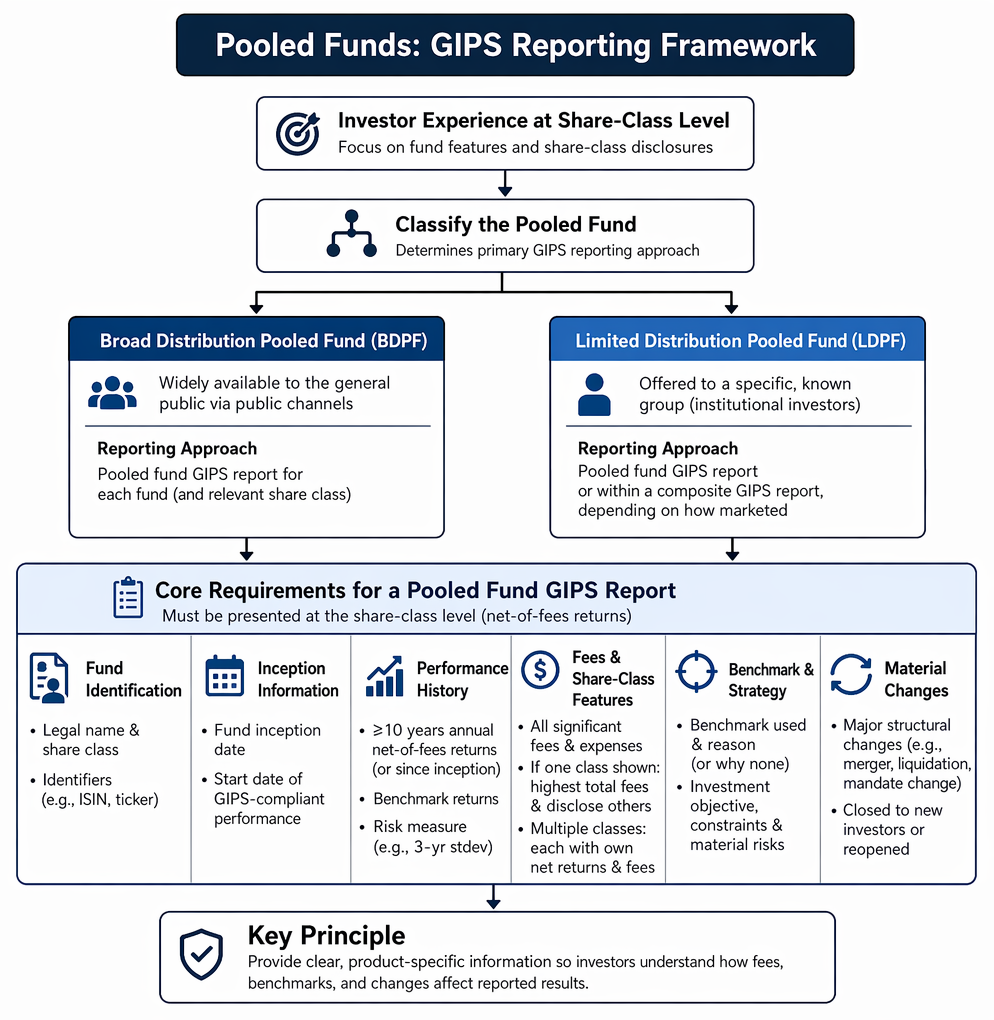
Pooled funds require tailored reporting because investors buy units or shares of a fund, not customized portfolios. They typically cannot negotiate individual mandates, so disclosures must focus on the features of the fund and its share classes.
GIPS reporting disclosures are organized into firm, product-specific, methodology-and-fee, and circumstance-dependent requirements, with representative examples in each group.
Under GIPS 2020, pooled funds are classified as:
- Broad distribution pooled funds (BDPFs): Offered to the general public, often through distribution platforms (e.g., retail mutual funds, UCITS funds).
- Limited distribution pooled funds (LDPFs): Offered to a specific, known group of investors (e.g., institutional commingled funds, hedge funds).
Key Term: broad distribution pooled fund
A pooled fund that is widely available to the general public, typically through public distribution channels. For BDPFs, firms must create GIPS pooled fund reports for each fund (and, in practice, for relevant share classes). Key Term: limited distribution pooled fund
A pooled fund that is not widely available to the general public and is typically marketed to a limited or institutional investor base. LDPFs may be represented either with a pooled fund GIPS report or within a composite GIPS report, depending on how they are marketed.
Core Requirements for Pooled Fund GIPS Reports
A GIPS‑compliant pooled fund report must emphasize:
-
Fund identification:
- Legal name of the fund and, usually, the specific share class.
- Any relevant identifiers (e.g., ISIN, ticker).
-
Inception information:
- Fund inception date.
- Start date of GIPS‑compliant performance (if the fund existed before the firm claimed compliance).
-
Performance history:
- At least 10 years of annual net‑of‑fees total returns for the share class (or since inception if shorter).
- Benchmark returns for the same periods, if appropriate.
- A risk measure similar to that for composites (e.g., 3‑year annualized standard deviation).
-
Fees and share‑class features:
-
All significant fees and expenses, including management fees, performance fees, distribution fees, and ongoing charges.
-
For BDPFs with multiple share classes that differ only by fee level:
- If a single pooled fund report is prepared, it must be for the share class with the highest total fee and expense.
- The report must clearly state which share class is presented and the existence of other classes.
-
If multiple share classes are shown, each share class must have its own net‑of‑fees performance series and fee disclosure.
-
-
Benchmark and strategy:
- The benchmark used and reasons for its selection (or explanation of why no benchmark is presented).
- Fund’s investment objective, constraints, and material risks.
-
Material changes:
- Explanation of any major changes to the fund structure (e.g., merger, liquidation, major mandate change).
- Disclosure if the fund closed to new investors or reopened.
Pooled fund reports may, but are not required to, display composite or firm‑level returns if they are not directly relevant for investors’ decision making. For a retail investor considering a BDPF, the key document is the pooled fund GIPS report, not the composite report.
Net‑of‑Fees and Share‑Class Treatment
Because pooled fund investors experience net returns at the share‑class level, GIPS places special emphasis on net‑of‑fees reporting:
- Pooled fund GIPS reports must present net‑of‑fees returns for the relevant share class.
- Gross‑of‑fees returns may also be shown, but they must be clearly defined and must still be net of transaction costs.
- If performance‑based fees apply, their existence and structure must be disclosed, along with any high‑water marks or hurdle rates.
In exam scenarios, failing to present net‑of‑fees returns for the share class—or presenting only composite‑level gross‑of‑fees returns—would be a clear violation.
Worked Example 1.2
A retail investor receives a compliant presentation for a pooled fund. The fund launches multiple share classes with different fee structures. What must the fund’s GIPS‑compliant report disclose?
Answer:
The GIPS pooled fund report must:
- Clearly state which share class is presented.
- Present net‑of‑fees returns for that share class and, if shown, define any gross‑of‑fees returns.
- Describe the fee and expense structure for the presented share class, including any performance fees.
- If only one share class is presented, ensure it is the share class with the highest total fee and expense when share classes are identical except for fees, and disclose that other share classes exist with different fee levels.
The report must not omit or obscure required net‑of‑fees returns or benchmark comparisons for the presented share class.
Composite vs Pooled Fund Reports in Practice
For broad distribution pooled funds:
- Prospective and existing investors should receive the pooled fund GIPS report for the fund (and relevant share class).
- Composite reports are generally not the primary GIPS documents for retail investors.
For limited distribution pooled funds:
-
If the fund is marketed as part of a strategy also offered as separate accounts, the firm may:
- Include the fund in a composite and present a composite GIPS report to institutional prospects, or
- Produce a dedicated pooled fund GIPS report.
-
The firm should choose the format that best matches how the product is offered. The exam will often test whether you recognize when a composite report is insufficient for pooled fund investors.
Worked Example 1.3
A firm manages a hedge fund (an LDPF) and also offers the same strategy as separate accounts. The composite, “Global Long/Short Equity,” includes both the hedge fund and separate accounts. The firm gives a prospective hedge fund investor only the composite GIPS report. Is this sufficient?
Answer:
It depends on how the hedge fund is being marketed:
- If the investor is considering a separate account mandate using the long/short strategy, the composite GIPS report is appropriate.
- If the investor is considering only an investment in the hedge fund itself, best practice (and exam‑expected behavior) is to provide a pooled fund GIPS report for the hedge fund, because:
- The investor’s actual experience will be at the fund/share‑class level, including specific fees and liquidity terms.
- Composite‑level performance may reflect fee schedules and implementation that differ from the fund.
The composite report alone may not provide sufficient, product‑specific information for a fund investor; the firm should supplement it with a pooled fund GIPS report.
Exam Warning: A frequent error is omitting or inadequately disclosing:
- The impact of switching from gross to net returns.
- Changes in fee calculation (e.g., moving from quarterly to monthly fee accruals or changing the fee rate).
- Benchmark changes and mandate changes affecting comparability.
Failing to make such changes clear can cause non‑compliance, even if the core return numbers are arithmetically correct. In essay questions, always comment on whether users can reasonably understand how fees and benchmarks have affected the reported numbers over time.
Revision Tip: Keep a concise, exam‑oriented checklist for each GIPS report you see:
- Firm‑level: claim of compliance, firm definition, availability of lists.
- Composite/fund‑level: description, inception date(s), currency, benchmark and changes.
- Performance: 10‑year (or since inception) annual returns, benchmark returns, risk measure, dispersion (for composites).
- Fees: gross/net treatment, fee schedule or total expense ratio, performance fees.
- Special issues: carve‑outs, non‑fee‑paying portfolios, significant changes, portability.
Whenever a relevant GIPS event occurs (e.g., change in firm definition, benchmark, valuation policy, or fee structure), the disclosures in all affected reports must be updated.
Summary
- Required GIPS disclosures ensure that investors are able to fairly interpret and compare results. Omitting a required disclosure when applicable breaks compliance.
- All GIPS‑compliant presentations—composite or pooled fund—must provide complete, timely, and comprehensible disclosures about strategy, fees, risks, and methodology.
- Distinguishing required from recommended disclosures is exam‑critical, especially for conditional items such as carve‑outs, non‑fee‑paying portfolios, and predecessor performance.
- Composite GIPS reports are strategy‑level records primarily for separate account prospects; pooled fund GIPS reports are product‑level records for pooled fund investors, with particular emphasis on share classes and net‑of‑fees returns.
- Evaluating whether a sample report is GIPS‑compliant requires a systematic checklist and the ability to link GIPS details to the broader ethical requirement of fair, accurate, and complete performance presentation.
Key Point Checklist
This article has covered the following key knowledge points:
- Explain the core required and recommended GIPS disclosures for compliant composite and pooled fund presentations.
- Distinguish presentation and reporting rules for firms (composites) versus pooled funds (broad and limited distribution).
- Identify what must be disclosed about valuation methods, fees, expenses, benchmarks, leverage, and methodology changes.
- Describe the specific pooled fund reporting requirements, especially around share classes, net‑of‑fees returns, and fund‑level risk disclosure.
- Recognize the difference between a composite GIPS report and a pooled fund GIPS report and when each must be provided.
- Diagnose common disclosure deficiencies in exam‑style exhibits and propose changes needed to restore GIPS compliance.
Key Terms and Concepts
- GIPS compliant presentation
- composite GIPS report
- pooled fund GIPS report
- composite
- pooled fund
- required disclosure
- recommended disclosure
- broad distribution pooled fund
- limited distribution pooled fund