Learning Outcomes
This article explains the core macroeconomic concepts and models needed for CFA Level 1 questions on economic growth and productivity. It clarifies how the aggregate production function links output to capital, labor, and total factor productivity (TFP), and how changes in each input affect output per worker, potential GDP, and long‑run growth. It distinguishes neoclassical (Solow) from endogenous growth theories, highlighting predictions about convergence, diminishing returns to capital, and the role of technological progress, human capital, institutions, and openness to trade in sustaining growth. It analyzes how growth accounting decomposes real GDP growth into contributions from labor, capital, and TFP and how to interpret numerical data and per‑worker, per‑capita, and aggregate GDP relationships in exam‑style calculations. It details the main drivers of sustainable growth—including capital deepening, demographic trends, innovation, public infrastructure, and policy choices—and connects these to living standards, output gaps, inflation pressures, and likely monetary policy responses. It also illustrates how small differences in growth rates compound over time and provides worked numerical examples of growth accounting and potential GDP calculations, similar to those seen in the CFA Level 1 exam, that are used to evaluate the impact of structural reforms and productivity shocks in both conceptual and quantitative questions.
CFA Level 1 Syllabus
For the CFA Level 1 exam, you are required to understand the drivers and models of economic growth and the factors influencing productivity, with a focus on the following syllabus points:
- Explain sources, measurement, and sustainability of economic growth and the impacts on macroeconomic performance.
- Describe the production function approach to analyzing the sources of growth.
- Define and contrast input growth and growth of total factor productivity as components of economic growth.
- Identify determinants of potential GDP and explain the significance of productivity and technological change.
- Evaluate the impact of capital accumulation, labor force growth, and improvements in human capital and technology on productivity.
- Compare and analyze economic growth rates, their effects on living standards, and policy implications.
Test Your Knowledge
Attempt these questions before reading this article. If you find some difficult or cannot remember the answers, look more closely at that area during your revision.
-
In the aggregate production function , what does the term represent?
- a) The amount of physical capital per worker
- b) The efficiency with which capital and labor are used
- c) The size of the labor force
- d) The share of income going to capital
-
Which statement best describes capital deepening?
- a) An increase in labor force participation holding capital constant
- b) An increase in capital per worker that raises output per worker
- c) An increase in TFP with unchanged capital–labor ratio
- d) A temporary increase in hours worked per employee
-
In the neoclassical (Solow) growth model, sustained long‑run growth in output per worker primarily depends on:
- a) Continuous increases in the saving rate
- b) Ongoing technological progress (TFP growth)
- c) Permanent increases in labor force growth
- d) A one‑time increase in physical capital
-
Which policy most directly supports higher long‑run growth in real GDP per capita?
- a) Subsidizing current consumption spending
- b) Imposing trade barriers to protect domestic firms
- c) Strengthening property rights and patent protection
- d) Fixing the exchange rate at a competitive level
-
Which of the following most closely corresponds to growth accounting in practice?
- a) Measuring changes in nominal GDP caused by inflation
- b) Decomposing real GDP growth into contributions from labor, capital, and a residual TFP component
- c) Estimating the size of the underground economy using surveys
- d) Measuring unemployment and labor force participation
-
If actual real GDP grows persistently faster than potential GDP, which outcome is most likely?
- a) Falling inflation and rising unemployment
- b) Stable inflation with unchanged unemployment
- c) Rising inflation as the output gap becomes positive
- d) Deflation as productivity growth accelerates
Introduction
Economic growth is fundamental for improving living standards and expanding the productive capacity of economies. For the CFA exam, a solid understanding of the main theories explaining growth, how productivity is measured, and the drivers of sustainable expansion in output is essential for interpreting macro data and forming investment views.
Key Term: Economic growth
Economic growth is the sustained increase in a country’s output of goods and services over time, usually measured as the percentage change in real GDP or real GDP per capita. Key Term: Productivity
Productivity is the efficiency with which inputs (labor, capital, and technology) are converted into output, often reflected in output per worker or per hour worked.
Because population can grow over time, aggregate real GDP is not the best indicator of living standards. Analysts focus on real GDP per capita and on how much each worker can produce.
Key Term: Real GDP per capita
Real GDP per capita is the inflation‑adjusted value of output per person; it is a common proxy for the average standard of living in an economy. Key Term: Labor productivity
Labor productivity is real output produced per unit of labor input, usually measured as real GDP per hour worked or real GDP per worker.
Long‑run growth in real GDP per capita is ultimately driven by gains in labor productivity. An economy can grow for a while by adding more workers, but living standards can rise over long periods only if each worker produces more on average.
Growth theory provides a structured way to:
- Relate productivity improvements to changes in capital, labor, and technology.
- Assess whether observed growth rates are likely to be sustainable.
- Understand why some countries grow rapidly while others stagnate.
- Evaluate how policy choices and institutional quality affect long‑run growth.
Test Tip: When revising Economic growth theories and productivity, connect each definition, method, or rule to the kind of question the assessment is likely to ask.
Exam Warning: Do not rely on keyword recognition alone; check the precise condition, exception, calculation step, or evidence the question requires.
Growth Rates and the Power of Compounding
Even small differences in annual growth rates, if sustained, lead to large differences in income over time because of compounding. This is often tested conceptually at Level 1.
Suppose two economies have the same initial real GDP per capita of $20,000:
- Country X grows at 1% per year.
- Country Y grows at 3% per year.
After 30 years:
- Country X’s income ≈ .
- Country Y’s income ≈ .
A 2‑percentage‑point difference in the growth rate nearly doubles the gap in income after three decades. This is why growth theory is central for long‑horizon investors: long‑run equity returns and credit quality are strongly influenced by an economy’s sustainable growth rate.
A useful mental shortcut sometimes used in practice is the “rule of 70”: the approximate number of years it takes for a variable to double is , where is the annual growth rate in percent. At 2% growth, GDP per capita doubles roughly every 35 years; at 4%, it doubles about every 17–18 years.
Theories and Models of Economic Growth
The Production Function Approach
A widely used framework in growth theory is the aggregate production function. This model expresses output (Y) as a function of capital (K), labor (L), and total factor productivity (A):
Key Term: Production function
A production function is a mathematical relationship showing how output is produced from inputs of capital, labor, and technology.
In this setup:
- Capital (K) is the stock of physical equipment, structures, and infrastructure used in production.
- Labor (L) is the amount of work effort, typically measured as aggregate hours worked rather than the simple number of workers.
- The function captures how K and L combine to produce output.
- The parameter measures how effectively capital and labor are used, given the current state of technology and organization. It scales the whole production function up or down.
Key Term: Total factor productivity (TFP)
Total factor productivity is the portion of output that cannot be explained by the measured amounts of capital and labor; it reflects technology, human capital, management quality, institutions, and other efficiency factors.
Three important concepts within this framework are:
- Capital deepening.
- Labor growth.
- TFP growth.
Key Term: Capital deepening
Capital deepening refers to increases in capital per worker, which raise output per worker up to a point but eventually face diminishing marginal returns.
- Capital deepening: Increasing the capital‑to‑labor ratio by investing in new physical capital (machines, factories, infrastructure). This generally raises output per worker but with diminishing marginal gains.
- Labor growth: Expansion of the labor input through population growth, higher labor force participation, or longer working hours.
- TFP growth: Improvements in technology, management, and institutions that allow a given bundle of capital and labor to produce more output.
A useful way to express the production function is in per‑worker terms. Under the assumption of constant returns to scale (if all inputs double, output doubles), we can divide both sides by L:
Here, is output per worker (labor productivity), and is capital per worker.
Key Term: Capital‑to‑labor ratio
The capital‑to‑labor ratio is the amount of physical capital available per unit of labor, often written as:
It is a key determinant of output per worker.
This equation highlights two main drivers of labor productivity:
- More capital per worker (capital deepening).
- A higher TFP term A (better technology and efficiency).
Marginal Products and Diminishing Returns
Microeconomic ideas carry over into this macro framework.
Key Term: Marginal product of capital
The marginal product of capital is the additional output produced when one more unit of capital is used, holding other inputs (like labor) constant. Key Term: Diminishing marginal productivity
Diminishing marginal productivity means that, beyond some point, each additional unit of an input (capital or labor), holding other inputs constant, adds less and less extra output.
The neoclassical model assumes:
- Constant returns to scale: If K and L both increase by x%, Y also increases by x%. This ensures that per‑worker relationships are well defined.
- Diminishing marginal productivity of each input: Holding the other input fixed, additional units of K or L add smaller and smaller amounts to output. For example, adding machines to a fixed number of workers raises output, but the incremental gain from each extra machine falls.
- No externalities in the basic form: The direct contributions of capital and labor are fully captured in their measured quantities, and TFP captures everything else.
Diminishing marginal productivity of capital is especially important: if capital grows much faster than labor, each extra unit of capital becomes less productive, so growth from capital deepening alone eventually slows.
Graphically (no diagram is needed in the exam, but the intuition helps), the production function in per‑worker terms (where and ) is upward‑sloping but concave: as rises, rises at a decreasing rate.
Neoclassical (Solow) Growth Model
The neoclassical (Solow) growth model builds on the production function and focuses on capital accumulation, labor growth, and exogenous technological progress.
Key Term: Neoclassical growth model
The neoclassical growth model is a growth model in which long‑run growth in output per worker is driven by exogenous technological progress, with capital deepening subject to diminishing returns and leading to convergence in incomes under similar structural conditions.
Key mechanisms and implications:
- Capital accumulation: Part of output is saved and invested in new capital. Capital depreciates over time. The capital stock changes according to investment minus depreciation.
- Diminishing returns to capital: As capital per worker rises, its marginal product falls. This means that higher saving and investment can boost growth temporarily but not forever.
- Exogenous technological progress: TFP (A) grows at a rate determined outside the model. This shifts the production function over time and is the ultimate driver of sustained growth in output per worker.
From these mechanisms, several important conclusions follow.
Key Term: Steady state (growth)
A steady state (in growth theory) is a situation where key variables such as capital per worker and output per worker grow at constant rates so that ratios like:
are constant over time; with no TFP growth, per‑worker variables are constant in level.
In the long run, the economy converges to a steady state in which:
- Capital per worker and output per worker settle at a constant level if TFP is fixed.
- If TFP grows at a constant rate, then output, capital, and other variables grow at constant rates, and output per worker grows at the TFP growth rate.
- The growth rate of total output equals TFP growth plus labor (or population) growth.
Key implications:
- Saving and investment: A higher saving rate raises the steady‑state level of capital per worker and therefore the level of output per worker, but it does not change the long‑run growth rate of output per worker. It produces a temporary period of faster growth while the economy moves to a higher level.
- Population growth: Faster labor force growth raises the growth rate of total output but tends to reduce the steady‑state level of capital per worker and output per worker (because the capital stock must be spread over more workers).
- Technology: Sustained growth in output per worker requires ongoing improvements in TFP, that is, continued technological progress and efficiency gains. Without TFP growth, per‑capita income in steady state is constant.
Convergence
One of the most discussed predictions of the neoclassical model is convergence.
Key Term: Convergence
Convergence is the tendency, under certain conditions, for poorer economies with lower capital per worker to grow faster than richer ones and gradually close the income gap.
Because capital is relatively scarce in developing economies, its marginal product is high. Given similar technology and institutions, capital inflows and domestic investment yield high returns and high growth rates. Over time, as capital accumulates and diminishing returns set in, growth slows and income levels converge towards those of richer economies.
However, this convergence is conditional, not automatic. It depends on:
- Access to similar technology.
- Reasonably comparable levels of human capital.
- Stable macroeconomic environment.
- Sound institutions (property rights, rule of law).
- Openness to trade and capital flows.
Without these conditions, poor countries may not catch up, even if capital is initially scarce.
Endogenous Growth and New Growth Theory
Endogenous (or new) growth theories modify the neoclassical view by emphasizing mechanisms inside the economy that can generate sustained growth in productivity without necessarily running into strong diminishing returns.
Key Term: Endogenous growth theory
Endogenous growth theory is a class of models in which long‑run growth rates are determined by factors within the economy—such as innovation, human capital formation, and knowledge spillovers—rather than by purely exogenous technological progress.
Key ideas:
- Broad capital: When investment includes not just physical capital but also human capital, R&D, and knowledge, the effective capital input may experience less or no diminishing returns at the economy‑wide level.
- Positive externalities: Investments in education, R&D, and infrastructure create spillovers: knowledge generated by one firm benefits others. For example, once a new production technique is discovered, other firms may imitate it at low cost.
- Non‑rival knowledge: Ideas are non‑rival: one firm’s use of an idea does not prevent others from using it. This allows the total stock of knowledge to accumulate without the usual congestion effects.
As a result, in some endogenous growth models:
- Policies that support investment in human capital, education, R&D, and innovation can permanently increase the long‑run growth rate of output per worker, not just its level.
- Institutional factors (such as intellectual property protection and ease of doing business) play an even more central role in determining long‑run growth.
For CFA Level 1, the key contrast is:
- Neoclassical growth: Long‑run per‑capita growth rate is driven by exogenous TFP growth; policies that change saving or investment mainly affect the level of output per worker.
- Endogenous growth: Policy choices that affect education, innovation, and knowledge creation can influence the long‑run growth rate itself.
Sources of Economic Growth
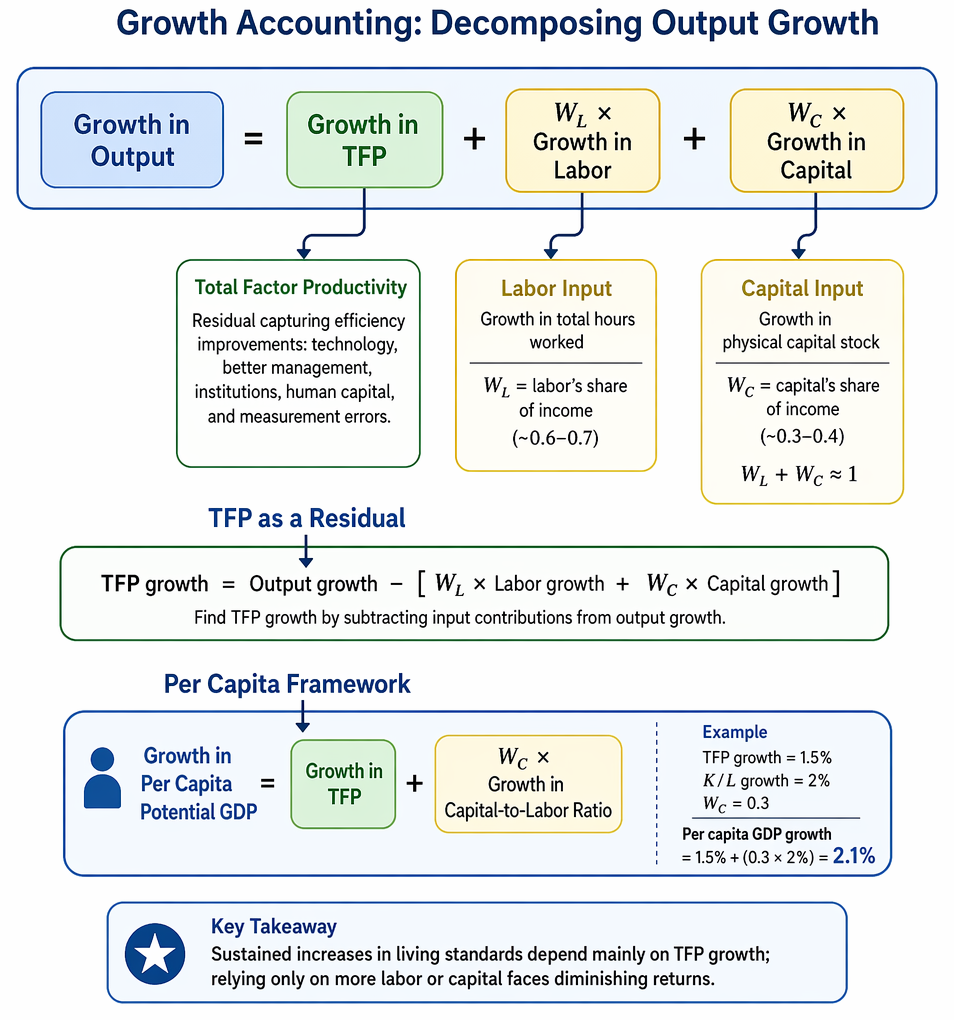
Economic growth is typically decomposed into contributions from labor, capital, and TFP using a growth accounting equation derived from the production function.
Neoclassical growth relationships show how capital deepening approaches a steady state, while technological progress determines sustained output-per-worker growth.
Key Term: Growth accounting
Growth accounting is a framework that decomposes the growth rate of output into contributions from growth in inputs (capital and labor) and growth in total factor productivity.
A common representation is:
where:
- = labor’s share of income (typically around 0.6–0.7 in many economies).
- = capital’s share of income (typically around 0.3–0.4), and .
Labor’s share is usually measured as employee compensation divided by GDP. Capital’s share is measured as the sum of profits, interest, rents, and depreciation divided by GDP.
Input Growth vs. TFP
- Input growth: Expanding the capital stock (more machines, structures) and the labor input (more workers or hours). This raises potential GDP, but because of diminishing returns to individual inputs, its impact on output per worker is limited over the long run.
- TFP growth: Captures gains from improved technology, better management, more efficient institutions, and other factors that allow the same inputs to produce more output. It shifts the entire production function upward.
In practice, TFP growth is often calculated as a residual:
Because it is a residual, TFP captures not only pure technology but also:
- Improvements in human capital (education and skills).
- Better public infrastructure.
- Institutional improvements and governance.
- Measurement errors in inputs and output.
Despite these limitations, TFP is a useful summary measure of the efficiency improvements driving growth.
Sustained increases in living standards require TFP growth. Relying solely on adding more labor or capital eventually runs into diminishing marginal productivity.
Growth in Per Capita Terms
For assessing living standards, the focus is on potential GDP per person or per worker. Under the neoclassical framework, when the growth accounting equation is expressed in per‑capita terms, the labor growth term drops out. A common expression is:
Per capita growth is driven by:
- Faster TFP growth.
- Faster capital deepening (growth in ), weighted by capital’s income share .
This equation shows that even rapid capital deepening has a limited effect on long‑run per capita growth if is modest and diminishing returns are strong.
For example, if:
- TFP grows at 1.5% per year.
- The capital‑to‑labor ratio grows at 2% per year.
- Capital’s share is 0.3.
Then:
Most of the per capita growth in this example comes from TFP rather than from capital deepening.
Key Drivers of Sustainable Growth
The main determinants of growth can be grouped into:
- Capital accumulation.
- Labor force growth and human capital.
- Technological progress (TFP).
- Natural resources and public infrastructure.
- Institutional quality and policy.
- Openness to trade and capital flows.
- Environmental factors and externalities.
Each of these affects either the level and growth of inputs or the rate of TFP growth.
Capital Accumulation
Investment in physical capital increases the stock of machinery, equipment, and structures.
Key Term: Physical capital stock
The physical capital stock is the accumulated stock of buildings, machinery, equipment, and infrastructure used to produce goods and services.
Important points:
- Net investment (gross investment minus depreciation) determines how quickly the capital stock grows.
- Higher investment rates are often associated with faster growth, especially in developing economies where capital per worker is low and the marginal product of capital is high.
- In advanced economies that already have a high capital‑to‑labor ratio, additional capital deepening yields smaller increases in output per worker because of diminishing marginal productivity.
Capital accumulation is necessary for growth but not sufficient for sustained increases in living standards. Without technological progress, capital deepening eventually runs into diminishing returns.
Labor Force Growth and Human Capital
The quantity of labor input can be measured as:
Key Term: Total hours worked
Total hours worked is the total amount of labor input used in production, equal to the number of workers (labor force) multiplied by the average number of hours worked per worker.
Long‑run growth in total hours depends on:
- Growth of the working‑age population.
- Labor force participation rate.
- Trends in average hours worked per worker.
Key Term: Labor force participation rate
The labor force participation rate is the proportion of the working‑age population that is either employed or actively seeking work.
In many advanced economies:
- Population growth has slowed.
- Labor force participation rates are affected by aging, social norms, and policies (such as childcare, retirement ages).
- Average hours worked per worker have tended to decline over decades, due to preferences for leisure, regulations, and the rise of part‑time work.
These trends reduce the contribution of labor quantity to growth and make productivity growth even more critical.
Key Term: Human capital
Human capital is the knowledge, skills, and health embodied in workers that make them more productive.
Human capital improves:
- Workers’ ability to use existing technologies.
- The speed at which new technologies are adopted.
- The economy’s capacity to innovate.
Investment in human capital includes formal education, vocational training, on‑the‑job training, and health spending. Empirical evidence shows that more years of schooling and better learning outcomes are associated with higher wages and higher productivity.
Human capital also generates positive externalities: higher skills in one worker can raise the productivity of colleagues and support innovation.
Technological Progress
Technological progress is the main source of sustained growth in output per worker, especially in developed economies.
Technological change encompasses:
- New products (e.g., smartphones, medical treatments).
- New production processes (e.g., automation, advanced manufacturing).
- Improved management and organization (e.g., lean production, supply chain optimization).
- Better ways to match inputs (e.g., platforms, data analytics).
TFP is often used as a proxy for these technological and organizational improvements.
Technological progress can result from:
- Private and public R&D spending.
- Learning by doing: productivity improves as firms gain experience.
- Diffusion of technology across firms and countries via trade, foreign direct investment, and migration.
Technological advances help economies overcome the limits imposed by diminishing marginal returns. They effectively shift the production function upward, so that more output can be produced with the same inputs.
Institutions and Policy
Institutions—the “rules of the game” in an economy—strongly influence TFP and investment decisions. Examples include:
- Property rights and the rule of law.
- Quality of contract enforcement and legal systems.
- Degree of corruption and regulatory burden.
- Development of financial markets and intermediaries.
- Macroeconomic policy frameworks (monetary and fiscal rules).
Well‑designed institutions:
- Encourage investment by protecting property and enforcing contracts.
- Support innovation by protecting intellectual property while allowing competition.
- Reduce transaction costs and misallocation of resources.
- Facilitate financial intermediation that channels saving into productive investment.
Weak institutions can discourage investment, slow technological adoption, and reduce growth.
Openness, Natural Resources, and Infrastructure
Open trade and capital flows allow economies to:
- Specialize according to comparative advantage.
- Import advanced capital goods and technologies.
- Learn from foreign firms and practices.
At the same time, openness exposes economies to global shocks, but overall it tends to support higher TFP growth.
Natural resources can be important, especially for resource‑rich economies. However:
- They are neither necessary nor sufficient for high incomes.
- Countries such as Japan and South Korea have grown rapidly with few natural resources by importing raw materials and exporting manufactured goods.
- Resource‑rich countries can suffer from volatility and governance challenges if resource revenues are not managed well.
Key Term: Public infrastructure
Public infrastructure is large‑scale public or regulated capital such as roads, ports, electricity networks, and water systems that supports private production and generates broad spillover benefits.
High‑quality infrastructure:
- Reduces transportation and communication costs.
- Expands market access.
- Complements private capital and labor, raising their productivity.
Externalities and the Environment
Key Term: Externalities
Externalities are spillover effects of production or consumption on third parties not directly involved in the transaction; they can be positive (e.g., knowledge spillovers) or negative (e.g., pollution).
Positive externalities, such as those from R&D and education, support endogenous growth. Negative externalities, especially environmental damage and climate change, can reduce long‑run sustainable growth if not addressed.
Key points:
- Economic growth has historically been associated with increased emissions of greenhouse gases.
- Climate change can damage agriculture, health, property, and ecosystems, reducing potential GDP.
- Individual firms and countries may have limited incentives to reduce emissions because the benefits are global, not local.
Policy responses include:
- Carbon pricing (taxes or cap‑and‑trade systems).
- Regulations limiting pollution.
- Support for low‑carbon technologies and energy efficiency.
These policies may raise costs in the short run but can support long‑run sustainable growth by reducing environmental damage.
Worked Example 1.1
Suppose a country’s real GDP grew by 4% last year. Over the same period, the labor force grew by 1.5%, the capital stock by 2%, and capital’s share of income is 35%, labor’s 65%. What was the contribution of TFP growth?
Answer:
Calculate contributions:
- Capital’s contribution:
- Labor’s contribution:
- Input growth contribution:
- TFP growth = Total GDP growth − Input contribution
So TFP contributed approximately 2.3 percentage points to real GDP growth.
This example illustrates that, in many economies, TFP accounts for a substantial fraction of observed output growth.
Measuring and Sustaining Economic Growth
GDP growth is most meaningful when measured in real per capita terms, removing the effects of inflation and population growth. Analysts are interested in whether observed growth can be maintained without generating inflationary pressures or exhausting resources.
Key Term: Potential GDP
Potential GDP is the level of real GDP that an economy can produce on a sustained basis when labor and capital are fully employed at normal utilization rates.
Potential GDP reflects the economy’s productive capacity. Actual GDP can temporarily exceed potential (an inflationary gap) or fall below it (a recessionary gap), but over the long run it tends to track potential.
A useful identity is:
Since “aggregate hours worked” is another way of describing total hours worked in the economy, this identity highlights that potential GDP grows because:
- The total amount of labor input increases.
- Labor productivity rises.
Transforming into growth rates:
Key Term: Sustainable rate of economic growth
The sustainable rate of economic growth is the long‑run growth rate of potential GDP that can be maintained without generating accelerating inflation, often approximated by the sum of trend growth in labor input and labor productivity.
Sustained growth requires ongoing improvements in TFP and labor productivity:
- Economies that rely only on increasing capital or labor face diminishing returns and eventually slower per capita growth.
- Technological advancement, human capital formation, and institutional quality are essential for continued increases in living standards.
Actual vs. Potential GDP and Inflation
If actual GDP is growing faster than potential GDP for a prolonged period, the economy is likely to be operating above its sustainable capacity:
- The output gap (actual minus potential) becomes positive.
- Firms face capacity constraints and difficulty hiring suitable workers.
- Wages and other input costs rise.
- Inflation tends to increase.
Conversely, if actual GDP grows more slowly than potential (or contracts), the output gap is negative:
- There is slack in the economy—unused labor and capital.
- Unemployment is above its “natural” or long‑run level.
- Downward pressure on inflation or even deflation may arise.
Central banks and fiscal authorities monitor estimates of potential GDP and the output gap when setting policy.
Worked Example 1.2
In an economy, aggregate hours worked are expected to grow at 0.5% per year over the next decade, and labor productivity is expected to grow at 1.8% per year. Estimate the sustainable growth rate of potential GDP.
Answer:
Potential growth rate = Growth in aggregate hours + Growth in labor productivity
per year. If actual GDP grows persistently faster than 2.3% without a corresponding rise in potential, inflationary pressures are likely to build.
For investors, comparing forecast actual GDP growth with estimated potential growth helps assess spare capacity, inflation risk, and likely central bank policy responses, which in turn affect interest rates and asset valuations.
Factors Affecting Long‑Run Growth and Productivity
Long‑run growth in potential GDP depends on:
- The trend growth rate of labor input (aggregate hours worked).
- The trend growth rate of labor productivity.
Both, in turn, are influenced by the factors described earlier.
Human Capital
Education, training, and health improve labor quality and adaptability.
Benefits:
- Higher human capital enables workers to use existing capital more effectively, raising productivity.
- Educated workers are better at adopting and adapting new technologies.
- Healthier workers are more productive and have fewer absences due to illness.
Policies that support:
- Primary and secondary education.
- Vocational and on‑the‑job training.
- Tertiary education aligned with labor market needs.
- Public health and nutrition programs.
tend to raise labor productivity and thus potential GDP.
In growth accounting, some of the impact of human capital is captured indirectly through TFP because it is not always measured as a separate input.
Physical Capital
Modern infrastructure, machinery, and communications enable firms to produce goods and services more efficiently.
Key points:
- Net investment increases the physical capital stock over time.
- The impact on per capita output depends on capital deepening (capital per worker) and the efficiency with which capital is used (TFP).
- In economies with low capital per worker, returns to investment are typically high, so increased investment can spur rapid growth.
- In highly capital‑intensive economies, the marginal product of additional capital tends to be lower because of diminishing marginal productivity.
Investors often look at the investment‑to‑GDP ratio as an indicator of future growth potential. Countries that sustain high investment rates (e.g., in infrastructure and productive capacity) often achieve higher growth, provided investment is efficient and supported by sound institutions.
Technological Innovation
Investments in R&D and favorable environments for adopting innovations are critical for long‑run productivity growth.
Mechanisms:
- Technological advances improve TFP directly by allowing more output to be produced with given capital and labor.
- Information and communication technologies (ICT), automation, and data analytics have been important drivers of productivity in many advanced economies.
- Technologies developed in leading economies can diffuse internationally, allowing latecomers to “import” innovations, though effective absorption requires adequate human capital and institutional quality.
Much of the high productivity growth in some periods (e.g., the late 1990s in the United States) is attributed to rapid advances and diffusion in ICT and related organizational changes.
Legal and Political Institutions
Protection of property rights, rule of law, and absence of corruption encourage investment, entrepreneurship, and innovation.
Institutional features supporting growth include:
- Independent and efficient courts.
- Transparent and predictable regulations.
- Low levels of corruption.
- Political stability and respect for contracts.
- Inclusive financial systems that allocate capital based on risk–return rather than connections.
Weak institutions or political instability can discourage long‑term investment, lower TFP, and hinder growth. Conversely, reforms that strengthen institutions can raise the sustainable growth rate by improving resource allocation and encouraging innovation.
Open Markets
Trade openness and foreign direct investment (FDI) facilitate the transfer of technology, capital, and best practices.
Benefits of open markets:
- Firms can exploit economies of scale by selling to larger markets.
- Exposure to international competition pushes firms to improve efficiency and innovation.
- Countries can specialize based on comparative advantage, raising overall productivity.
- Capital inflows can finance investment and technology transfer.
On the other hand, excessive or poorly designed trade barriers can:
- Shelter inefficient domestic industries.
- Slow diffusion of technology.
- Reduce TFP growth.
From an investment standpoint, open economies with sound institutions often show stronger growth and more attractive long‑run opportunities.
Public Infrastructure and Externalities
Well‑maintained infrastructure reduces costs and expands markets, supporting private investment and productivity.
Examples:
- Transport infrastructure (roads, ports, railways).
- Communication networks (broadband, mobile networks).
- Utilities (electricity, water, sewage).
These assets often exhibit natural monopoly characteristics (high fixed costs, low marginal costs) and generate significant positive externalities for the private sector.
At the same time, policymakers must address negative externalities, particularly environmental ones:
- High growth accompanied by rising pollution and greenhouse gas emissions can damage health, reduce agricultural productivity, and create long‑term risks to potential GDP.
- Policies such as carbon pricing, regulation of emissions, and support for clean technologies aim to reduce the environmental cost of growth and support long‑run sustainability.
Balancing economic growth with environmental sustainability is a central policy challenge and highly relevant when assessing long‑term growth prospects.
Worked Example 1.3
An economy’s labor force is growing at 0.2% per year, and average hours worked per worker are trending down at 0.3% per year due to increased part‑time employment. At the same time, labor productivity is rising at 2.0% per year. What is the approximate potential GDP growth rate?
Answer:
First compute growth in aggregate hours:
- Labor force growth = 0.2%
- Average hours per worker growth = −0.3%
- Aggregate hours growth ≈
Potential GDP growth ≈ Aggregate hours growth + Labor productivity growth
per year. Despite declining total hours, rising productivity allows potential GDP to grow at about 1.9% per year.
This example shows that in aging or high‑income economies, growth can rely heavily on productivity gains even when labor input is flat or declining.
Economic Convergence
Under the neoclassical model, poorer countries are generally expected to grow faster than richer ones, a process called convergence, because:
- Capital is more productive where it is scarce.
- Technologies developed in rich countries can be adopted by poorer countries without bearing the full R&D cost.
In practice, convergence is often conditional:
- Countries with similar savings rates, population growth, human capital, institutions, and access to technology tend to converge in income levels.
- Countries lacking these conditions may not catch up and can remain in a low‑growth trap.
Some observations consistent with conditional convergence:
- Many East Asian economies (e.g., South Korea, Taiwan) achieved rapid growth and convergence by investing heavily in education, maintaining openness to trade and FDI, and building strong institutions.
- Several resource‑rich or institutionally weak economies have not converged despite low initial income levels.
Endogenous growth theory reinforces the idea that policy choices affecting education, innovation, and institutions can alter long‑run growth prospects and the likelihood of convergence.
For investors:
- Poor but reforming countries with improving institutions and openness may offer high growth potential.
- Persistently weak institutional frameworks and low human capital can justify lower growth assumptions and higher risk premiums even when income per capita is low.
Productivity and Economic Policy Implications
Governments aiming to accelerate long‑term growth focus on policies that influence the determinants of labor productivity and TFP. These are often called supply‑side policies.
Examples of growth‑oriented policies:
- Supporting technological innovation (e.g., R&D tax incentives, university–industry collaboration, intellectual property protection).
- Investing in education, health, and skills to develop human capital.
- Maintaining and upgrading infrastructure to support private sector activity.
- Ensuring macroeconomic stability (sustainable fiscal policy, low and stable inflation) to reduce uncertainty for investors.
- Maintaining open and competitive markets that encourage efficient resource allocation.
- Supporting entrepreneurship and efficient capital allocation via developed financial systems.
By contrast, policies that only stimulate demand (such as temporary tax cuts or transfers) may raise short‑run GDP but will not raise potential GDP unless they also affect the supply side—for example, by encouraging investment or innovation.
For CFA Level 1, it is important to distinguish:
-
Demand‑side policies that mainly shift aggregate demand (AD) in the short run. These include:
- Changes in government spending and taxes (fiscal policy).
- Changes in the money supply and interest rates (monetary policy).
-
Supply‑side policies that shift long‑run aggregate supply (LRAS) by influencing capital, labor, and TFP. These include:
- Structural reforms, deregulation, privatization.
- Education and training policies.
- R&D support.
- Labor market reforms affecting participation and mobility.
In many exam questions, you may be asked to identify whether a given policy mainly affects the level of demand, the level of potential output, or both.
Worked Example 1.4
An economy’s labor force stagnates, but capital deepening and rapid advances in AI technology increase TFP. What will likely happen to per capita GDP?
Answer:
Per capita GDP can still rise if capital per worker and especially TFP increase, even if the labor force does not grow. Productivity improvements (TFP growth) allow each worker to produce more, so living standards can increase despite stagnant labor input.
Worked Example 1.5
Country A and Country B are similar in size and starting income per capita. Over the next decade:
- Country A focuses on raising its investment‑to‑GDP ratio but makes little progress on education, institutions, or innovation.
- Country B maintains moderate investment but significantly improves education quality, strengthens property rights, and increases R&D spending.
Assuming both countries start from similar capital per worker, which country is more likely to experience higher sustained growth in real GDP per capita, and why?
Answer:
Country B is more likely to experience higher sustained growth in real GDP per capita. Country A’s strategy mainly increases physical capital, which raises output per worker initially but faces diminishing marginal returns. Without improvements in TFP, its per capita growth rate will eventually slow. Country B’s focus on education, institutions, and R&D directly boosts TFP and supports endogenous growth mechanisms, leading to more persistent gains in labor productivity and living standards.
Policy, Productivity, and Investment Analysis
From an investment analyst's standpoint:
- Higher sustainable growth in potential GDP supports stronger long‑run earnings growth for firms operating in that economy.
- Productivity growth allows real wages and profits to rise together, which can support equity valuations without excessive inflation.
- Slowing productivity growth may signal lower long‑run returns to capital and justify lower valuation multiples, all else equal.
Typical applications include:
- Equity analysis: Analysts often start with assumptions about long‑run real GDP and productivity growth when building revenue forecasts for broad sectors or markets.
- Fixed‑income analysis: Comparing forecast GDP growth with potential growth helps assess inflation pressures, monetary policy direction, and thus the outlook for yields and bond prices.
- Sovereign credit analysis: Economies with higher, stable growth and strong institutional frameworks generally have better capacity to service debt and obtain higher credit ratings.
Understanding the drivers of potential growth is thus directly relevant for multi‑asset allocation, country selection, and sector strategies.
Summary
Economic growth is underpinned by increases in capital, labor, and total factor productivity. While capital accumulation and labor force growth account for part of economic growth, only continued advances in technology and efficiency (TFP growth) can sustain higher living standards in the long run.
The aggregate production function provides a structured way to analyze how inputs and TFP contribute to output and labor productivity. It highlights the key role of capital deepening and TFP, and the constraints imposed by diminishing marginal productivity.
Growth accounting decomposes observed GDP growth into input and TFP components, allowing analysts to assess the quality and sustainability of growth. Per capita growth depends mainly on TFP and the growth of capital per worker.
Potential GDP and its growth rate summarize an economy’s capacity to produce goods and services without generating accelerating inflation. Potential growth depends on long‑term trends in aggregate hours worked and labor productivity.
Policies that develop human capital, encourage innovation, improve institutions, expand public infrastructure, and support open markets all contribute to higher TFP and sustainable growth. Understanding these relationships is essential for interpreting macroeconomic data, evaluating policy proposals, and forming investment views across countries and over time.
Key Point Checklist
This article has covered the following key knowledge points:
- The importance of real GDP per capita and labor productivity for assessing living standards.
- The production function approach to economic growth and its components (capital, labor, and TFP).
- The assumptions of the neoclassical (Solow) growth model, including constant returns to scale and diminishing marginal productivity.
- The implications of diminishing returns for capital deepening and the need for TFP growth to sustain long‑run per capita growth.
- The concept of a steady state and the distinction between changes in the level and rate of growth of output per worker.
- The idea of convergence, and why it is conditional on structural and institutional factors.
- Differences between neoclassical and endogenous growth theories, especially regarding the role of policy and innovation in determining long‑run growth rates.
- The growth accounting framework and how to decompose real GDP growth into contributions from labor, capital, and TFP.
- How to interpret growth in per capita terms and the role of capital‑to‑labor ratio growth.
- The relationship between aggregate hours worked, labor productivity, and the sustainable rate of economic growth.
- Key drivers of sustainable economic growth: capital accumulation, labor and human capital, technology, natural resources, infrastructure, institutions, and openness.
- The role of externalities—both positive (R&D, education) and negative (pollution, climate change)—in shaping long‑run growth.
- How potential GDP and the output gap relate to inflation pressures and monetary policy.
- The distinction between demand‑side and supply‑side policies and their different effects on short‑run activity and long‑run growth.
- The relevance of growth and productivity analysis for equity valuation, fixed‑income analysis, and sovereign credit assessment.
Key Terms and Concepts
- Economic growth
- Productivity
- Real GDP per capita
- Labor productivity
- Production function
- Total factor productivity (TFP)
- Capital deepening
- Capital‑to‑labor ratio
- Marginal product of capital
- Diminishing marginal productivity
- Neoclassical growth model
- Steady state (growth)
- Convergence
- Endogenous growth theory
- Growth accounting
- Physical capital stock
- Total hours worked
- Labor force participation rate
- Human capital
- Public infrastructure
- Externalities
- Potential GDP
- Sustainable rate of economic growth