Learning Outcomes
This article explains economic growth and cycles with a focus on output gaps, inflation behavior, and expectations, including:
- Identifying and describing the main phases of the business cycle and linking each phase to typical patterns in GDP growth, employment, and inflation risk.
- Distinguishing clearly between actual output, potential output, and the output gap, and interpreting whether an economy is overheating or operating below capacity.
- Evaluating how persistent positive or negative output gaps influence wage-setting, price pressures, and the evolution of headline and core inflation.
- Assessing the role of inflation expectations in amplifying or dampening the impact of output gaps on realized inflation.
- Interpreting central bank policy actions in response to changing output gaps and expectations, with emphasis on interest-rate decisions and communication strategies.
- Applying output-gap and expectations analysis to macroeconomic forecasting, scenario analysis, and valuation judgments relevant for the CFA Level 2 exam.
- Critically analyzing statements about inflation risk, identifying when supply shocks, anchored expectations, or global factors may weaken the usual output gap–inflation link.
CFA Level 2 Syllabus
For the CFA Level 2 exam, you are expected to understand economic growth and cycles, output gaps, inflation behavior, and expectations, with a focus on the following syllabus points:
- Explain the business cycle phases and their implications for growth and valuation
- Define and interpret actual output, potential output, and output gaps
- Analyze the relationship between economic activity, output gaps, and inflation
- Discuss the formation and role of expectations in economic forecasting and policy
- Describe policy responses and their impact on cycles and inflation
Test Your Knowledge
Attempt these questions before reading this article. If you find some difficult or cannot remember the answers, look more closely at that area during your revision.
- What is an output gap, and why is it important for inflation forecasts?
- How do expectations influence the effectiveness of monetary policy in controlling inflation?
- During which phase of the business cycle is core inflation risk typically highest?
- True or false? A positive output gap always leads to immediate inflationary pressures.
Introduction
Economic growth is rarely steady—economies tend to fluctuate around a trend, moving through cycles with periods of expansion and contraction. A key part of analyzing these cycles involves assessing the gap between what an economy is currently producing (actual output) and what it could produce without generating excessive inflation (potential output). Understanding output gaps, inflation behavior, and expectations is fundamental for forecasting economic outcomes, evaluating investment opportunities, and interpreting policy decisions for the CFA exam.
Key Term: Potential Output
The highest level of sustainable GDP an economy can achieve without sparking accelerating inflation, typically assuming full employment and efficient resource use. Key Term: Actual Output
The current level of economic activity measured by real GDP, which fluctuates over time around potential output. Key Term: Output Gap
The difference between actual output and potential output. Positive when actual exceeds potential (overheating); negative when actual is below potential (slack).Test Tip: When revising Output gaps inflation dynamics and expectations, connect each definition, method, or rule to the kind of question the assessment is likely to ask.
The Business Cycle and Output Gaps
Economic activity expands and contracts in well-documented cycles:
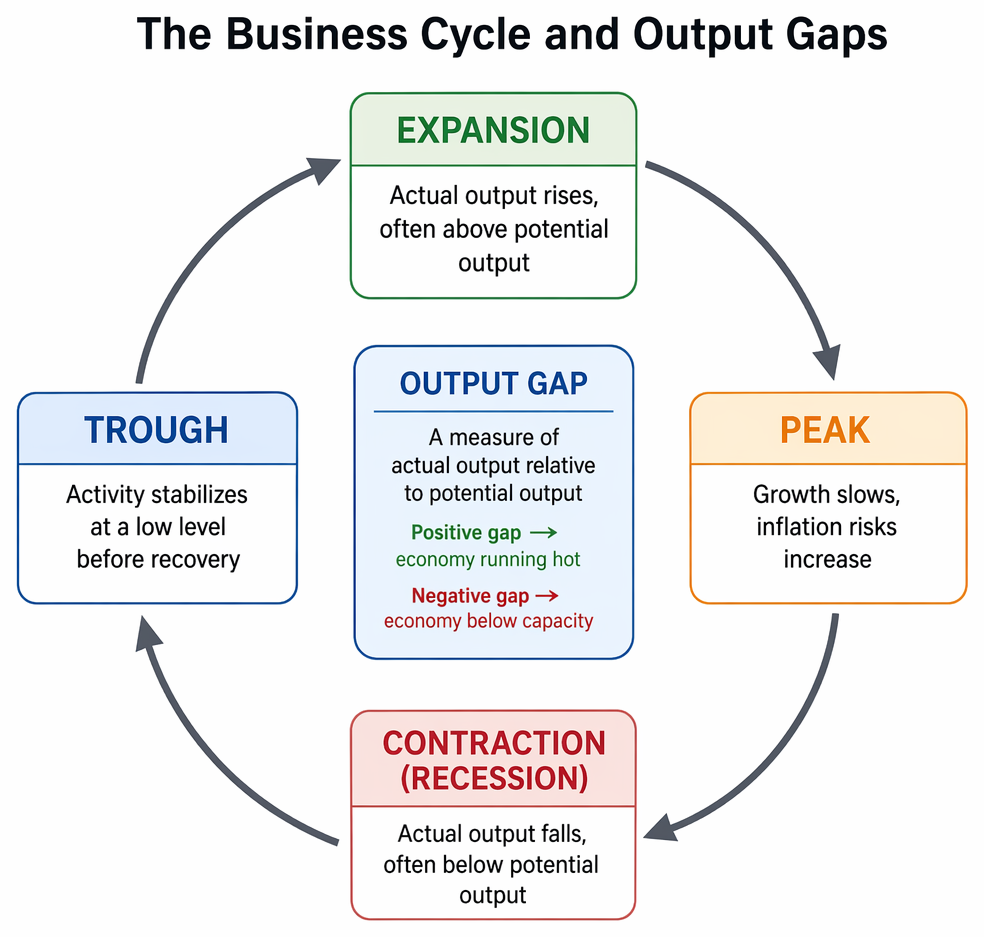
Output-gap relationships link real GDP relative to sustainable capacity with higher inflation under excess demand and lower inflation under spare capacity.
- Expansion: Actual output rises, often moving above potential output.
- Peak: Growth slows, and inflation risks increase.
- Contraction (recession): Actual output falls, often below potential output.
- Trough: Activity stabilizes at a low level before recovery.
The output gap offers a quantifiable approach to identify if an economy is running hot (positive gap) or operating below its capacity (negative gap). Detecting output gaps is central to analyzing inflation risk and shaping monetary and fiscal policy responses.
Inflation Behavior and the Output Gap
A persistent positive output gap typically leads to rising inflation. When demand outpaces supply, firms raise prices and seek more workers, increasing wage pressures. Conversely, a negative output gap means spare capacity—firms struggle to raise prices, and unemployment remains high, leading to subdued inflation or even deflation risk.
Key Term: Inflation Expectations
The beliefs of households, firms, and investors about future inflation, which influence wage negotiations, price setting, and the transmission of monetary policy.
Inflation expectations are essential. If people anticipate higher future inflation, they demand higher wages and are more willing to accept price increases, causing actual inflation to accelerate even without output gaps.
Role of Expectations and Policy
Central banks and policymakers closely monitor both the output gap and inflation expectations. If inflation expectations become "unanchored" (rising sharply), monetary authorities may raise interest rates preemptively—even before a positive output gap emerges. If expectations remain stable, inflation can be contained even during expansions.
Worked Example 1.1
Suppose a country’s potential real GDP is $1.2 trillion, but actual real GDP during the last quarter was $1.15 trillion. Calculate the output gap and interpret its meaning for inflation risk.
Answer:
Output gap = Actual Output – Potential Output = $1.15tr – $1.2tr = –$0.05tr (–$50bn). This is a negative output gap, indicating underutilized economic capacity. Inflation risk in this scenario is low.
Worked Example 1.2
During a boom, actual GDP reaches $1.3 trillion while potential remains $1.2 trillion. Unemployment is at a record low, and core inflation rises from 2% to 3.5% year-on-year. What mechanism is most likely driving this inflation increase?
Answer:
The positive output gap (actual > potential) creates tight labor and product markets, allowing wages and prices to rise, driving higher inflation.Exam Warning: Do not assume a positive output gap always leads to immediate or large inflation. Supply shocks, well-anchored expectations, or global factors can delay pass-through. Always consider both current and expected output gaps and incorporate available inflation expectations data.
Inflation, Output Gaps, and Economic Policy
Central banks use estimates of the output gap and inflation forecasts to set policy rates. When a positive output gap and rising inflation are detected, policy rates often rise. The larger and more persistent the output gap, the higher the policy response typically required to restrain inflation. Conversely, a significant negative output gap prompts monetary easing or fiscal stimulus.
Anchored inflation expectations reduce the risk of self-fulfilling inflation even at high levels of activity, giving central banks more flexibility. Unanchored expectations, on the other hand, can lead to inflationary spirals.
Expectations Formation and Implications
Expectations can be adaptive (based on past inflation) or rational (incorporating all information). Central banks now emphasize clear communication (forward guidance) to shape rational expectations and strengthen policy credibility—key to keeping inflation stable even during large output swings.
Worked Example 1.3
A central bank’s inflation target is 2%. Recent expansion pushed actual inflation to 2.8%, but surveys show that five-year inflation expectations remain near 2%. The policy rate remains unchanged. Is this a defensible stance? Why?
Answer:
Yes, if inflation expectations are well anchored near the target, policymakers may judge the current inflation overshoot as temporary and avoid tightening policy. However, if expectations rise, prompt action may be needed.
Summary
Business cycles move economies around their growth trend, causing actual output to exceed or fall short of potential. The resulting output gap is a key signal for inflation pressures and policy. Inflation is driven by persistent positive output gaps and, crucially, by expectations. Controlling inflation and maintaining stable growth depends on anticipating output gaps, understanding expectations, and using policy to stabilize both.
Key Point Checklist
This article has covered the following key knowledge points:
- Distinguish actual and potential output and define the output gap
- Identify business cycle phases and relate them to output gaps and inflation risks
- Explain how positive and negative output gaps affect wage and price pressures
- Recognize the critical role of expectations in inflation behavior and policy responses
- Apply these concepts directly in macroeconomic interpretation and forecasting for CFA assessment
Key Terms and Concepts
- Potential Output
- Actual Output
- Output Gap
- Inflation Expectations