Learning Outcomes
This article explains how central banks influence the money supply through open market operations, policy interest rates, and reserve requirements, and how these tools affect bank lending, credit conditions, and overall economic activity. It explains how money is created in a fractional reserve banking system and clarifies the concept of the money multiplier and its link to reserve requirements. It discusses the objectives and design of monetary policy, contrasting them with those of fiscal policy, including taxation and government spending decisions. It examines how monetary and fiscal actions transmit through interest rates, aggregate demand, inflation expectations, and asset prices, and how these channels ultimately influence output, employment, and inflation. It analyzes the impact of monetary and fiscal policy on foreign exchange markets, highlighting the role of interest rate differentials, capital flows, and FX interventions. It reviews common exam-style applications, including identifying the appropriate tool for a policy objective, predicting the directional effects of policy changes, and distinguishing clearly between monetary and fiscal measures in multiple-choice questions.
CFA Level 1 Syllabus
For the CFA Level 1 exam, you are expected to understand the principles and use of policy tools by central banks and governments, with a focus on the following syllabus points:
- The objectives and functions of central banks
- The main instruments of monetary policy: open market operations, policy interest rates, and reserve requirements
- The distinction and interaction between monetary and fiscal policy
- The money creation process and the concept of the money multiplier
- The effects of monetary and fiscal policy on economic growth, inflation, interest rates, and exchange rates
Test Your Knowledge
Attempt these questions before reading this article. If you find some difficult or cannot remember the answers, look more closely at that area during your revision.
- Which tool allows a central bank to directly influence the supply of money in the banking system?
- True or false? Fiscal policy can be used to stabilize cyclical fluctuations in an economy.
- Which monetary policy tool, if increased, would typically reduce the ability of banks to make new loans?
- Briefly explain the difference between monetary and fiscal policy in terms of their primary instruments and objectives.
Introduction
This article examines how monetary, fiscal, and foreign exchange (FX) policy tools operate, with a focus on central banks and money supply. These policies are fundamental to the evaluation of economic conditions and capital markets, as tested in CFA Level 1.
Test Tip: When revising Central banks money supply and policy tools, connect each definition, method, or rule to the kind of question the assessment is likely to ask.
Central Banks: Functions and Objectives
Central banks are central to monetary policy and the money supply.
Key Term: central bank
The primary institution conducting monetary policy and issuing legal tender, acting as a lender of last resort, and typically seeking stable prices.
Their key goals include:
- Price stability (controlling inflation)
- Promoting sustainable economic growth
- Safe and efficient payments system
- Supervising and regulating financial institutions
Most central banks, such as the US Federal Reserve, European Central Bank, or Bank of England, specifically target low and stable inflation and support full employment.
Money Supply: Definition and Creation
Money supply refers to all currency and deposits in the economy that can be used for transactions.
Key Term: money supply
The total amount of money available in an economy, usually measured by aggregates like M1, M2, and M3.
Commercial banks play a key role in creating money through fractional reserve banking: they keep only a fraction of deposits as reserves, lending out the rest, thus “creating” new money.
Key Term: money multiplier
The ratio showing how much money is created in the banking system from an initial deposit, due to fractional reserve lending.
A lower reserve requirement increases the money multiplier, expanding the total supply when banks lend more.
Policy Tools of Central Banks
Central banks use several instruments to influence the money supply and economic activity.
Open Market Operations (OMO)
Buying and selling government securities in the open market to increase or decrease bank reserves.
Policy Interest Rate (“Refinancing Rate”)
Setting the short-term rate at which banks borrow from the central bank. Lowering the rate generally eases monetary conditions (stimulates the economy), while raising it tightens them (slows the economy).
Reserve Requirements
Mandating a minimum portion of deposits banks must hold in reserve. A higher requirement limits lending and contracts the money supply.
Key Term: open market operations
Central bank purchases or sales of government securities to manage the level of bank reserves. Key Term: reserve requirement
The minimum proportion of deposits banks must retain and cannot lend out, set by the central bank.
Worked Example 1.1
A central bank increases its policy interest rate by 0.5%. What is the expected initial effect on the growth rate of the money supply and overall lending?
Answer:
A higher policy rate makes it more costly for banks to borrow and discourages lending, so money supply growth is likely to slow, and credit creation will decrease.
Fiscal Policy: Government’s Role
Fiscal policy is conducted by governments (not central banks) and involves decisions about taxation and government spending.
Key Term: fiscal policy
The use of government taxing and expenditure powers to influence aggregate demand, economic growth, and employment.
Objectives often include:
- Smoothing economic cycles
- Supporting long-term growth
- Reducing unemployment
- Achieving “fiscal sustainability” (manageable deficits/debt)
Fiscal expansion (higher spending or lower taxes) increases aggregate demand, while contraction does the opposite.
Worked Example 1.2
Suppose the economy is entering a recession. The government gives every taxpayer a one-time cash payment. What policy tool is this, and what effect is it expected to have?
Answer:
This is an example of expansionary fiscal policy (an increase in government spending). It aims to boost aggregate demand and reduce the depth of the recession.
Distinguishing Monetary and Fiscal Policy
It is essential to distinguish these two major forms of macroeconomic policy:
- Central banks use monetary policy tools (interest rates, OMOs, reserve requirements) to regulate money and credit.
- Governments use fiscal policy tools (taxes, spending, transfers) to influence demand directly.
Monetary policy acts mainly through the banking system and interest rates, while fiscal policy works through direct resource allocation.
Transmission Mechanisms and Economic Impacts
How do these policy tools transmit their effects?
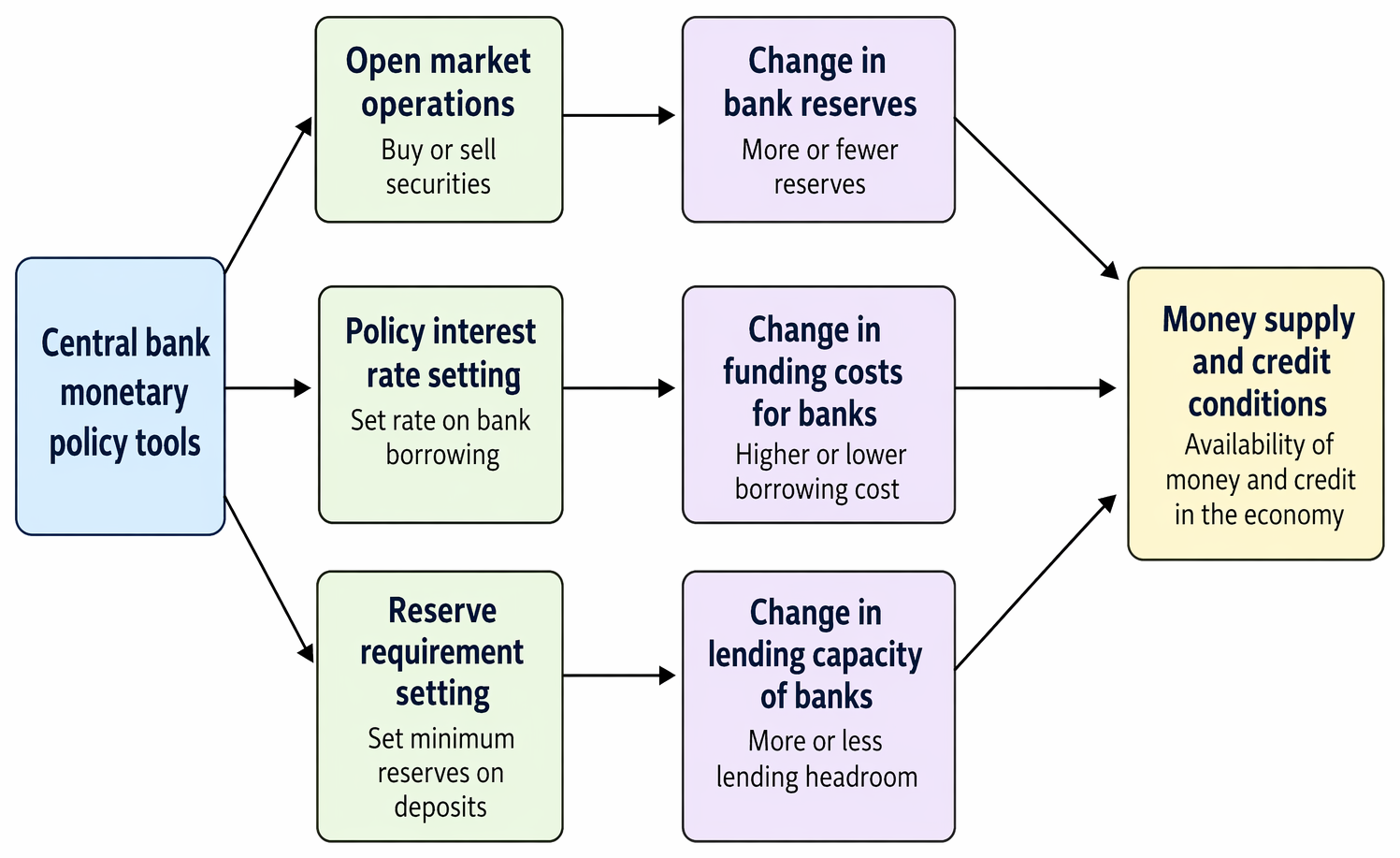
Central bank instruments affect money supply and credit conditions through changes in reserves, bank funding costs, and commercial bank lending.
- Monetary policy alters bank lending, asset prices, expectations, and the exchange rate.
- Fiscal policy acts directly on demand for goods and services via public sector spending and tax policies.
Key outcomes include:
- Economic growth: Both policies can stimulate or dampen output.
- Inflation: Overly loose monetary policy tends to increase inflation.
- Interest rates: Central bank actions influence the level and structure of market rates, affecting investment decisions.
- FX rates: Monetary tightening often attracts capital flows and appreciates the currency; loosening may cause depreciation.
Key Term: transmission mechanism
The process by which policy actions (especially monetary) affect real economic activity and inflation through channels such as lending, asset prices, expectations, and exchange rates.
FX (Foreign Exchange): Policy and Implications
Monetary and fiscal policy also impact FX rates:
- Higher real interest rates attract foreign capital, appreciating the currency.
- Expansionary fiscal policy may widen budget and current account deficits, pressuring FX rates.
Central banks may intervene directly in FX markets, buying or selling their own currency to achieve desired outcomes.
Key Term: FX intervention
Direct buying or selling of a country's currency in foreign exchange markets by the central bank to influence the exchange rate.
Interaction and Limitations of Policy Tools
Monetary and fiscal policy often interact:
- Effective monetary policy may be hampered if fiscal policy is inconsistent (e.g., persistent large deficits).
- Conversely, when short-term interest rates are near zero (“liquidity trap”), fiscal policy may take a larger role.
- In fixed exchange rate regimes, the central bank loses monetary policy autonomy.
Exam Warning: Be careful: On the CFA exam, confusing monetary and fiscal policies, or the tools used for each, is a common error. Monetary policy is central bank-led; fiscal policy is government-led.
Summary
Central banks influence money supply mainly through open market operations, policy rates, and reserve requirements, seeking to stabilize prices and support growth. Fiscal policy alters tax and spending to affect aggregate demand. Both sets of tools impact economic growth, inflation, and FX, but their relative effectiveness and transmission mechanisms differ. Understanding these distinctions is essential for CFA success.
Key Point Checklist
This article has covered the following key knowledge points:
- Distinguish between the objectives and tools of monetary and fiscal policy
- Understand central bank instruments: open market operations, policy rates, reserve requirements
- Explain the money creation process and the money multiplier
- Describe fiscal policy instruments and their macroeconomic roles
- Recognize how monetary and fiscal policy transmission mechanisms affect growth, inflation, and FX rates
- Identify basic effects of policy actions on money supply, interest rates, and exchange rates
Key Terms and Concepts
- central bank
- money supply
- money multiplier
- open market operations
- reserve requirement
- fiscal policy
- transmission mechanism
- FX intervention