Learning Outcomes
This article explains option-adjusted spread (OAS), effective duration, and effective convexity for bonds with embedded options and securitized products, including:
- defining and interpreting OAS as a measure of credit and liquidity spread net of embedded option value
- calculating effective duration and effective convexity using model-derived prices from yield curve shifts
- comparing effective measures with modified and Macaulay duration and standard convexity for option-free bonds
- evaluating how embedded calls, puts, and prepayment features alter cash flows, price sensitivity, and convexity patterns
- assessing the impact of parallel interest rate shifts and changes in volatility on OAS, duration, and convexity
- applying OAS-based risk measures to mortgage-backed and asset-backed securities when analyzing relative value
- interpreting numerical results for OAS, effective duration, and effective convexity in worked examples similar to CFA Level 2 exam questions
- integrating these tools into exam-style reasoning about valuation, risk management, and performance attribution for fixed-income portfolios that contain structured and securitized products.
CFA Level 2 Syllabus
For the CFA Level 2 exam, you are expected to understand how embedded options and securitized products affect fixed income valuation and risk metrics, with a focus on the following syllabus points:
- Explain the use of OAS in the valuation and comparison of bonds with embedded options and securitized products
- Calculate and interpret the effective duration and convexity for securities with embedded options and for securitized products
- Compare effective duration and convexity to standard duration and convexity for option-free bonds
- Assess the impact of changes in interest rates and volatility on OAS, duration, and convexity in bonds with embedded options
Test Your Knowledge
Attempt these questions before reading this article. If you find some difficult or cannot remember the answers, look more closely at that area during your revision.
- What does the option-adjusted spread (OAS) represent when valuing a callable corporate bond?
- Why is effective duration preferred over modified duration for bonds with embedded options?
- How does increased interest rate volatility affect the value and measured OAS of a callable bond?
- True or False: Effective convexity for a callable bond is always positive.
Introduction
Valuing and managing the risk of bonds with embedded options and securitized products requires specialized tools. Standard duration and convexity metrics do not fully capture the changing cash flows and price/yield relationship for these securities. This article presents the option-adjusted spread (OAS), effective duration, and effective convexity, which allow you to evaluate relative value and risk for callable and putable bonds, mortgage-backed securities, and other structured products.
Key Term: embedded option
An option included in a bond or security contract that gives either the issuer or investor specific rights, such as redeeming or selling the bond before maturity.
OAS: Option-Adjusted Spread
OAS is the yield spread over benchmark rates that makes the model value of a bond with embedded options equal to its observed market price, after adjusting for the value of embedded options. For securitized products built with prepayment risk or other features, OAS removes the cost of the option, measuring only spread for credit and liquidity risk.
Key Term: option-adjusted spread (OAS)
The constant spread added to all rates in an interest rate model such that the model price equals the observed market price, with option value removed.
Effective Duration for Embedded Options and Securitized Products
Conventional duration assumes fixed cash flows, which is not appropriate for securities with embedded options or path-dependent prepayments. Effective duration addresses this by capturing sensitivity to parallel shifts in the yield curve, taking into account potential cash flow changes if embedded options are exercised.
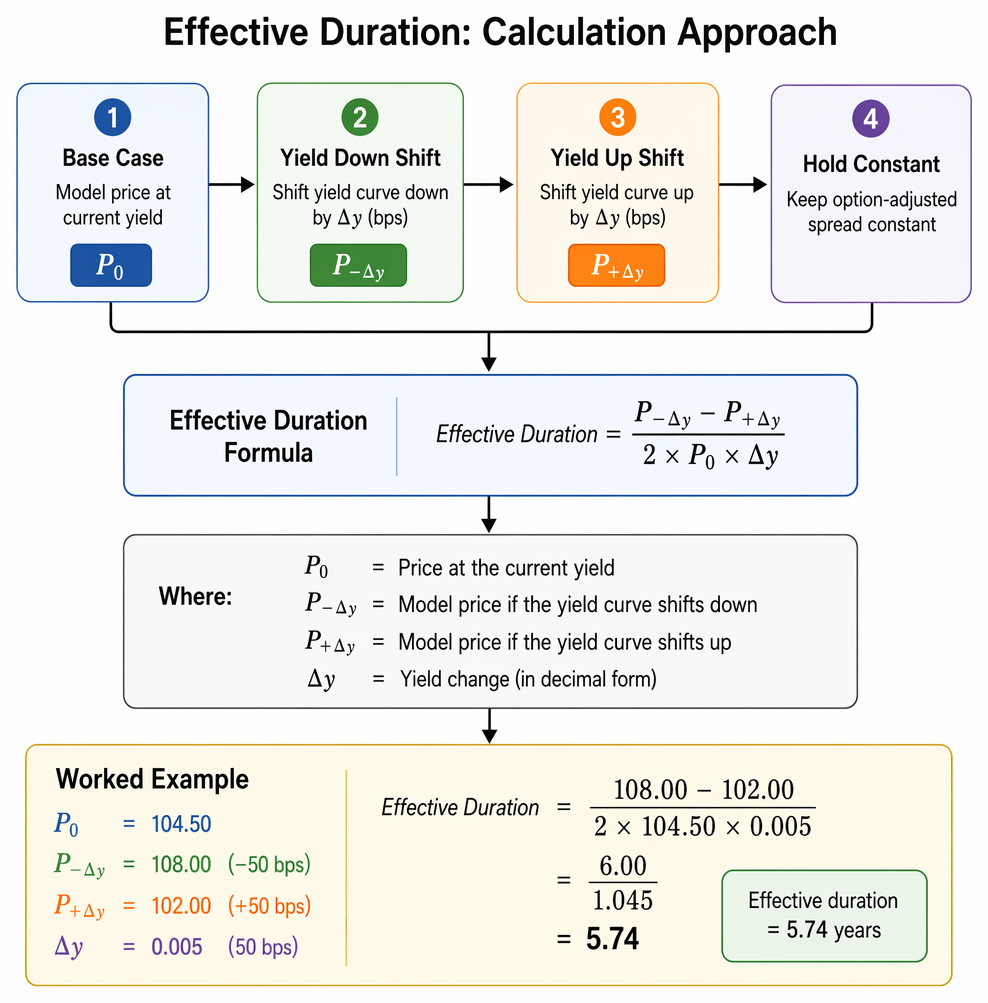
Effective duration is computed after OAS calibration by repricing under parallel benchmark curve shifts while holding the spread constant.
Key Term: effective duration
The percentage change in value of a bond or security, per unit change (in basis points) in the benchmark yield curve, that incorporates changes in expected cash flows due to option exercise. Key Term: effective convexity
A measure capturing the curvature in the price/yield relationship for bonds whose cash flows change as yields move, as with embedded options and prepayments.
Why Modified Duration Is Not Enough
Modified or Macaulay duration do not adjust for the changing timing or amounts of cash flows when options are exercised or prepaid. For example, if a callable bond is likely to be called when rates drop, its duration will decrease accordingly, an effect not captured by modified duration.
Calculating Effective Duration
To compute effective duration, you use a model (typically a binomial interest rate tree or Monte Carlo simulation) to estimate the bond’s price for a specified up and down shift in the benchmark yield curve, holding the option-adjusted spread constant.
- : Price at the current yield.
- : Model price if the yield curve shifts down.
- : Model price if the yield curve shifts up.
- : Yield change (in decimal form).
Worked Example 1.1
Question: A $100-par callable bond (annual coupon, currently priced at $104.50) is valued using a binomial model. The price increases to $108.00 if yields fall by 50 bps, and falls to $102.00 if yields rise by 50 bps. What is its effective duration?
Answer:
The effective duration is 5.74 years.
Effective Convexity for Embedded Options
Effective convexity adjusts for the fact that for bonds with embedded calls, price increases as yields fall are limited (negative convexity near call), while for putable and option-free bonds, price increases more than price decreases as yields fall.
Worked Example 1.2
Given the previous bond and price data ( = $104.50, P_{-\Delta y} = $108.00, P_{+\Delta y} = $102.00, = 0.005), calculate effective convexity.
Answer:
The negative convexity indicates the callable bond's limited price gain if yields fall.
Exam Warning: Many candidates confuse effective duration with modified duration for embedded option securities. Only effective duration correctly accounts for cash flow changes from option exercise or prepayment.
Application to Securitized Products
Mortgage- and asset-backed securities often have cash flows that depend on interest rates due to prepayments. As rates fall, prepayments rise, reducing both the expected maturity and duration (negative convexity characteristic).
Key Term: securitized product
A security whose cash flows are backed by a pool of collateral assets and often subject to path-dependent prepayment, extension, or credit events affecting expected cash flows.
OAS and Risk Measures for Embedded Option Securities
- For securities with options, OAS is the correct spread to use when comparing credit and liquidity risk across products and issuers, as it removes the embedded option's value.
- Effective duration and convexity, calculated using OAS, provide a more accurate representation of market and prepayment risk.
Worked Example 1.3
Question: A 30-year mortgage-backed security has an OAS of 150 bps over Treasuries, effective duration of 3.5, and effective convexity of -45. What does this tell an investor?
Answer:
The OAS of 150 bps reflects compensation for credit and liquidity risk, excluding option risk. A duration of 3.5 means modest sensitivity to parallel yield shifts. The negative convexity signals that as yields fall, prepayments accelerate and duration shrinks.Revision Tip: For option-free bonds, duration and convexity are stable, but for securities with embedded options or prepayment risk, always use effective duration and convexity when analyzing interest rate sensitivity.
Summary
For fixed income securities with embedded options and securitized products, traditional risk measures underestimate changes in cash flow and price sensitivity. OAS, effective duration, and effective convexity allow for proper valuation, meaningful spread comparisons, and robust risk measurement, all of which are critical for your CFA Level 2 preparation.
Key Point Checklist
This article has covered the following key knowledge points:
- Explain and interpret OAS in the context of embedded options and prepayment risk
- Calculate effective duration and convexity for securities with changing cash flows
- Distinguish between effective duration/convexity and standard duration/convexity
- Relate the impact of volatility, prepayment, and embedded options to risk measures
Key Terms and Concepts
- embedded option
- option-adjusted spread (OAS)
- effective duration
- effective convexity
- securitized product