Learning Outcomes
After reading this article, you will understand how to construct effective introduction and conclusion paragraphs in LSAT argumentative essays. You will know the roles, key features, and logical expectations for each paragraph type. You will be able to apply practical techniques that maximise essay clarity, direction, and persuasiveness across all assessment scenarios.
LSAT Syllabus
For LSAT, you are required to understand written argument structure, with a specific focus on the opening and closing paragraphs of persuasive essays. In your revision for this topic, pay particular attention to:
- the purpose and typical language of introduction and conclusion paragraphs in LSAT essays
- how to introduce a clear thesis and preview argument structure
- the correct approach to closing an argument and reinforcing your main position
- common pitfalls and effective strategies for both paragraphs under timed exam conditions
Test Your Knowledge
Attempt these questions before reading this article. If you find some difficult or cannot remember the answers, look more closely at that area during your revision.
- What are the two essential components of an LSAT argumentative essay introduction?
- Which paragraph should explicitly restate your thesis in a persuasive manner?
- Name one common mistake made when writing LSAT conclusions.
- True or false: An introduction should always list every supporting argument in detail.
Introduction
Clear and effective essays begin and end with purpose. In the LSAT Writing section, the introduction and conclusion each have a distinct role: the introduction sets the direction, the conclusion signals that your case is complete. Both must quickly show the reader that you understand how to construct a focused, reasoned argument.
Key Term: introduction paragraph
The first paragraph of an argumentative essay, designed to establish context, present the central thesis, and preview the essay's structure. Key Term: conclusion paragraph
The final paragraph in an argumentative essay, used to reaffirm your thesis, pull together main points, and give the essay a sense of completion.
ESSAY INTRODUCTIONS
An effective introduction paragraph is purposeful, focused, and direct. The goal is to help the reader immediately understand your answer to the given prompt.
Conclusion development is presented as a stepwise process from thesis reaffirmation and brief synthesis to wording checks and confident closure.### The Purpose of the Introduction
The introduction serves three essential functions:
- Outlines the essay’s general topic and any relevant context or scenario from the prompt.
- States your clear thesis: the main argument or "side" you are taking.
- Previews the logic or structure of the essay—without giving away all details.
Key Term: thesis statement
A sentence that asserts your main position or answer to the argumentative essay’s central question.
Typical Structure
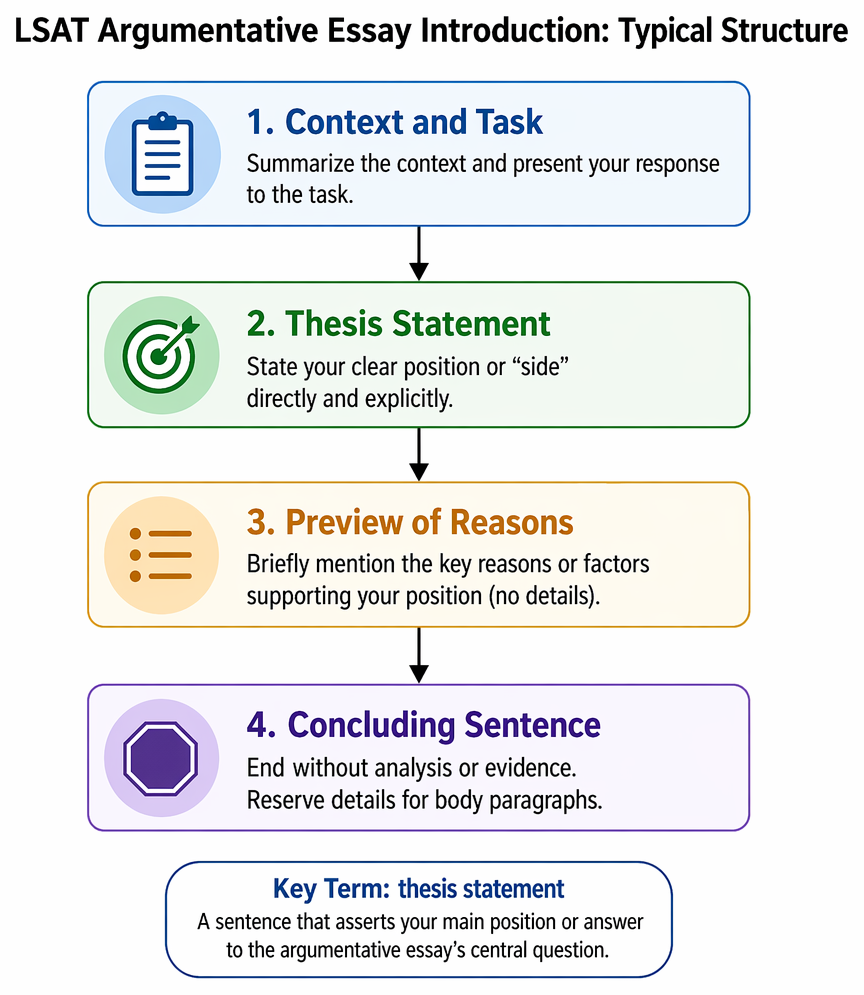
A model LSAT argumentative essay introduction will:
- Open with a concise sentence summarizing the context and presenting your response to the task.
- State your thesis clearly. This should be direct (e.g., “The manager should choose Option A because...”).
- Briefly mention (without detail) the key reasons or factors that support your thesis.
- End without including supporting analysis or detailed evidence (reserve these for body paragraphs).
Worked Example 1.1 Essay Prompt: A school leader must choose between funding an art club or a computer class. Write an argument for either option, considering student engagement and long-term benefits
Possible Introduction: "School leaders often face limited budgets and must prioritize student needs. In this case, funding the computer class is the more effective choice for two reasons: it equips students with necessary career skills and supports engagement through relevant technology. Therefore, the school should direct resources towards the new computer class."
Answer:
This example establishes context, states the choice, previews two reasons, and avoids detailed evidence.
Common Introduction Errors
- Failing to state a clear thesis.
- Including too many details about evidence or explanation.
- Using vague or formulaic openers that add no value.
Revision Tip: Always state your thesis in the introduction. Avoid starting with a generic definition or restating the entire prompt word-for-word.
ESSAY CONCLUSIONS
The conclusion is often the last thing a reader remembers. In LSAT essays, it must firmly indicate the end of your case while ensuring your position is both restated and strengthened.
The Purpose of the Conclusion
LSAT examiners expect you to:
- Restate your thesis in fresh, persuasive language.
- Summarize—very briefly—the primary arguments or principles without repeating body paragraph details.
- Signal resolution: make it clear the essay is finished and your recommendation is firm.
Typical Structure Details
An effective conclusion will:
- Open by reaffirming your central argument (using different language from the introduction).
- Reference (without restating) key factors or principles you relied on.
- Optionally, note any acknowledgment of the other side, or why your approach is best regardless.
Worked Example 1.2 Original Essay Thesis: The school should fund the computer class because it prepares students for modern work and increases learning interest
Possible Conclusion: "In summary, while supporting arts is valuable, investing in computer education ensures that every student gains essential skills for future success and remains engaged in their studies. For these reasons, the computer class represents the more effective and responsible choice for the school."
Answer:
The conclusion restates the judgment, briefly touches on reasoning, and gives closure.
Common Conclusion Errors
- Repeating the introduction verbatim.
- Adding new evidence or introducing unrelated arguments.
- Using weak, formulaic endings (e.g., "In conclusion, that's why I think...").
Exam Warning: Do not introduce new evidence, arguments, or examples in your conclusion. The LSAT expects closure, not development of new points.
ENSURING LOGICAL CONSISTENCY
Strong introductions and conclusions must align: your essay's position should not shift. If you opened with a direct recommendation, ensure your closing language remains firmly on that side.
Worked Example 1.3 Flawed Example: An introduction that supports Option B, followed by a conclusion that says "Either funding choice may be valid."
Answer:
Inconsistent. You must recommend one side throughout.
Key Point Checklist
This article has covered the following key knowledge points:
- An LSAT essay’s introduction must present clear context, directly state your thesis, and briefly preview supporting reasons.
- The thesis is the central claim that guides your argument and should appear early in your essay.
- The conclusion paragraph restates your position, brings together key arguments, and always signals completion—never adds new evidence.
- Consistency between introduction, body, and conclusion is required for a logical and effective essay structure.
- Avoid common mistakes—such as vague openings, excessive detail in the introduction, or inconsistent recommendations.
Key Terms and Concepts
- introduction paragraph
- conclusion paragraph
- thesis statement