Learning Outcomes
This article explains intoxication as a criminal law defense, including:
- Distinguishing clearly between voluntary and involuntary intoxication based on how the intoxicant was consumed, the defendant's awareness, and any coercion involved.
- Identifying when intoxication can negate the mental state required for specific intent crimes, with emphasis on how severe intoxication must be to defeat formation of purpose or knowledge.
- Applying intoxication rules to general intent, malice, and strict liability offenses, and recognizing why voluntary intoxication almost never assists a defendant for these categories on the MBE.
- Analyzing how intoxication interacts with homicide offenses, particularly how voluntary intoxication may affect premeditation and deliberation without eliminating malice or recklessness.
- Evaluating how intoxication is treated in crimes requiring recklessness, including the doctrine that voluntarily intoxicated defendants are deemed aware of substantial risks they fail to perceive.
- Spotting common MBE traps in intoxication fact patterns, such as confusing memory loss with lack of mens rea, misclassifying offense types, or overstating the scope of involuntary intoxication as an insanity-type defense.
MBE Syllabus
For the MBE, you are required to understand how intoxication affects criminal liability and interacts with mental state requirements, with a focus on the following syllabus points:
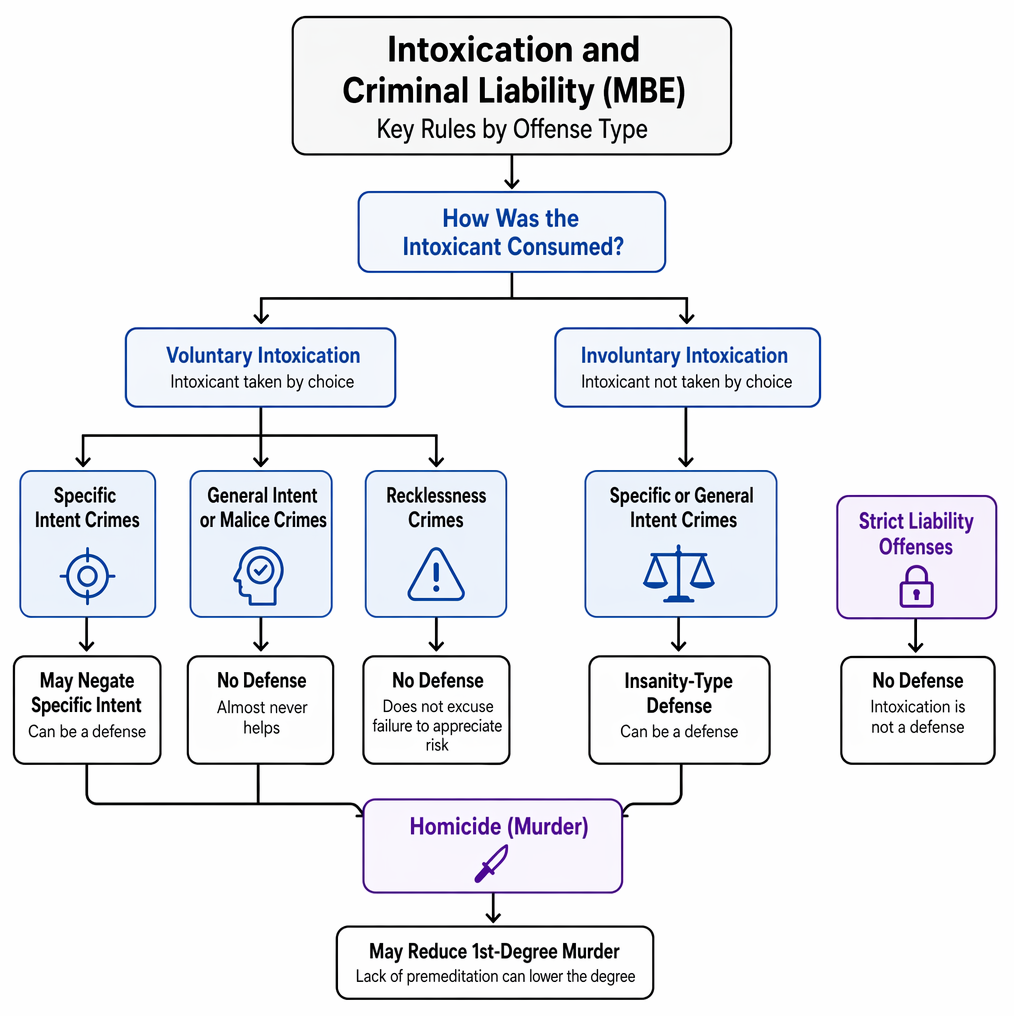
Voluntary intoxication negates culpability only when it prevents specific intent; it is unavailable for general intent, malice, and strict liability.
- Distinguish voluntary from involuntary intoxication based on how the intoxicant was consumed.
- Determine when voluntary intoxication can negate specific intent, and why it almost never helps with general intent or malice crimes.
- Apply involuntary intoxication as an insanity‑type defense to specific and general intent crimes.
- Analyze how intoxication operates in homicide, particularly in reducing first‑degree murder based on lack of premeditation.
- Evaluate crimes requiring recklessness and why intoxication does not excuse failure to appreciate risk.
- Confirm that intoxication is not a defense to strict liability offenses on the MBE.
Test Your Knowledge
Attempt these questions before reading this article. If you find some difficult or cannot remember the answers, look more closely at that area during your revision.
-
Which type of crime is most likely to be negated by voluntary intoxication?
- a) Strict liability
- b) General intent
- c) Specific intent
- d) Malice
-
Involuntary intoxication is a defense to:
- a) Only specific intent crimes
- b) Only strict liability crimes
- c) Both specific and general intent crimes if it negates mens rea
- d) No crimes
-
Which of the following is NOT a recognized form of involuntary intoxication?
- a) Being drugged without knowledge
- b) Taking medication with an unexpected reaction
- c) Drinking alcohol voluntarily
- d) Being forced to consume an intoxicant
Introduction
Intoxication is a recurring issue in criminal law, especially on the MBE. Whether intoxication can serve as a defense depends on whether it was voluntary or involuntary, and on the type of crime charged. Because intoxication affects a defendant’s mental state, the key exam task is to decide whether the intoxication prevents the prosecution from proving the required mens rea.
Two questions should guide your analysis in every intoxication problem:
- Was the intoxication voluntary or involuntary?
- Is the charged crime a specific intent crime, a general intent or malice crime, or a strict liability offense?
Once you answer those two questions, most intoxication issues become mechanical. The rules below are framed to mirror common MBE patterns.
Key Term: Voluntary Intoxication
The state of being intoxicated as a result of one's own voluntary act of consuming alcohol, drugs, or other intoxicating substances, knowing their nature.
Voluntary Intoxication
Voluntary intoxication occurs when a person knowingly consumes an intoxicant, such as alcohol or drugs, by their own choice. This is sometimes called self‑induced intoxication.
Voluntary intoxication is generally not a defense to most crimes. However, it may negate the mens rea for specific intent crimes if the intoxication is so severe that the defendant could not form the required intent at the time of the act.
Key Term: Specific Intent Crime
A crime that requires the defendant to have a particular purpose or objective beyond the act itself, such as larceny (intent to permanently deprive) or burglary (intent to commit a felony inside).
For specific intent crimes (the classic FIAT group: first‑degree premeditated murder, inchoate offenses like attempt, assault with intent crimes, and theft‑type offenses such as larceny and burglary), the prosecution must prove that extra mental element. If the defendant was so drunk or high that they could not form that specific purpose, voluntary intoxication can operate as a failure‑of‑proof defense: the state simply cannot establish the required intent.
Important limits:
- Mere drunkenness is not enough. The intoxication must actually prevent formation of the specific intent.
- Timing matters. If the defendant formed the specific intent before becoming intoxicated and then drank to “get up the nerve,” voluntary intoxication is not a defense. The mental state already existed.
Voluntary intoxication is never a defense to:
- General intent crimes,
- Malice crimes (like common law murder or arson), or
- Strict liability offenses on the MBE.
Key Term: General Intent Crime
A crime that requires only the intent to perform the prohibited act, without a further specific purpose, such as battery or rape. Key Term: Strict Liability Crime
A crime that does not require proof of any mental state as to at least one material element; the act alone is sufficient for liability (e.g., statutory rape, many regulatory offenses). Key Term: Malice Crime
A crime—such as common law murder or arson—that requires a reckless or depraved mental state, showing a disregard of an obvious or high risk of harm.
For malice and recklessness crimes, a voluntarily intoxicated person is treated as if they were aware of the risk. A defendant cannot argue, “I was too drunk to realize the danger.” If the only reason the defendant was unaware of a substantial and unjustifiable risk is intoxication, the law deems that unawareness reckless.
Voluntary Intoxication and Homicide Degrees
Many jurisdictions divide murder into degrees:
- First‑degree murder often requires premeditation and deliberation.
- Second‑degree murder captures other killings with malice (including “depraved heart” reckless murders).
Voluntary intoxication may, in some jurisdictions, negate premeditation and deliberation, potentially reducing a charge from first‑degree murder to second‑degree. However, it does not negate the malice or recklessness needed for second‑degree murder. On the MBE, if voluntary intoxication appears in a murder question, look for answer choices that reduce first‑degree to second‑degree, rather than to manslaughter.
Involuntary Intoxication
Involuntary intoxication arises when a person becomes intoxicated without their knowledge or against their will, or has an unexpected reaction to medication.
Key Term: Involuntary Intoxication
Intoxication that occurs without the person's voluntary action or informed choice, such as being drugged unknowingly, forced to consume an intoxicant, or experiencing an unanticipated intoxicating reaction to properly taken medication.
Common forms of involuntary intoxication include:
- Being given an intoxicant without knowledge of its nature (e.g., someone spikes a drink).
- Being forced or coerced to consume an intoxicant.
- Taking prescription or over‑the‑counter medication as directed and having a truly unexpected intoxicating effect, where the person had no reason to anticipate impairment.
Involuntary intoxication is treated similarly to insanity. It is a defense to both specific and general intent crimes if it prevents the defendant from forming the required mental state or, in some jurisdictions, if it causes the defendant to meet the jurisdiction’s insanity test.
Because it is not self‑induced, courts are willing to excuse conduct when the intoxication destroys the defendant’s ability to understand their acts or conform to the law.
Application to Crime Types
Pulling these rules together:
-
Specific Intent Crimes
- Voluntary intoxication may be a defense if it actually prevents formation of the specific intent.
- Involuntary intoxication is a defense if it negates intent or renders the defendant insane.
-
General Intent and Malice Crimes
- Voluntary intoxication is not a defense. A voluntarily intoxicated defendant is still treated as having the general intent or malice required.
- Involuntary intoxication may be a defense if it prevents the defendant from forming the general intent or malice, or if it satisfies an insanity standard.
-
Crimes Requiring Recklessness
- Voluntary intoxication cannot be used to claim lack of awareness of risk. If the defendant’s failure to perceive a substantial risk is due to intoxication, the law treats the defendant as having acted recklessly.
- Involuntary intoxication can be a defense if, because of the intoxication, the defendant was incapable of the required awareness and the intoxication was not self‑induced.
-
Strict Liability Crimes
- On the MBE, neither voluntary nor involuntary intoxication is a defense as to the strict liability element, because no mens rea is required.
Worked Example 1.1
A defendant is charged with burglary after breaking into a store while extremely drunk. He claims he was so intoxicated he did not intend to steal anything. Is voluntary intoxication a defense?
Answer:
Possibly. Burglary is a specific intent crime (entry plus intent to commit a felony inside). If the defendant was so intoxicated that he truly could not form the intent to commit a felony at the time of entry, voluntary intoxication may negate that specific intent. The jury would need to decide whether he actually lacked the intent, not just whether he was heavily intoxicated.
Worked Example 1.2
A woman is charged with battery after assaulting someone while under the influence of a drug slipped into her drink without her knowledge. She claims she would not have acted that way if sober. Is involuntary intoxication a defense?
Answer:
Yes. Battery is a general intent crime, but involuntary intoxication can be a defense to both specific and general intent crimes if it prevents formation of the required intent. Here, the woman did not voluntarily become intoxicated, and if the drugged state caused her to act without the usual control or awareness, she may be acquitted.
Worked Example 1.3
A man spends the evening drinking heavily at a bar. On his way home, he angrily punches a passerby (causing bodily injury) and then, moments later, quietly slips the passerby’s phone out of his pocket and walks away with it. He is charged with battery and larceny. Can he use voluntary intoxication as a defense?
Answer:
Voluntary intoxication is not a defense to battery because battery is a general intent crime; the prosecution only needs to show that he intended the harmful or offensive contact. However, larceny is a specific intent crime requiring intent to permanently deprive. If the man was so intoxicated that he could not form that intent, voluntary intoxication could potentially negate the mens rea for larceny, though the deliberate act of taking and keeping the phone will make that argument difficult.
Worked Example 1.4
A woman firmly decides one afternoon to kill her neighbor. She loads a gun, but becomes nervous and drinks several shots of whiskey “to calm her nerves” before walking next door and shooting the neighbor. She claims voluntary intoxication as a defense to intentional murder. How should a court rule?
Answer:
The defense fails. Intentional murder is a specific intent crime, but the woman formed the specific intent before becoming intoxicated and drank only to strengthen her resolve. Voluntary intoxication does not negate a mental state that already existed. On these facts, intoxication cannot reduce or eliminate her liability for intentional murder.Exam Warning: Voluntary intoxication is never a defense to strict liability or general intent crimes on the MBE, and it does not negate the malice required for common law murder or arson. Also remember that being “too drunk to remember” is not the same as being too intoxicated to form intent—memory loss after the fact does not prove lack of mens rea at the time of the act.
Revision Tip: Always begin by identifying (1) the type of crime (specific intent, general intent, malice, or strict liability), and (2) whether the intoxication was voluntary or involuntary. Then ask whether the intoxication, under those classifications, can legally negate the required mental state. This step‑by‑step approach mirrors how MBE questions are drafted and helps eliminate attractive but incorrect answer choices.
Summary
Intoxication as a defense turns on both the source of the intoxication (voluntary versus involuntary) and the type of crime charged. Voluntary intoxication may, in limited circumstances, negate the extra mental element for specific intent crimes, but it offers no help for general intent, malice, recklessness, or strict liability offenses. Involuntary intoxication, treated like an insanity‑type condition, can be a complete defense to specific and general intent crimes if it prevents the defendant from forming the required mens rea. For homicide, voluntary intoxication may sometimes reduce a first‑degree premeditated murder charge to second‑degree by undermining deliberation, but it cannot erase malice. Focusing on these structured distinctions will allow you to resolve MBE intoxication questions efficiently and accurately.
Key Point Checklist
This article has covered the following key knowledge points:
- Voluntary intoxication may be a defense only to specific intent crimes, and only if it actually negates the specific intent at the time of the act.
- Voluntary intoxication is not a defense to general intent, malice, reckless, or strict liability crimes, and cannot be used to deny awareness of obvious risks.
- Involuntary intoxication is a defense to both specific and general intent crimes if it negates mens rea or causes the defendant to satisfy an insanity standard.
- On the MBE, intoxication—whether voluntary or involuntary—is not recognized as a defense to strict liability offenses.
- For murder, voluntary intoxication may negate premeditation and deliberation (affecting first‑degree), but not the malice supporting second‑degree murder.
- Always analyze intoxication questions in two steps: classify the intoxication (voluntary/involuntary) and classify the offense (specific intent/general intent/malice/strict liability).
Key Terms and Concepts
- Voluntary Intoxication
- Involuntary Intoxication
- Specific Intent Crime
- General Intent Crime
- Strict Liability Crime
- Malice Crime