Learning Outcomes
This article reviews the fundamental principles of jurisdiction essential for success on the MBE Civil Procedure section. It clarifies the difference between personal jurisdiction (a court's power over the parties or property) and subject matter jurisdiction (a court's power over the type of case), emphasizing how both must be satisfied in any federal civil action. It reviews how to analyze statutory and constitutional bases for personal jurisdiction, including traditional bases, long-arm statutes, minimum contacts, specific versus general jurisdiction, relatedness, fairness, and the constitutional notice requirement. It details how to determine when federal courts have subject matter jurisdiction based on diversity and federal question, and when related state or additional party claims may be heard through supplemental jurisdiction. It explains how removal jurisdiction operates, including who may remove, time limits, and the in-state defendant limitation in diversity cases. It also reviews the basic federal venue rules, transfer, and the relationship between venue and personal jurisdiction in common exam fact patterns. Finally, it examines how the Erie doctrine directs federal courts sitting in diversity to apply state substantive law and federal procedural law, and how to spot Erie issues that are frequently embedded in MBE questions.
MBE Syllabus
For the MBE, you are required to understand the principles governing a court's power over both the parties (personal jurisdiction) and the type of case (subject matter jurisdiction), with a focus on the following syllabus points:
- Distinguish personal jurisdiction (PJ) from subject matter jurisdiction (SMJ).
- Analyze the constitutional "minimum contacts" test for PJ (International Shoe).
- Identify traditional bases for PJ (domicile, presence, consent).
- Apply state long-arm statutes.
- Differentiate general and specific personal jurisdiction.
- Understand in personam, in rem, and quasi in rem jurisdiction.
- Assess federal diversity jurisdiction requirements (complete diversity, amount in controversy).
- Assess federal question jurisdiction requirements ("arising under" federal law).
- Apply rules for supplemental jurisdiction.
- Apply rules for removal jurisdiction.
- Understand basic venue rules and transfer.
- Recognize constitutional notice requirements (Mullane).
- Understand the Erie doctrine's application in diversity cases.
Test Your Knowledge
Attempt these questions before reading this article. If you find some difficult or cannot remember the answers, look more closely at that area during your revision.
-
For a federal court to exercise diversity jurisdiction, which requirement must generally be met?
- a) The claim must arise under federal law.
- b) The amount in controversy must exceed $75,000, and there must be complete diversity between opposing parties.
- c) The defendant must have minimum contacts with the forum state.
- d) At least one plaintiff must be diverse from at least one defendant.
-
A defendant's purposeful availment of the forum state is most relevant to analyzing:
- a) Federal question jurisdiction.
- b) The amount in controversy for diversity jurisdiction.
- c) Constitutional limitations on personal jurisdiction.
- d) Venue.
-
A state court action may generally be removed to federal court by the defendant if:
- a) The state court lacks personal jurisdiction over the defendant.
- b) The plaintiff consents to removal.
- c) The case could have originally been filed in federal court.
- d) The defendant asserts a federal defense.
Introduction
Before a court can validly adjudicate a dispute, it must have jurisdiction. Jurisdiction refers to the power of the court to hear a case and issue a binding judgment. For the MBE, you must understand two primary types of jurisdiction:
- Personal Jurisdiction (PJ) – the court's power over the specific parties (or property) involved.
- Subject Matter Jurisdiction (SMJ) – the court's power over the type of claim being asserted.
A federal court must have both PJ and SMJ, and venue must also be proper. A state court must have PJ, and usually has broad SMJ over most civil disputes unless a federal statute gives federal courts exclusive jurisdiction (e.g., patents, bankruptcy, copyrights).
Key Term: Jurisdiction
The legal authority of a court to bind the parties before it by entering a valid, enforceable judgment. Key Term: In Personam Jurisdiction
Personal jurisdiction based on the court’s power over a particular person (the defendant). It supports a judgment for money damages or injunctive relief enforceable against all of the defendant’s assets. Key Term: In Rem Jurisdiction
Jurisdiction over a piece of property within the forum, allowing the court to determine the rights of all persons in the world concerning that property (e.g., condemnation, forfeiture, probate of local property). Key Term: Quasi In Rem Jurisdiction
Jurisdiction where the court uses a defendant’s property in the forum to adjudicate either ownership of that property (type I) or an unrelated personal claim (type II); recovery is limited to the value of the property. Key Term: Domicile
A person’s permanent home—where they are physically present with the intent to remain indefinitely. An individual has only one domicile at a time, and it determines state citizenship for diversity jurisdiction.
On the MBE, jurisdiction questions often mix several doctrines in a single fact pattern: minimum contacts, long-arm statutes, removal, supplemental jurisdiction, venue, and the Erie doctrine. You should train yourself to spot and separate each issue.
Test Tip: When revising Jurisdiction, connect each definition, method, or rule to the kind of question the assessment is likely to ask.
Exam Warning: Do not rely on keyword recognition alone; check the precise condition, exception, calculation step, or evidence the question requires.
Personal Jurisdiction (PJ)
Personal jurisdiction refers to the court's ability to exercise authority over a particular defendant. The exercise of PJ must satisfy both statutory and constitutional requirements.
At a high level:
- Ask first: Is there a statutory basis?
- Then ask: Is the exercise of jurisdiction constitutional (minimum contacts, relatedness, and fairness)?
- Finally: Was PJ preserved, or was it waived by failing to object?
Key Term: Personal Jurisdiction
The court's power over a specific defendant or item of property, necessary for the court to issue an enforceable judgment against that defendant or affecting that property interest.
Statutory Analysis
States decide by statute over whom their courts may exercise personal jurisdiction. Federal courts typically borrow state rules.
Under FRCP 4(k)(1)(A), a federal district court usually has the same personal jurisdiction as a court of general jurisdiction in the state where it sits. So the initial question is typically: Would a state court in this state have PJ?
Common statutory bases:
- Traditional Bases (in personam):
- Presence ("tag" jurisdiction): The defendant is served with process while physically present in the forum state, even briefly and even if the claim is unrelated to the visit. This was upheld in Burnham.
- Domicile: The defendant is domiciled in the forum state, even if served elsewhere.
- Consent: The defendant consents to jurisdiction:
- Expressly (e.g., forum-selection clause or appointment of an agent for service),
- Impliedly (e.g., by driving in the state under a nonresident motorist statute), or
- By voluntary appearance without timely objection.
Key Term: Long Arm Statute
A state law that permits a court to exercise personal jurisdiction over an out-of-state defendant based on specified contacts the defendant has with the forum state (e.g., transacting business, committing a tort, owning property).
-
Long-Arm Statutes:
- "Coextensive" or "unlimited" long-arm statutes: Authorize jurisdiction to the full extent permitted by due process. In these states, the statutory and constitutional analyses merge.
- "Enumerated act" long-arm statutes: List specific situations where PJ is allowed (e.g., transacting business in the state, committing a tort in the state, owning property, contracting to insure a risk located in the state). In such jurisdictions you must:
- First fit the case within the statute, and
- Then test constitutionality (minimum contacts).
-
Special federal provisions:
- 100-mile bulge rule (FRCP 4(k)(1)(B)): In federal court, parties joined under Rules 14 (implaeder) or 19 (required joinder) can be served within 100 miles of the issuing court—even across state lines—regardless of state long-arm limits.
- Nationwide service statutes: Some federal statutes (e.g., certain federal securities or antitrust statutes) authorize nationwide service of process; in those cases the due process inquiry focuses on contacts with the United States as a whole.
Waiver of Personal Jurisdiction
Even if there is no statutory or constitutional basis for PJ, a defendant can waive the defense.
-
PJ is an affirmative defense that must be raised in the first Rule 12 response:
- Either in a pre-answer motion, or
- In the first responsive pleading (answer),
-
Or it is waived (FRCP 12(h)(1)).
A defendant who answers on the merits without objecting to PJ, and only later moves to dismiss for lack of PJ, has waived the defense—even if PJ clearly did not exist.
Constitutional Analysis
Even if a statute grants jurisdiction, the exercise of that jurisdiction must also satisfy the Due Process Clause. The modern constitutional analysis focuses on minimum contacts, relatedness, and fairness, and applies to all forms of personal jurisdiction, including in rem and quasi in rem (per Shaffer v. Heitner).
Key Term: Minimum Contacts
The constitutional requirement under the Due Process Clause that a defendant have sufficient, purposeful connections with the forum state before a court in that state may exercise personal jurisdiction over the defendant.
Minimum Contacts
The core test comes from International Shoe: Does the defendant have "such minimum contacts with the forum state that the exercise of jurisdiction does not offend traditional notions of fair play and substantial justice"?
Key components:
-
Purposeful Availment The defendant must have purposefully availed itself of the privilege of conducting activities in the forum state, invoking its benefits and protections. Contacts cannot be accidental or attributable solely to the unilateral acts of the plaintiff.
- Targeted sales, contracts, advertising, or operations directed at the forum usually satisfy purposeful availment.
- Merely placing a product into the stream of commerce, knowing it might reach the forum, is typically not enough by itself. Most justices require additional conduct showing an intent to serve the forum market (e.g., designing the product for that state, advertising there, or having a distributor there), as in Asahi and McIntyre.
- A defendant’s physically entering the forum to commit a tort (e.g., a car accident while passing through) is classic purposeful availment.
-
Internet Contacts Courts look at the interactivity of the website:
- Purely passive sites that only post information normally do not support PJ.
- Interactive, transactional sites that intentionally conduct business with forum residents typically do support specific jurisdiction for claims arising from that online activity.
- Key question: Has the defendant targeted users in that state, or is the site essentially globally accessible with no state-specific focus?
-
Foreseeability The foreseeability that matters is foreseeability of being sued in the forum, not mere foreseeability that a product might end up there. The defendant must reasonably anticipate being haled into court in the forum state based on its conduct.
Relatedness
The relationship between the defendant's contacts with the forum and the plaintiff's claim determines whether specific or general jurisdiction applies.
Key Term: Specific Jurisdiction
Personal jurisdiction over a defendant that is based on the defendant's specific activities or contacts within the forum state, where the lawsuit arises out of or relates to those contacts. Key Term: General Jurisdiction
Personal jurisdiction over a defendant that allows a court to hear any claim against that defendant, regardless of where the claim arose, because the defendant's contacts with the forum state are so continuous and systematic as to render the defendant essentially "at home" there.
-
Specific Jurisdiction Jurisdiction is based on the defendant's specific contacts with the forum state that gave rise to or relate closely to the claim.
- The claim must arise out of or relate to the defendant's forum contacts.
- When there are multiple plaintiffs or claims, each claim must satisfy relatedness for specific jurisdiction.
- Example: A manufacturer that sells a defective product into the state can be sued there for injuries caused by that product.
-
General Jurisdiction Jurisdiction is based on the defendant being essentially "at home" in the forum state. This allows the court to hear any claim against the defendant, even unrelated to its activities in the state.
- Individuals: At home in their state of domicile.
- Corporations: At home where incorporated and where they have their principal place of business (the “nerve center” where officers direct and control the company), per Daimler and Goodyear.
- Exceptionally, a corporation might be at home in another state where its operations are so substantial as to be comparable to its home base, but this is rare.
- Merely doing substantial or continuous business in a state is not enough for general jurisdiction after Daimler.
Fairness
If minimum contacts and relatedness are established (primarily for specific jurisdiction), the court must also consider whether exercising jurisdiction would be fair and reasonable. Fairness is not a separate inquiry for general jurisdiction, which is almost automatically fair if the defendant is at home.
Relevant factors:
- Burden on the defendant (must be so severe that the defendant is at a serious disadvantage, a tough standard to meet).
- Forum state's interest in adjudicating the dispute (e.g., protecting its residents, regulating in-state conduct).
- Plaintiff’s interest in obtaining convenient and effective relief.
- Interstate judicial system's interest in efficient resolution of controversies.
- Shared interests of the states in furthering substantive social policies.
Courts have found jurisdiction unfair, for example, where a foreign manufacturer faced extreme burdens defending in a distant U.S. forum over a marginal dispute (Asahi).
Property-Based Jurisdiction: In Rem and Quasi In Rem
Although many MBE questions focus on in personam jurisdiction, you must recognize property-based jurisdiction and the impact of modern due process doctrine.
-
In Rem Jurisdiction
- Based on the presence of property in the forum.
- The court adjudicates rights of all persons in the world with respect to the property (e.g., condemnation, forfeiture, probate of local land, title registration).
- The property must be within the state, and not brought there by fraud or force.
- Due process still requires adequate notice to interested parties.
-
Quasi In Rem Jurisdiction
- The court uses property in the forum as a jurisdictional hook to resolve a dispute involving specific parties.
- Type I: The dispute is about rights in the property itself (e.g., co-owners disputing who owns a boat docked in the forum state).
- Type II: The merits claim is unrelated to the property; the plaintiff attaches the defendant’s property in the forum to secure jurisdiction, and any judgment is limited to the value of that property.
Under Shaffer v. Heitner, minimum contacts analysis applies to all exercises of jurisdiction, including in rem and quasi in rem. Merely owning property in the forum, unrelated to the claim, is not enough for Type II quasi in rem jurisdiction unless there are sufficient forum contacts.
Constitutional Notice Requirement
Due process also requires that the defendant receive adequate notice of the action.
Key Term: Notice
The constitutional requirement that a defendant must be properly informed of a pending lawsuit through a method reasonably calculated to succeed, allowing them an opportunity to defend.
Notice must be "reasonably calculated, under all the circumstances, to apprise interested parties of the pendency of the action and afford them an opportunity to present their objections" (Mullane).
Under FRCP 4:
-
Who may serve: Any non-party at least 18 years old.
-
Time limit: Service must be made within 90 days of filing the complaint, absent good cause.
-
How individuals may be served:
- Personal delivery,
- Leaving papers at the defendant’s usual abode with a person of suitable age and discretion who resides there,
- Serving an authorized agent, or
- Any method permitted by state law where the federal court sits or where service is made.
-
Businesses: Service on an officer, managing or general agent, or authorized agent.
A defendant may be asked to waive formal service by mail. If the defendant signs and returns the waiver, they gain extra time to answer and avoid the costs of service. A defendant who refuses to waive without good cause can be ordered to pay the costs of service.
Critically for exam purposes: Failure to file proof of service with the court does not invalidate otherwise proper service. Proof can be filed later; the validity of service depends on how it was made, not on the filing of proof.
Key Term: Venue
The set of rules determining the proper geographic district in which a federal civil action may be brought, assuming subject matter and personal jurisdiction exist.
Worked Example 1.1
A company, incorporated and headquartered in Delaware, manufactures widgets and sells them nationwide through its website and through independent distributors. A resident of California purchased a widget directly from the company's website while in California. The widget malfunctioned and injured the California resident in California. The resident sues the company in federal court in California. The company has no offices or employees in California but makes numerous sales to California residents via its interactive website. Does the California court have personal jurisdiction over the company?
Answer:
Yes, likely specific personal jurisdiction. The company purposefully availed itself of the California market by operating an interactive website through which it solicited and completed sales with California residents. The resident's claim arises directly from the purchase and use of a widget bought through this website contact with California. Minimum contacts and relatedness are therefore satisfied. Exercising jurisdiction would likely be fair, considering California's interest in providing a forum for its injured resident and the company's deliberate engagement with the California market. General jurisdiction is unlikely because the company is "at home" in Delaware (place of incorporation and principal place of business), not California.
Worked Example 1.2
A plaintiff was severely injured when her car collided with the defendant's truck on a highway in State A. The plaintiff was a citizen of State B, and the defendant was a citizen of State A. The defendant had no contacts with State B. The plaintiff filed suit in federal district court in State B under diversity jurisdiction, asserting a state-law claim for damages. The defendant filed an answer denying the claims, but did not object to personal jurisdiction. Three months later, after discovery ended and just before trial, the defendant moved to dismiss for lack of personal jurisdiction. Should the court dismiss?
Answer:
No. The defendant waived the personal jurisdiction objection by failing to raise it in the first Rule 12 response (here, the answer). Under FRCP 12(h)(1), lack of PJ is waived if not raised in the initial responsive motion or pleading. That is true even if the court would in fact lack minimum contacts with the defendant. Prejudice to the plaintiff or the timing of the motion reinforces the unfairness, but the waiver rule itself is dispositive.
Subject Matter Jurisdiction (SMJ)
Subject matter jurisdiction refers to the court's power to hear the type of case presented. State courts generally have broad SMJ, capable of hearing most types of claims. Federal courts, however, are courts of limited jurisdiction and can only hear cases authorized by the Constitution and federal statutes.
The two main bases for federal SMJ are:
- Diversity Jurisdiction (28 U.S.C. § 1332), and
- Federal Question Jurisdiction (28 U.S.C. § 1331).
SMJ is never waivable. It can be challenged by any party, or by the court sua sponte, at any stage of litigation—even on appeal. If a court lacks SMJ, it must dismiss (or remand if the case was removed from state court).
Key Term: Subject Matter Jurisdiction
The power of a court to adjudicate a particular type of case or controversy. Federal courts have limited subject matter jurisdiction, primarily based on diversity of citizenship or the presence of a federal question.
Diversity Jurisdiction (28 U.S.C. § 1332)
Federal courts have SMJ over cases where:
- There is complete diversity of citizenship between plaintiffs and defendants, and
- The amount in controversy exceeds $75,000, exclusive of interest and costs.
Key Term: Diversity Jurisdiction
Federal court subject matter jurisdiction based on the parties being citizens of different states (or a citizen of a state and a citizen of a foreign country), provided the amount in controversy exceeds $75,000. Requires complete diversity.
Complete Diversity
- Complete diversity means no plaintiff may be a citizen of the same state as any defendant.
- Diversity is measured at the time the suit is filed, not when the cause of action arose, and is not destroyed by later changes in citizenship.
Citizenship rules:
-
Individuals: Citizens of the state of their domicile.
-
Domicile requires:
- Physical presence in the state, and
- Intent to remain there indefinitely.
-
A person can have only one domicile at a time.
-
A child generally has the domicile of their parents.
-
-
Corporations: Citizens of:
- Every state (or foreign country) in which they are incorporated, and
- The one state (or foreign country) where they have their principal place of business (nerve center, usually headquarters).
-
Unincorporated associations (partnerships, LLCs, etc.):
- Citizens of every state in which any member or partner is a citizen.
- This often defeats diversity when any member shares a state with a party on the other side.
-
Aliens (foreign citizens):
- A case between a state citizen and a foreign citizen is permitted ("alienage") if the amount in controversy is satisfied.
- No diversity if all parties are aliens on both sides, unless there are U.S. citizens on both sides and the statutory conditions are met.
- A permanent resident alien domiciled in the same state as the opposing party is treated as a citizen of that state for diversity purposes.
Amount in Controversy
- The amount in controversy must exceed $75,000 (so $75,000 is not enough).
- The amount is judged based on the plaintiff’s good-faith allegation at filing, unless it appears to a legal certainty that the claim is worth less.
- Subsequent recovery of less than $75,000 does not retroactively destroy jurisdiction.
Key aggregation rules:
- A single plaintiff may aggregate all claims against a single defendant, even if unrelated.
- A single plaintiff may aggregate claims against multiple defendants only if they are jointly liable on a single claim.
- Multiple plaintiffs may aggregate their claims against one defendant only if they share a common, undivided interest (e.g., co-owners of property seeking to quiet title), not when each has a separate injury.
- Counterclaims cannot be combined with the plaintiff’s claim to reach the jurisdictional amount. A compulsory counterclaim itself need not exceed $75,000 because it can fall under supplemental jurisdiction.
Valuing Nonmonetary Relief
For equitable relief (injunctions, declaratory judgments), courts often use either:
- The value of the right to the plaintiff, or
- The cost of compliance to the defendant.
If either exceeds $75,000, the amount in controversy requirement is satisfied.
Federal Question Jurisdiction (28 U.S.C. § 1331)
Federal courts have SMJ over civil actions "arising under the Constitution, laws, or treaties of the United States."
Key Term: Federal Question Jurisdiction
Federal court subject matter jurisdiction over cases involving claims that arise under the U.S. Constitution, federal statutes, or treaties. Determined by the plaintiff's well-pleaded complaint. Key Term: Well-Pleaded Complaint Rule
The principle that federal question jurisdiction exists only if the federal issue appears on the face of the plaintiff’s properly pleaded complaint as part of the cause of action, not merely in an anticipated defense or counterclaim.
Key points:
-
The federal question must appear in the plaintiff’s well-pleaded complaint.
- Anticipating a federal defense, or alleging that the defendant will rely on federal law, does not create federal question jurisdiction (as in Mottley).
- A counterclaim based on federal law does not convert the case into a federal question case.
-
The plaintiff must be enforcing a federal right, not simply referencing federal law in argument.
-
There is no amount in controversy requirement for § 1331 cases.
-
Some statutes grant exclusive federal jurisdiction (e.g., patents, copyrights, bankruptcy, many securities cases).
A small number of cases arise under federal law even when pled as state-law claims, because the state claim necessarily depends on resolving a substantial federal issue. These “embedded federal question” cases are rare on the MBE but can appear.
Supplemental Jurisdiction (28 U.S.C. § 1367)
Supplemental jurisdiction allows a federal court with SMJ over one claim (the anchor claim) to hear additional claims over which it would not independently have SMJ, provided the additional claims are part of the same constitutional case.
Key Term: Supplemental Jurisdiction
Authority of a federal court to hear additional claims substantially related to an original claim over which the court has subject matter jurisdiction, even if the additional claims lack an independent basis for federal jurisdiction. Subject to statutory limitations, especially in diversity cases.
The statutory test:
- The additional claim must share a “common nucleus of operative fact” with the claim that invoked original federal jurisdiction (usually meaning the same transaction or occurrence).
The court may (but need not) exercise supplemental jurisdiction over:
- Related state-law claims in a federal question case.
- Related claims between nondiverse parties in a diversity case, if allowed under § 1367(b).
- Cross-claims, certain counterclaims, and third-party claims.
Limitations in Diversity Cases (§ 1367(b))
In cases based solely on diversity, supplemental jurisdiction cannot be used to circumvent the complete diversity requirement by certain plaintiffs:
-
No supplemental jurisdiction over claims by plaintiffs against persons made parties under:
- Rule 14 (impleader),
- Rule 19 (compulsory joinder),
- Rule 20 (permissive joinder), or
- Rule 24 (intervention),
-
And no supplemental jurisdiction over claims by persons joined as plaintiffs under Rule 19 or intervening as plaintiffs under Rule 24,
-
If doing so would be inconsistent with the requirements of § 1332 (i.e., would destroy complete diversity).
Importantly, these restrictions apply only to plaintiffs. Defendants and third-party defendants may assert transactionally related claims under supplemental jurisdiction even if non-diverse.
The court may decline to exercise supplemental jurisdiction when:
- The supplemental claim raises a novel or complex issue of state law.
- The supplemental claim predominates over the claim that invoked federal jurisdiction.
- The claim that invoked federal jurisdiction has been dismissed.
- Other exceptional circumstances apply.
Worked Example 1.3
Plaintiff (Citizen of State A) sues Defendant (Citizen of State B) in federal court for State A, asserting a state-law breach of contract claim for $50,000. Plaintiff also joins a related claim against Defendant arising under a federal statute, seeking $40,000. Does the federal court have subject matter jurisdiction over the entire case?
Answer:
Yes. The court has federal question jurisdiction over the claim arising under the federal statute (§ 1331), and that claim requires no minimum amount in controversy. The state-law contract claim does not meet the amount requirement for diversity jurisdiction and is between citizens of different states, but that is irrelevant. Because the state claim arises from the same common nucleus of operative fact as the federal claim, the court may exercise supplemental jurisdiction (§ 1367(a)) over the state-law claim. The § 1367(b) limitations do not apply because the anchor claim is based on federal question jurisdiction, not solely on diversity.
Removal Jurisdiction (28 U.S.C. § 1441)
Key Term: Removal Jurisdiction
The right of a defendant to move a lawsuit filed in state court to the federal district court for the district where the state court action is pending, provided the federal court would have had original subject matter jurisdiction.
Removal allows a defendant (never a plaintiff) to move a case from state court to federal court if the case could have originally been filed in federal court (i.e., if federal SMJ exists).
Key rules:
- Only defendants may remove. A plaintiff cannot remove, even if the defendant files a federal counterclaim.
- All properly joined and served defendants must join in or consent to removal.
- Removal must be to the federal district court for the district where the state action is pending (venue for removal is fixed by statute).
Limitations on Removal
- Subject matter jurisdiction required: The case must satisfy diversity, federal question, or some other statutory basis.
- Federal defense insufficient: A federal defense alone does not make the case removable, because it does not create federal question jurisdiction.
- In-state defendant rule (diversity only): In diversity cases, removal is improper if any defendant is a citizen of the forum state.
- One-year limit (diversity only): A diversity case generally cannot be removed more than one year after commencement in state court, unless the plaintiff acted in bad faith to prevent removal.
- Timing: A notice of removal must typically be filed within 30 days of service of the first removable pleading or paper.
After removal, the plaintiff may move to remand the case back to state court:
- For procedural defects in removal (e.g., late removal, violation of the in-state defendant rule), a motion to remand must be filed within 30 days of the notice of removal.
- For lack of subject matter jurisdiction, remand can be sought at any time, and the court must remand if SMJ is lacking.
Worked Example 1.4
A plaintiff, a citizen of State A, sues two defendants in a state court in State B, where a car accident occurred. The claims are purely state law. One defendant is a citizen of State B; the other is a citizen of State C. Each claim is for $100,000. Both defendants timely file a notice of removal to the federal district court in State B. The plaintiff moves to remand. Should the federal court grant the motion?
Answer:
Yes. Although there is complete diversity and the amount in controversy requirement is satisfied, this is a diversity case and one defendant is a citizen of the forum state (State B). Under the in-state defendant rule, removal is barred when any properly joined and served defendant is a citizen of the state where the action was filed. The federal court must grant the motion to remand based on this procedural defect (assuming the motion was filed within 30 days).
Venue (Brief Overview)
Although venue is distinct from jurisdiction, examiners often test venue alongside PJ and SMJ.
- In federal court, venue is generally proper in:
- A judicial district where any defendant resides, if all defendants reside in the same state.
- A judicial district where a substantial part of the events or omissions giving rise to the claim occurred, or where a substantial part of the property in dispute is located.
- If no district satisfies these, any district where any defendant is subject to personal jurisdiction (fallback).
If venue is improper, the court must either dismiss or, in the interests of justice, transfer the case to a district where the case could have been brought. Unlike SMJ, venue can be waived if not timely challenged in the first Rule 12 response. Courts may also transfer from a proper venue to another more convenient one (forum non conveniens and § 1404(a) transfers), but these details are less heavily tested than the basics.
The Erie Doctrine
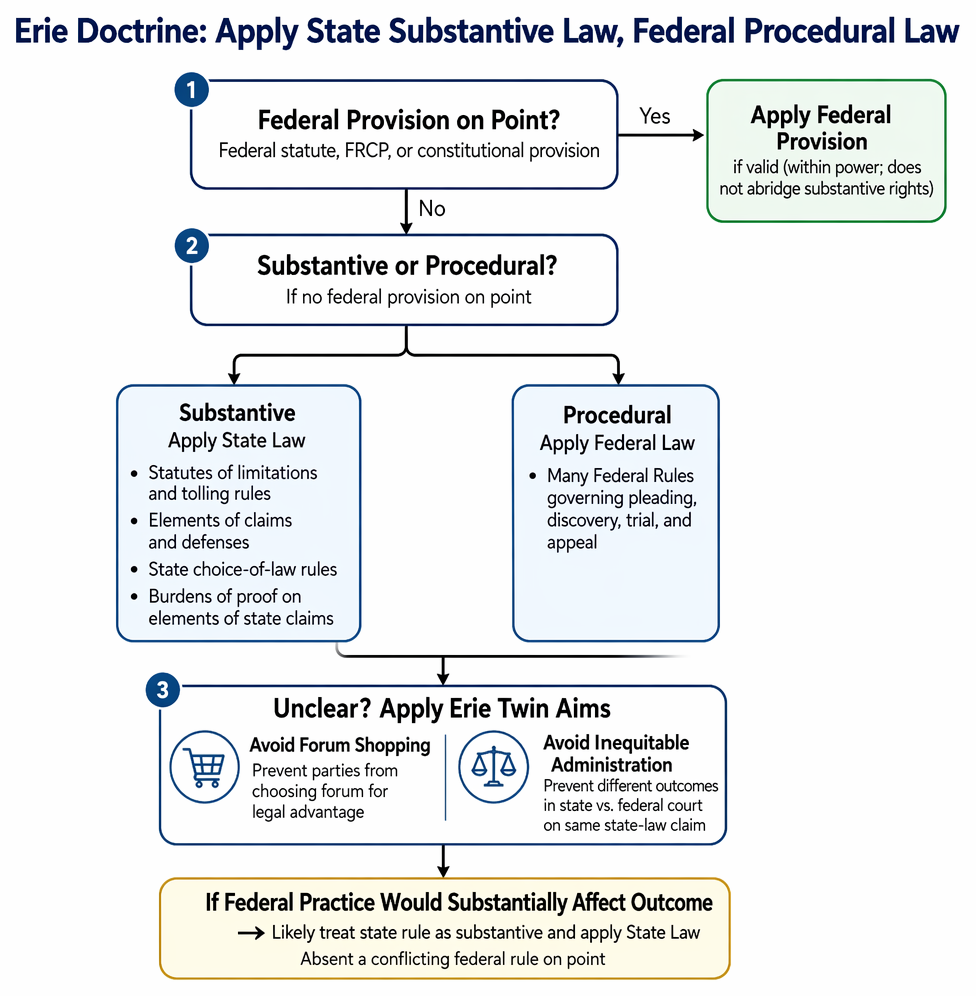
Specific jurisdiction principles are organized by minimum contacts, including purposeful availment, forum foreseeability, online activity, and stream-of-commerce considerations.
Key Term: Erie Doctrine
The principle requiring federal courts exercising diversity jurisdiction to apply state substantive law and federal procedural law. Aims to prevent forum shopping and ensure consistent outcomes.
When a federal court sits in diversity (or hears state claims under supplemental jurisdiction), it must decide whether to apply state or federal law on a particular issue.
Basic steps:
-
Is there a federal statute, Federal Rule of Civil Procedure, or constitutional provision on point?
- If yes, and it is valid (i.e., within Congress’s power or the Rules Enabling Act and not abridging substantive rights), the federal provision controls.
- Example: If FRCP 4 allows substituted service but state law does not, the federal court applies FRCP 4.
-
If no federal provision on point, is the issue substantive or procedural?
-
Clearly substantive for Erie purposes:
- Statutes of limitations and tolling rules.
- Elements of claims and defenses.
- State choice-of-law rules.
- Burdens of proof on elements of state claims.
-
Clearly procedural:
- Many Federal Rules governing pleading, discovery, trial, and appeal.
-
-
If unclear, apply the “twin aims” of Erie:
- Avoid forum shopping (i.e., preventing parties from choosing federal vs. state court solely to gain a legal advantage).
- Avoid inequitable administration of the laws (different outcomes in state vs. federal court on the same state-law claim).
If applying federal practice instead of state law would substantially affect the outcome and encourage forum shopping, the court is likely to treat the state rule as substantive and apply it, absent a conflicting federal rule on point.
Key Point Checklist
This article has covered the following key knowledge points:
- Jurisdiction requires both power over the parties/property (Personal Jurisdiction) and the type of case (Subject Matter Jurisdiction).
- Personal jurisdiction must satisfy both a statutory basis (traditional bases, long-arm statutes, special federal rules) and constitutional limits (minimum contacts, relatedness, fairness).
- Minimum contacts require purposeful availment and foreseeability that the defendant may be haled into court in the forum.
- Relatedness distinguishes specific jurisdiction (claim arises out of or relates to forum contacts) from general jurisdiction (defendant “at home” in the forum).
- In rem and quasi in rem jurisdiction also require minimum contacts; mere presence of property is not automatically enough for jurisdiction over unrelated claims.
- Notice must be reasonably calculated to inform the defendant of the action and permit an opportunity to defend; traditional methods of service normally satisfy due process, and failure to file proof of service does not invalidate proper service.
- Subject matter jurisdiction in federal court primarily relies on Diversity (§ 1332) or Federal Question (§ 1331).
- Diversity requires complete diversity and an amount in controversy exceeding $75,000, using proper aggregation rules.
- Federal question jurisdiction requires the claim to arise under federal law as shown on the face of a well-pleaded complaint; federal defenses do not create federal question jurisdiction.
- Supplemental jurisdiction (§ 1367) allows related claims lacking independent SMJ, but § 1367(b) restricts its use by plaintiffs in diversity-only cases to preserve complete diversity.
- Removal (§ 1441) allows defendants (and only defendants) to move cases from state to federal court if federal SMJ exists, subject to limitations such as the in-state defendant rule and the one-year limit in diversity cases.
- Venue determines the proper federal district; improper venue may be waived and cases may be transferred for convenience or dismissed.
- The Erie doctrine requires federal courts in diversity cases to apply state substantive law (including state choice-of-law rules) and federal procedural law, focusing on the twin aims of Erie.
Key Terms and Concepts
- Jurisdiction
- Personal Jurisdiction
- In Personam Jurisdiction
- In Rem Jurisdiction
- Quasi In Rem Jurisdiction
- Long Arm Statute
- Domicile
- Minimum Contacts
- Specific Jurisdiction
- General Jurisdiction
- Notice
- Venue
- Subject Matter Jurisdiction
- Diversity Jurisdiction
- Federal Question Jurisdiction
- Well-Pleaded Complaint Rule
- Supplemental Jurisdiction
- Removal Jurisdiction
- Erie Doctrine