Learning Outcomes
This article explains how mental disorder doctrines operate in criminal law for MBE purposes, including:
- pinpointing when mental disorder issues arise in exam questions on criminal liability, defenses, and criminal procedure, and determining which doctrine—insanity, diminished capacity, competency, or intoxication—is actually being tested
- applying and comparing the four major insanity tests (M'Naghten, Irresistible Impulse, Durham, and the Model Penal Code substantial‑capacity test), and predicting how changes in facts affect the outcome under each standard
- distinguishing insanity from diminished capacity and from both voluntary and involuntary intoxication, and using mental‑state evidence to evaluate whether the prosecution has proved specific intent beyond a reasonable doubt
- evaluating competency (fitness) to stand trial, recognizing when a competency hearing is required, and identifying the legal consequences when a defendant is found incompetent yet later regains competency
- assessing the procedural and evidentiary rules that govern raising an insanity defense, including presumptions, burdens of production and persuasion, and access to psychiatric expertise on the exam
- analyzing typical bar‑style fact patterns involving mental disorder, avoiding common distractors (such as confusing timing issues), and selecting the answer that best reflects modern majority and minority rules
MBE Syllabus
For the MBE, you are required to understand how mental disorder affects criminal responsibility and procedure, with a focus on the following syllabus points:
Criminal-law mental condition analysis distinguishes insanity, competency to stand trial, diminished capacity, and voluntary or involuntary intoxication.
- Recognizing when insanity is a defense to criminal charges and knowing the main insanity tests (M'Naghten, Irresistible Impulse, Durham, and Model Penal Code).
- Distinguishing insanity from diminished capacity and intoxication, and understanding when mental disorder may negate specific intent.
- Understanding the presumption of sanity, the burden of production, and the burden of persuasion when insanity is raised.
- Knowing the rules for fitness (competency) to stand trial, how competency is determined, and what happens if a defendant is incompetent.
- Identifying the usual consequences of a verdict of not guilty by reason of insanity, including commitment procedures.
- Recognizing when mental disorder is relevant at sentencing or post‑trial (e.g., incompetency at time of execution).
Test Your Knowledge
Attempt these questions before reading this article. If you find some difficult or cannot remember the answers, look more closely at that area during your revision.
-
Which of the following is NOT a recognized test for insanity on the MBE?
- a) M'Naghten test
- b) Irresistible impulse test
- c) Substantial capacity test (Model Penal Code)
- d) Reasonable person test
-
If a defendant is found not guilty by reason of insanity, the usual result is:
- a) Immediate release
- b) Civil commitment until no longer mentally ill and dangerous
- c) Mandatory life imprisonment
- d) Automatic retrial
-
Which statement best describes the difference between insanity and diminished capacity?
- a) Insanity is a procedural issue; diminished capacity is a defense to liability.
- b) Insanity is a complete defense; diminished capacity may negate specific intent.
- c) Both are complete defenses to all crimes.
- d) Diminished capacity applies only to strict liability offenses.
-
Which party generally bears the burden of proving insanity on the MBE?
- a) The prosecution, beyond a reasonable doubt
- b) The defendant, by a preponderance of the evidence or clear and convincing evidence
- c) The judge, by judicial notice
- d) The jury, by majority vote
Introduction
Mental disorder can affect criminal liability and procedure at several distinct points. For MBE purposes, three are central:
- insanity as a complete defense to criminal liability based on the defendant’s mental condition at the time of the offense
- diminished capacity, which may negate specific intent even when the defendant is not legally insane
- fitness (competency) to stand trial, which concerns the defendant’s present ability to be tried
It is essential to separate these concepts from each other and from intoxication and other capacity doctrines (like infancy). The exam frequently tests whether you can identify which doctrine applies and what kind of legal consequence it has.
Key Term: Insanity (Legal)
A legal defense excusing criminal responsibility if, at the time of the offense, the defendant met a recognized jurisdictional test for insanity due to a mental disease or defect. Key Term: Mental Disease or Defect
A clinically significant mental abnormality that can support an insanity defense. Most jurisdictions exclude conditions such as antisocial personality disorder and exclude mental states caused solely by voluntary intoxication.
Insanity as a Defense
Insanity is a complete defense to criminal liability if, at the time of the offense, the defendant met the legal test for insanity in that jurisdiction. If successful, the defendant is found not guilty by reason of insanity rather than guilty.
Key Term: Not Guilty by Reason of Insanity (NGRI)
A verdict that the defendant committed the act but is not criminally responsible because, at the time of the offense, they were legally insane under the applicable test.
The MBE may refer to any of four main insanity tests. You are expected to recognize and apply each when the question identifies which test the jurisdiction uses.
Key Term: M'Naghten Test
The defendant is insane if, due to a mental disease or defect, they did not know the nature and quality of the act or did not know that the act was wrong.
The M'Naghten test is purely cognitive. It focuses on the defendant’s ability to understand:
- the physical nature and quality of the act (e.g., thinking you are squeezing a lemon rather than someone’s neck), or
- the wrongfulness of the act (often framed as “did not know it was wrong”).
Jurisdictions vary on whether “wrong” means legally wrong, morally wrong, or both. On the MBE, you will usually not need that level of detail unless the fact pattern clearly highlights it.
Key Term: Irresistible Impulse Test
The defendant is insane if, due to mental illness, they could not control their actions or conform their conduct to the requirements of law.
The Irresistible Impulse test adds a volitional component. The defendant may intellectually understand that the act is wrong but be unable to control their behavior because of mental illness. Many jurisdictions combine M'Naghten with Irresistible Impulse (a “cognitive plus volitional” standard).
Key Term: Durham Test
The defendant is insane if the unlawful act was the product of a mental disease or defect.
The Durham, or “product,” test is broader and more favorable to defendants. If the crime would not have occurred but for the mental disease or defect, insanity is established. This test has been largely abandoned and is primarily associated with the District of Columbia, but it can appear on the MBE as a minority rule.
Key Term: Model Penal Code (Substantial Capacity) Test
The defendant is insane if, due to mental disease or defect, they lacked substantial capacity either to appreciate the criminality (wrongfulness) of their conduct or to conform their conduct to the law.
The Model Penal Code (MPC) test blends cognitive and volitional elements and uses a “substantial capacity” standard rather than requiring total inability. It is less strict than M'Naghten and is used by a significant minority of jurisdictions.
Timing and Scope
Insanity focuses on the defendant’s mental condition at the time of the offense. A defendant can be:
- insane at the time of the offense (potentially excusing liability), but
- competent at trial, or vice versa.
Evidence of mental disorder that does not meet the insanity standard may still be relevant to mens rea (e.g., to negate specific intent) or to sentencing.
Burden of Proof
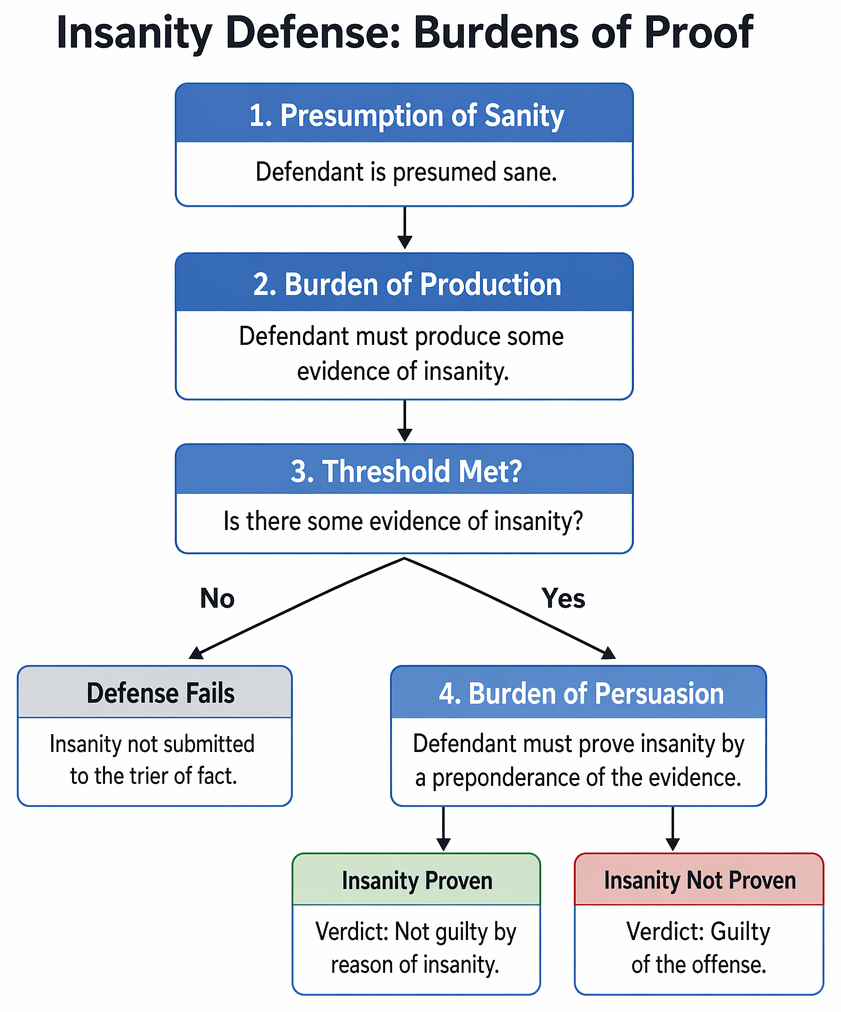
On the MBE, assume that all defendants are presumed sane unless and until the insanity issue is raised.
Key Term: Presumption of Sanity
The default rule that defendants are assumed sane; insanity becomes an issue only after the defendant produces some evidence of insanity.
The burden rules break down into:
-
Burden of production (going forward): The defendant must introduce some evidence supporting insanity before the issue is considered. Some jurisdictions require only a “scintilla” of evidence; others require enough to create a reasonable doubt.
-
Burden of persuasion:
- In most states, once the issue is raised, the defendant must prove insanity, usually by a preponderance of the evidence.
- In some jurisdictions and under the MPC, once insanity is in issue, the prosecution must prove the defendant was sane beyond a reasonable doubt.
- In federal court, the defendant must prove insanity by clear and convincing evidence (a higher standard than preponderance).
On MBE questions that speak generally, the safest assumption is that the defendant bears the burden of persuasion on insanity, either by preponderance or by clear and convincing evidence, unless the question specifies otherwise.
The prosecution always bears the burden of proving the elements of the offense, including the required mens rea, beyond a reasonable doubt. Even when the defendant fails to prove insanity, mental disorder evidence may still cast doubt on whether the prosecution has established the necessary specific intent.
Consequences of a Successful Insanity Defense
A verdict of not guilty by reason of insanity does not result in automatic release.
In most jurisdictions:
- The defendant is subject to civil commitment or a similar mental health confinement procedure.
- The standard procedures vary, but commonly:
- The court either automatically commits the defendant or conducts a hearing to determine whether the defendant is currently mentally ill and dangerous.
- The defendant is confined until they are no longer mentally ill and dangerous, which can be longer than the maximum possible prison term for the offense.
From a constitutional standpoint:
- For adults generally, indefinite civil commitment requires the state to prove mental illness and dangerousness by clear and convincing evidence.
- For insanity acquittees, the Court has upheld commitment based on the trial court’s insanity finding by a preponderance of the evidence, even if this leads to confinement beyond the maximum sentence for the charged offense.
The exam often tests the idea that NGRI is not a “get‑out‑of‑jail‑free card”; it typically leads to long‑term hospitalization rather than freedom.
Procedural Aspects of the Insanity Defense
Several procedural issues may appear on the MBE:
-
When and how the defense is raised:
- The defense may be raised at arraignment, but a simple “not guilty” plea does not waive it.
- Many jurisdictions require the defendant to give advance notice to the prosecution of an intent to rely on insanity.
- A competent defendant, adequately represented, controls whether the defense is asserted. Neither prosecutor nor judge may force an insanity defense on such a defendant.
-
Psychiatric assistance for the defense: If the defendant makes a preliminary showing that an insanity defense is plausible, due process requires that the state provide access to a mental health expert to assist in evaluating, preparing, and presenting the defense, especially for indigent defendants.
-
Court‑ordered psychiatric examination:
- If the defendant places mental condition in issue (e.g., by raising insanity), the state may require examination by its own expert.
- There is generally no privilege against self‑incrimination as to the fact of the examination and the expert’s opinion on mental condition, although statements may be limited in use (primarily to rebut the mental state defense).
- If the defendant has not put mental state in issue and does not plan to use an insanity defense, they may be able to refuse certain competency‑related examinations or at least receive Miranda warnings before custodial evaluations.
Some jurisdictions limit insanity evidence to expert psychiatric testimony; others allow lay witnesses (family, friends, officers) to testify about observed behavior.
Diminished Capacity
Key Term: Diminished Capacity
A partial defense in some jurisdictions where mental disorder short of insanity prevents the defendant from forming the specific intent required for certain crimes.
Diminished capacity differs from insanity in several important ways:
-
Scope of effect:
- Insanity is a complete defense: if established, the defendant is not criminally liable (though subject to commitment).
- Diminished capacity is a partial defense: it may prevent conviction of a specific intent crime by showing that the defendant could not form the required intent. The defendant may still be convicted of a lesser included general intent offense.
-
Availability:
- Diminished capacity is not recognized in all jurisdictions. Some states have abolished it as a distinct doctrine, though they may still allow mental disorder evidence to rebut mens rea.
- It typically does not apply to general‑intent crimes, crimes with recklessness or negligence as the mens rea, or strict liability offenses.
-
Relationship to mens rea In jurisdictions recognizing diminished capacity, mental disorder evidence functions as “failure‑of‑proof” evidence: it shows that the prosecution has not proved the specific intent element beyond a reasonable doubt, even though the defendant is legally sane.
Common examples:
- First‑degree premeditated murder: diminished capacity may prevent a finding of premeditation or deliberation, reducing the offense to second‑degree murder or manslaughter.
- Specific intent property crimes (e.g., burglary requiring intent to commit a felony inside): mental disorder may show the defendant lacked that specific intent.
Diminished capacity is distinct from using mental illness as a mitigating sentencing factor. Even jurisdictions that reject diminished capacity as a defense often allow mental disorder to be considered in deciding an appropriate sentence.
Fitness to Stand Trial (Competency)
A defendant cannot be tried, convicted, or sentenced if they are incompetent to stand trial.
Key Term: Fitness to Stand Trial (Competency)
The requirement that a defendant have a present ability to understand the criminal proceedings and to consult with counsel with a reasonable degree of rational understanding.
The constitutional test is whether, as a result of mental disease or defect, the defendant is unable:
- to understand the nature of the proceedings against them, or
- to assist their lawyer in the preparation of their defense.
Key Term: Competency Hearing
A judicial proceeding to determine whether the defendant is competent to stand trial; it may be initiated by the court, the prosecution, or the defense.
Key points for the MBE:
-
Timing: Competency concerns the defendant’s current mental condition, not their state at the time of the offense.
-
Who may raise the issue: Any party (defense, prosecution, or the judge) may raise competency if there is reason to doubt the defendant’s ability to proceed.
-
Procedures:
- Due process requires notice and a hearing before a defendant is declared incompetent.
- Many jurisdictions give the defendant a right to a jury determination of competency.
- If found incompetent, the criminal proceedings are suspended.
-
Disposition of incompetent defendants:
- Typically, the defendant is committed to a mental health facility or placed in treatment until competency is restored.
- The Constitution requires that confinement be limited to a reasonable period necessary to determine whether there is a substantial likelihood of regaining competency. If recovery is not likely, the state must either initiate civil commitment proceedings or release the defendant.
-
Competency at execution: A defendant may not be executed if they cannot understand the nature and purpose of the punishment. Modern statutes often allow only the warden or similar official to raise this issue, sometimes with a jury determination.
Incompetency is not a defense to the crime itself. If competency is later restored, the defendant can be tried for the charged offense.
Intoxication and Mental Disorder
Intoxication is not itself a mental disorder, but it interacts with mental state doctrines.
Key Term: Voluntary Intoxication
Intoxication resulting from the defendant’s voluntary ingestion of alcohol or drugs, knowing their intoxicating nature. Key Term: Involuntary Intoxication
Intoxication not self‑induced, such as by force, fraud, or unforeseen reaction to medication, which may excuse criminal liability if it produces insanity.
Key relationships:
-
Voluntary intoxication:
- May be a defense to specific intent crimes if it prevents the formation of the required intent (e.g., premeditated murder, burglary), though some modern statutes restrict this defense.
- Is not a defense to crimes requiring only recklessness, negligence, general intent, or strict liability. A person who was unaware of a substantial risk solely because of voluntary intoxication is treated as if they were aware and consciously disregarded the risk.
-
Involuntary intoxication:
- Treated like a mental illness. If, because of involuntary intoxication, the defendant meets the applicable insanity test (M'Naghten, MPC, etc.), they are entitled to acquittal by reason of insanity.
- Involuntary intoxication arises when the defendant:
- ingests an intoxicant without knowledge of its nature,
- is forced to consume it, or
- takes prescribed medication without knowing its intoxicating effects.
-
Chronic substance use and insanity Continuous or extreme substance abuse may result in a separate mental disorder (e.g., psychosis) that qualifies as a “mental disease or defect” for insanity purposes. In that case, the defendant might have both an intoxication issue and a true insanity issue.
On the MBE, be careful to distinguish:
- a direct intoxication defense (voluntary or involuntary), and
- insanity produced by long‑term substance‑induced mental illness.
Worked Example 1.1
A defendant is charged with murder. At trial, he presents evidence that, due to schizophrenia, he believed he was squeezing a lemon, not a person's neck, when he strangled the victim. The jurisdiction applies the M'Naghten test.
Answer:
Under the M'Naghten test, the defendant is insane if, due to mental disease, he did not know the nature and quality of his act. Here, if the jury believes he thought he was squeezing a lemon, he did not understand the physical nature of his act and should be found not guilty by reason of insanity. The key is his cognitive inability to perceive what he was actually doing at the moment of the offense.
Worked Example 1.2
A defendant is charged with burglary, a specific intent crime. He suffers from a personality disorder that impairs his judgment but does not meet the legal test for insanity. He argues he could not form the intent to commit a felony inside the building.
Answer:
If the jurisdiction recognizes diminished capacity, and the jury finds the defendant's mental disorder prevented him from forming the specific intent for burglary, he may be acquitted of burglary but could still be convicted of a lesser general intent offense (such as criminal trespass). If the jurisdiction does not recognize diminished capacity, the personality disorder may still be relevant to whether the prosecution has proved specific intent, but it will not operate as a separate partial defense.
Worked Example 1.3
A defendant is charged with assault. Before trial, his attorney moves for a competency hearing, arguing the defendant cannot understand the proceedings or assist in his defense.
Answer:
If the court finds the defendant incompetent to stand trial, the trial is postponed until competency is restored. The defendant is typically committed for treatment for a reasonable period to determine whether recovery is likely. This does not bar prosecution if competency is later regained; it only suspends the proceedings until the defendant can meaningfully participate.
Worked Example 1.4
A defendant is charged with first‑degree murder (premeditated, deliberate killing). On the night of the killing, he consumed a large amount of alcohol voluntarily. He claims he was so intoxicated that he could not premeditate or deliberate, though he admits he intended to shoot the victim.
Answer:
Voluntary intoxication may negate the specific mental state of premeditation and deliberation. If the jury believes that due to intoxication the defendant could not premeditate or deliberate, the crime may be reduced from first‑degree to second‑degree murder. However, voluntary intoxication will not excuse the intentional killing entirely; it does not negate the general intent to kill or the recklessness required for depraved‑heart murder.
Worked Example 1.5
A defendant is charged with robbery. He was given a powerful sedative by a friend who falsely described it as a vitamin pill. The drug produced a psychotic state in which he believed he was collecting his own property as part of a game show and that the “victim” was an actor. The jurisdiction uses the MPC insanity test.
Answer:
The defendant’s intoxication is involuntary because he took the drug without knowing its intoxicating nature. If, because of this condition, he lacked substantial capacity either to appreciate the criminality of taking another’s property or to conform his conduct to the law, he satisfies the MPC insanity test. He may be entitled to a verdict of not guilty by reason of insanity, with the usual consequence of civil commitment, even though the cause of his mental state was the drug.Exam Warning: The insanity defense is only available if the defendant meets the legal test at the time of the offense. Mental illness alone does not equal legal insanity. Do not assume that “schizophrenic,” “bipolar,” or “depressed” automatically means insane—apply the specific insanity test given in the question. Also distinguish carefully among insanity (time of offense), diminished capacity (specific intent), and competency (present ability to stand trial).
Revision Tip: On the MBE, pay close attention to whether the question is asking about: (1) insanity, (2) diminished capacity (or mental state evidence), (3) competency to stand trial, or (4) intoxication. Many distractors are wrong because they apply the right doctrine to the wrong time period or mental condition.
Key Point Checklist
This article has covered the following key knowledge points:
- Insanity is a complete defense if, at the time of the offense, the defendant meets a recognized legal test (M'Naghten, Irresistible Impulse, Durham, or MPC) due to a mental disease or defect.
- Most jurisdictions presume sanity; the defendant must first produce some evidence of insanity and usually bears the burden of proving it, often by a preponderance or clear and convincing evidence.
- A verdict of not guilty by reason of insanity usually leads to civil commitment in a mental health facility, often until the defendant is no longer mentally ill and dangerous, which may exceed the maximum prison term.
- Diminished capacity is a partial defense recognized in some jurisdictions that may negate specific intent and reduce liability but does not excuse all criminal responsibility.
- Mental disorder can be relevant in three distinct ways: insanity at the time of the offense, diminished capacity (or failure of proof of mens rea), and competency (fitness) to stand trial.
- A defendant must be competent to stand trial; incompetency suspends but does not bar prosecution and typically leads to hospitalization for restoration of competency.
- Voluntary intoxication may partially negate specific intent but is not a defense to crimes requiring only recklessness, negligence, or no mens rea; involuntary intoxication may be treated like insanity if it produces the required degree of mental impairment.
- Mental disorder is also relevant at later stages, including post‑acquittal commitment and competency at the time of execution.
Key Terms and Concepts
- Insanity (Legal)
- Mental Disease or Defect
- M'Naghten Test
- Irresistible Impulse Test
- Durham Test
- Model Penal Code (Substantial Capacity) Test
- Not Guilty by Reason of Insanity (NGRI)
- Presumption of Sanity
- Diminished Capacity
- Fitness to Stand Trial (Competency)
- Competency Hearing
- Voluntary Intoxication
- Involuntary Intoxication