Learning Outcomes
This article explains required criminal mental states for MBE Criminal Law, including:
- Defining and differentiating specific intent, general intent, malice, recklessness, negligence, and strict liability.
- Comparing common-law mental state labels with the Model Penal Code hierarchy of purpose, knowledge, recklessness, and negligence.
- Linking each mental state to frequently tested crimes such as homicide, theft offenses, burglary, arson, sex offenses, inchoate crimes, and possession offenses.
- Using mental state requirements to evaluate mistake of fact, mistake of law, and intoxication issues on multiple-choice questions.
- Interpreting statutory terms like “intentionally,” “knowingly,” “recklessly,” and “negligently” and assigning them to the appropriate mens rea level.
- Identifying when an offense is treated as strict liability or a public welfare offense and the consequences for defenses and burden of proof.
- Applying doctrines of transferred intent and concurrence of actus reus and mens rea to fact patterns.
- Developing a systematic approach to spotting the governing mental state in MBE questions and eliminating answer choices that assume the wrong mens rea.
MBE Syllabus
For the MBE, you are required to understand the mental state (mens rea) necessary for criminal liability, with a focus on the following syllabus points:
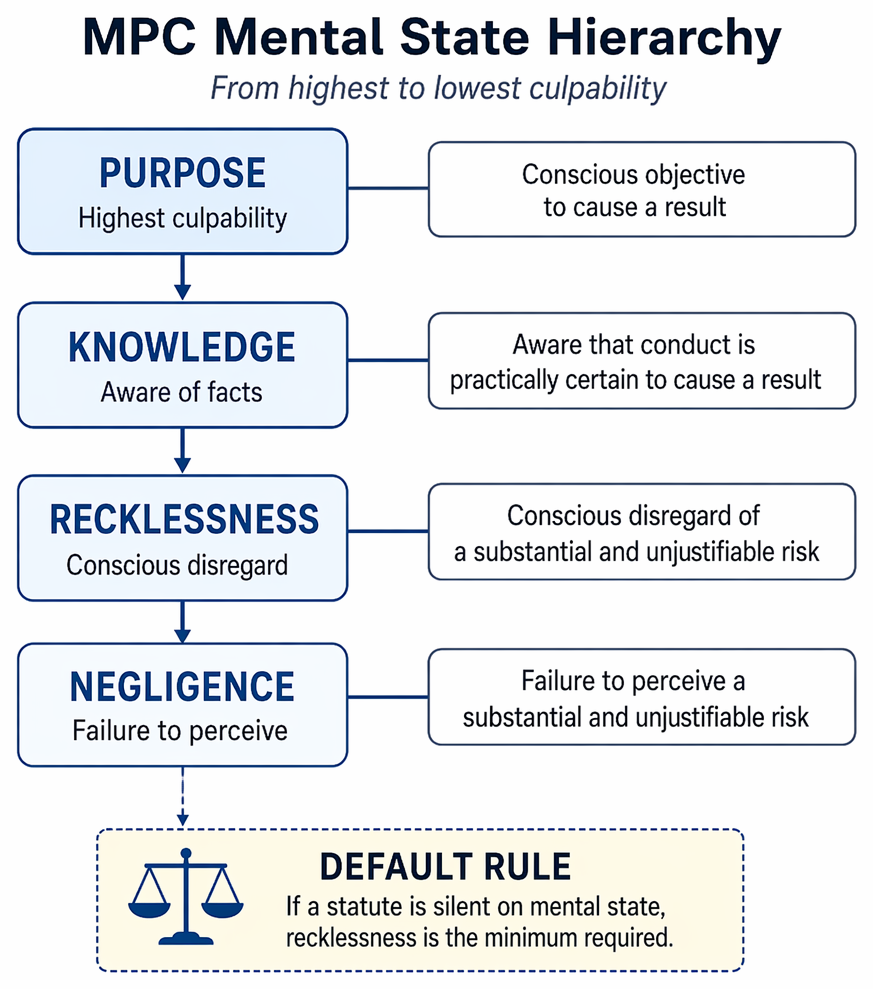
MPC culpability categories appear in descending order, with recklessness serving as the default where the offense definition omits a mental state.
- Identify and define specific intent, general intent, malice, recklessness, negligence, and strict liability.
- Distinguish common-law mental state labels from the MPC mental state hierarchy (purpose, knowledge, recklessness, negligence).
- Recognize which mental state is required for common MBE crimes (homicide, theft offenses, inchoate offenses, sex offenses, and strict liability offenses).
- Understand how possession offenses work and what mental state is required for “knowingly possessing” contraband.
- Apply mental state rules to mistake of fact and mistake of law, and to voluntary and involuntary intoxication.
- Use the MPC default rule that recklessness is the minimum mental state when a statute is silent.
- Analyze how mental state affects accomplice liability, transferred intent, and the concurrence requirement.
- Distinguish how mental state affects criminal defenses and the availability of partial defenses (e.g., reduction from first- to second-degree murder).
Test Your Knowledge
Attempt these questions before reading this article. If you find some difficult or cannot remember the answers, look more closely at that area during your revision.
-
Which of the following crimes is most likely to be classified as a strict liability offense?
- a) Battery
- b) Statutory rape
- c) Burglary
- d) Larceny
-
Under the Model Penal Code, which mental state requires a person to consciously disregard a substantial and unjustifiable risk?
- a) Purpose
- b) Knowledge
- c) Recklessness
- d) Negligence
-
Which of the following is a specific intent crime?
- a) Arson
- b) Battery
- c) Burglary
- d) Involuntary manslaughter
-
For which type of crime is mistake of fact a defense even if the mistake is unreasonable?
- a) Strict liability
- b) General intent
- c) Specific intent
- d) Malice
-
A federal statute makes it a crime “knowingly to possess any endangered species of fish or wildlife.” What is the minimum the prosecution must prove?
- a) The defendant knew the animal was an endangered species
- b) The defendant knew possession was prohibited by federal law
- c) The defendant knowingly possessed the animal
- d) The defendant possessed the animal, even if unaware of it
-
Voluntary intoxication can most clearly operate as a defense (or partial defense) to which of the following?
- a) Statutory rape
- b) Common-law arson
- c) First-degree premeditated murder
- d) General intent battery
Introduction
Criminal liability on the MBE requires proof of both a prohibited act (actus reus) and a required mental state (mens rea). The mental state element determines what the prosecution must prove about the defendant's mind at the time of the act. Understanding the distinctions between intent, knowledge, recklessness, negligence, and strict liability is essential for answering MBE questions correctly.
Key Term: Mens Rea
The required mental state or level of culpability a defendant must have at the time of committing a criminal act.
The same conduct can lead to very different results depending on the required mental state. For example, causing another’s death can be murder, manslaughter, or no crime at all depending on whether the defendant acted intentionally, recklessly, negligently, or without fault.
Mental state also drives many defenses: some defenses (like voluntary intoxication or an unreasonable mistake of fact) are available only for certain mental states. So, on every Criminal Law question, you should first identify the required mental state before deciding what the prosecution must prove and which defenses are available.
Categories of Required Mental State
Crimes are classified by the mental state required for conviction. On the MBE you will see both traditional common-law labels and MPC terminology.
1. Specific Intent
Some crimes require the defendant to act with a particular purpose or objective beyond just doing the act. These are called specific intent crimes.
Key Term: Specific Intent
A mental state where the defendant acts with a particular purpose or objective to bring about a specific result or to perform a further act.
Two features make specific intent important:
- The prosecution must prove the specific mental purpose; it cannot simply be inferred from the act alone.
- Certain defenses (voluntary intoxication and even unreasonable mistakes of fact) can negate specific intent.
Common specific intent crimes on the MBE and their required intent include:
- Solicitation: intent that the person solicited commit the crime.
- Attempt: intent to complete the target crime.
- Conspiracy: intent that the crime be completed.
- First-degree premeditated murder (where so defined): premeditated intent to kill.
- Assault (attempted-battery type): intent to commit a battery.
- Larceny and robbery: intent to permanently deprive another of their interest in the property.
- Burglary: intent, at the time of entry, to commit a felony (or the statutory target crime) inside.
- Forgery, false pretenses, embezzlement: intent to defraud.
Exam tip: If the crime is inchoate (attempt, solicitation, conspiracy) or a theft-type offense, assume it is specific intent unless the statute clearly says otherwise.
2. General Intent
General intent crimes require only that the defendant intended to do the act that constitutes the crime, not that they had some further goal or result in mind.
Key Term: General Intent
A mental state where the defendant intends to perform the prohibited act and is aware of the attendant circumstances, but need not intend a further specific result.
At common law, general intent means the defendant is aware of the factors that make up the offense. The prosecution can often rely on the natural inference that a person intends the ordinary consequences of their voluntary acts.
Typical general intent crimes on the MBE include:
- Battery (the actual harmful or offensive contact).
- “Apprehension” type assault in some jurisdictions.
- Rape (non-statutory).
- Kidnapping.
- False imprisonment.
General intent crimes do not get the benefit of the full range of specific-intent defenses. For example, voluntary intoxication is not a defense to a general intent crime.
3. Malice
Malice is a special common-law category used mainly for murder and arson.
Key Term: Malice
A mental state involving intentional or extremely reckless disregard for a known and obvious risk of a prohibited result.
For common-law murder and arson, “malice” is satisfied if the defendant:
- Intends the prohibited harm (e.g., intent to kill), or
- Acts with “depraved heart” or extreme recklessness toward an obvious and high risk that death or burning will occur.
Malice crimes are treated differently from specific intent crimes:
- They typically do not allow voluntary intoxication or an unreasonable mistake of fact to reduce liability.
- The prosecution need not show a carefully formed purpose; extremely reckless disregard of a known high risk is enough.
Common malice crimes:
- Common-law murder (intent to kill, intent to cause serious bodily harm, depraved-heart murder, or felony murder).
- Common-law arson (malicious burning of the dwelling of another; modern statutes often broaden this).
4. Recklessness and Negligence (MPC)
The Model Penal Code uses a hierarchy of four mental states, from most to least culpable: purpose, knowledge, recklessness, and negligence.
Key Term: Purpose (MPC)
Acting with purpose means it is the defendant’s conscious objective to engage in certain conduct or cause a particular result. Key Term: Knowledge (MPC)
Acting knowingly means the defendant is aware that their conduct is of a particular nature or that a result is practically certain to occur.
Under the MPC:
- Purpose (Intent): Defendant's conscious objective is to cause a result or engage in conduct.
- Knowledge: Defendant is aware that the result is practically certain or that a circumstance exists.
- Recklessness: Defendant consciously disregards a substantial and unjustifiable risk.
- Negligence: Defendant should be aware of a substantial and unjustifiable risk but is not.
Key Term: Recklessness
Conscious disregard of a substantial and unjustifiable risk, where such disregard is a gross deviation from the standard of care a law-abiding person would observe. Key Term: Negligence
Failure to be aware of a substantial and unjustifiable risk where such failure is a gross deviation from the standard of care a reasonable person would observe.
Important MPC points for the MBE:
- If a statute is silent about mental state, recklessness is the default minimum under the MPC.
- If a statute uses one mental-state word (e.g., “knowingly”), that usually applies to all material elements of the offense.
- A higher mental state satisfies a lower one: purpose satisfies knowledge, which satisfies recklessness, which satisfies negligence.
5. Strict Liability
Strict liability crimes require no proof of mental state as to at least one element of the offense. The mere commission of the prohibited act is enough.
Key Term: Strict Liability
Liability imposed without proof of intent, knowledge, recklessness, or negligence as to the strict-liability element.
Common strict liability offenses on the MBE include:
- Statutory rape (consensual intercourse with a person under the age of consent).
- Selling alcohol to minors.
- Certain bigamy statutes.
- Many regulatory or “public welfare” offenses (e.g., some traffic, food-safety, or licensing violations).
Key Term: Public Welfare Offense
A regulatory offense involving public health, safety, or welfare, often punishable without proof of mens rea to encourage high levels of care.
Because strict liability dispenses with mens rea, usual mistake and intoxication defenses are not available for the strict-liability element.
Possession Offenses and “Knowingly”
Possession crimes (e.g., possession of drugs, weapons, or contraband wildlife) are common on the MBE.
- At common law, absent contrary statutory language, the prosecution must show that the defendant was aware of possessing the item (actual or constructive possession).
- The defendant need not know the item is illegal unless the statute requires it.
Many statutes add a “knowingly” requirement.
Under such statutes, the prosecution generally must prove:
- The defendant knowingly possessed the item (i.e., was aware of its presence), and
- Often, that the defendant knew the nature of the item (e.g., that it was a controlled substance), but
- Not that the defendant knew the specific statute or that the item was “endangered” or otherwise specially regulated.
Deliberate ignorance (“I didn’t want to know what was in the package”) often counts as knowledge where the defendant consciously avoids confirming a high probability of an illegal fact.
Application to Common Crimes
On the MBE you must be able to link each crime to its required mental state.
-
Specific Intent Crimes: Attempt, conspiracy, solicitation, burglary, larceny, robbery, forgery, false pretenses, embezzlement, and first-degree premeditated murder (where defined).
These all require a further goal: to complete a target crime, to permanently deprive, or to defraud.
-
General Intent Crimes: Battery (unlawful application of force), rape, kidnapping, false imprisonment, most forms of unlawful possession (absent a “knowingly” modifier).
-
Malice Crimes: Common-law murder and arson. Extreme recklessness can satisfy malice.
-
Strict Liability Crimes: Statutory rape, selling alcohol to minors, some traffic offenses, and certain regulatory offenses designed to protect public welfare.
Exam focus: For theft crimes (larceny, robbery, embezzlement, false pretenses), always ask whether the defendant had the specific intent to permanently deprive or to defraud. If the defendant honestly believes the property is theirs, that can negate the specific intent, even if the belief is unreasonable.
Model Penal Code Approach
The MPC replaces the common-law categories of “specific intent,” “general intent,” and “malice” with its four mental states: purpose, knowledge, recklessness, and negligence.
- Many MBE questions will present a statute using MPC language (e.g., “A person commits an offense if he knowingly receives stolen property.”).
- You must match facts to the correct MPC mental state: did the defendant desire the result (purpose), know it was virtually certain (knowledge), consciously disregard a substantial risk (recklessness), or fail to perceive such a risk (negligence)?
Under the MPC:
- If a statute is silent, assume at least recklessness is required.
- If the question uses common-law labels (specific intent, general intent, malice), answer using common-law rules, unless it explicitly tells you to apply the MPC.
Mistake of Fact and Mental State
Mistake of fact can negate mens rea. How far it goes depends on the type of crime.
-
Specific intent crimes: Any honest mistake of fact—reasonable or unreasonable—can be a defense if it negates the specific intent.
-
General intent and malice crimes: Only a reasonable mistake of fact is a defense. An unreasonable mistake does not excuse general intent or malice.
-
Strict liability crimes: Mistake of fact is never a defense as to the strict-liability element. If the statute imposes absolute liability for a particular fact (e.g., age in statutory rape), the defendant’s mistake about that fact is irrelevant.
Mistake of Law (briefly)
While this article focuses on mental state, you should know how mistake of law fits in:
- As a general rule, ignorance of the law is no excuse.
- Narrow exceptions include reasonable reliance on an official interpretation later found to be wrong (e.g., binding judicial decision or official interpretation by a responsible public officer).
- More commonly on the MBE, what looks like “mistake of law” is actually a mistake about a legal status that is an element of the crime (e.g., whether property is “stolen”). That can function as a mistake of fact and negate mens rea.
Intoxication and Mental State
Voluntary and involuntary intoxication interact differently with mental states:
-
Voluntary intoxication (choosing to consume an intoxicant):
- Can negate specific intent if it prevents formation of the required purpose (e.g., premeditated intent to kill). It may reduce first-degree murder to second-degree.
- Is not a defense to general intent or malice crimes; a person who is unaware of a risk solely because they drank is treated as if they were aware for “recklessness” purposes.
- Never a defense to strict liability.
-
Involuntary intoxication (without knowledge, under duress, or pursuant to medical advice without warning):
- Treated like insanity if it renders the defendant unable to understand the nature or wrongfulness of the act under the jurisdiction’s insanity test.
Other Doctrines Tied to Mental State
Two additional doctrines are frequently tested with mental state:
Key Term: Transferred Intent
When a defendant intends to cause harm to one person or object but accidentally harms another, the intent transfers to the actual victim for certain crimes (typically homicide, battery, and arson).
Transferred intent does not apply to attempt, but the defendant may be guilty of both the completed offense against the unintended victim and attempted offense against the intended victim.
Key Term: Motive
The reason or explanation for committing a crime; motive is different from intent and is generally irrelevant to liability, although it can be relevant to sentencing or to proving intent circumstantially. Key Term: Concurrence
The requirement that the defendant possess the required mental state at the time they commit the actus reus, and that the mens rea prompt or drive the act.
If the intent comes too early or too late, there may be no concurrence, and thus no liability for that offense.
Worked Example 1.1
A defendant is charged with statutory rape after having consensual sex with a 16-year-old who claimed to be 18. The defendant genuinely believed the partner was of legal age. Is mistake of fact a defense?
Answer:
No. Statutory rape is a strict liability crime as to the victim’s age in most jurisdictions. The defendant's belief, even if reasonable and honest, does not negate liability because no mental state is required for that element.
Worked Example 1.2
A defendant is charged with burglary after entering a house at night intending to steal a laptop. The defendant mistakenly believed the laptop belonged to a friend who owed him money. Is mistake of fact a defense?
Answer:
Yes, if the defendant honestly believed he had a right to the property, this negates the specific intent to steal (the intent to permanently deprive another of their property). For specific intent crimes, any honest mistake of fact, even if unreasonable, can be a defense because it shows the specific purpose was never formed.
Worked Example 1.3
A defendant is charged with arson after setting fire to a building, knowing people were inside but not caring about the risk. What mental state applies?
Answer:
Malice. Arson requires acting with intent or reckless disregard for a high risk of burning the structure (and often of endangering occupants). Here, consciously disregarding a known, serious risk of harm satisfies malice.
Worked Example 1.4
By federal statute, it is unlawful to “knowingly possess any endangered species of fish or wildlife.” Congress wants the statute applied broadly. A defendant has an exotic bird in her home. She believes it is common and has never heard of the statute. What is the minimum the prosecution must prove?
Answer:
The prosecution must prove that the defendant knowingly possessed the bird (i.e., was aware of having the bird in her control). It need not prove that she knew the bird was an endangered species or that possessing it was a crime. The statute uses “knowingly” to modify “possess,” not to require knowledge of the bird’s status or the law.
Worked Example 1.5
A defendant, extremely drunk, shoots and kills someone after saying, “I’m going to kill you.” He is charged with first-degree premeditated murder (which requires premeditated intent to kill) and, in the alternative, with depraved-heart second-degree murder (extreme recklessness). How does intoxication affect his liability?
Answer:
Voluntary intoxication may negate the premeditated intent required for first-degree murder if the jury believes he was too intoxicated to premeditate or form a deliberate purpose. However, it does not negate extreme recklessness. He can still be convicted of second-degree depraved-heart murder because being unaware of the risk only due to voluntary intoxication does not excuse reckless homicide.
Worked Example 1.6
A defendant swings a bat toward a friend as a joke, intending to miss by a few inches. He misjudges the distance and hits the friend, causing injury. He is charged with battery, a general intent crime. He claims he did not intend to hurt anyone. Is the mental state satisfied?
Answer:
Yes. For general intent battery, it is enough that the defendant intentionally engaged in the act (swinging the bat) and caused a harmful or offensive contact. He need not have intended serious injury or any injury at all; his voluntary act and awareness that he was striking near the friend satisfy general intent.Exam Warning: On the MBE, strict liability crimes are infrequent but often tested. Do not assume intent is required unless the statute or question clearly requires it. Look for telltale strict-liability contexts, such as statutory rape or regulatory/public welfare offenses with relatively light penalties. If the statute is silent and the crime is regulatory (food safety, traffic, environmental), treat it as a strong candidate for strict liability, especially as to specific regulatory facts (e.g., age, labeling).
Revision Tip: For MBE questions, memorize which crimes are specific intent, general intent, malice, or strict liability, and know the MPC mental state definitions cold. When you see a defense like voluntary intoxication or an unreasonable mistake of fact, immediately ask: “Is this a specific intent crime?” That will often let you quickly eliminate wrong answer choices.
Key Point Checklist
This article has covered the following key knowledge points:
- Mens rea is the required mental state for criminal liability and must concur with the actus reus.
- Crimes are classified as specific intent, general intent, malice, recklessness, negligence, or strict liability.
- Specific intent crimes require proof of a particular purpose (e.g., to permanently deprive or to defraud); they permit defenses like voluntary intoxication and unreasonable mistake of fact.
- General intent crimes require only intent to do the prohibited act; voluntary intoxication and unreasonable mistake do not excuse them.
- Malice crimes (common-law murder and arson) require intent or extreme recklessness; specific-intent defenses generally do not apply.
- The MPC uses purpose, knowledge, recklessness, and negligence as mental states and treats recklessness as the default when a statute is silent.
- Possession offenses often require knowledge of possession (and sometimes of the item’s character) but not knowledge of the law.
- Strict liability crimes require no proof of mental state as to the strict-liability element; mistake of fact and intoxication are not defenses to that element.
- Mistake of fact is a defense to specific intent crimes even if unreasonable, a defense to general intent and malice crimes only if reasonable, and no defense to strict liability.
- Voluntary intoxication can negate specific intent but not general intent, malice, or strict liability; involuntary intoxication is treated like insanity.
- Transferred intent and concurrence are mental state doctrines that frequently appear in homicide, battery, and arson questions.
Key Terms and Concepts
- Mens Rea
- Specific Intent
- General Intent
- Malice
- Purpose (MPC)
- Knowledge (MPC)
- Recklessness
- Negligence
- Strict Liability
- Public Welfare Offense
- Transferred Intent
- Motive
- Concurrence