Learning Outcomes
This article explains the general principles of criminal responsibility for the MBE, including:
- Identifying and analyzing the requirement of a voluntary act (actus reus), recognizing when omissions, involuntary movements, or status conditions can and cannot satisfy that requirement.
- Distinguishing and comparing the main mental states (mens rea) at common law and under the Model Penal Code, and using that framework to decode exam statutes.
- Differentiating specific intent from general intent crimes, spotting classic examples in fact patterns, and predicting which defenses—especially intoxication and mistake of fact—remain available.
- Applying the doctrine of transferred intent to unintended-victim scenarios, deciding when liability extends to the actual victim and when separate attempt charges are appropriate.
- Recognizing strict liability offenses, particularly public-welfare and statutory-rape–type crimes, and evaluating how the absence of mens rea limits the relevance of mistake or ignorance.
- Evaluating how mistake of fact, mistake of law, accident, and negligence interact with different mens rea levels to negate, reduce, or preserve criminal responsibility.
- Understanding concurrence, insanity, and capacity as additional limits on liability, and integrating those issues into structured, time-efficient analysis for bar exam essays and MBE items.
MBE Syllabus
For the MBE, you are required to understand the foundational doctrines that determine when a person is criminally responsible, with a focus on the following syllabus points:
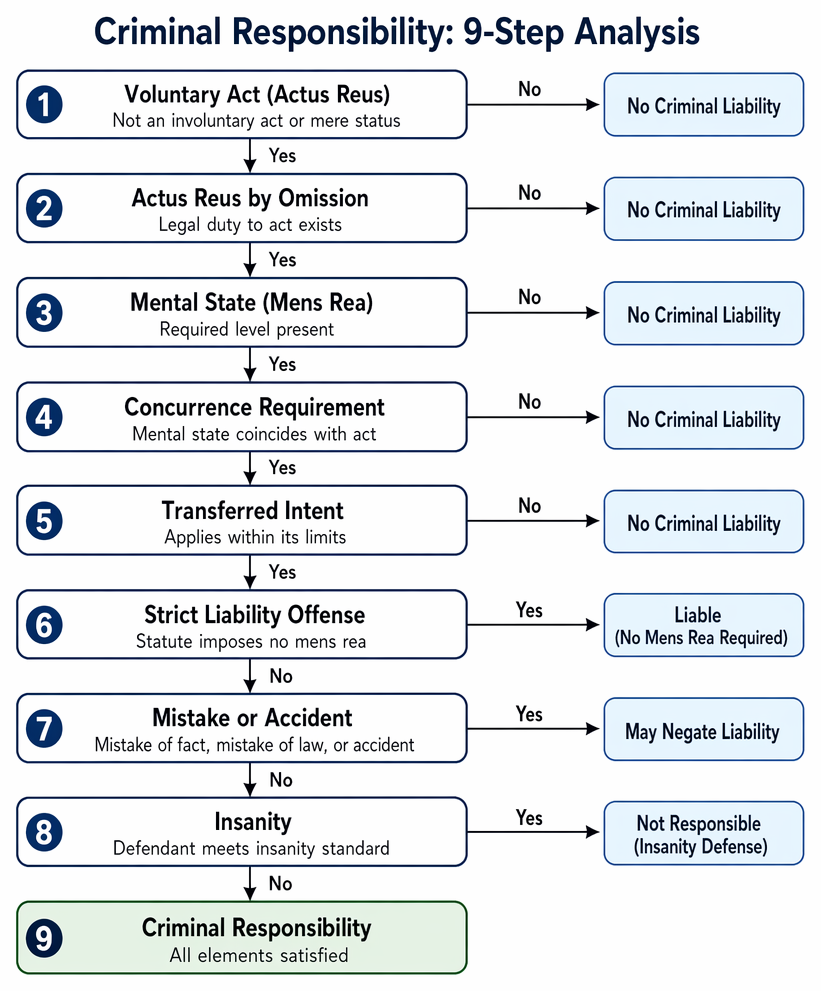
Omissions satisfy actus reus only when a duty exists, the defendant knows the duty-triggering facts, and performance is reasonably possible.
- The requirement of a voluntary act (actus reus) for criminal liability, including involuntary acts and status.
- Omissions as actus reus and the situations in which a legal duty to act arises.
- The various mental states (mens rea) required for different crimes at common law and under the Model Penal Code.
- The distinction between specific intent and general intent crimes and the consequences for available defenses.
- The doctrine of transferred intent and its limits.
- Strict liability offenses and how to identify them when a statute is silent on mens rea.
- The effect of mistake of fact, mistake of law, and accident on criminal responsibility.
- The concurrence requirement (the mental state must coincide with the prohibited act).
- A high-level overview of insanity and the presumption of sanity as they relate to responsibility.
Test Your Knowledge
Attempt these questions before reading this article. If you find some difficult or cannot remember the answers, look more closely at that area during your revision.
-
Which of the following is required for criminal liability?
- a) A voluntary act or omission
- b) A motive to commit the crime
- c) A bad result alone
- d) A confession
-
Which of the following best describes "transferred intent"?
- a) The intent to commit a crime against one person applies to the actual victim.
- b) The intent to commit a crime is transferred to a different crime.
- c) The intent to commit a crime is transferred to a co-conspirator.
- d) The intent to commit a crime is negated by mistake.
-
Which of the following is true about strict liability crimes?
- a) They require proof of intent.
- b) They require proof of recklessness.
- c) They require only the commission of the prohibited act.
- d) They require proof of motive.
Introduction
Criminal responsibility on the MBE requires a clear understanding of when a person can be held liable for a crime. This is determined by two main elements: a voluntary act (actus reus) and a culpable mental state (mens rea). Some crimes require a specific intent, while others require only general intent or none at all (strict liability). The doctrine of transferred intent and the effect of mistake or accident are also frequently tested. In addition, the mental capacity of the defendant (for example, insanity) can be a separate bar to liability even when actus reus and mens rea are technically present.
Key Term: Actus Reus
The physical act or omission that comprises the external component of a crime. It must be voluntary to support criminal liability. Key Term: Mens Rea
The mental state or intent required for a particular crime. It refers to the defendant's state of mind at the time of the act. Key Term: Voluntary Act
A bodily movement that is the product of the actor’s conscious choice or control; it can be an action or a willed omission.
Actus Reus: The Voluntary Act Requirement
Criminal liability generally requires a voluntary act or omission. The law does not punish mere thoughts or involuntary movements. A person who merely thinks about committing a crime has not committed any offense, no matter how evil those thoughts may be.
Typical involuntary movements that cannot by themselves form the actus reus include:
- Reflexes or convulsions.
- Bodily movements during unconsciousness or sleep (e.g., sleepwalking).
- Acts performed under hypnosis or resulting from hypnotic suggestion.
- Bodily movements that are not the product of the actor’s effort or determination.
However, the presence of some involuntary component does not automatically preclude liability. If the defendant engaged in an earlier voluntary act that created the risk, that voluntary act can serve as the actus reus. For example, voluntarily driving while knowing you are prone to seizures may satisfy the act requirement if a subsequent seizure causes a crash.
The Constitution also limits punishment for pure “status crimes.” A person may not be criminally punished solely for having a status (e.g., being addicted to narcotics) without any conduct. The criminal law focuses on voluntary acts or omissions, not merely on who a person is.
Key Term: Omission
A failure to act when the law imposes a duty to act and the actor has the capacity to perform that duty.
Omissions as Actus Reus
A failure to act can be criminal only if there is a legal duty to act, the defendant is aware of the facts giving rise to the duty, and it is reasonably possible to perform the duty.
Key Term: Legal Duty to Act
A duty imposed by law—arising from statute, contract, relationship, voluntary undertaking, or creation of risk—such that failure to act can satisfy actus reus.
Sources of a legal duty to act commonly tested on the MBE include:
- Statute: A law may require action (e.g., filing tax returns, reporting child abuse).
- Contract: A contractual duty to care for another (e.g., a lifeguard, nurse, or paid caregiver).
- Special relationship: Close relationships where the law imposes mutual support duties (e.g., parent–child, spouses).
- Voluntary assumption of care: A person who voluntarily assumes care of another and isolates the victim from help may acquire a duty.
- Creation of risk: One who creates a risk of harm to another has a duty to take reasonable steps to prevent or mitigate that harm.
The defendant must also be physically capable of acting without unreasonable risk to self. If rescue is impossible or would impose excessive danger, failure to act will not usually be criminal.
Many exam questions test that there is no general duty to rescue strangers. A bystander who sees a stranger drowning, with no special relationship and no prior creation of danger, has no criminal liability for failing to help.
Concurrence of Actus Reus and Mens Rea
It is not enough that a voluntary act and a culpable mental state both occur at some point. The mental state must concur with the prohibited conduct.
Key Term: Concurrence
The requirement that the defendant’s culpable mental state exists at the time of, and causes or motivates, the actus reus.
For example, if someone accidentally takes another’s suitcase believing it is their own, there is no theft at that moment because there is no intent to steal. If they later discover the mistake and decide to keep the suitcase, a new actus reus—continued possession plus an act inconsistent with the owner’s rights—combined with the new intent can then satisfy the elements of larceny in many jurisdictions.
Concurrence often appears in MBE questions involving theft and continuing offenses; pay attention to the timing of the defendant’s mental state.
Mens Rea: The Mental State Requirement
Most crimes require a culpable state of mind. The required mental state varies by offense. The MBE uses both traditional common law terminology and the Model Penal Code (MPC) categories, so familiarity with both is helpful.
At common law, the principal mental states include:
- Intent (purpose): Acting with the conscious objective to bring about a result.
- Knowledge: Awareness that a result is practically certain to occur.
- Recklessness: Conscious disregard of a substantial and unjustifiable risk.
- Criminal negligence: Failure to perceive a substantial and unjustifiable risk when a reasonable person would have perceived it.
- Malice: A heightened level of culpability often defined as intent to cause a particular harm or acting with reckless disregard of an obvious risk of such harm (e.g., common law murder and arson).
Under the MPC, four main mental states are used:
Key Term: Purpose
The conscious object to engage in certain conduct or cause a particular result. Key Term: Knowledge
Awareness that conduct is of a certain nature or that certain circumstances exist, or that a result is practically certain to follow. Key Term: Recklessness
Conscious disregard of a substantial and unjustifiable risk, in gross deviation from the standard of conduct a law-abiding person would observe. Key Term: Criminal Negligence
Failure to be aware of a substantial and unjustifiable risk, where such failure is a gross deviation from the standard of care a reasonable person would observe. Key Term: Malice
For MBE purposes, a mental state involving intention to cause a particular harm or acting with a reckless disregard of an obvious or high risk that the harm will occur.
When a statute is silent on mens rea, courts generally read in at least recklessness, especially for serious offenses. Only in limited circumstances will an offense be treated as strict liability (discussed below).
Key Term: Motive
The reason or basic purpose that prompts a person to act; unlike mens rea, motive is not an element of crimes and need not be proved.
Specific Intent and General Intent
Crimes are classified by the type of intent required.
Key Term: Specific Intent
A crime that requires not just the doing of an act, but the doing of it with a particular purpose or objective beyond the act itself. Key Term: General Intent
A crime that requires only the intent to do the act that causes the harm, without any further or special purpose.
Specific intent crimes traditionally tested on the MBE include:
- Solicitation.
- Attempt.
- Conspiracy.
- First-degree premeditated murder (in jurisdictions that treat it as requiring premeditated intent to kill).
- Larceny and robbery (intent to permanently deprive).
- Burglary (intent to commit a felony inside).
- False pretenses and embezzlement.
General intent crimes include:
- Battery.
- Rape.
- Kidnapping.
- False imprisonment.
- Many regulatory offenses with a mental state requirement but no special purpose element.
Why the distinction matters for the MBE:
- Defenses: Voluntary intoxication and an unreasonable mistake of fact can negate the higher mental state required for specific intent crimes. These defenses usually do not apply to general intent or malice crimes.
- Interpretation of statutes: If the crime requires intent to achieve a further goal (e.g., entering a building “with intent to commit a felony inside”), treat it as a specific intent crime.
When reading an MBE fact pattern, identify whether the statute or common law definition requires only doing the act or doing it for some further purpose. That will guide which defenses might succeed.
Strict Liability Offenses
Some crimes dispense with the requirement of mens rea. For these, the mere commission of the prohibited act is enough for liability.
Key Term: Strict Liability
Offenses that do not require proof of any mental state as to one or more elements; liability is imposed solely for committing the prohibited act.
Classic strict liability examples include:
- Statutory rape (as to the victim’s age).
- Selling alcohol or dangerous items to minors.
- Certain traffic and regulatory offenses (e.g., parking violations, food and drug labeling in some statutes).
On the MBE, strict liability is disfavored for serious crimes. Unless the question clearly indicates a strict liability offense (or identifies one of the traditional example crimes), assume that some mens rea is required.
Also note:
- Many statutes are partially strict liability. For instance, statutory rape may require voluntary sexual intercourse (which must be intentional) but be strict liability as to the victim’s age.
- For public welfare offenses (regulatory crimes involving health, safety, or welfare with relatively light penalties), courts are more willing to treat certain elements as strict liability.
Transferred Intent
If a defendant intends to commit a crime against one person but harms another, the intent transfers to the actual victim.
Key Term: Transferred Intent
The doctrine that holds a defendant liable when the intent to harm one person results in the same type of harm to a different victim.
Transferred intent applies where:
- The intended and actual harms are of the same type (e.g., intent to kill A but accidentally killing B results in murder of B).
- The doctrine typically applies to completed crimes such as homicide, battery, or arson.
Important limitations:
- Transferred intent does not usually apply to attempt crimes. If D shoots at A but misses and hits no one, D is guilty of attempted murder of A but there is no victim for transferred intent.
- The better exam view: The defendant may be guilty of a crime against the actual victim (via transferred intent) and attempt against the intended victim. For example, intending to kill A but killing B makes D guilty of murder of B and attempted murder of A.
- Transferred intent does not turn one type of crime into another. Intent to commit battery on A that accidentally causes property damage to B does not “transfer” into intent to commit arson or criminal mischief.
Mistake, Accident, and Responsibility
A mistake or accident may prevent the required mens rea from being present.
Key Term: Mistake of Fact
A misunderstanding or ignorance about a factual matter that, if true, would make the defendant’s conduct non-criminal or a lesser crime. Key Term: Mistake of Law
A misunderstanding or ignorance about whether conduct is prohibited by law; usually not a defense, with narrow exceptions.
Mistake of Fact
The effect of a mistake of fact depends on the type of crime:
- Specific intent crimes: Any honest mistake of fact, whether reasonable or unreasonable, can negate the specific intent (e.g., an unreasonable but honest belief that property is yours can negate intent to steal).
- General intent or malice crimes: Only a reasonable mistake of fact is a defense. An unreasonable mistake will not negate liability.
- Strict liability crimes: Mistake of fact is never a defense. For example, believing a minor is over the age of consent does not excuse statutory rape.
Mistake of Law
The general rule is that mistake of law is not a defense: ignorance of the law is no excuse. There are narrow exceptions:
- When the statute has not been reasonably made available, and due process concerns arise (rarely tested).
- When the defendant reasonably relies on an official interpretation of the law by a body charged with interpreting that law (e.g., a judicial decision, official administrative interpretation).
- When the mistake of law negates a required specific intent element (e.g., believing in good faith that you have a legal right to the property may negate the specific intent to steal in larceny).
Accidents are analyzed under these same principles. If the harmful result was a pure accident and the crime requires purpose, knowledge, or recklessness, then the mens rea element may be missing. However, for crimes defined in terms of negligence, a result that seems “accidental” may still be criminal if a reasonable person would have recognized and avoided the risk.
Key Term: Insanity
A legal concept describing a mental condition so severe at the time of the offense that it excuses the defendant from criminal responsibility under a jurisdiction’s chosen test. Key Term: Presumption of Sanity
The legal presumption that a defendant is sane; the prosecution need not prove sanity unless the defendant introduces evidence of insanity.
Capacity and Insanity (Overview)
Even when actus reus and mens rea are present, a defendant may not be criminally responsible because of a serious mental disease or defect. Insanity is a legal term; the precise test varies by jurisdiction. Common formulations include:
- The M’Naghten rule: focuses on whether a mental disease caused the defendant to lack the ability to know the nature and quality of the act or to know that it was wrong.
- The irresistible impulse test: excuses a defendant who, due to mental illness, could not control his conduct or conform it to the law.
- The Model Penal Code (ALI) test: asks whether, due to mental disease or defect, the defendant lacked substantial capacity to appreciate the criminality (wrongfulness) of his conduct or to conform his conduct to the law.
States usually presume defendants are sane. The defendant bears at least the burden of producing some evidence of insanity (and sometimes the burden of persuasion, depending on jurisdiction). Once insanity is established under the applicable test, the defendant is typically found not guilty by reason of insanity even though he performed the actus reus with the requisite mens rea.
Worked Example 1.1
A, intending to hit B with a rock, throws it but misses and strikes C instead, causing injury. Can A be held criminally liable for battery against C?
Answer:
Yes. Under the doctrine of transferred intent, A's intent to commit battery against B is transferred to C, making A liable for battery against C. A may also be guilty of attempted battery against B.
Worked Example 1.2
X is charged with selling adulterated food, a strict liability offense. X claims he did not know the food was contaminated. Is X's lack of knowledge a defense?
Answer:
No. For strict liability offenses, the prosecution does not need to prove intent or knowledge. X is liable if he sold the adulterated food, regardless of his mental state.
Worked Example 1.3
D honestly but unreasonably believes that a jacket on a café chair is his and takes it home. He is charged with larceny, a specific intent crime requiring intent to permanently deprive another of property. Is D guilty?
Answer:
Probably not. Larceny is a specific intent crime. D’s honest belief that the jacket was his, even if unreasonable, negates the specific intent to steal. His mistake of fact is therefore a defense to larceny.Exam Warning: On the MBE, do not confuse motive with intent. Motive is never required for criminal liability. Only the required mental state (mens rea) matters. A defendant can be fully liable even if the reason for acting is sympathetic or unclear.
Revision Tip: If a question asks whether a person can be convicted of a crime for an involuntary act (e.g., a reflex or seizure), the answer is almost always "No." Criminal liability requires a voluntary act. Also, check whether the defendant had a legal duty to act before treating an omission as the actus reus.
Key Point Checklist
This article has covered the following key knowledge points:
- Criminal liability requires a voluntary act (actus reus) and a culpable mental state (mens rea), unless the crime is strict liability.
- Involuntary movements (reflexes, convulsions, acts while unconscious) do not satisfy the actus reus requirement.
- Omissions can be criminal only if there is a legal duty to act, the defendant knows the relevant facts, and acting is reasonably possible.
- Concurrence requires that the required mens rea exist at the time of, and motivate, the prohibited act.
- Common law and MPC mental states (purpose, knowledge, recklessness, negligence, malice) determine how much risk awareness is needed for liability.
- Specific intent crimes require a particular purpose; general intent crimes require only intent to do the act.
- The specific/general intent distinction affects available defenses, especially voluntary intoxication and mistake of fact.
- Strict liability offenses require no proof of intent or knowledge as to certain elements; mistake of fact is not a defense to those elements.
- Transferred intent applies when the intended harm affects a different victim, usually for completed crimes of the same type.
- Motive is not required for criminal responsibility.
- Mistake of fact may be a defense to some crimes, depending on whether the crime is specific intent, general intent, or strict liability.
- Mistake of law is rarely a defense, with limited exceptions that often involve reliance on official interpretations or negation of specific intent.
- Insanity is a legal concept that can excuse criminal responsibility; defendants are presumed sane until they raise insanity with supporting evidence.
Key Terms and Concepts
- Actus Reus
- Mens Rea
- Voluntary Act
- Omission
- Legal Duty to Act
- Concurrence
- Specific Intent
- General Intent
- Purpose
- Knowledge
- Recklessness
- Criminal Negligence
- Malice
- Strict Liability
- Transferred Intent
- Motive
- Mistake of Fact
- Mistake of Law
- Insanity
- Presumption of Sanity