Learning Outcomes
This article explains reckless and negligent killings within homicide, including:
- Clarifying how criminal law distinguishes reckless, criminally negligent, and purely accidental killings, and how those distinctions affect grading of homicide offenses on the MBE.
- Setting out the elements of involuntary manslaughter at common law and under the Model Penal Code, with emphasis on the required mental states and level of risk.
- Comparing involuntary manslaughter with depraved-heart murder, intentional murder, and voluntary manslaughter, and identifying factual cues that raise or lower liability.
- Explaining the misdemeanor-manslaughter (unlawful-act manslaughter) rule, its limits, and how examiners commonly disguise it in short homicide hypotheticals.
- Showing how duties to act, omissions, and causation issues can transform risky behavior or neglect into criminal homicide liability.
- Demonstrating how to read fact patterns involving dangerous driving, medical caretakers, parents, and street fights, and to select the most accurate homicide charge among similar answer choices.
- Reinforcing exam strategy for distinguishing mere civil negligence from criminal negligence or recklessness, ensuring that you avoid overcharging or undercharging in multiple-choice questions.
MBE Syllabus
For the MBE, you are required to understand homicide where the defendant does not intend to kill, with a focus on the following syllabus points:
Involuntary manslaughter requires proof of death, causation, unintentional conduct, and recklessness or criminal negligence creating a substantial unjustifiable risk.
- Homicide based on recklessness or criminal negligence (involuntary manslaughter / negligent homicide)
- The relationship between malice, depraved-heart murder, and ordinary recklessness
- The misdemeanor manslaughter (unlawful-act manslaughter) doctrine
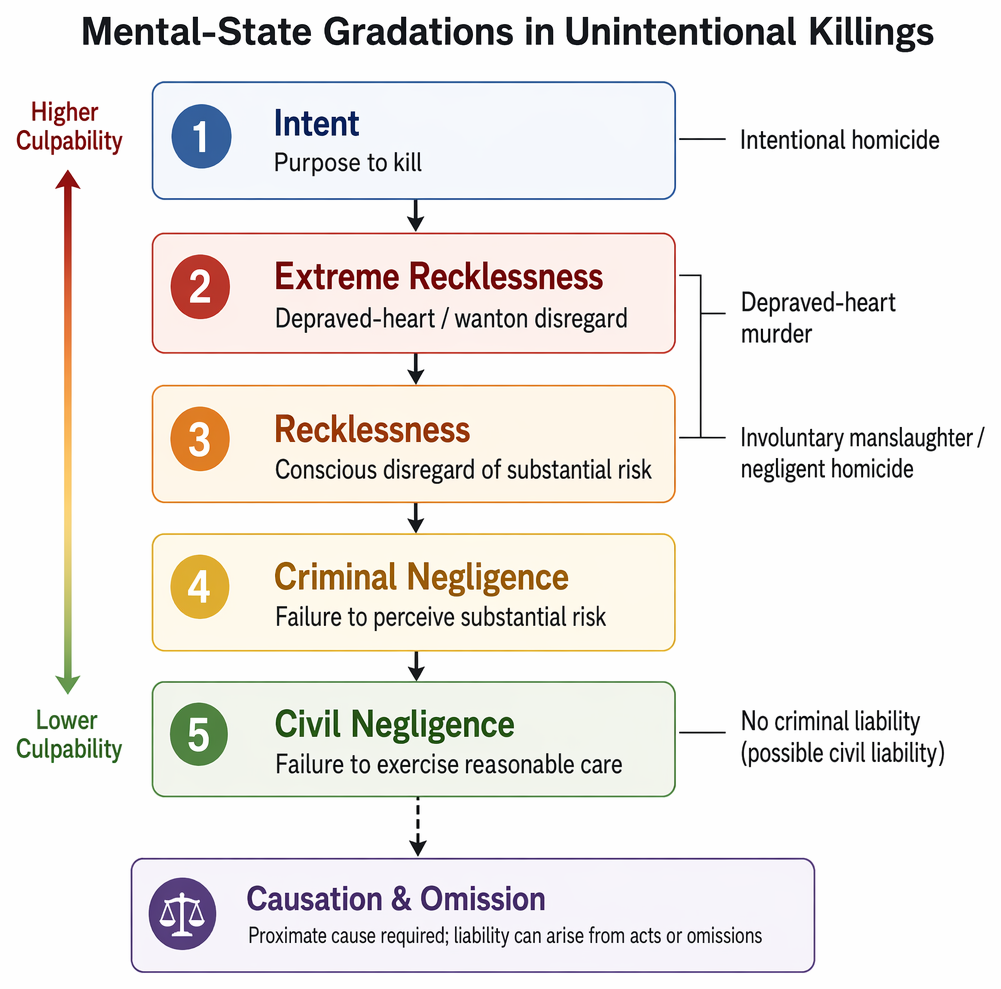
- Mental-state gradations: intent, extreme recklessness, recklessness, criminal negligence, and civil negligence
- Causation and omission issues in unintentional killings
Test Your Knowledge
Attempt these questions before reading this article. If you find some difficult or cannot remember the answers, look more closely at that area during your revision.
-
Which of the following best describes the mental state required for involuntary manslaughter at common law?
- a) Purposeful intent to kill
- b) Malice aforethought
- c) Recklessness or criminal negligence
- d) Premeditation
-
A driver, texting while speeding 25 mph over the limit through a crowded downtown area, runs a red light and kills a pedestrian. The jurisdiction follows the Model Penal Code. What is the most serious homicide charge likely to apply?
- a) First-degree murder
- b) Voluntary manslaughter
- c) Manslaughter based on recklessness
- d) Negligent homicide
-
Which of the following is NOT required to prove involuntary manslaughter under the “criminal negligence” theory?
- a) A death occurred
- b) The defendant acted with a gross deviation from reasonable care
- c) The defendant intended to kill
- d) The defendant’s conduct created a substantial risk of death and caused the death
Introduction
Homicide on the MBE is not limited to intentional killings. A large portion of tested questions involve deaths caused by risky or careless behavior where the defendant did not desire anyone’s death. These are the “reckless” and “negligent” homicides.
At common law, the principal unintentional homicide offense is involuntary manslaughter. Modern statutes (including the Model Penal Code) often divide this category further into reckless manslaughter and negligent homicide.
Key Term: Involuntary Manslaughter
Unintentional killing resulting from recklessness or criminal negligence, or from committing an unlawful act not amounting to an inherently dangerous felony. Key Term: Recklessness
Conscious disregard of a substantial and unjustifiable risk that death or serious bodily injury will result from one’s conduct. Key Term: Criminal Negligence
A gross deviation from the standard of care that a reasonable person would observe, creating a substantial risk of death, where the defendant should have been, but was not, aware of the risk. Key Term: Negligent Homicide
Under the Model Penal Code and many statutes, an unintentional killing caused by criminal negligence, usually punished less severely than manslaughter. Key Term: Depraved-Heart Murder
A killing resulting from extreme recklessness—conduct that shows an abandoned and malignant heart or extreme indifference to human life; classified as murder, not manslaughter. Key Term: Misdemeanor Manslaughter Rule (Unlawful-Act Manslaughter)
The common-law rule that a killing during the commission of a misdemeanor or non-dangerous felony may be involuntary manslaughter if the death is a natural and probable consequence of the unlawful act. Key Term: Duty to Act (for Homicide by Omission)
A legal obligation to act arising from statute, special relationship, contract, voluntary assumption of care, or creation of risk; failure to perform such a duty can supply the actus reus for homicide. Key Term: Causation (in Homicide)
The requirement that the defendant’s conduct be both the actual cause and the proximate (legal) cause of the victim’s death; the death must be a natural and foreseeable result of the conduct.
On the MBE, the key tasks are:
- Identifying the mental state proved by the facts
- Matching that mental state to the appropriate homicide grade
- Spotting whether a predicate unlawful act or omission supplies the basis for liability
Test Tip: When revising Reckless and negligent killings, connect each definition, method, or rule to the kind of question the assessment is likely to ask.
Reckless and Negligent Killings: Overview
Most jurisdictions recognize involuntary manslaughter as a form of homicide where the defendant causes death by acting recklessly or with criminal negligence. The central feature is that the defendant does not intend to kill or to inflict serious bodily harm, but does create an unjustifiable risk of death.
It is helpful to think of mental states for homicide on a spectrum:
- Intent / purpose / knowledge – classic intentional murder
- Extreme recklessness (depraved heart) – murder based on a very high, unjustified risk to human life
- Ordinary recklessness – manslaughter in most jurisdictions
- Criminal negligence – involuntary manslaughter or negligent homicide
- Civil negligence / pure accident – no criminal homicide
The exam will often hinge on whether the facts show ordinary recklessness (manslaughter) or extreme recklessness (depraved-heart murder).
Elements of Involuntary Manslaughter
To prove involuntary manslaughter under the recklessness/negligence theory, the prosecution must generally establish:
-
A killing – The defendant’s conduct caused the death of another human being.
-
Unintentional – The defendant had no purpose to kill or inflict serious injury.
-
Recklessness or criminal negligence – The defendant:
- Either consciously disregarded a substantial and unjustifiable risk (recklessness), or
- Failed to perceive such a risk despite a duty to do so (criminal negligence).
-
Gross deviation from reasonable care – The conduct was a serious departure from what a law-abiding person would do, given the risk.
-
Causation – The death was a natural and foreseeable result of the defendant’s conduct; no superseding cause breaks the chain.
Distinguishing Recklessness from Criminal Negligence
- Recklessness is subjective: the defendant is actually aware of the risk but proceeds anyway.
- Criminal negligence is objective: the defendant is not aware, but a reasonable person would have been, and the failure to perceive the risk is grossly careless.
On the MBE, the fact pattern will signal awareness with language like “despite repeated warnings,” “he knew,” “she realized,” or “he saw but decided to ignore.” If nothing suggests awareness, but the risk is obvious and severe, think criminal negligence.
Distinguishing from Murder
Murder requires malice aforethought. Malice is satisfied not only by intent to kill, but also by extreme recklessness—depraved-heart murder.
- Depraved-heart murder: Extremely dangerous conduct, undertaken with awareness, that shows a complete indifference to human life (e.g., firing into a crowded room, playing Russian roulette).
- Involuntary manslaughter: Risky conduct that is serious but does not rise to that extreme level.
Key exam factors that push conduct up from manslaughter to depraved-heart murder:
- Magnitude of the risk (how likely death is)
- Number of people endangered
- Duration and persistence of the conduct
- Any prior near misses or express warnings ignored
If the facts describe grossly dangerous driving (e.g., 100 mph through a school zone at dismissal, ignoring multiple red lights) or deliberately firing a gun at an occupied building, the best answer is usually murder via depraved heart, not involuntary manslaughter.
By contrast, a single instance of very careless driving (e.g., texting while speeding in ordinary traffic) usually supports involuntary manslaughter or reckless manslaughter under the MPC.
Misdemeanor Manslaughter Rule
In some jurisdictions, a killing during the commission of a misdemeanor or a non-dangerous felony is treated as involuntary manslaughter if the death is a foreseeable result of the unlawful act. This is sometimes called unlawful-act manslaughter.
Examples:
- Pushing someone in a minor, unlawful battery, causing the victim to fall, hit their head, and die.
- Committing a regulatory offense (e.g., unlicensed fireworks sale) in a way that reasonably leads to a fatal explosion.
The misdemeanor manslaughter rule is the less serious counterpart to felony murder. The predicate crime is not serious enough to classify the killing as murder, but it supplies the culpability needed for manslaughter.
Model Penal Code Approach
Many questions explicitly state that the jurisdiction “follows the Model Penal Code.” Under the MPC:
- Murder – Purposely or knowingly causing death, or recklessly causing death under circumstances manifesting extreme indifference to human life (includes felony murder).
- Manslaughter – Recklessly causes death, or kills under extreme mental or emotional disturbance (MPC’s voluntary manslaughter).
- Negligent homicide – Death caused by criminal negligence.
On MPC questions:
- Reckless killings → Manslaughter
- Negligent killings → Negligent homicide
- Extreme indifference → Murder
The fact pattern will typically tell you whether to label the offense manslaughter or negligent homicide.
Omissions and Duties in Reckless/Negligent Killings
Unintentional homicides frequently arise from failures to act. An omission can satisfy the act requirement for homicide when there is a legal duty to act and the omission is reckless or criminally negligent.
Legal duties commonly arise from:
- Statute (e.g., duty to file safety reports, duty of a parent to support a child)
- Special relationship (parent–child, spouse–spouse, innkeeper–guest)
- Contract (lifeguard, nursing-home staff)
- Voluntary assumption of care, isolating the victim from other help
- Creation of the risk (e.g., pushing someone into water, then failing to pull them out)
If the defendant has a legal duty, is aware (or should be aware) of a substantial risk of death, and grossly fails to act, involuntary manslaughter or negligent homicide is likely.
Worked Example 1.1
A parent leaves a toddler unattended in a bathtub while answering a phone call. The parent knows the child can stand but has slipped before. The child drowns. The jurisdiction follows common law.
Answer:
The parent may be guilty of involuntary manslaughter based on criminal negligence. As a parent, there is a clear duty to act. Leaving a toddler alone in a bathtub creates a substantial and unjustifiable risk of death and is a gross deviation from reasonable care, even if the parent did not consciously think through the risk at that moment. There is no intent to harm, so murder is not appropriate, but the mental state comfortably fits criminal negligence.
Worked Example 1.2
A construction foreman ignores repeated written warnings from engineers about a faulty safety rail on a high-rise project. The foreman decides repairs can “wait until next month” to save time. An employee leans on the rail, falls, and dies.
Answer:
The foreman’s conscious disregard of a known, substantial risk supports a finding of recklessness. His conduct is at least involuntary manslaughter. Whether it rises to depraved-heart murder depends on how serious and obvious the risk was and how many workers were exposed. On typical MBE facts like this, the examiners are aiming at involuntary manslaughter rather than murder.
Worked Example 1.3
A driver has one beer, feels “fine,” and drives 5 mph over the speed limit through a residential area at night. While adjusting the radio, the driver fails to see a pedestrian stepping into the crosswalk and kills her. The jurisdiction requires recklessness for involuntary manslaughter.
Answer:
This is likely civil negligence, not criminal recklessness. Momentary inattention at only slightly above the speed limit is a breach of civil duty but does not show conscious disregard of a substantial and unjustifiable risk. Absent additional aggravating facts (e.g., texting, extreme speeding, prior near misses), the best answer is no criminal homicide, though the driver is liable in tort.
Worked Example 1.4
A driver decides to race another car at 90 mph on a busy city street at noon, weaving in and out of traffic. The driver runs a red light and kills a bicyclist in the crosswalk.
Answer:
This conduct is extremely dangerous and obviously life-threatening, showing extreme indifference to human life. The best classification is depraved-heart murder, not involuntary manslaughter. The risk is far beyond ordinary recklessness: multiple people are endangered, and a fatal outcome is highly likely.
Worked Example 1.5
A shopkeeper commits a minor battery by angrily shoving a customer out the door, intending only to move him aside. The customer unexpectedly falls down the stairs, hits his head, and dies. The jurisdiction follows common law and recognizes the misdemeanor manslaughter rule.
Answer:
The shove is an unlawful act (a misdemeanor battery). The resulting death is a foreseeable consequence of pushing someone near stairs, even if the severity of the injury was not anticipated. Under the misdemeanor manslaughter rule, the shopkeeper can be convicted of involuntary manslaughter, even if his mental state did not rise to recklessness or criminal negligence as to death.
Worked Example 1.6
A caregiver in a residential home routinely sedates elderly residents at night so that she can sleep through her shift, contrary to written policy and training. One night, a resident vomits while heavily sedated and aspirates, dying.
Answer:
The caregiver’s conduct is at least reckless. She consciously disregarded a substantial risk of serious harm by using sedatives in violation of policy and medical judgment. The death is a foreseeable result of that risk. In a majority jurisdiction, this supports involuntary manslaughter (or reckless manslaughter under the MPC).
Causation and Intervening Acts
In reckless and negligent killings, causation is often contested:
- Ordinary negligent medical treatment of the victim is usually considered foreseeable and does not break the chain of causation.
- Only a superseding cause—something unforeseeable and extraordinary (e.g., a completely unrelated third-party attack)—will relieve the defendant of liability.
If the defendant’s risky behavior sets in motion a sequence leading to death, and nothing extraordinary intervenes, causation is satisfied.
Exam Warnings
On the MBE, do not confuse recklessness with mere civil negligence. Criminal negligence requires a gross deviation from reasonable care, not just a simple mistake or brief inattention. When a fact pattern involves very high risk to many people—drag racing through a school zone, shooting into a dwelling, dropping heavy objects from a highway overpass—think carefully whether the best answer is depraved-heart murder rather than involuntary manslaughter.
Revision Tip: If the defendant’s conduct creates a high risk of death but there is no proof of intent to kill or maim, ask in order:
- Is the risk extreme enough for depraved-heart murder?
- If not, does the conduct show conscious disregard of a substantial risk (recklessness) → involuntary manslaughter / reckless manslaughter?
- If not, does it at least show a gross failure to perceive a substantial risk (criminal negligence) → involuntary manslaughter / negligent homicide?
- If none of the above, the killing may be a tragic accident with no criminal homicide.
Key Point Checklist
This article has covered the following key knowledge points:
- Involuntary manslaughter is homicide based on recklessness or criminal negligence, not intent to kill.
- Recklessness involves conscious disregard of a substantial and unjustifiable risk of death or serious harm.
- Criminal negligence is a gross deviation from reasonable care in failing to perceive a substantial risk of death.
- Depraved-heart murder requires extreme recklessness showing an abandoned and malignant heart, and is treated as murder.
- At common law, involuntary manslaughter also includes unlawful-act (misdemeanor) manslaughter where death is a foreseeable result of a misdemeanor or non-dangerous felony.
- Under the Model Penal Code, reckless killings are manslaughter; negligent killings are negligent homicide.
- An omission can support reckless or negligent homicide when there is a legal duty to act and the failure is a gross deviation from reasonable care.
- Causation requires that the defendant’s conduct be both the actual and proximate cause of death; ordinary medical negligence does not break the chain.
- Ordinary accidents or simple civil negligence are not enough for criminal liability; the risk must be substantial and the deviation from care gross.
Key Terms and Concepts
- Involuntary Manslaughter
- Recklessness
- Criminal Negligence
- Negligent Homicide
- Depraved-Heart Murder
- Misdemeanor Manslaughter Rule (Unlawful-Act Manslaughter)
- Duty to Act (for Homicide by Omission)
- Causation (in Homicide)