Learning Outcomes
This article outlines the core constitutional principles of legitimacy, separation of powers, and the rule of law in UK public law, including:
- The meaning and sources of legitimacy in the UK state and its institutions, distinguishing legitimacy from mere legality and highlighting the roles of consent, accountability, and proper procedure
- How the doctrine of separation of powers operates within the flexible UK constitution, focusing on overlaps between branches, practical checks and balances, and the implications for constitutional stability
- Classical and contemporary understandings of the rule of law, and how they constrain government action, support judicial control, and protect individual rights in everyday legal contexts
- The interaction between legitimacy, separation of powers, and the rule of law in legislation, ministerial decision-making, the use of prerogative powers, and judicial review proceedings
- The impact of parliamentary sovereignty, delegated legislation, and public order powers on the perceived legitimacy of state action and on the effectiveness of legal and political safeguards
- Key case law and statutory developments (including the Constitutional Reform Act 2005 and the Human Rights Act 1998) that illustrate these principles in practice and shape modern UK constitutional doctrine
- Application of these constitutional principles to SQE1-style problem questions, enabling precise identification of issues such as government lawfulness, proportionality of interferences with rights, and the adequacy of judicial scrutiny
SQE1 Syllabus
For SQE1, you are required to understand legitimacy, separation of powers, and the rule of law in UK public law, with a focus on the following syllabus points:
- the concept of legitimacy in public law and its relevance to the exercise of state power
- the doctrine of separation of powers and its operation in the UK constitution
- the principle of the rule of law and its practical implications
- the relationships and checks between the legislative, executive, and judicial branches
- the role of judicial review in upholding legality and accountability
Test Your Knowledge
Attempt these questions before reading this article. If you find some difficult or cannot remember the answers, look more closely at that area during your revision.
- What is meant by 'legitimacy' in the context of UK public law?
- Which constitutional principle requires that government actions must have a legal basis and be subject to judicial scrutiny?
- How does the separation of powers operate in the UK, and what are the main branches of government?
- Why is judicial independence important for the rule of law?
Introduction
Legitimacy, separation of powers, and the rule of law are three foundational constitutional principles that ensure the justified, effective, and accountable exercise of state power in the UK. These doctrines are deeply embedded in UK public law and shape both the theoretical basis and the practical operation of the UK constitution. A clear understanding of these principles is critical to effective legal analysis and professional practice across all areas of law, and are frequently tested in SQE1.
Test Tip: In SQE-style questions on Concepts of legitimacy in public law, identify the legal test, the triggering fact, and the consequence before choosing between similar answer options.
Exam Warning: Do not rely on a familiar phrase from Concepts of legitimacy in public law alone; check whether the facts satisfy every condition, exception, and timing requirement.
Legitimacy in Public Law
Legitimacy is the quality that grants authority or power the acceptance and moral claim to obedience by those over whom it is exercised. In public law, legitimacy is closely associated with the rightfulness and acceptance of governmental authority, derived from both legal rules and the broader societal consensus that those rules and the actors who wield power are justified in doing so.
Key Term: legitimacy
Legitimacy is the recognised and justified authority of government or public bodies to exercise power, based on legal rules, democratic consent, or accepted social norms.
Legitimacy goes beyond mere legality: while legality denotes compliance with the letter of the law, legitimacy encompasses public justification of authority, conformity with constitutional principles, and the acceptability of the exercise of power in the eyes of the governed. In a modern democracy like the UK, legitimacy is secured through:
- Compliance with the law and procedure (legality)
- Democratic participation and representation (e.g. regular, free elections)
- Institutional accountability and transparency
- Respect for fundamental rights and freedoms
In the context of parliamentary sovereignty, legitimacy arises from the fact that Parliament is democratically elected and possesses the supreme law-making power. The government, as the executive, derives its authority from Parliament and, ultimately, from the electorate. When public institutions act within the framework established by the law and the constitution, their actions are more likely to be accepted as legitimate.
However, legitimacy can be threatened in situations where:
- Public bodies act ultra vires (beyond the scope of their legal powers)
- There is non-compliance with established procedures, or breach of constitutional conventions
- Power is exercised in a manner that is arbitrary, discriminatory, or inconsistent with the principles of fairness and equality before the law
- Government actions lack transparency or are not subject to meaningful scrutiny
In contemporary UK public law, legitimacy also depends on the observance of international obligations, compliance with rights under the Human Rights Act 1998 and the European Convention on Human Rights, and continuing public trust in public institutions.
Legitimacy and Parliamentary Process
Legitimacy in law-making is derived from the structured procedures of the legislative process. Statutes (Acts of Parliament) originate as Bills, debated and scrutinised at several stages by both the House of Commons and the House of Lords before receiving Royal Assent. These procedures help to ensure that laws have public input and parliamentary consent, key ingredients for legitimacy.
The legitimacy of a law may be further questioned where Acts are passed too swiftly (using 'fast-track' legislation) or without adequate scrutiny, or where delegated legislation is used inappropriately to bypass parliamentary debate on significant issues.
Legitimacy, Public Law Decisions, and Judicial Control
The legitimacy of executive and public authority decisions is supported by the rule that public bodies must act within the scope of powers conferred by law and follow correct procedures. Judicial review allows the courts to scrutinise administrative action, ensuring that public bodies act lawfully, reasonably, and fairly. This process supports legal and procedural legitimacy and maintains public confidence in the constitutional order.
Key Term: ultra vires
'Ultra vires' denotes actions taken beyond the scope of legal authority granted to a public body or official.
Where public bodies exceed their powers or act in breach of the standards of procedural fairness, the courts can declare those actions unlawful, undermining their legitimacy and enforcing constitutional principle.
Separation of Powers
The separation of powers is the doctrine that distributes the main functions of the state among three distinct branches: the legislature, the executive, and the judiciary. This separation aims to prevent the accumulation of excessive power in any one branch, provide a system of checks and balances, and safeguard constitutional freedoms.
Key Term: separation of powers
The separation of powers is the constitutional principle that allocates legislative, executive, and judicial functions to separate bodies to prevent abuse of power.
The UK constitution adopts a pragmatic and flexible approach to the separation of powers. Unlike the strict, formal separation set out in systems such as that of the United States, the UK’s “unwritten” constitution instead provides for some overlap while retaining meaningful checks and balances.
- The legislature (Parliament: House of Commons, House of Lords, and the Monarch) makes laws.
- The executive (Prime Minister, Cabinet, and government departments, acting in the name of the Crown) implements and enforces laws.
- The judiciary (the courts) interprets and applies laws, and adjudicates disputes.
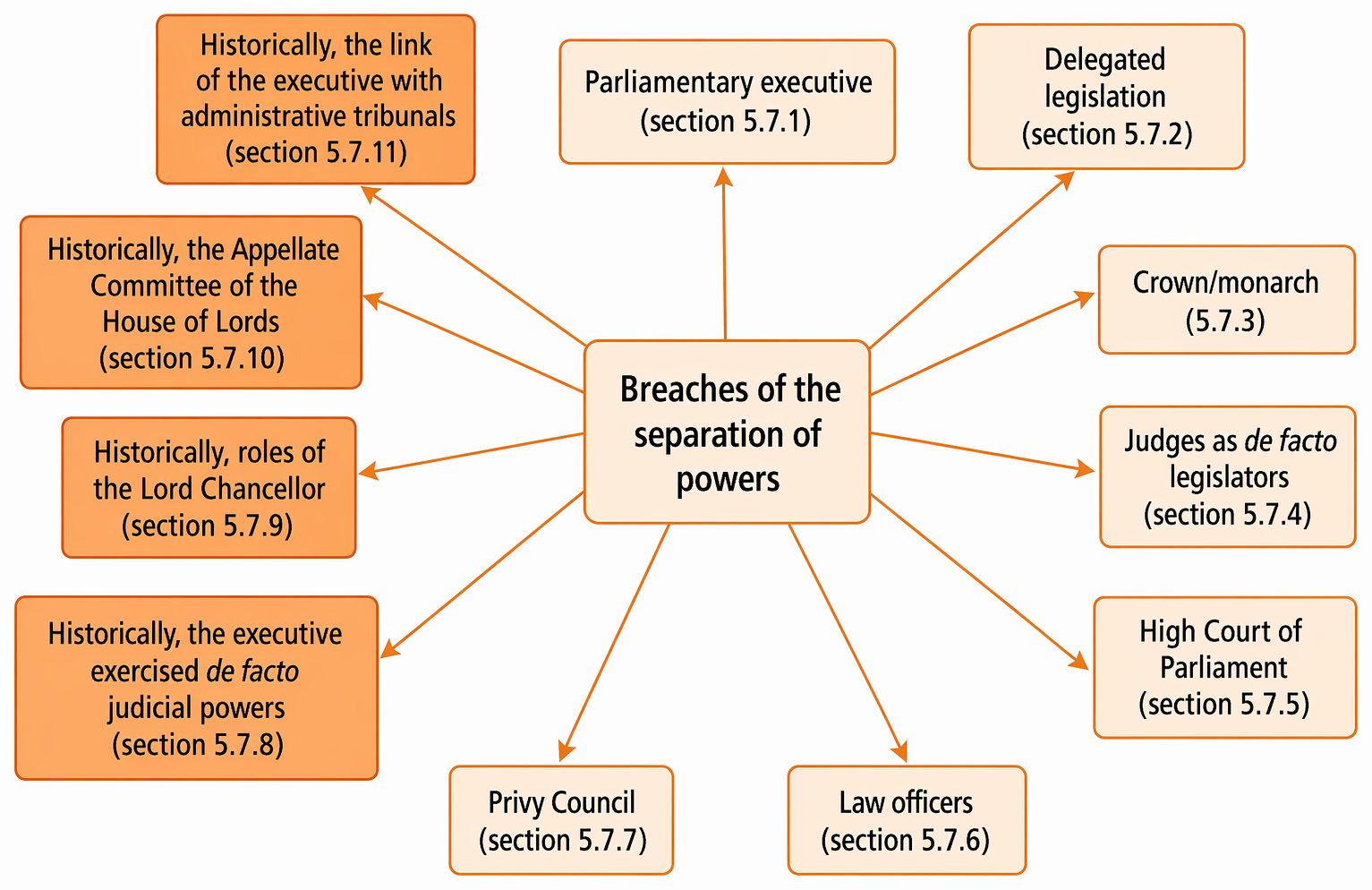
While each branch primarily exercises distinct powers, there are deliberate overlaps. Most government ministers are also Members of Parliament, and government is drawn from the party or parties commanding a majority in the Commons—a feature sometimes called the "parliamentary executive." The judiciary, however, is increasingly institutionally and functionally separate, especially following the Constitutional Reform Act 2005, which established the Supreme Court and clarified the roles of the judiciary and the Lord Chancellor.
Checks and Balances
Checks and balances are mechanisms by which each branch is held accountable and restricted in its exercise of power by the others.
- Parliamentary scrutiny, via select committees, debates, and Prime Minister's Questions, checks the executive.
- The courts, through judicial review, ensure the executive acts lawfully and within the scope of powers conferred by Parliament.
- The judiciary themselves are subject to the rule of law, expectations of impartiality, and parliamentary oversight in matters such as judicial conduct.
Some tools that support checks and balances in the UK include:
- Votes of no confidence and parliamentary committees holding the government to account
- Judicial review challenging the lawfulness of executive and administrative actions
- The Human Rights Act 1998, requiring all public authorities to act compatibly with the ECHR
- The common law duty on ministers and public officials to act within the law and for proper purposes
The SRA Principles also commit solicitors to upholding the rule of law and the proper administration of justice, and acting with independence, integrity, and in the public interest, supporting the important role of legal professionals as constitutional actors.
The Evolving Separation of Powers in the UK
Recent constitutional reforms have increased the separation and independence of the judiciary, especially with the creation of the Supreme Court and the introduction of a Judicial Appointments Commission. The Lord Chancellor is no longer the head of the judiciary, and active politicians no longer serve as law lords. This has further clarified boundaries between the branches but also preserved important interconnections allowing effective government.
Legitimacy, separation of powers, and the rule of law in UK public law, including sources, functions, threats, and interrelationship.
However, certain significant overlaps (such as the executive's control over the legislative timetable, or ministers sitting in Parliament) remain a distinctive feature, with both benefits (ensuring government accountability) and risks (potential executive dominance). Academic commentators stress that as long as genuine judicial independence is maintained and parliamentary scrutiny remains robust, the UK model of a “blended” separation of powers is effective.
Worked Example 1.1
Scenario: The government wishes to introduce a new law that would restrict certain forms of protest. Parliament debates and passes the law, but the courts later find that the government has used powers not granted by the statute to enforce the restrictions.
Answer:
The courts may declare the government’s actions unlawful for exceeding its legal authority. This upholds the separation of powers by allowing the judiciary to check the executive and supports the legitimacy of the legal process.
The Rule of Law
The rule of law is the principle that the law itself is supreme and that all persons and public authorities, including the government, are subject to and accountable to the law. This doctrine ensures that power is exercised, and disputes are resolved, according to clear, established, and accessible legal rules rather than arbitrary commands.
Key Term: rule of law
The rule of law is the principle that everyone, including the state, is subject to the law, which must be applied equally, fairly, and predictably.
The core components of the rule of law, across modern and classical interpretations, include:
- All government action must be authorised by law (principle of legality)
- Government officials are not above the law and are accountable for their actions
- Legal rules must be accessible, clear, and predictable
- Equality before the law: the laws apply equally to all, except where objective and justifiable differences exist
- Fundamental human rights and liberties should be protected
- Law should not be retrospective unless Parliament clearly states otherwise
- Access to justice: there must be effective means to vindicate rights and resolve disputes in court
- The judiciary must be independent and impartial
The rule of law has been given explicit statutory recognition in the Constitutional Reform Act 2005 (s.1) and is the basis for the ethical requirements of all legal practitioners.
Judicial Review and the Rule of Law
Judicial review is an essential safeguard for the rule of law, providing the means by which the courts can ensure that public bodies act within their legal powers, act for proper purposes, and comply with required procedures. The grounds of judicial review—illegality, irrationality, and procedural impropriety—ensure that state power is lawfully exercised, blocking arbitrary conduct and protecting fundamental rights. The Human Rights Act 1998 further enhances these protections by requiring public authorities to act compatibly with ECHR rights.
Key Term: judicial review
Judicial review is the process by which courts review the lawfulness of decisions or actions taken by public bodies.
Judicial review remedies, including quashing orders, prohibiting orders, and declarations, enable the courts to set aside unlawful government action and uphold the supremacy of law over administrative discretion.
The Rule of Law in Practice
In practice, the rule of law requires that:
- Parliament passes laws through established procedures, ensuring transparency, participation, and public debate
- Ministers and officials act only under legal authority, and can be challenged in court if they do not do so
- Individual rights and liberties are respected by public bodies, subject to limits justified only by law and necessary for democratic society
- Complex issues such as public order or national security are addressed by law, with judicial oversight to prevent excessive or arbitrary incursions on basic rights
Various judicial decisions support the principle that neither executive officials nor ministers are above the law and that the courts can issue binding orders against them (see, for example, M v Home Office [1994] 1 AC 377).
Worked Example 1.2
Scenario: A local council introduces a new policy affecting housing benefits. The policy is challenged in court on the grounds that it was introduced without proper legal authority and discriminates against certain groups.
Answer:
The court may use judicial review to assess whether the council acted within its legal powers and followed the correct procedures. If not, the policy may be quashed, demonstrating the rule of law in practice.
The Interrelationship of Principles
Legitimacy, separation of powers, and the rule of law are deeply interrelated within the UK constitution:
- Legitimacy is grounded in legal authority, adherence to proper procedures, and respect for democratic values—concepts which are enforced through the rule of law and checked via the separation of powers.
- The separation of powers helps to secure legitimacy by ensuring that power is not concentrated and is exercised accountably.
- The rule of law binds all branches, ensuring that even the legislature and executive must respect legal limits and justify the exercise of power.
This system provides mechanisms for government accountability, limits the potential for abuse of power, and fosters the public trust necessary for law and government to function effectively.
Worked Example 1.3
Scenario: The executive seeks to use prerogative powers to make a major constitutional change without parliamentary approval. The courts are asked to decide whether this is lawful.
Answer:
The courts may hold that such a change requires an Act of Parliament, not just executive action. This supports the rule of law, maintains the separation of powers, and ensures legitimacy by requiring democratic approval.
Parliamentary Sovereignty and the Rule of Law
A distinctive feature of the UK constitution is the doctrine of parliamentary sovereignty, which means Parliament is the supreme legislative authority and can make or unmake any law. While this is the basis for legitimacy, it also creates tension where Parliament may, in principle, legislate contrary to rule of law principles. The modern approach is that Parliament is presumed not to intend to override fundamental rights or the rule of law without clear wording.
Courts have sometimes expressed the view—without establishing new legal doctrine—that the rule of law may pose limits to parliamentary sovereignty in extreme cases (see R (Jackson) v Attorney General [2005] UKHL 56), but the prevailing position remains that Parliament is sovereign.
The Human Rights Act 1998 represents a "weak" incorporation of rights: while the courts must strive for compliant interpretations under s.3 HRA, and may declare legislation incompatible with the ECHR under s.4 HRA, they cannot strike down primary legislation. Political and procedural pressures, together with judicial scrutiny, now act as important constraints on arbitrary law-making.
Delegated Legislation, Public Order, and Legitimacy
Delegated legislation (also known as secondary or subordinate legislation) allows the detailed implementation of parliamentary statutes but must be made within the limits set by Parliament. Excessive or inappropriate use of delegated powers, or so-called "Henry VIII clauses" (allowing ministers to amend primary legislation by secondary means), are widely criticised as undermining both parliamentary scrutiny and legitimacy.
Public order law—encompassing the powers of police and other authorities to control processions, assemblies, and prevent breaches of the peace—exemplifies the significance of formal procedures and the necessity of legal controls. Statutory and common law powers to restrict protest and preserve order are only justified where the legal basis is clear, proportionate, and subject to effective judicial review.
Key Term: breach of the peace
Breach of the peace denotes violence, the threat of violence, or behaviour likely to provoke such violence and thereby disrupt public order.
The Human Rights Act 1998 and ECHR rights to freedom of assembly and expression mean that statutory and police powers curtailing protest must be lawfully exercised and proportionate, with judicial control available to prevent abuses, maintaining both legitimacy and the rule of law.
Legitimacy and the European Union
During the UK's EU membership, the supremacy of EU law required that, where EU law conflicted with domestic statute, EU law prevailed (as in Factortame and Costa v ENEL). The principle of direct effect allowed individuals to invoke certain EU legal rights before domestic courts. Parliamentary sovereignty was therefore limited by the necessity to comply with EU obligations.
Since Brexit, ‘retained EU law’ has continued to affect the domestic legal order, but Parliament has ultimate authority. However, historical constraints imposed by EU law continue to inform debates over legitimacy and the respective roles of Parliament, the executive, and the courts.
Key Term: supremacy of EU law
The doctrine that, within areas of EU competence, EU law took priority over conflicting domestic law while the UK remained a member state.
Summary
| Principle | Meaning | UK Application |
|---|---|---|
| Legitimacy | Rightful and accepted authority to exercise power | Based on law, democratic consent, and proper process |
| Separation of Powers | Division of state functions among branches | Partial separation, with checks and balances; judiciary increasingly independent |
| Rule of Law | All are subject to and accountable under the law | Judicial review, independent courts, legal equality; all government power must be lawfully exercised |
Key Point Checklist
This article has covered the following key knowledge points:
- Legitimacy means the justified and accepted exercise of state power, grounded in law, democratic consent, and conformity to legal and constitutional procedures.
- The UK separation of powers is pragmatic, with some institutional overlap, but maintains accountability and checks, especially via parliamentary control and growing judicial independence.
- The rule of law requires all individuals and public offices (including the government and Parliament) to be subject to and accountable under law, with equality and clarity of law safeguarded.
- Judicial review is the main judicial mechanism for upholding legality, ensuring government is limited, accountable, and operates in ways that maintain both legality and legitimacy.
- Parliamentary sovereignty is central but is balanced by the rule of law and procedural safeguards, including human rights protections and principles of legality.
- The use of delegated legislation, statutory regulation, and control of public order must always be circumscribed by law, subject to review, and justified by clear purposes—preserving democratic legitimacy and legal certainty.
- The historical interplay between UK law and EU law exemplified the dynamic relationship between sovereignty, legitimacy, and the supremacy of law, with continuing influence post-Brexit.
Key Terms and Concepts
- legitimacy
- separation of powers
- rule of law
- judicial review
- ultra vires
- breach of the peace
- supremacy of EU law