Learning Outcomes
This article examines legitimacy, separation of powers, and the rule of law as interlocking constitutional pillars within the UK system, including:
- Sources and mechanisms of legal authority in the UK supporting legitimacy
- Maintenance of legitimacy through the rule of law, human rights, clear legislative processes, and responsiveness to public expectation
- Allocation of law-making, executive, and adjudicatory authority under the separation of powers
- UK deviations from a pure separation model and constitutional checks and balances
- Principles of the rule of law as triggers for judicial review and legal accountability
- Judicial independence and the requirements of legal certainty, fairness, equality before the law, and procedural justice, in statutory and case law contexts
- Impact of legitimacy, separation of powers, and the rule of law on the balance of powers across Parliament, Government, and the courts
- Practical SQE1 scenarios involving the legitimacy and limits of public authority, enforcement of rights, and legal challenges
SQE1 Syllabus
For SQE1, you are required to understand legitimacy, separation of powers, and the rule of law in UK public law, with a focus on the following syllabus points:
- the origins and sources of legitimacy in the UK constitutional system, including parliamentary sovereignty, democratic accountability, and respect for the rule of law
- the role and practical operation of the separation of powers, including overlaps and mechanisms for checks and balances between the legislature, executive, and judiciary
- the core values and requirements constituting the rule of law in the UK, including legal certainty, equality, access to justice, and procedural fairness
- the interface between the rule of law, fundamental rights (including European Convention rights), and judicial review
- the relationship between legitimacy, separation of powers, and judicial accountability, especially in relation to government action and the protection of individual rights
Test Your Knowledge
Attempt these questions before reading this article. If you find some difficult or cannot remember the answers, look more closely at that area during your revision.
- What is meant by 'legitimacy' in the context of the UK constitution?
- Name the three branches of government and briefly describe their primary functions.
- Which principle requires that all individuals and authorities, including the government, are subject to the law?
- How does judicial review demonstrate the interaction between the rule of law and the separation of powers?
- True or false? The UK constitution enforces a strict separation of personnel between the executive and the legislature.
Introduction
Legitimacy, separation of powers, and the rule of law are central and interdependent principles that support the UK constitutional order. Legitimacy ensures that governmental authority is recognised as rightful and lawful by the people, drawing its force from consensus, established legal processes, and democratic accountability. Separation of powers divides the principal functions of the state between Parliament, the executive, and the judiciary, creating a framework for mutual checks and balanced constraint that protect against the arbitrary exercise of power. The rule of law commits all individuals and authorities, including the government, to obeying laws that are public, certain, fair, and justly applied by independent courts. These concepts collectively provide the theoretical and practical basis for constitutional government, individual liberty, effective government, and accountability under UK law.
Test Tip: In SQE-style questions on Principles of the rule of law, identify the legal test, the triggering fact, and the consequence before choosing between similar answer options.
Legitimacy in the UK Constitution
Legitimacy is fundamental for the acceptance and authority of governmental power. In constitutional terms, legitimacy refers not only to lawfulness but also to a recognised right to govern, derived from the observance of constitutional rules, traditions, democratic norms, and the values embedded in the conduct of public institutions. In the UK, legitimacy is maintained and challenged through a combination of legal formality, democratic procedures, rule of law compliance, and evolving public expectations.
Key Term: legitimacy
Legitimacy is the recognised and lawful right of a government or public institution to exercise power, based on constitutional rules, democratic consent, and respect for fundamental principles such as the rule of law.
The main sources of legitimacy in the UK are:
- Legal authority and parliamentary sovereignty: Acts of Parliament are the highest form of law, and the government derives authority from the laws passed by Parliament, reflecting the notion that every use of state power must have a legal basis. Parliamentary sovereignty, in turn, reinforces legitimacy by ensuring that government is, in law, answerable to Parliament, which is representative of the people.
- Democratic processes and political accountability: Legitimacy is also founded on the periodic election of representatives by universal (adult) suffrage, ensuring that government can be removed and that the executive remains answerable to Parliament. In practice, party-political mechanisms such as ministerial responsibility and parliamentary questions (as well as the operation of select committees) help maintain the accountability of government and support legitimate authority.
- Constitutional conventions and historical documents: Many important principles—including ministerial responsibility, the regular summoning of Parliament, and legislative procedures—are not found in statutes but are rooted in long-established conventions or historical instruments like the Magna Carta and Bill of Rights 1689. Conventions play a major role in conferring legitimacy, especially in the UK’s uncodified constitution.
- Judicial affirmation and adherence to the rule of law: The courts, through the process of judicial review, ensure that government and public bodies act within their legal powers and comply with procedural fairness, thus supporting governmental legitimacy.
- Respect for fundamental rights and values: The protection of rights, including human rights as incorporated by the Human Rights Act 1998, also enhances legitimacy by aligning the constitution with public expectations of fairness and justice.
Legitimacy is dynamic, and can be eroded by breaches of legal or constitutional principles, arbitrary exercise of power, persistent misconduct, or disregard for public trust. For instance, in R (Miller) v Secretary of State for Exiting the European Union [2017] UKSC 5, the Supreme Court affirmed that significant constitutional changes must be made through Parliament rather than executive action, reinforcing legal and political legitimacy.
Worked Example 1.1
A government minister issues a regulation without statutory authority. Is this action legitimate?
Answer:
No. Legitimacy is compromised when government action lacks a valid legal basis. Regulations made without statutory authority are unlawful, and neither compliance with procedure nor ministerial intention can confer legitimacy in the absence of legal power.
The Separation of Powers
The doctrine of separation of powers is central to the constitutional design of many liberal democracies, intended to limit the potential for abuse through the accumulation of power in one branch or office. The UK's separation is pragmatic rather than strict, with overlap and interdependence in practice, but the principle still exerts an important influence on the organisation and operation of government.
Key Term: separation of powers
The separation of powers describes the division of governmental functions among the legislature (law-making), executive (law implementation), and judiciary (law interpretation and dispute resolution), aiming to prevent the concentration of power and provide checks against misuse.
The three principal branches of government under the UK separation of powers are:
- Legislature: Parliament (House of Commons, House of Lords, and the Monarch), whose primary function is to make and amend law, authorise expenditure, and scrutinise the government. Parliament also serves as the forum for public debate and consent.
- Executive: The government (Prime Minister, Cabinet ministers, civil service), which implements law and oversees administration of public policy. The executive is drawn from Parliament under the UK model of responsible government.
- Judiciary: The courts, which resolve legal disputes and interpret the law, acting independently to uphold justice and the rule of law.
While these bodies are distinct in function, in the UK there are important overlaps:
- Government ministers are also Members of Parliament.
- The Lord Chancellor historically had executive, legislative, and judicial functions until reforms under the Constitutional Reform Act 2005.
- The Prime Minister and Cabinet are accountable to Parliament, which they seek to control by virtue of their majority but can be removed by a vote of no confidence.
- The executive’s power to make secondary (delegated) legislation is subject to parliamentary procedures and judicial review.
- Judges are independent of government and may not sit in Parliament, and their tenure is protected save for misconduct or incapacity.
Key Term: checks and balances
Checks and balances are constitutional mechanisms that enable each branch of state to limit, review, or oversee the powers exercised by the others, preserving a balance and preventing any single branch from acting beyond its constitutional remit.
In practice, the UK’s structure does not achieve a pure separation but creates a “parliamentary executive,” where executive government is dependent on continued parliamentary confidence. This results in a flexible but robust system where Parliament may hold ministers to account and the judiciary, through judicial review and statutory interpretation, may scrutinise executive decisions.
Worked Example 1.2
Can Parliament remove a judge from office for disagreeing with a government policy?
Answer:
No. Judicial independence is a core safeguard of the separation of powers. Judges can only be removed for incapacity or serious misconduct by address of both Houses of Parliament (very rare in practice), not for their decisions or their policy views. This secures impartiality and prevents executive or legislative interference with the judiciary. The Constitutional Reform Act 2005 reinforced the institutional separation and independence of the judiciary by creating the Supreme Court (removing the Law Lords from the House of Lords) and reforming the office of Lord Chancellor, who is now prohibited from judicial functions. Appointment of judges is now overseen by an independent commission, further securing the independence of the judicial branch.
The Rule of Law
The rule of law is a fundamental constitutional principle, securing the highest degree of legal order, equality, and liberty within the state. It requires that all persons and bodies, private and public, are subject to and accountable before publicly established laws administered by independent courts. The rule of law protects against arbitrariness, ensures predictability, and supports both legitimacy and accountability.
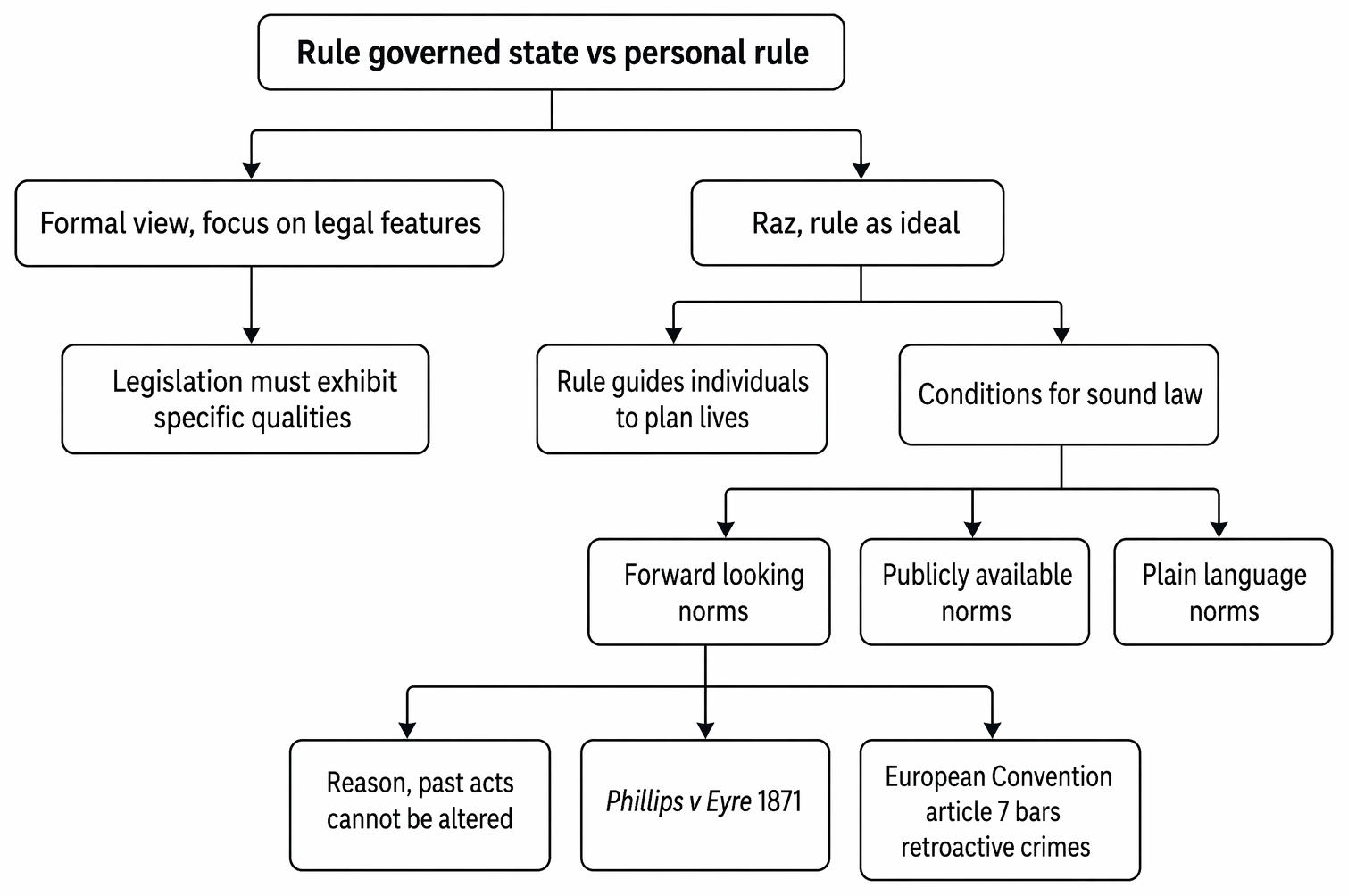
Raz's formal conception of the rule of law is presented through prospectivity, publicity and clarity, including limits on retroactive criminal liability.
Key Term: rule of law
The rule of law means that everyone, including the government, is subject to the law, and laws must be public, clear, stable, and fairly enforced by independent and impartial courts. It incorporates principles of equality before the law, legal certainty, fair procedures, and effective remedies for breaches.
Key requirements and dimensions of the rule of law in the UK (drawing on authorities such as Dicey and Lord Bingham) include:
- All government actions must be authorised by law: Executive power must be exercised within legally conferred powers; any action beyond that is ultra vires and may be quashed by the courts.
- Equality before the law: No one is above or exempt from the law, whether citizen, minister, or official; laws must be applied without discrimination (subject to legitimate exceptions such as parliamentary privilege or diplomatic immunity).
- Legal certainty and public accessibility: Laws must be clear and accessible so citizens can understand their rights and obligations; secret, retroactive, or arbitrary laws violate this principle.
- Independent and impartial judiciary: Judges must act without external influence in the resolution of disputes, interpreting and applying the law independently of the executive or legislature.
- Access to justice: Individuals must be able to seek remedies for breaches of their rights, including constitutional rights, in independent courts not subordinated to the executive.
- Fair procedures and due process: Decisions affecting rights, liberty, or property must be made according to legal process, with opportunity to be heard and to challenge adverse measures.
- Respect for and protection of human rights: The law must afford adequate protection to fundamental rights, including civil and political liberties and, where supported by convention or statute, economic and social rights.
These principles have statutory and judicial support:
- Section 1 of the Constitutional Reform Act 2005 recognises the rule of law as a fundamental principle.
- The Human Rights Act 1998 requires courts to interpret laws in a way that is compatible with Convention rights, securing the rule of law in areas governed by ECHR.
- The Common Law (e.g. Entick v Carrington) protects liberties not by written declarations but by effective remedies before the ordinary courts.
A significant contemporary aspect is the role of the judiciary in holding the executive to account under judicial review, ensuring that governmental actions comply with law and that legal wrongs can be redressed. The courts’ willingness to uphold access to justice, as in R (UNISON) v Lord Chancellor [2017] UKSC 51 (striking down excessive tribunal fees), exemplifies the centrality of the rule of law to the constitution.
Key Term: judicial review
Judicial review is the procedure by which courts review the legality of actions, decisions, or omissions of public authorities, ensuring such action is within lawful powers, reasonable, procedurally fair, and compliant with fundamental rights.
Worked Example 1.3
A local authority refuses to grant a licence without giving reasons or following proper procedure. What principle is at risk?
Answer:
The rule of law is at risk. The authority must act for a legitimate purpose, within legal powers, and in accordance with fair procedure. If it fails to do so, citizens may challenge the decision by judicial review, enforcing the requirement for lawful, reasoned, and just action.
Interactions and Practical Application
Legitimacy, separation of powers, and the rule of law constantly interact within the UK constitution to maintain accountable and effective government. Judicial review provides a daily demonstration of these concepts in practice:
- Legitimacy: Judicial review upholds legitimacy by demanding that exercises of power have a proper legal basis and comply with constitutional procedures.
- Separation of powers: Review actions are undertaken by the judiciary, independent of the executive, checking the lawfulness of executive action and, in some instances, secondary legislation.
- Rule of law: Courts enforce adherence to legal standards and fair process, providing remedies where legal violations occur.
Parliamentary sovereignty remains a central tenet in the UK's constitutional framework, but its continuing legitimacy depends upon democratic procedures, constitutional compliance, and respect for the rule of law. The executive is accountable to Parliament for the lawfulness and propriety of its actions, while the judiciary (with strict independence) exercises control through review of legality, not the merits, of government decisions.
- Disputes about legislative or administrative power, conflict of laws, and the application of fundamental rights are typically resolved through a combination of:
- Political accountability, via parliamentary processes
- Legal accountability, via judicial review and appeals
- Rights-based challenges, often invoking the Human Rights Act and ECHR
The UK Supreme Court and Court of Appeal have reasserted the significance of these principles in high-profile cases, such as R (Miller) v The Prime Minister [2019] UKSC 41 (finding the prorogation of Parliament unlawful for frustrating the constitutional role of Parliament) and A v Secretary of State for the Home Department [2005] 2 AC 68 (striking down indefinite detention of foreign nationals as incompatible with the right to liberty).
Further, the partially separated nature of UK government—where ministers sit in Parliament, and the executive wields delegated legislative powers—highlights the importance of checks and balances, theoretical and practical, to prevent the abuse of power.
Exam Warning: In the SQE1, be careful not to assume that the UK constitution enforces a strict separation of powers. The UK system is characterised by a pragmatic, flexible, and partially fused model, with overlaps in personnel and function, but effective accountability maintained by a combination of statutory safeguards, conventions, political scrutiny, and judicial review.
Summary
| Principle | Definition | Application in UK Constitution |
|---|---|---|
| Legitimacy | Lawful and accepted use of power | Derived from law, democracy, and conventions |
| Separation of powers | Division of state authority among branches | Partial separation, with checks and balances |
| Rule of law | All are subject to and accountable under the law | Ensured by judicial review and legal process |
Key Point Checklist
This article has covered the following key knowledge points:
- Legitimacy is achieved through legal authority, democratic processes, adherence to constitutional conventions, and public trust.
- The separation of powers allocates state functions between the legislature, executive, and judiciary, aiming to restrict concentration of power and enable mutual checks.
- In the UK, the separation is not rigid—overlap exists (especially between Parliament and government)—but checks are provided by conventions, statutes, and external scrutiny.
- The rule of law requires that all actions by individuals and state bodies, including government, are subject to and consistent with the law.
- Judicial review is the principal mechanism by which courts ensure legality, procedural fairness, and respect for rights, preventing arbitrary, unlawful, or unreasonable government action.
- The interaction of these principles is central to legal accountability, prevention of arbitrary power, and the maintenance of public confidence in UK public law.
Key Terms and Concepts
- legitimacy
- separation of powers
- checks and balances
- rule of law
- judicial review