Learning Outcomes
This article explains the UK doctrine of separation of powers and its relationship to legitimacy and the rule of law, including:
- The historical and theoretical basis of the doctrine and its importance in restraining government power.
- The roles, composition, and core functions of the legislature (Parliament), executive (government), and judiciary (courts), and practical overlaps such as the parliamentary executive.
- The qualified nature of separation in the UK and the checks and balances that mitigate power concentration, including ministerial responsibility, parliamentary privilege, select committees, judicial review, and conventions such as the Sewel Convention.
- The safeguards of judicial independence—appointments, tenure, and reforms under the Constitutional Reform Act 2005, including the creation of the Supreme Court—and accountability mechanisms for reviewing legislation and executive action.
- The relevance of separation of powers and the rule of law to legitimacy, justice, and the protection of rights and freedoms under the Human Rights Act 1998, alongside constitutional developments such as devolution and the evolution of UK–EU relations.
- How to analyze scenarios that test or infringe the separation of powers and structure legally robust answers in line with current statutory and constitutional law.
SQE1 Syllabus
For SQE1, you are required to understand the separation of powers among the legislative, executive, and judiciary and its relationship to legitimacy and the rule of law, with a focus on the following syllabus points:
- the meaning and purpose of the separation of powers
- the structure, function, and composition of the legislature, executive, and judiciary in the UK
- the interplay and overlap between the three branches (combination of powers and checks/balances)
- statutory, legal, and conventional mechanisms ensuring judicial independence and preventing abuse of executive and legislative power
- the role of constitutional conventions (e.g., ministerial responsibility, Sewel Convention)
- the significance of the rule of law and legitimacy in government action
- the operation and effect of judicial review in controlling public and government power
- the impact of developments such as devolution, EU law, and the HRA 1998 on the balance of powers
Test Your Knowledge
Attempt these questions before reading this article. If you find some difficult or cannot remember the answers, look more closely at that area during your revision.
-
Which branch of government is responsible for implementing and administering the law in the UK?
- a) Judiciary
- b) Executive
- c) Legislature
-
What is the main purpose of the separation of powers doctrine?
- a) To ensure government efficiency
- b) To prevent the concentration of power and protect liberty
- c) To allow Parliament to control the judiciary
-
Which of the following best describes judicial independence?
- a) Judges are appointed by the Prime Minister and can be dismissed at will
- b) Judges are free from improper influence by the executive and legislature
- c) Judges must follow government policy
-
True or false? In the UK, there is a strict, formal separation of personnel between the executive and the legislature.
Introduction
The architecture of the United Kingdom’s constitution is defined by a core set of constitutional principles, with the separation of powers at the heart. The principle establishes the allocation of powers and functions among the principal bodies of state: the legislature (Parliament), the executive (government, including ministers and civil service), and the judiciary (the courts). This separation is intended to prevent the concentration of unchecked power, to ensure accountability, and to uphold the rule of law and the legitimacy of state action. In the UK, the separation is not absolute but partial—characterised by pragmatic overlaps, robust constitutional conventions, and continuous adaptation.
Key Term: separation of powers
The constitutional principle that allocates governmental functions to three branches—legislative, executive, and judicial—and prescribes distinct and independent spheres of authority as a safeguard against the concentration or abuse of power.
Understanding how the separation of powers works in practice in the UK—through the allocation of state functions, the mechanisms and conventions which keep the branches in balance, and the statutory protections afforded to judicial independence—is fundamental to public law and the professional obligations of solicitors.
Test Tip: In SQE-style questions on Separation of powers among the legislative, executive, and judiciary, identify the legal test, the triggering fact, and the consequence before choosing between similar answer options.
Exam Warning: Do not rely on a familiar phrase from Separation of powers among the legislative, executive, and judiciary alone; check whether the facts satisfy every condition, exception, and timing requirement.
The Principle of Separation of Powers
The separation of powers is designed to prevent arbitrary and despotic government. The core principle is that liberty is at risk where the same individuals or institutions both make, administer, and interpret the law. This principle, articulated by Montesquieu, is foundational in modern constitutional democracies and is influential in common law traditions. According to Montesquieu, liberty requires that the legislative, executive, and judicial powers are distinct, and that personnel and functions are kept separate.
Within the UK’s uncodified constitution, a formal and complete separation, as exists in the United States or France, is replaced by a more practical and flexible system. The UK system embraces the reality of a parliamentary executive—ministers drawn from and sitting in Parliament—while still seeking to prevent the harmful combination of power through a matrix of conventions, statutory rules, and judicially developed checks and balances.
A rigorous separation is neither always possible nor always desirable. Instead, the British constitution incorporates a partial and modified separation, counterbalanced by a system of checks (such as accountability to Parliament, judicial review, and public scrutiny) and by conventions (including ministerial responsibility and parliamentary privilege) that ensure the branches do not act unchecked.
The Three Branches of Government
The Legislature
Parliament is the legislative authority, charged with enacting laws, authorising public expenditure, scrutinising government, and providing ministers. The UK Parliament is bicameral, consisting of the elected House of Commons, the unelected House of Lords, and the Monarch. Of these, the House of Commons is preeminent due to its direct democratic legitimacy and legal dominance in law-making, enhanced by the Parliament Acts 1911 and 1949. These Acts allow the Commons to ultimately pass most public Bills in the face of Lords' opposition, and prevent the Lords from blocking financial ("money") Bills for more than one month.
Key Term: legislature
The branch of government responsible for enacting primary legislation (statutes), scrutinising government activity, and providing a forum for democratic debate; in the UK, this is Parliament (House of Commons, House of Lords, and the Monarch).
Parliament’s legislative process is multi-staged: Bills are tabled, debated, scrutinised in committee (where amendments and evidence from outside are considered), and—once agreed in identical form by both Houses—ascend to law after royal assent. Royal assent is now, by constitutional convention, invariably granted on the advice of ministers, and has not been refused since 1708—a fact that highlights the purely formal character of the Monarch's legislative role.
Beyond legislating, Parliament acts as the chief guardian of government accountability, holding the executive to account for its actions, decisions, and use of public funds. Parliamentary scrutiny is effected through:
- debates and questioning (including Prime Minister’s Questions, Ministerial Questions),
- select committees with investigatory powers to call witnesses and examine documents,
- legislative oversight (including the ability to amend, delay, or reject proposed laws),
- votes of confidence or no confidence (which can force a government's resignation).
The House of Commons ultimately controls the passage of legislation and the executive’s ability to govern. The House of Lords’ scrutiny is influential, but can usually be overridden by the Commons. Government discipline, party majorities, and control of the legislative timetable, however, mean that executive dominance is a risk when large majorities are held.
The Executive
The executive in the UK is headed by the Prime Minister and Cabinet and is comprised of government ministers, the civil service, police, armed forces, and a range of public bodies and non-departmental organisations. Execution of government policy, the administration of the state, the conduct of international relations, and the implementation of the law all fall within the purview of this branch.
Key Term: executive
The branch of government responsible for administering and implementing the law; includes the Prime Minister, Cabinet, ministers, civil servants, and a variety of public authorities.
The executive derives its authority from both statutory powers—granted through Acts of Parliament—and the royal prerogative, which encompasses ancient common law powers now almost always exercised by ministers. Prerogative powers include:
- representing the state in foreign affairs (treaty-making, recognition, diplomatic relations),
- organising the armed forces and national security,
- certain elements of criminal justice (including the prerogative of mercy),
- granting of honours,
- dissolution and summoning of Parliament (now again a prerogative power following the repeal of the Fixed-term Parliaments Act 2011 by Dissolution and Calling of Parliament Act 2022).
The extent of ministerial authority is also shaped by constitutional conventions, in particular:
Key Term: ministerial responsibility
The principle that government ministers are collectively responsible for government policy (collective responsibility) and individually accountable for the actions and decisions of their departments (individual responsibility).
Ministers must account to Parliament for departmental actions and may be required to resign for mismanagement, misconduct, or breaches of the Ministerial Code—a set of standards and expectations encompassing integrity, objectivity, and the avoidance of personal interests conflicting with official duty.
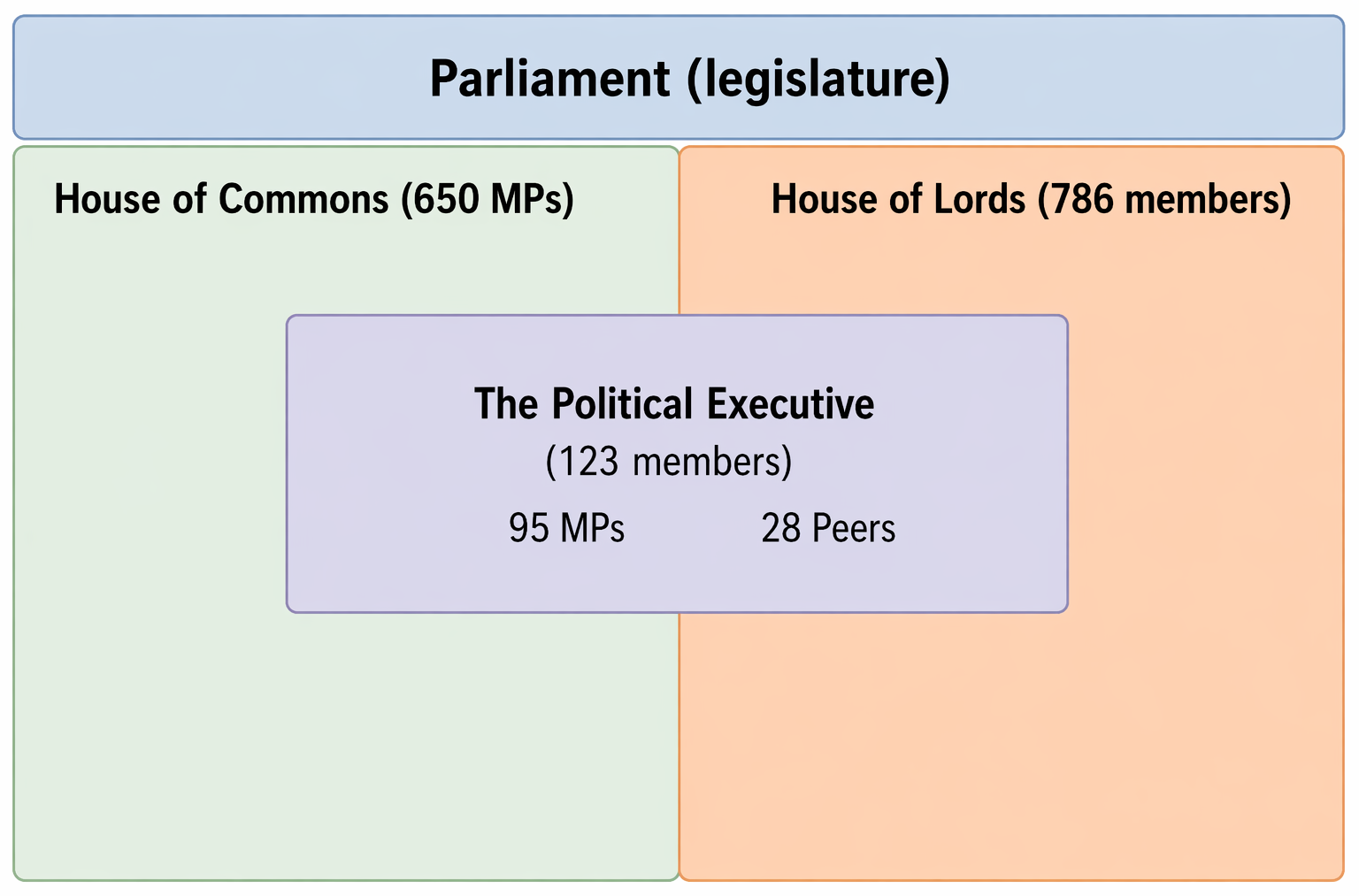
Cabinet government in the UK follows the “parliamentary executive” model: ministers are invariably members of either House of Parliament. While this overlap supports executive accountability, it carries a risk of executive dominance, especially under stable or large majorities, raising concerns about the UK system approaching 'elective dictatorship' (Lord Hailsham’s phrase).
The executive also controls much delegated legislation: statutory instruments made by ministers under enabling Acts of Parliament. Although subject to parliamentary and judicial controls, the volume and detail of delegated legislation mean that real scrutiny can sometimes be limited.
The Judiciary
The judiciary interprets, applies, and enforces the law, providing a forum for dispute resolution, an institutional guardian of individual rights, and a check on the other branches through judicial review. The judiciary is strictly separated in personnel from the executive and legislature, with the exception of some tribunals and quasi-judicial government functions, which are nonetheless now subject to clear rules to protect independence.
Key Term: judiciary
The branch of government that resolves legal disputes and interprets and applies the law, operating with institutional and personal independence from the executive and legislature.
Judicial independence is central—secured by legislation, convention, and constitutional principle. Senior judges may only be removed on address by both Houses of Parliament, and appointments to the judiciary are made transparently and independently following the reforms of the Constitutional Reform Act 2005. The creation of the Supreme Court in 2009 structurally and symbolically separated the highest UK court from Parliament.
While the main judicial role is the resolution of disputes and the determination of the lawful meaning of statutes, the courts also act as a restraint against unlawful or ultra vires state action. Through judicial review and the interpretation of relevant statutes, judges play an important constitutional role in holding the executive and—save for the principle of parliamentary sovereignty—other public bodies to account.
Overlap and Checks and Balances in the UK
A defining feature of the UK’s constitutional order is its pragmatic, functional approach to the separation of powers. Rather than establishing rigid divisions, the system relies on a mixture of statutory rules, conventions, and political processes to prevent the abuse or concentration of power.
Key Term: checks and balances
Mechanisms, formal or informal, by which the branches of government mutually restrain each other's powers and prevent abuses of authority, thus ensuring accountability.
Examples of Overlap
The timeline sets out constitutional enactments and reforms affecting the separation of powers in the United Kingdom from 1689 to 2020.
- Government ministers and the Prime Minister are members of the legislature (Commons and Lords), exercising both legislative and executive functions.
- The Lord Chancellor historically combined legislative, executive, and judicial roles, a situation much diluted by the Constitutional Reform Act 2005, which limited their judicial functions and transferred headship of the judiciary to the Lord Chief Justice.
- Delegated legislation is drafted, enacted, and often scrutinised by the executive, yet derives its authority from Parliament.
- The Privy Council exercises both executive (Orders in Council) and—through its Judicial Committee—judicial roles as the final court of appeal for some overseas and Commonwealth cases.
- The Monarch remains, in formal terms, part of all three branches, although all significant exercise of royal power is now by convention on ministerial advice.
These overlaps are mitigated by effective systems of scrutiny and accountability. For example, legislative scrutiny occurs both before and after the passage of laws: through debates, committee stages, evidence gathering, and possible judicial review of secondary legislation.
Parliamentary Scrutiny
Parliament’s role in checking the executive is essential for constitutional balance. The main instruments of scrutiny include:
- Regular and topical debates in both Houses,
- Oral and written questions to ministers and the Prime Minister,
- Select committees, which investigate and report on the executive’s actions and policies,
- The sub judice rule, which prevents Parliament from discussing matters before the courts, reciprocated by judicial restraint from reviewing parliamentary procedure (see Pickin v British Rail Board [1974] AC 765),
- Parliamentary privilege, including freedom of speech in debates and exclusive jurisdiction over Parliament’s internal procedures.
Parliamentary power to control the executive is enhanced in cases of minority government, small majorities, or assertive backbenchers. Nonetheless, executive government often enjoys control of the Commons timetable, making full and detailed legislative scrutiny difficult—a challenge addressed only by robust committee work and vigilant opposition or public debate.
Ministerial Accountability
Within the UK, the political accountability of ministers is governed by constitutional conventions—collective and individual ministerial responsibility. Ministers must answer for performance, mismanagement, breaches of the code, failure to declare interests, or policy errors. Resignations and dismissals, though declining in frequency, remain significant in cases of serious misconduct.
Delegated Legislation
The negative and affirmative resolution procedures allow Parliament some oversight of delegated legislation, but the government’s control of time and the technicality of statutory instruments mean detailed challenge is rare. The volume of such legislation—compared to primary laws—means that parliamentary scrutiny is often less searching than for Acts of Parliament.
Judicial Independence and Review
Judicial independence is a fundamental aspect of the UK constitution, secured by a range of statutory protections and conventions:
- Security of tenure for judges, whereby senior judges may only be removed after a vote in both Houses of Parliament (Act of Settlement 1701, Senior Courts Act 1981).
- The Lord Chancellor’s duty—now statutory—to uphold the continued independence of the judiciary (Constitutional Reform Act 2005 s.3).
- Judicial appointments made by the independent Judicial Appointments Commission, ensuring appointments on merit and resistant to political influence.
- Strict rules and conventions barring senior judges from sitting in the House of Commons or taking active political roles.
- Prohibitions on members of the executive interfering in the administration of justice or commenting on ongoing cases.
- Remuneration of judges from the Consolidated Fund, with salaries protected from reduction while in office.
Key Term: judicial independence
The principle that judges must be able to decide cases fairly and impartially without fear of interference, reprisal, or improper influence from the executive or legislature.
The judiciary’s capacity to restrain the executive is expressed through the institution of judicial review. This process enables courts—most often the High Court’s Administrative Court—to ensure that public authorities and state actors stay within the limits of their legal power. The principal grounds of review are set out in Council of Civil Service Unions v Minister for the Civil Service [1985] AC 374: illegality (acting outside legal authority), irrationality (decisions so unreasonable no reasonable authority would have made them), and procedural impropriety (breach of statutory or common law procedural requirements including fairness and the rules of natural justice).
Breach of human rights protected by the Human Rights Act 1998, or contravention of retained EU law, can also form grounds for judicial review. However, courts will not review primary legislation for compliance with the HRA 1998—this falls under the doctrine of parliamentary sovereignty.
While judicial review provides an important check on the executive, the courts have recognised that certain areas—such as foreign affairs, national security, and the making or ratification of treaties—may be unsuitable (non-justiciable) for judicial determination, given their inherently political character and the comparative institutional capacities of government.
Key Term: sub judice rule
A parliamentary convention whereby Parliament refrains from debating matters currently before the courts, reciprocated by judicial restraint regarding parliamentary procedure. Key Term: parliamentary privilege
The legal immunities (notably freedom of speech) enjoyed by Parliament and its members, protecting them from litigation or prosecution arising from activities in the course of parliamentary debates or proceedings. Key Term: ministerial responsibility
The convention that government ministers are answerable to Parliament for all actions and decisions of their department (individual responsibility), and collectively for policy as members of the Cabinet (collective responsibility).
Worked Example 1.1
A cabinet minister is found to have failed to declare a significant shareholding in a company that the department has awarded contracts to. How is this dealt with under the UK separation of powers?
Answer:
The minister is politically accountable under the doctrine of ministerial responsibility and the Ministerial Code. Depending on the severity, they may be subject to parliamentary scrutiny, demands for explanation, and ultimately resignation or dismissal.
Worked Example 1.2
A government agency makes a regulation under the authority of statute that disproportionately limits access to a public service. Can individuals challenge this action?
Answer:
Individuals can seek judicial review, arguing that the agency has acted unlawfully, for example by exceeding its statutory authority (ultra vires), breaching the HRA 1998, or acting irrationally or procedurally unfairly.
The Rule of Law and Legitimacy
Key Term: rule of law
The constitutional doctrine that the exercise of government power must be authorised by law, all individuals (including officials) are subject to law, and that rights and freedoms are protected through impartial adjudication and due process.
The rule of law is a foundational concept—emphasised by theorists such as AV Dicey and Lord Bingham—that forms the basis for the legitimacy of government and provides a check on arbitrary or despotic rule. Its main implications are:
- all government action must have a clear legal basis,
- law should be clear, accessible, and applied consistently,
- equality before the law, including for public officials,
- protection of individual rights through due process and fair hearing,
- the judiciary is independent and able to review executive action for legality,
- access to the courts may not be arbitrarily limited,
- public authorities must show justification for restriction of rights or liberty.
The UK’s courts have affirmed the central role of the rule of law repeatedly—in cases such as R (Unison) v Lord Chancellor [2017] UKSC 51 (striking down tribunal fees as unlawful) and Entick v Carrington (1765) (limiting Executive discretion over property and liberty).
Section 1 of the Constitutional Reform Act 2005 expressly acknowledges the constitutional importance of the rule of law, though it does not comprehensively define it.
A further guarantee of the rule of law is found in the judicial power to issue declarations of incompatibility under the Human Rights Act 1998: the courts cannot strike down primary legislation but may formally declare where it is incompatible with Convention rights. Parliament may then choose how (or whether) to respond.
Key Term: declaration of incompatibility
A formal statement issued by a higher court under s.4 of the HRA 1998, indicating that an Act of Parliament cannot be interpreted in a manner compatible with the European Convention on Human Rights, but without invalidating the Act.
Worked Example 1.3
Parliament passes a law requiring indefinite detention of certain individuals without trial. How will the courts respond if this is challenged?
Answer:
Courts cannot strike down the Act due to parliamentary sovereignty but can issue a declaration of incompatibility under the HRA 1998 if the law violates an individual's ECHR rights (such as Article 5). This places political pressure on Parliament to review or repeal the offending law.
Practical Operation and Challenges
Executive Dominance
The UK system of parliamentary government facilitates efficient administration but, especially under governments with large Commons majorities, risks excessive executive dominance. Party discipline, control over parliamentary time, and the use of procedural devices (such as programme motions and guillotines) can enable the executive to limit scrutiny and pass legislation with little effective challenge. However, minority governments or active select committees can reassert the capacity of Parliament to hold government to account.
Judicial Review and Parliamentary Sovereignty
Judicial review is necessarily limited by the doctrine of parliamentary sovereignty, a principle that Parliament's statutes are the highest form of law and cannot be struck down by the courts for constitutional impropriety. However, the courts possess robust authority to interpret statutes by reference to constitutional principles (including the rule of law, legality, and fundamental rights), to review (and set aside) the validity of delegated or secondary legislation, and to restrain unlawful government action.
Post-Brexit, retained EU law remains subject to parliamentary amendment and repeal, though, as a matter of constitutional reality and political legitimacy, both the Government and courts remain influenced by rule of law concerns and potential European Convention obligations.
Devolution
Since 1998, legislative power has been devolved to the Scottish Parliament, Senedd Cymru (Welsh Parliament), and the Northern Ireland Assembly, each with defined competences and limits set by the UK Parliament. Though these legislatures have power to make primary legislation, ultimate sovereignty remains with Westminster, which can (and has) legislated over devolved areas where political necessity or national interest is asserted (see R (Miller) v Secretary of State for Exiting the EU [2017] UKSC 5).
Key Term: Sewel Convention
A constitutional convention that the UK Parliament will not normally legislate on devolved matters without the consent of the relevant devolved legislature. The Sewel Convention is now recognised in statute (e.g., Scotland Act 2016, s.28(8)), but is not legally enforceable—its observance is a matter of political obligation rather than law.
The devolved legislatures and governments must not legislate beyond their legislative competence, and their legislation is subject to judicial review for compatibility with the UK constitution, the ECHR, and, as relevant, retained EU law.
Worked Example 1.4
The UK Parliament seeks to legislate on a devolved health matter in Scotland despite the Scottish Parliament's opposition. What is the legal barrier?
Answer:
There is no legal barrier; Parliament is legally sovereign. The Sewel Convention provides a political, not a legal, constraint. Parliament would not normally legislate in this manner, but it retains the ultimate legal authority.
The Constitutional Reform Act 2005
This Act represents one of the most significant reforms for the separation of powers and judicial independence in recent constitutional history. Its key measures include:
- Removing the Law Lords from the House of Lords and replacing them with a separate Supreme Court, physically and statutorily independent from Parliament.
- Reforming the office of Lord Chancellor—removing the Lord Chancellor's direct role as head of the judiciary and Speaker of the House of Lords, transferring headship of the judiciary to the Lord Chief Justice.
- Creating the Judicial Appointments Commission to ensure merit-based and transparent judicial selection.
- Imposing a statutory duty (s.3) on the Lord Chancellor and ministers to maintain the continued independence of the judiciary.
- Affirming in s.1 the constitutional principle of the rule of law.
Prior to these reforms, the Lord Chancellor was a member of all three branches—a unique overlap incompatible with a strict separation, and often criticised. The Act clarified the respective boundaries, formalised the judiciary's independence, and enhanced public confidence in the impartiality of the senior courts.
Judicial Review as a Check on the Executive
Key Term: judicial review
The process by which courts scrutinise the legality of acts, decisions, and omissions of public bodies and government officials, ensuring they do not exceed or abuse powers.
Judicial review enables courts to review a wide range of state action—from ministerial decisions under statutory or prerogative power, to delegated legislation, to the actions of public authorities. The principal grounds for review are:
- Illegality—exercising a power wrongly, outside its scope, or for an improper purpose.
- Irrationality—decisions that are so unreasonable that no reasonable authority could have come to them (the so-called Wednesbury unreasonableness, after Associated Provincial Picture Houses v Wednesbury Corporation [1948]).
- Procedural impropriety—failure to observe the requirements of statute, fairness, or the rules of natural justice.
Additional grounds include breach of legitimate expectation, violation of ECHR rights under the HRA 1998, or incompatibility with retained EU law.
Judicial review does not generally entertain political questions involving high-level policy decisions, foreign affairs, or national security unless rights or law are specifically infringed and justiciable.
Worked Example 1.5
A Home Office minister decides to withdraw British citizenship on national security grounds, using discretionary powers. The affected individual believes the action is unfair and not lawfully justified. Is there a remedy?
Answer:
The individual may challenge the decision by way of judicial review, arguing the decision was unlawful, breached due process, or was disproportionate. The courts may determine the legality of the minister's decision but generally cannot second-guess the merits of national security or policy itself.
The Rule of Law and the Separation of Powers in Action
The doctrine of separation of powers, as it operates in the UK, functions as a practical system for upholding the rule of law, preventing arbitrary government, and ensuring that every exercise of public power can be subjected to some form of political or legal scrutiny. While the system contains pragmatic overlaps, these are counterbalanced by robust procedural and institutional safeguards—such as independent judicial appointments, parliamentary committees, and the capacity of the courts to grant remedies for breaches of law or rights.
Public confidence in the legal system is sustained when the branches of government, notwithstanding overlaps, perform coherent and independent functions in accordance with constitutional principle and legal process. Access to an independent judiciary, the possibility of legal redress, and continued legislative oversight support the legitimacy and effectiveness of government in the UK.
Summary
| Branch | Main Function | Overlap/Checks and Balances |
|---|---|---|
| Legislature | Makes law | Holds executive to account; ministers are MPs |
| Executive | Implements law | Accountable to Parliament; subject to judicial review |
| Judiciary | Interprets law | Reviews executive actions; independent from government |
Key Point Checklist
This article has covered the following key knowledge points:
- The UK separates state power among the legislature (Parliament), executive (government), and judiciary (courts), with practical overlap—especially between the executive and legislature.
- The separation of powers is partial and pragmatic, not strict; conventions and statutory developments operate alongside legal rules.
- Checks and balances are provided by parliamentary scrutiny, ministerial responsibility, judicial review, and parliamentary privilege.
- Judicial independence is central, protected by the Act of Settlement 1701, Senior Courts Act 1981, Constitutional Reform Act 2005, and conventions that exclude political interference and guarantee tenure.
- Reforms under the Constitutional Reform Act 2005 (including the creation of a separate Supreme Court, Judicial Appointments Commission, and limits on the role of the Lord Chancellor) support the independence of the judiciary and clarify the boundaries between branches.
- Parliamentary sovereignty remains foundational: the courts cannot strike down Acts of Parliament, but can issue declarations of incompatibility under the HRA 1998 for violations of the ECHR, or interpret legislation to uphold constitutional principles.
- Devolution has created new, complex relationships between central and devolved institutions; the devolved legislatures’ powers are subject to limits, and the UK Parliament remains legally sovereign while politically constrained by conventions such as Sewel.
- The rule of law provides constitutional legitimacy—government and public officials must act according to law, enjoy no immunity from court action, and are accountable for misuses of public power.
- Practical operation of the separation of powers is subject to ongoing challenges, including executive dominance, limits of scrutiny, expanded judicial review, constitutional conventions, and the pressures of political realities.
Key Terms and Concepts
- separation of powers
- legislature
- executive
- judiciary
- checks and balances
- judicial independence
- rule of law
- judicial review
- ministerial responsibility
- Sewel Convention
- sub judice rule
- parliamentary privilege
- declaration of incompatibility
Key Term: ministerial responsibility
The political and constitutional doctrine requiring government ministers to answer to Parliament for their official conduct, the conduct of their department(s), and the conduct of civil servants for whom they are responsible. This includes both individual ministerial responsibility (for personal and departmental failings) and collective ministerial responsibility (for decisions and policies of the government as a whole). Key Term: sub judice rule
A constitutional convention that restricts Parliament from debating matters currently before the courts, to protect judicial independence and fair trial rights. In return, courts avoid ruling on internal parliamentary procedures. Key Term: declaration of incompatibility
A formal statement issued by a higher court (under s.4 HRA 1998) that primary legislation is incompatible with the European Convention on Human Rights. Such a declaration does not invalidate the law, but signals a need for parliamentary reconsideration or amendment. Key Term: Sewel Convention
A constitutional convention, recognised in statute, that the UK Parliament will not normally legislate for devolved matters without the consent of the devolved legislature. Key Term: parliamentary privilege
Legal immunities enjoyed by members of Parliament in relation to their official functions and communications, most notably the absolute privilege of free speech within parliamentary proceedings. Key Term: judicial review
A process by which courts examine the lawfulness of acts or decisions of public bodies, ensuring compliance with the rule of law. Key Term: checks and balances
A set of mechanisms, both legal and political, that prevent any one branch of government from exercising unchecked or absolute power and ensure accountability among branches. Key Term: judicial independence
The principle that the judiciary must function without external influence from the executive or legislature, with decisions made impartially according to law. Key Term: rule of law
The fundamental constitutional principle that requires all public officials, as well as citizens, to act within the law and be subject to lawful constraint, ensuring legal accountability and individual rights. Key Term: separation of powers
The allocation of powers and responsibilities among different branches of government—legislative, executive, and judicial—to support effective governance and prevent abuses of authority. Key Term: legislature
The law-making body of the state, composed in the UK of the House of Commons, the House of Lords, and the Monarch. Key Term: executive
The branch of government responsible for the administration and enforcement of laws, including the Prime Minister, Cabinet, government departments, armed forces, and other public officials. Key Term: judiciary
The courts and related institutions tasked with interpreting and applying the law, and with providing redress to those claiming violation of legal rights. Key Term: Sewel Convention
The non-legally binding convention that the UK Parliament will not normally legislate in areas devolved to Scotland, Wales, or Northern Ireland without the consent of the relevant legislature. Key Term: declaration of incompatibility
A formal statement from a superior court indicating that a provision of primary legislation is incompatible with the European Convention on Human Rights, issued under s.4 of the Human Rights Act 1998. Key Term: parliamentary privilege
The absolute immunity granted to members of Parliament in respect of statements made and actions undertaken as part of parliamentary proceedings. Key Term: sub judice rule
The convention barring parliamentary discussion of matters under active judicial consideration to protect fair trial rights and judicial independence. Key Term: checks and balances
Mechanisms within the constitution that enable each branch of government to limit and oversee the powers of the others.
This enhanced article now integrates essential context and detail across all major themes of the separation of powers in the UK, ensuring complete alignment with the requirements of the SQE1 syllabus and legal practice.