Learning Outcomes
This article explains the assessment of compensatory damages for personal injury and death in tort, including:
- the distinction between pecuniary and non-pecuniary, general and special damages, and how these classifications structure examination answers;
- the overarching aims of compensation and the restitutio in integrum principle as applied to personal injury and fatal accident claims;
- key statutory frameworks, including the Law Reform (Personal Injuries) Act 1948, the Law Reform (Miscellaneous Provisions) Act 1934, and the Fatal Accidents Act 1976;
- methods of quantifying non-pecuniary loss, with emphasis on Judicial College Guidelines and statutory whiplash tariffs;
- application of the multiplier/multiplicand method, Ogden tables, and the discount rate to future pecuniary losses such as earnings, care, and services;
- operation of the “one action” rule and its exceptions: provisional damages and periodical payment orders;
- the impact of contributory negligence, mitigation, collateral benefits, and Compensation Recovery Unit procedures on the overall quantum;
- treatment of divisible and indivisible injuries, multiple tortfeasors, apportionment, and contribution between defendants;
- distinct heads such as loss of earning capacity, Smith v Manchester awards, and “lost years” claims for reduced life expectancy;
- interaction between estate and dependency claims following death, and techniques for avoiding double counting in SQE1 problem questions.
SQE1 Syllabus
For SQE1, you are required to understand how compensatory damages function within tort law, particularly in negligence claims involving personal injury or death. This involves understanding the fundamental principles and practical application of damage assessment rules, with a focus on the following syllabus points:
- The primary aim of compensatory damages in tort.
- The classification of damages into pecuniary and non-pecuniary, and general and special damages.
- The main heads of damage recoverable for personal injury claims, including pain, suffering, loss of amenity, loss of earnings, and expenses.
- The principles for calculating future losses, including the multiplier/multiplicand method.
- The statutory frameworks governing claims following death: the Law Reform (Miscellaneous Provisions) Act 1934 and the Fatal Accidents Act 1976.
- The types of damages recoverable under fatal accident claims, including bereavement awards and loss of dependency.
- Factors affecting the final award, such as mitigation and contributory negligence.
- The “one action” rule for lump-sum assessment, and limited exceptions: provisional damages and periodic payment orders.
- Practical quantification tools: Judicial College Guidelines for PSLA, Ogden tables and the discount rate for future loss.
- Entitlement to private medical treatment (and why NHS availability cannot be used to reduce damages).
- Claims for care, including gratuitous care, aids/equipment, and home adaptations.
- Collateral benefits and the Compensation Recovery Unit (including deduction and repayment of specified state benefits).
- Divisible versus indivisible injury and apportionment between multiple tortfeasors (including contribution between defendants).
- Awards for loss of earning capacity (Smith v Manchester) and “lost years” in reduced life expectancy claims.
- Fatal Accidents Act dependants: statutory list of eligible family relationships and service-based dependency.
Test Your Knowledge
Attempt these questions before reading this article. If you find some difficult or cannot remember the answers, look more closely at that area during your revision.
-
What is the fundamental principle guiding the award of compensatory damages in tort?
- a) To punish the defendant for wrongdoing.
- b) To restore the claimant to their pre-tort position.
- c) To provide a fixed sum based on the severity of the injury.
- d) To cover only the claimant's legal costs.
-
Which of the following is an example of non-pecuniary loss?
- a) Cost of physiotherapy treatment.
- b) Loss of earnings up to the date of trial.
- c) Compensation for pain and suffering.
- d) Cost of adapting the claimant's home.
-
Under the Fatal Accidents Act 1976, who is typically eligible for a bereavement award?
- a) All close family members.
- b) The deceased's employer.
- c) The deceased's spouse or civil partner.
- d) Any friend who provided care.
-
True or False: Special damages relate to losses that are not easily quantifiable in monetary terms, such as loss of enjoyment of life.
Introduction
When a claimant succeeds in a tort claim, typically for negligence, the primary remedy sought is damages – monetary compensation. The fundamental aim of compensatory damages is restitutio in integrum: to put the claimant back into the position they would have been in had the tort not occurred. This principle applies to claims involving personal injury and those resulting from death. The focus is on compensation, not punishment; punitive elements (exemplary damages) are rare in tort and not a feature of ordinary personal injury damages. This article explores the classification, calculation, and relevant legal principles governing compensatory damages in these contexts, focusing on knowledge required for the SQE1 assessment. It explains both (i) the legal heads of damage available and (ii) the practical methods and statutory rules used to quantify them, including how damages are assessed once-and-for-all in a lump sum and the limited statutory routes to revisit or structure future loss.
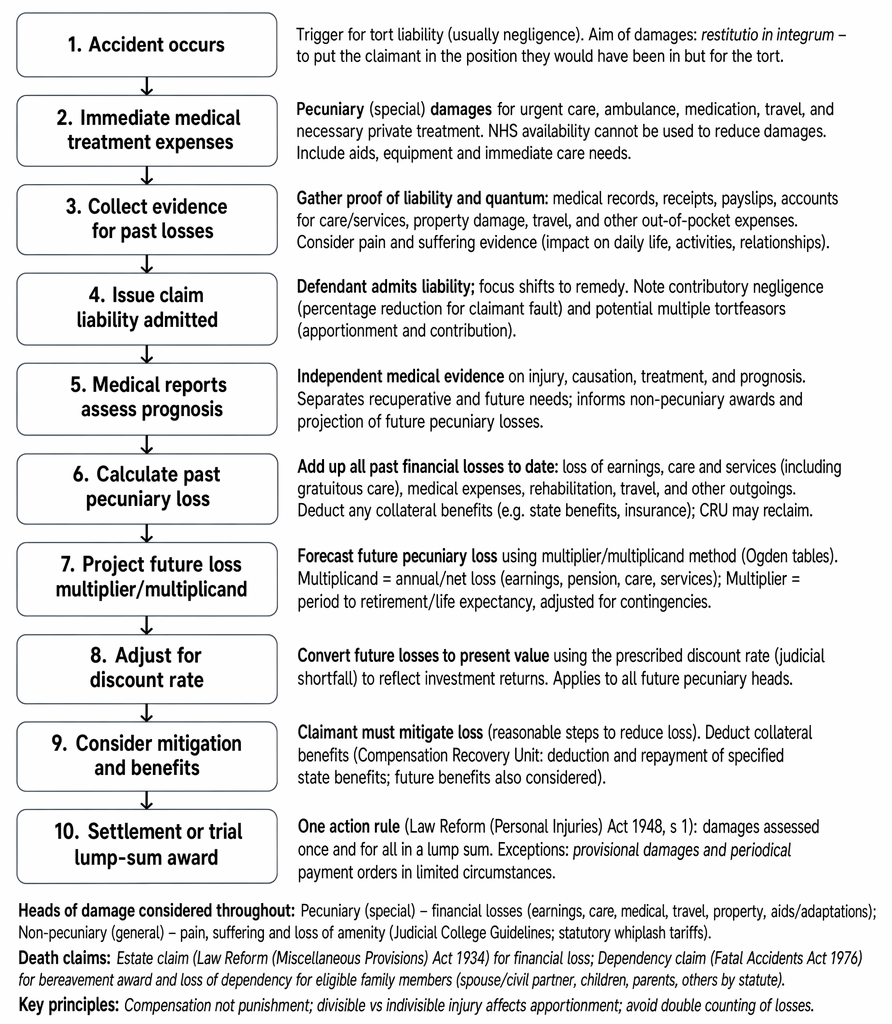
Personal injury damages are assessed by reference to past and future pecuniary loss, multiplier/multiplicand, discount rate, mitigation, and lump-sum award.
Key Term: Pecuniary damages
Financial losses that can be calculated with relative precision, such as lost earnings, medical and care expenses, and property damage. Key Term: Non-pecuniary damages
Losses that are not primarily financial in nature, compensating for harms such as pain, suffering, and reduced quality of life (loss of amenity).Test Tip: In SQE-style questions on Compensatory damages, identify the legal test, the triggering fact, and the consequence before choosing between similar answer options.
Types of Compensatory Damages
Compensatory damages are broadly divided into two categories: pecuniary losses and non-pecuniary losses. Further classification distinguishes between general and special damages. While the categories overlap, the distinctions help to structure claims and to present evidence on quantum.
Pecuniary Damages
These are losses that can be quantified in financial terms. They represent the actual financial expenditure and loss of earnings resulting from the tort. Pecuniary losses include costs already incurred up to the date of trial (past losses) and those expected to arise in the future (future losses). Typical examples include:
- Medical treatment costs (including therapies, medications, surgeries).
- Professional and gratuitous care costs, nursing, and assistance.
- Aids, equipment, and vehicles (e.g., wheelchairs, adapted cars).
- Home adaptations (e.g., ramps, widened doorways, accessible bathrooms).
- Travel expenses associated with injury and treatment.
- Loss of earnings and pension losses.
- Property damage and consequential expenses (e.g., hire of replacement vehicle).
Key Term: Special damages
Losses that can be specifically calculated and proven up to the date of trial, typically encompassing past pecuniary losses like pre-trial loss of earnings and expenses.
Non-Pecuniary Damages
These compensate for harms not easily quantifiable in money. They cover pain and suffering and loss of amenity. The assessments are informed by judicial guidelines and past awards, adjusted for the claimant’s particular circumstances.
- Pain and suffering reflects the subjective experience of pain and mental anguish.
- Loss of amenity reflects the objective impact on the claimant’s enjoyment of life, hobbies, relationships, and independence.
Key Term: General damages
Losses not capable of precise calculation at the date of trial. This includes all non-pecuniary losses (pain, suffering, loss of amenity) and future pecuniary losses (future loss of earnings, future care costs).
Damages for Personal Injury Claims (Living Claimant)
Where the claimant survives the tortious event but suffers personal injury, damages are assessed to cover both pecuniary and non-pecuniary losses. The court must award a single lump sum at trial covering past and future losses; limited statutory exceptions are discussed below.
Non-Pecuniary Losses
Pain and Suffering
This head compensates for the physical pain and mental anguish experienced due to the injury, both past and future. The assessment is subjective: the claimant must be aware of the pain to claim for it. Accordingly, no damages for pain and suffering are awarded for periods of unconsciousness (Wise v Kaye). However, where the claimant is aware that their life expectancy has been shortened because of the tort, the mental distress of that knowledge may be compensated within pain and suffering (Administration of Justice Act 1982, s 1(1)(b)). Anxiety about future surgery, and mental anguish associated with ongoing symptoms, may also be included.
Loss of Amenity
Loss of amenity compensates for the reduced ability to enjoy life, pursue hobbies, or engage in activities due to the injury. It is assessed objectively, meaning an award can be made even if the claimant is unconscious and unaware of their loss (West v Shephard). The claimant’s pre-accident lifestyle matters: someone very active who can no longer engage in sports or pursuits normally receives a higher award under this head than someone with fewer affected activities.
Quantification
Awards for pain, suffering, and loss of amenity (PSLA) are typically made as a single lump sum. Quantification relies heavily on the Judicial College Guidelines and comparable case law, taking account of the severity, prognosis, treatment, and the impact on the claimant’s daily life. Statute fixes the amount of damages for some low-level whiplash injuries (Civil Liability Act 2018 and associated Regulations), displacing guideline-based assessment for those injuries.
Key Term: PSLA (Pain, suffering and loss of amenity)
The composite non-pecuniary award reflecting both the claimant’s subjective pain and suffering and the objective loss of enjoyment of life caused by the injury.
Pecuniary Losses
Medical and Other Expenses
Claimants can recover reasonable expenses incurred due to the injury. This includes costs of medical treatment (including private treatment, even if NHS care is available), therapies, necessary aids and equipment, adaptations to accommodation, travel costs, and the cost of care (professional or gratuitously provided by family/friends). Past expenses are claimed as special damages; future expenses are general damages calculated using the multiplier/multiplicand method.
Under the Law Reform (Personal Injuries) Act 1948, s 2(4), a defendant cannot argue that the claimant must rely on NHS treatment to mitigate loss. If private treatment is reasonable, its costs are recoverable even where NHS care is available.
Key Term: Gratuitous care
Care provided by family or friends without payment. The reasonable value of such care can be claimed as damages; the sum is commonly held on trust for the carer (subject to exceptions where the carer is the tortfeasor).
Gratuitous care is recoverable to reflect the cost of needed assistance (Hunt v Severs), typically calculated at a commercial care rate less an allowance for savings (e.g., agency overheads), and for necessary future periods of disability. Necessary aids and adaptations (ramps, lifts, bathroom alterations) are compensable if reasonably required by the injury.
Loss of Earnings
Compensation is awarded for income lost due to the injury preventing the claimant from working.
- Past loss of earnings: Calculated precisely from the date of injury to trial/settlement, based on net earnings (after tax and national insurance). This is special damages. Loss of pension contributions up to trial may also be claimed.
- Future loss of earnings: Awarded as a lump sum for projected future income loss. This is general damages, calculated using the multiplier/multiplicand method. Losses can incorporate pension loss and career trajectory (e.g., promotion prospects).
Key Term: Multiplier
In damages calculation, a figure representing the years for which a future loss (e.g., earnings, care costs) is expected to continue, adjusted for contingencies and accelerated receipt using the discount rate. Key Term: Multiplicand
In damages calculation, the claimant’s net annual loss (e.g., loss of earnings, cost of care) used in the multiplier/multiplicand method.
The multiplier is derived from actuarial tables (the Ogden tables) considering the claimant’s age, likely period of loss (e.g., to retirement or for a fixed period), contingencies of life (e.g., risk of unemployment, illness), and the current discount rate set by the Lord Chancellor. The discount rate adjusts the lump sum to reflect the real return expected from investing the sum; it can be negative, zero, or positive depending on economic assessment.
Key Term: Ogden tables
Actuarial tables published to assist courts in selecting appropriate multipliers for future loss, reflecting age, discount rate, and contingencies (including employment-related reduction factors). Key Term: Discount rate
A percentage rate set by the Lord Chancellor, used to adjust lump sum awards for future pecuniary loss to reflect the real rate of return expected from investing the sum. The rate is subject to periodic review and may be negative.
Adjustments may be made to reflect “contingencies of life” and employment reduction factors, ensuring the award is neither over- nor under-compensatory. Where partial residual earning capacity exists, future losses are calculated on the difference between the claimant’s pre-accident earning trajectory and likely post-accident earnings.
- Loss of earning capacity: If the injury causes a long-term disadvantage on the open labour market, even if the claimant returns to their previous job, an award (a Smith v Manchester Corporation award) may be made for the risk of future unemployment or reduced prospects. This is often a modest capital sum reflecting potential vulnerability.
- Lost years: If the injury shortens the claimant’s life expectancy, they can claim for loss of earnings during the years they would have worked but for the premature death, subject to deductions for their own living expenses during those years (Pickett v British Rail Engineering; Gammell v Wilson). This recognizes the claimant’s loss of the ability to earn to benefit dependants or their estate.
Key Term: Smith v Manchester award
A modest capital sum awarded to compensate for reduced earning capacity where the claimant remains employed but has a measurable disadvantage on the labour market due to injury. Key Term: Lost years
Future earnings that the claimant would have made but for reduced life expectancy caused by the tort. Recoverable by a living claimant (not by the estate), subject to deduction for their own prospective living expenses.
Divisible and Indivisible Injury; Multiple Defendants
Where medically and evidentially possible, damages in disease cases may be apportioned between defendants to reflect material contributions over time (divisible injury), as in Holtby v Brigham & Cowan (asbestosis cumulative exposure). In indivisible injury (e.g., a single broken bone from a crash with negligent drivers), the claimant may recover the full loss from either defendant; apportionment as between defendants then proceeds under the Civil Liability (Contribution) Act 1978 on a “just and equitable” basis. These rules affect defendants’ ultimate shares but not the claimant’s ability to recover full compensation.
Factors Affecting the Award
- Mitigation: Claimants must take reasonable steps to mitigate losses. Failure to seek suitable alternative work when medically fit, to replace essential tools or vehicles, or to undergo reasonable treatment may reduce damages. However, reasonable choices (such as private medical care) are protected and cannot be impugned by availability of NHS treatment.
- Contributory negligence: If the claimant’s own carelessness contributed to their injury or its severity, damages may be reduced proportionally under the Law Reform (Contributory Negligence) Act 1945.
- Collateral benefits: Insurance payments, ill-health pensions, and charitable donations are generally not deducted, to avoid disincentivizing self-protection and generosity. Specified state benefits paid due to the injury are deducted from particular heads (loss of earnings, cost of care, loss of mobility), and the defendant repays the deducted amount to the state via the Compensation Recovery Unit (CRU). NHS treatment charges arising from road traffic accidents are also recovered from defendants via the Road Traffic (NHS Charges) Act 1999.
Key Term: Compensation Recovery Unit (CRU)
The government body that recovers specified state benefits and certain NHS charges from a compensator following a personal injury award. Deductions are made from designated heads of damages; the compensator repays the state.
- One action rule: Damages are awarded once-and-for-all in a lump sum covering past and future loss. Except in limited circumstances, the claimant cannot return to court if their condition worsens or improves unexpectedly.
Provisional Damages and Periodical Payments
Two limited exceptions respond to future uncertainty:
- Provisional damages: The court may award provisional damages where there is a real risk of serious deterioration in the claimant’s condition due to the tort (Senior Courts Act 1981, s 32A). The claimant may return once if the deterioration occurs.
- Periodical payments: The court may order periodic payment of future pecuniary loss instead of a lump sum (Damages Act 1996, s 2, as amended by the Courts Act 2003). Periodical payments are index-linked (often to a relevant earnings index for care costs) and can provide secure, predictable funding for future needs.
Key Term: Provisional damages
A mechanism allowing an initial award with the right to return once if specified serious deterioration occurs due to the tort. Key Term: Periodic payment order (PPO)
A court order paying future pecuniary loss (e.g., care, case management) by regular indexed instalments rather than a lump sum.
Damages Following Death
Where the victim of the tort dies, compensation principles are governed primarily by two statutes. Understanding which claim belongs to the estate and which belongs to dependants is essential to avoid double counting and to identify proper heads of recovery.
Law Reform (Miscellaneous Provisions) Act 1934
This Act allows the deceased's existing causes of action in tort (except defamation) to survive for the benefit of their estate. The claim is brought by the personal representatives.
-
Damages recoverable: The estate can recover damages for losses suffered by the deceased up to the date of death. This includes:
- Non-pecuniary losses (pain, suffering, loss of amenity) experienced before death.
- Pecuniary losses (loss of earnings, medical and other expenses) incurred before death.
- Damage to property.
- Reasonable funeral expenses if paid by the estate.
-
Limitations: No damages are awarded for losses occurring after death, nor for the death itself. There is no “lost years” recovery by the estate. The cause of action survives regardless of whether the death was caused by the tort or by some unrelated cause. Any contributory negligence by the deceased affects the surviving action as it would for a living claimant. Defamation claims do not survive.
Fatal Accidents Act 1976
This Act creates a separate cause of action for specified dependants of a person whose death was caused by another's wrongful act, neglect, or default. The claim depends on the deceased having had a valid claim had they survived. Contributory negligence by the deceased may reduce dependants’ damages.
Loss of Dependency Claim
Key Term: Loss of dependency
A claim under the Fatal Accidents Act 1976 by eligible dependants for the loss of financial support or services they reasonably expected to receive from the deceased had they not died.
Eligibility requires that claimants fall within the statutory list of dependants and prove actual financial dependency or dependency on services provided by the deceased (e.g., domestic chores, childcare). The statutory list of dependants includes (FAA 1976):
- Spouse and former spouse.
- Civil partner and former civil partner.
- Cohabiting partner living with the deceased in the same household for at least two years immediately before death, as husband/wife/civil partner.
- Any person treated by the deceased as a parent.
- Any child or other descendant of the deceased.
- Any person (not being a child of the deceased) who, in the case of marriage or civil partnership, was treated by the deceased as a child of the family.
- Any person who is, or is the issue of, a brother, sister, uncle or aunt of the deceased.
Financial dependency typically derives from the deceased’s net earnings (adjusted for the deceased’s own personal living expenses, to identify the portion available for family support). Dependency on services recognizes the economic value of the deceased’s domestic contributions (e.g., childcare, household maintenance). The calculation aims to compensate for the lost support and/or services:
- Multiplicand: Net annual value of support/services lost (income minus the deceased’s personal living expenses; plus the estimated market value of household services).
- Multiplier: Years the dependency would have continued (e.g., to retirement for spouse, to completion of education for children), adjusted using Ogden multipliers and contingencies. The multiplier reflects the expected period the dependency would last.
Remarriage or prospects of remarriage are disregarded in assessing damages. Benefits received by dependants due to death (insurance payouts, pension rights, inheritance) are disregarded, preventing windfalls to defendants. The calculation must avoid double counting with the estate claim: funeral expenses should not be claimed twice; pre-death losses belong to the estate, post-death dependency losses belong to dependants.
Awards recognize that dependency may end or change (e.g., children becoming independent). Courts assess appropriate fractions for each dependant’s share depending on household composition and expenditure patterns (often guided by case law, such as Harris v Empress Motors on household expenditure). Loss of consortium or grief beyond the bereavement award is not compensable as part of dependency; the bereavement award is the statutory acknowledgment of grief.
Bereavement Award
Key Term: Bereavement award
A statutory fixed sum awarded under the Fatal Accidents Act 1976 to a limited class of relatives (primarily spouses, civil partners, qualifying cohabitees, and parents of unmarried minors) to acknowledge grief.
The amount is fixed by statute (currently £15,120). Eligible claimants typically include:
- The deceased’s spouse or civil partner.
- A qualifying cohabiting partner (permitted by the 2020 Remedial Order) living together as partners for at least two years immediately prior to death.
- The parents of an unmarried minor (rules differ for legitimacy/adoption; the current approach allows both parents of a legitimate or adopted child, and the mother of an illegitimate child).
Only one award is made per death; if multiple claimants are eligible (e.g., both parents), the award is shared equally. Children cannot claim bereavement damages for the death of a parent.
Funeral Expenses
Reasonable funeral expenses can be claimed by dependants if they paid for them (otherwise, claimed by the estate under the 1934 Act). The same expense cannot be recovered twice.
Worked Example 1.1
Scenario: Ahmed, aged 40, was severely injured in a road traffic accident caused by Beth's negligence. He died from his injuries one week later. Before his death, he incurred £1,000 in medical expenses and suffered significant pain. He earned £30,000 net per year. He is survived by his wife, Chloe, and their 10-year-old son, David. Ahmed paid all household bills and gave Chloe £800 per month for housekeeping. Chloe paid the funeral costs of £4,000.
Question: What claims can be brought following Ahmed's death?
Answer:
Two claims can be brought:
- Estate Claim (under LR(MP)A 1934): Ahmed's estate (represented by his personal representatives, likely Chloe) can claim for:
- Pain and suffering endured by Ahmed in the week before death.
- Loss of amenity pre-death (if any).
- Medical expenses (£1,000).
- Loss of earnings for that week.
- Funeral expenses (£4,000) if paid by the estate (if Chloe paid personally, this element should be claimed under FAA 1976 instead).
- Dependants’ Claim (under FAA 1976): Brought by Chloe on behalf of herself and David:
- Loss of dependency: For Chloe and David, based on the financial support and services Ahmed provided. The calculation would use the multiplier/multiplicand method, considering Ahmed's net earnings (less his personal expenditure), the household’s spending pattern, and the expected duration of dependency (e.g., David to end of education; Chloe to Ahmed’s expected retirement).
- Bereavement award: Chloe (as spouse/civil partner) is entitled to the statutory fixed sum (£15,120). David is not eligible.
- Funeral expenses: Chloe can claim the £4,000 she paid (ensure the estate does not also claim this sum to avoid duplication).
Worked Example 1.2
Scenario: Priya is injured in a workplace accident due to her employer's negligence. She breaks her arm, causing significant pain and requiring six weeks off work. Her net weekly wage is £400. She also misses a pre-booked, non-refundable holiday costing £500. She attends physiotherapy sessions costing £30 per session for 10 sessions.
Question: Identify Priya's potential heads of damage.
Answer:
Priya can potentially claim for:
- Non-Pecuniary Loss (General Damages): Pain, suffering, and loss of amenity resulting from the broken arm, assessed by reference to the Judicial College Guidelines.
- Pecuniary Loss (Special Damages):
- Past loss of earnings: 6 weeks x £400 = £2,400 (net).
- Physiotherapy costs: 10 sessions x £30 = £300.
- Wasted holiday cost: £500 (consequential financial loss due to injury).
- If residual symptoms persist causing future disadvantage on the labour market, a Smith v Manchester award may be appropriate.
Worked Example 1.3
Scenario: Jamal, aged 35, develops terminal mesothelioma due to negligent exposure at work. He will likely survive for 5 more years, whereas his pre-accident life expectancy was to age 65. His net annual earnings were £28,000. He has a partner and young child.
Question: Can Jamal recover “lost years” and how is this approached?
Answer:
Yes. As a living claimant with reduced life expectancy, Jamal may claim for “lost years”—the net earnings he would have made in the 25 years of life lost (from age 40 to 65) had he not been injured, less his own prospective living expenses during those years. The claim recognizes the claimant’s lost capacity to earn for dependants or accrue wealth to pass on. The calculation uses a multiplicand reflecting the net annual earnings minus Jamal’s personal living costs (to avoid over-compensation) and a multiplier to retirement adjusted using Ogden tables and the discount rate. This claim is not available to the estate under LR(MP)A 1934; it is a living claimant’s claim.
Worked Example 1.4
Scenario: Sofia, aged 38, dies due to medical negligence. She earned £36,000 net annually and provided substantial childcare and housework for two children aged 7 and 12. Her spouse, Marco, paid £3,800 in funeral expenses. The family’s household expenditure indicated Sofia’s personal living expenses at approximately one quarter of her net income.
Question: How is the dependency assessed, including services?
Answer:
The dependency includes both financial support and the economic value of domestic services. For financial support, the multiplicand starts with Sofia’s net income, deducting her personal living expenses (often between one quarter and one third in similar cases) to identify the portion applied to the family. The value of services (childcare, housework) is added at a reasonable market rate for equivalent paid assistance. The multiplier reflects the expected years of dependency: children to completion of education and Marco to Sofia’s expected retirement (subject to contingencies). Marco may claim funeral expenses of £3,800 under FAA 1976. Benefits such as insurance or inheritance are disregarded. Remarriage prospects are disregarded. The bereavement award of £15,120 is payable to Marco (spouse/civil partner) or to a qualifying cohabitee; children are not eligible.Exam Warning: Do not confuse the claims available under the Law Reform (Miscellaneous Provisions) Act 1934 and the Fatal Accidents Act 1976. The 1934 Act deals with the survival of the deceased's own claim for losses up to death, brought by the estate. The 1976 Act creates a new cause of action for specified dependants for losses arising from the death. Ensure you identify the correct Act and claimant(s) for each head of damage in fatal accident scenarios. Avoid double counting (e.g., funeral expenses claimed once only) and remember that grief is compensated only via the bereavement award.
Key Point Checklist
This article has covered the following key knowledge points:
- The aim of compensatory damages in tort is restitution (restitutio in integrum), not punishment.
- Damages are categorised as pecuniary (quantifiable financial loss) and non-pecuniary (pain, suffering, loss of amenity).
- Special damages cover quantifiable pre-trial losses; general damages cover non-quantifiable losses and future losses.
- Pain and suffering is assessed subjectively; loss of amenity is assessed objectively. PSLA awards often rely on the Judicial College Guidelines; some whiplash awards are fixed by statute.
- Claimants can recover reasonable medical expenses, including private treatment (NHS availability does not limit recovery).
- Care costs, including gratuitous care, aids/equipment, and home adaptations, are recoverable if reasonably required.
- Future pecuniary losses are calculated using the multiplier/multiplicand method, supported by Ogden tables and the discount rate; adjustments reflect contingencies of life.
- Loss of earning capacity (Smith v Manchester) and “lost years” (for living claimants with reduced life expectancy) are distinct heads.
- Divisible injuries may be apportioned; indivisible injuries allow full recovery against any one defendant with contribution between tortfeasors under the Civil Liability (Contribution) Act 1978.
- Claimants must mitigate their losses; damages may be reduced for contributory negligence.
- Collateral benefits (insurance, charity) are usually not deducted; specified state benefits are deducted from certain heads and repaid to the state via the CRU; NHS RTA charges are recovered from defendants.
- The “one action” rule requires a lump-sum award at trial; provisional damages and periodic payment orders are limited exceptions.
- The Law Reform (Miscellaneous Provisions) Act 1934 allows the deceased's estate to claim for losses suffered up to the date of death (defamation excepted).
- The Fatal Accidents Act 1976 allows dependants (from a statutory list) to claim for loss of dependency and provides a statutory bereavement award for specific relatives; inheritance and remarriage prospects are disregarded.
Key Terms and Concepts
- Pecuniary damages
- Non-pecuniary damages
- Special damages
- General damages
- PSLA (Pain, suffering and loss of amenity)
- Multiplier
- Multiplicand
- Ogden tables
- Discount rate
- Gratuitous care
- Smith v Manchester award
- Lost years
- Compensation Recovery Unit (CRU)
- Provisional damages
- Periodic payment order (PPO)
- Loss of dependency
- Bereavement award