Learning Outcomes
This article outlines how damages awarded in personal injury and death claims may be reduced, focusing on contributory negligence, the treatment of collateral benefits, the rules governing deduction and recovery of state benefits, distinctions between deductions that must be made and sums that must not be deducted, the Gourley principle on assessing loss of earnings on a net basis, and the operation of the Compensation Recovery Unit (CRU) scheme, including like-for-like offsets and exclusion from pain, suffering and loss of amenity. It details how courts identify and quantify contributory negligence across all heads of loss, how typical percentage reductions are selected in common scenarios, and how different categories of collateral benefits (insurance payments, sick pay, pensions, charitable gifts and state benefits) are classified for deduction purposes. It also reviews the interaction between the Social Security (Recovery of Benefits) Act 1997 and common-law principles, highlighting exam-standard issues such as double recovery, the treatment of gratuitous care, net-of-tax calculations for past and future earnings, and the impact of these rules on both personal injury and fatal accident damages.
SQE1 Syllabus
For SQE1, you are required to understand how damages in personal injury and fatal accident claims are adjusted before payment, with a focus on the following syllabus points:
- the principle that damages compensate, not enrich, the claimant or dependants
- how contributory negligence reduces damages under the Law Reform (Contributory Negligence) Act 1945
- the calculation and apportionment of reductions for contributory negligence
- the treatment of collateral benefits (insurance, sick pay, pensions, charity, state benefits)
- the effect of the Social Security (Recovery of Benefits) Act 1997 on deduction and recovery of state benefits
- the Gourley principle: loss of earnings is assessed net of tax and national insurance
- standard contributory negligence scenarios (seat belts and motorcycle helmets) and typical percentage reductions
- how contractual vs discretionary sick pay is treated, including employer recoupment clauses
- the CRU “like-for-like” matching rules and the exclusion of pain, suffering and loss of amenity from benefit deductions
- interaction with fatal accident claims, including the impact of the deceased’s contributory negligence on the estate and dependants
- awareness that NHS treatment charges in road traffic cases are recovered from the defendant/insurer separately and are not deducted from the claimant’s damages
Test Your Knowledge
Attempt these questions before reading this article. If you find some difficult or cannot remember the answers, look more closely at that area during your revision.
- Which Act allows a court to reduce a claimant’s damages if they contributed to their own injury?
- If a claimant receives £2,000 from a personal accident insurance policy after an injury, should this sum be deducted from their damages against the defendant?
- True or false: If a claimant is found 30% contributorily negligent, their damages are reduced by 70%.
- Name two types of collateral benefits that are generally not deducted from damages in personal injury claims.
Introduction
Damages in personal injury and death claims are awarded to compensate the claimant or dependants for loss caused by the defendant’s tort. However, the final amount payable may be reduced. The two main reasons for deductions are: (1) the claimant’s own fault (contributory negligence), and (2) the receipt of money or benefits from other sources (collateral benefits). Alongside these, there are core calculation principles that prevent over-compensation, notably the use of net (after tax and national insurance) figures for loss of earnings.
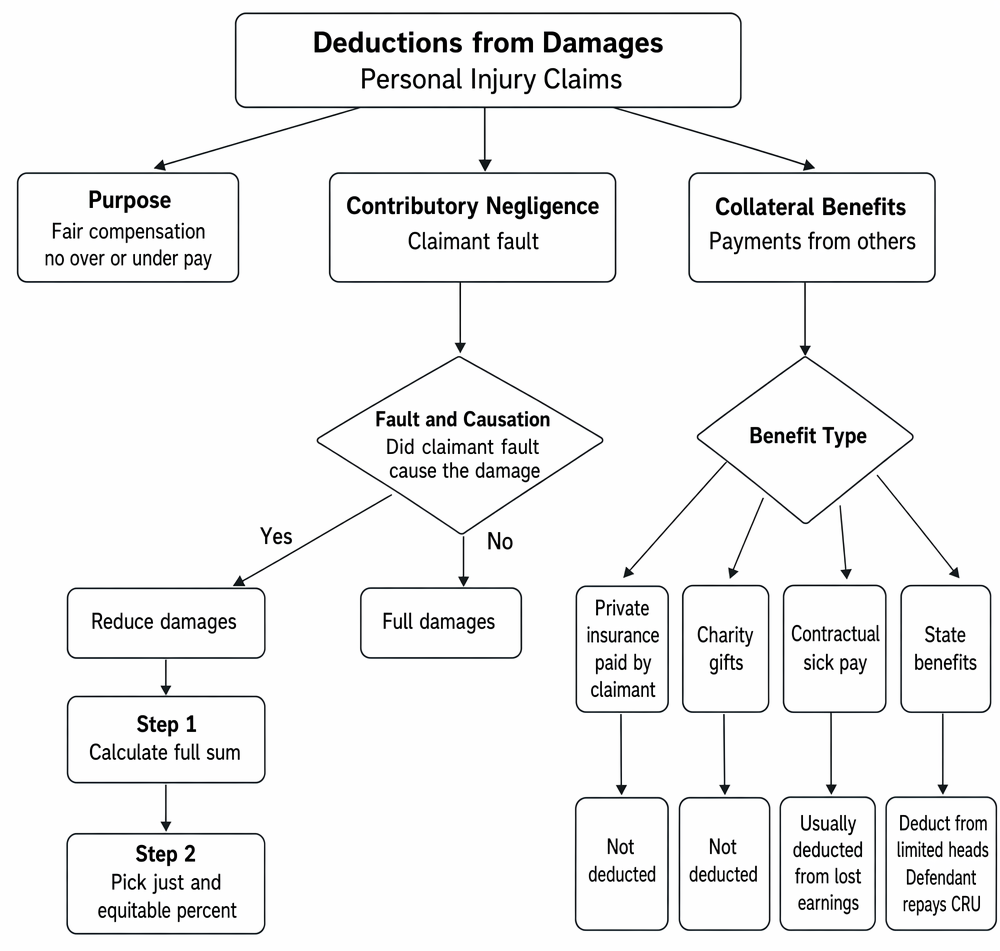
Deductions from damages in personal injury claims are summarised by reference to compensation, contributory negligence, collateral benefits, and state benefit recovery.
Key Term: contributory negligence
Contributory negligence occurs where the claimant’s own failure to take reasonable care for their safety contributed to the damage suffered. The court reduces damages by a percentage reflecting the claimant’s share of responsibility. Key Term: collateral benefits
Collateral benefits are payments or advantages received by the claimant from a source other than the defendant as a result of the injury or death. Key Term: double recovery
Double recovery means the claimant receives compensation for the same loss from more than one source (e.g., damages plus insurance payout). The law generally seeks to prevent double recovery, but not at the expense of penalising the claimant’s foresight or third-party generosity. Key Term: PSLA
Pain, suffering and loss of amenity (PSLA) is the non-pecuniary element of general damages compensating for physical and mental suffering and the loss of enjoyment of life. Key Term: Gourley principle
Loss of earnings is assessed on a net basis (after tax and national insurance). This ensures the claimant is compensated for actual financial loss, not gross income that would never have been received.
Understanding these deductions and principles is essential for determining the correct compensation and for avoiding both under- and over-compensation.
Contributory Negligence
If the claimant’s own lack of care contributed to their injury or loss, their damages may be reduced. This is governed by the Law Reform (Contributory Negligence) Act 1945.
Legal Test and Apportionment
To succeed with this defence, the defendant must show:
- the claimant was at fault (objectively, judged against the standard of a reasonable person in the claimant’s position), and
- the claimant’s fault contributed to the damage (it need not have contributed to the accident itself; it is enough that it increased the extent of the injury).
The court decides what reduction is “just and equitable,” considering both the blameworthiness and the causative potency of each party’s conduct. The reduction is expressed as a single percentage applied to the final sum of damages across all heads, including PSLA and pecuniary loss. Contributory negligence is a partial defence; it does not extinguish the claim.
Practical points frequently tested:
- Children: the standard is that of a reasonable child of the claimant’s age; this often results in a lower or no reduction.
- Rescuers: genuine rescuers acting in emergencies are rarely criticised; reductions are uncommon unless their conduct was wholly unreasonable.
- Safety measures: failing to take basic safety precautions may justify a reduction, such as not wearing a seat belt or a motorcycle helmet.
Seat belts and helmets:
- Not wearing a seat belt can justify a typical reduction of 25% if wearing it would have prevented the injury, 15% if it would have reduced its severity, and 0% if it would have made no difference.
- Motorcyclists who fail to wear a helmet, or wear one improperly fastened, may face reductions in a similar range where causation is proved.
Multiple defendants:
- Contributory negligence reduces the claimant’s overall damages. Contribution and apportionment between multiple defendants under the Civil Liability (Contribution) Act 1978 occurs separately and does not affect the total the claimant may recover.
Fatal claims:
- Where the deceased was contributorily negligent, reductions apply to the estate’s claim (continuing under the Law Reform (Miscellaneous Provisions) Act 1934) and to dependants’ claims under the Fatal Accidents Act 1976. The percentage reduction reflects the deceased’s share of responsibility.
Worked Example 1.1
A pedestrian is hit by a speeding car while crossing the road outside a designated crossing. The court finds the driver 75% responsible and the pedestrian 25% responsible for not using the crossing. Damages are assessed at £40,000. What sum does the pedestrian receive?
Answer:
The pedestrian’s damages are reduced by 25%. £40,000 – 25% (£10,000) = £30,000. The pedestrian receives £30,000.
Worked Example 1.2
A front-seat passenger injured in a collision was not wearing a seat belt. The court finds that wearing a seat belt would have reduced the severity of the injuries, but not prevented them. Total damages (before any reduction) are £80,000. What adjustment is likely?
Answer:
A typical reduction is 15% where a seat belt would have reduced, but not prevented, injury. £80,000 – 15% (£12,000) = £68,000.Exam Warning: Do not confuse contributory negligence (which reduces a claimant’s damages due to their own fault) with contribution between defendants (which is about sharing liability between multiple tortfeasors).
Collateral Benefits
A claimant may receive money or benefits from sources other than the defendant after an injury or death. These are called collateral benefits. The key question is whether such sums should be deducted from the damages awarded against the defendant.
The general rule is that most collateral benefits are not deducted from damages. The defendant should not benefit from the claimant’s prudence (e.g., buying insurance) or the generosity of others.
Main principles and common types:
- Private insurance: sums received under policies funded by the claimant (or on their behalf) are not deducted. This includes personal accident and life insurance payments.
- Charitable gifts: donations from the public, employers’ ex gratia payments (where the employer is not the tortfeasor), and crowdfunding are not deducted.
- Pensions: ill-health or disability pensions are generally not deducted, especially if funded by the claimant’s contributions or are a benefit of employment. The fact a claimant may receive an ill-health pension does not reduce their damages for lost earnings, though separate claims for loss of pension rights may be adjusted to avoid double counting within that head.
- Gratuitous care: where family or friends provide unpaid care, the claimant can recover the reasonable commercial value of that care from the defendant. This is not a deduction; it is a recoverable head of loss. The award is commonly held on trust for the carer.
Key Term: gratuitous care
Care provided without charge by relatives or friends. The claimant may recover its reasonable market value as damages for cost of care; the award is typically held on trust for the carer.
- Sick pay:
- Contractual sick pay: if paid under the employment contract, it is usually deducted from loss of earnings to avoid double recovery, unless the employer has a contractual right to recoup it from the employee upon a damages award (in which case it should not be deducted).
- Discretionary sick pay: if paid voluntarily and not under a contractual obligation, it is treated like a gift and is not deducted.
Net, not gross, earnings:
- Loss of earnings is calculated on a net basis (after tax and national insurance). This prevents over-compensation and aligns with the Gourley principle. The same approach applies to future earnings loss using multipliers.
Key Term: Gourley principle
Damages for loss of earnings are based on net income (after tax and national insurance), ensuring compensation matches true financial loss.
Main Types of Collateral Benefits
-
Private Insurance: Sums received under insurance policies paid for by the claimant (or on their behalf) are not deducted. The claimant paid for this benefit.
-
Charitable Gifts: Money received from public appeals or charities is not deducted. The defendant should not benefit from others’ generosity.
-
Pensions: Ill-health or disability pensions are generally not deducted, especially if funded by the claimant’s own contributions or as part of their employment.
-
Sick Pay:
- Contractual Sick Pay: If paid under the contract of employment, it is usually deducted from damages for loss of earnings, unless the employer can recover the sum from the employee if damages are awarded.
- Discretionary Sick Pay: If paid voluntarily (not under contract), it is treated as a gift and not deducted.
-
State Benefits: The treatment of state benefits is governed by the Social Security (Recovery of Benefits) Act 1997.
State Benefits and the Social Security (Recovery of Benefits) Act 1997
Certain state benefits received as a result of the injury are deducted from specific heads of damage. The defendant (or their insurer) must then repay the amount of those deducted benefits to the state via the Compensation Recovery Unit (CRU). Benefits are not deducted from damages for pain, suffering, and loss of amenity (PSLA).
Key Term: Compensation Recovery Unit (CRU)
The government body responsible for certifying state benefits paid because of an injury and recovering those sums from the compensator when damages are paid.
Core features of the scheme:
-
Like-for-like matching: only benefits of a particular kind are set off against the corresponding head(s) of loss. In broad terms:
- Loss of earnings: matched to income-replacement benefits.
- Cost of care: matched to care-related benefits.
- Loss of mobility: matched to mobility-related benefits.
-
No deduction from PSLA: benefits are never set off against PSLA.
-
Defendant repays the state: any amount deducted from the specified heads is repaid by the defendant/insurer to the CRU. This prevents the state bearing the cost of the defendant’s tort.
-
Certification: before settlement or judgment, the compensator should obtain a CRU certificate confirming the recoverable benefits. The certificate guides the set-off.
Road traffic NHS charges:
- In road traffic cases, NHS treatment charges are recovered from the compensator under separate legislation. These charges are payable by the defendant/insurer to the NHS authority and are not deducted from the claimant’s damages.
Worked Example 1.3
A claimant is injured at work and is off for three months. During this time, they receive:
- £1,500 from a personal accident insurance policy
- £1,000 in contractual sick pay from their employer
- £500 from a public fundraising appeal
- £2,000 in state benefits for loss of earnings
Their total loss of earnings is £6,000. How are these benefits treated?
Answer:
The £1,500 insurance payout and £500 charity payment are not deducted. The £1,000 contractual sick pay is deducted (unless the employer can recover it from the employee). The £2,000 state benefit is deducted from the damages for loss of earnings, and the defendant must repay this sum to the state. The claimant’s net loss of earnings claim is £6,000 – £1,000 (sick pay) – £2,000 (state benefit) = £3,000.
Worked Example 1.4
A claimant suffers a significant injury. Before trial, the CRU certificate shows:
- £3,500 income-replacement benefits
- £1,000 care-related benefits
The claimant’s heads of loss are assessed as:
- Past loss of earnings: £4,000 (net)
- Past care and assistance: £800 (gratuitous care valued on commercial rates)
- PSLA: £15,000
What is deducted from the award and what is repaid to the state?
Answer:
Loss of earnings (£4,000) is matched first against £3,500 income-replacement benefits, so £3,500 is deducted from that head and repaid by the defendant to CRU. Care (£800) is matched against £1,000 care-related benefits, so £800 is deducted and repaid; the remaining £200 care-related benefits are not set off against PSLA and are not recoverable from the claimant’s PSLA award. PSLA (£15,000) is unaffected. The claimant receives: £(4,000−3,500) + £(800−800) + £15,000 = £15,500.Revision Tip: Always check the source and character of any payment received by the claimant. Most insurance and charity payments are not deducted. State benefits are deducted only from specific heads of loss and are repaid by the compensator to the state. PSLA is never reduced for state benefits. Remember: loss of earnings is calculated on a net basis.
Summary
| Deduction Type | Rule/Statute | Deducted from Damages? | Notes |
|---|---|---|---|
| Contributory Negligence | Law Reform (Contributory Negligence) Act 1945 | Yes (by % of claimant’s fault) | Single % reduction across all heads, including PSLA; based on blameworthiness and causative potency. |
| Private Insurance | Common law | No | Not deducted; claimant paid for the benefit. |
| Charitable Gifts | Common law | No | Not deducted; defendant does not benefit from generosity of others. |
| Pensions (ill-health/disability) | Common law | No | Generally not deducted where earned through claimant’s contributions or as part of employment benefits. |
| Contractual Sick Pay | Common law | Yes (usually) | Deducted from loss of earnings unless employer can recoup from employee upon damages award. |
| Discretionary Sick Pay | Common law | No | Voluntary payments are treated as gifts. |
| State Benefits (like-for-like) | Social Security (Recovery of Benefits) Act 1997 | Yes (specified heads only) | Matched to loss of earnings, care, and mobility; never deducted from PSLA. Defendant repays CRU. |
| Loss of Earnings (net of tax/NI) | Gourley principle (common law) | Yes (to net figures) | Loss of earnings always assessed on a net basis to avoid over-compensation. |
| Gratuitous Care (family/friends) | Common law | Not a deduction (recoverable head) | Reasonable commercial value recoverable; award typically held on trust for the carer. |
| NHS Treatment Charges (RTAs) | Road traffic NHS charging regime | No deduction from claimant | Payable by defendant/insurer to the NHS; does not reduce the claimant’s damages. |
Key Point Checklist
This article has covered the following key knowledge points:
- Damages in tort are compensatory; over-compensation is avoided through targeted deductions and net calculations.
- Contributory negligence reduces damages by a “just and equitable” percentage reflecting the claimant’s share of responsibility for the damage; standard reductions apply for seat belt/helmet omissions when causative.
- The reduction for contributory negligence applies across all heads, including PSLA; in fatal cases it affects both estate and dependency claims.
- Most private insurance and charitable payments are not deducted from damages; the defendant should not profit from prudence or generosity.
- Ill-health and disability pensions are generally not deducted; check for head-specific adjustments to avoid double counting when assessing loss of pension rights.
- Contractual sick pay is usually deducted from loss of earnings unless there is a recoupment clause; discretionary sick pay is not deducted.
- Loss of earnings is calculated on a net basis (after tax and national insurance) under the Gourley principle.
- State benefits are deducted from specified heads only (loss of earnings, cost of care, loss of mobility) under the Social Security (Recovery of Benefits) Act 1997; the compensator repays the CRU; PSLA is never reduced by benefits.
- Gratuitous care provided by family/friends is a recoverable head of loss and not a deduction; the award is commonly held on trust for the carer.
- In road traffic cases, NHS treatment charges are recovered from the compensator separately and do not reduce the claimant’s damages.
Key Terms and Concepts
- contributory negligence
- collateral benefits
- double recovery
- PSLA
- Gourley principle
- Compensation Recovery Unit (CRU)
- gratuitous care