Learning Outcomes
This article explains the structure, routes, and core principles of criminal appeals from the Magistrates’ and Crown Courts in England and Wales. It identifies the correct forum for challenging conviction and sentence, distinguishing rehearings in the Crown Court from case stated, judicial review, and appeals to the Court of Appeal and Supreme Court. It sets out the statutory grounds for appeal, including the “unsafe conviction” test, errors of law or principle, manifestly excessive sentences, and the strict criteria for admitting fresh evidence. It details mandatory procedural requirements under the Criminal Procedure Rules and relevant legislation, focusing on notices, document content, and the key 21‑ and 28‑day time limits, together with the approach to extensions of time. It examines the powers of each appellate court to quash, substitute, remit, vary sentence, or order retrials, and highlights prosecution rights of appeal, including terminating rulings, unduly lenient sentences, and exceptional retrials of acquittals. It also reviews practical issues of bail pending appeal, costs and “loss of time” orders, and summarises the professional and ethical duties when advising on prospects, drafting grounds, and managing client expectations.
SQE1 Syllabus
For SQE1, you are required to understand the criminal appeals procedure in England and Wales, with a focus on the following syllabus points:
- The structure and jurisdiction of criminal courts and appeal courts in England and Wales
- Appeal rights from the Magistrates’ Court to the Crown Court and by case stated to the High Court (Divisional Court)
- Appeal rights from the Crown Court to the Court of Appeal (Criminal Division); requirements for leave and relevant statutory grounds
- Prosecution appeals (terminating rulings, unduly lenient sentences, retrials of acquittals in qualifying offences) and defence rights of appeal
- Grounds for appeals against conviction and sentence; the “unsafe conviction” test; manifest excess and errors of law/principle
- Mandatory procedures, document content, and time limits for criminal appeals; extension applications
- Powers of appellate courts to quash, substitute, remit, and order retrials; handling ancillary orders
- Handling and admission of fresh evidence on appeal, and its limits
- Costs, adverse costs, and “loss of time” orders for unmeritorious appeals
- Route to the Supreme Court; certification and leave requirements
- Distinctions between rehearing (Crown Court on magistrates’ appeals) and review limited to points of law (case stated; judicial review)
- Professional and ethical standards when advising on appeals; duty not to mislead; drafting grounds and complying with CrimPR
Test Your Knowledge
Attempt these questions before reading this article. If you find some difficult or cannot remember the answers, look more closely at that area during your revision.
- Which court hears an appeal against conviction from the Magistrates’ Court where the appellant wishes to challenge factual findings?
- What is the standard time limit for lodging a notice of appeal from the Crown Court to the Court of Appeal (Criminal Division) against conviction?
- What issues can be raised by case stated to the High Court (Divisional Court), and who can bring that appeal?
- In Crown Court appeals against conviction, what does the Court of Appeal mean when deciding whether a conviction is “unsafe”?
Introduction
Appeals are a structured means of correcting error and maintaining fairness in criminal proceedings. Each route has its own jurisdiction, time limits, and procedural framework. Understanding how to select the appropriate route, frame proper grounds, meet strict filing requirements, and anticipate appellate powers is central to effective practice. Importantly, different appellate bodies approach appeals differently: some rehear factual disputes afresh; others review the legal correctness of decisions. Success often turns on clear, well‑supported grounds, timely compliance with procedural rules, realistic assessment of prospects, and robust professional standards.
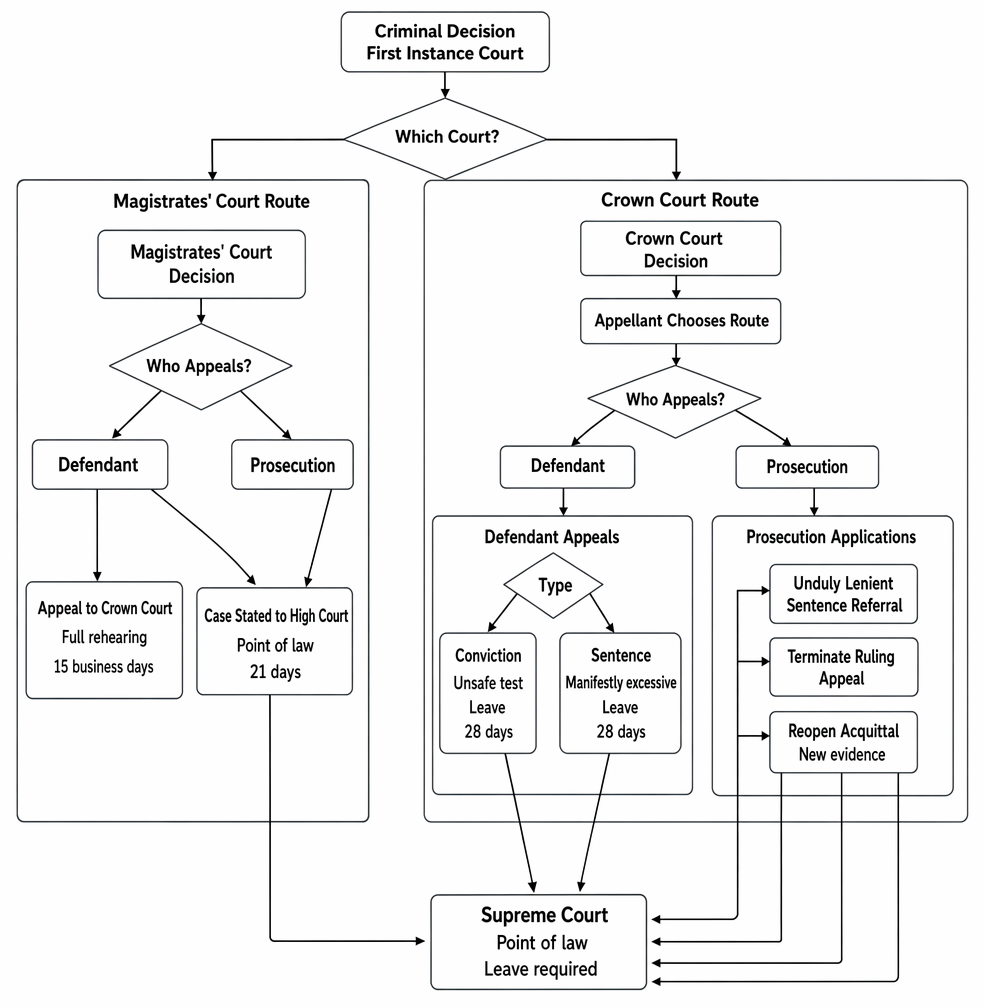
Criminal appeal routes from Magistrates’ Courts and the Crown Court, indicating forum, appellant, principal grounds, and applicable time limits.> Key Term: appeal> A statutory or common law process by which a higher court reviews, and may vary or overturn, a lower court’s decision. Routes, powers, standards, and time limits differ by court and type of challenge.
Appeals from the Magistrates’ Court
Convictions and sentences in the Magistrates’ Court (including the Youth Court) may be challenged by way of rehearing in the Crown Court or by way of case stated to the High Court (Divisional Court). In narrow circumstances where neither route is suitable, judicial review in the Administrative Court remains a residual safeguard.
Appeal to the Crown Court
This is the primary avenue for a defendant to challenge conviction and/or sentence following summary trial. It is a rehearing (de novo) of the factual and legal issues that the appellant puts in issue.
Key Term: appeal against conviction
A challenge to the correctness of a guilty verdict, inviting the appellate court to set aside or vary the conviction on factual and/or legal grounds. Key Term: appeal against sentence
A challenge to the lawfulness or severity of a penalty, inviting the appellate court to substitute a different sentence or remit for resentencing.
Parties Eligible to Appeal
- Only the defendant may appeal from the Magistrates’ Court to the Crown Court. The prosecution cannot use this route to overturn an acquittal or increase sentence; its statutory alternatives are case stated or judicial review where appropriate.
Nature and Scope of the Appeal
- Appeals are heard de novo: the Crown Court (a circuit judge or recorder sitting with two magistrates who did not hear the original case) rehears evidence and argument afresh. The court may admit fresh oral or documentary evidence, subject to ordinary evidential rules.
- The Crown Court will hear legal submissions and may rule on admissibility issues that arise on the appeal. It can reconsider identification, credibility, and other factual questions.
Procedure and Time Limits
- The appellant must lodge a notice of appeal at the Magistrates’ Court (and serve the prosecution) within the statutory time limit. The default period under the Magistrates’ Courts Act 1980 and Criminal Procedure Rules is 21 days from sentence or order (or from conviction if appealing conviction), subject to the court’s power to extend time for good reason. Local listing practices sometimes specify shorter business-day periods; always check and comply with the applicable direction as well as the statutory default.
- The notice must state whether the appeal is against conviction, sentence, or both, and should outline the grounds clearly and concisely.
- The Magistrates’ Court transmits the case papers and notice to the Crown Court for listing.
Revision Tip: Do not assume that an extension will be granted. Set out a full chronology, reasons for delay, and the merits of the proposed grounds when seeking more time.
Court’s Powers on Appeal
- The Crown Court may allow or dismiss the appeal; quash a conviction; substitute a conviction for a lesser or alternative offence that could have been charged on the facts; vary sentence; or remit for resentencing by the magistrates with directions.
- On sentence appeals, the Crown Court may impose any sentence that the Magistrates’ Court could have imposed, including ancillary orders. It may reduce, maintain, or increase the sentence within the limits of summary jurisdiction. The risk of an increased sentence must be explained to the client.
Exam Warning: The Crown Court may lawfully increase a sentence if justified, provided the total remains within the maximum the Magistrates’ Court could have imposed for the offence(s).
Procedural Features
- Appeals to the Crown Court are of right; no leave is required.
- Representation orders for the appeal hearing must be obtained afresh where public funding is sought. Comply with Legal Aid Agency merits and means tests.
- Costs orders may be made. An appellant who fails or pursues hopeless grounds risks adverse costs.
Appeals following Guilty Pleas
- Appeals against sentence following a guilty plea are common. Appeals against conviction after a guilty plea are very exceptional and generally limited to equivocal pleas, lack of capacity, coercion, or fundamental procedural error.
Appeal to the High Court by Way of Case Stated
Either party may seek case stated to the High Court (Divisional Court), but only on points of law or jurisdiction.
Key Term: case stated
A formal statement by the magistrates (or Crown Court in its appellate capacity on summary matters) setting out the facts found and the legal question(s) for the High Court’s opinion.
Parties Eligible to Appeal
- Either the defendant or the prosecution may apply. It is commonly used by the prosecution to challenge legal misdirections or jurisdictional errors.
Nature of the Appeal
- The Divisional Court determines points of law or jurisdiction only. It does not rehear evidence or resolve disputed facts; it decides whether the decision below was legally correct on the facts as stated.
Procedure and Time Limits
- Application must be made to the magistrates to state a case within 21 days of the decision, identifying precisely the legal question(s).
- The magistrates draft a stated case after considering submissions on form and content. Parties may propose amendments to ensure all relevant facts and steps are recorded.
- The stated case is then lodged with the High Court and served on all parties. The appeal proceeds by written and oral argument.
Powers of the High Court
- The Divisional Court may affirm, reverse, or amend the decision, or remit the case with directions. It will avoid intruding into factual disputes and focus strictly on the legal question posed.
Key Features and Distinction from Judicial Review
- Case stated is not a rehearing. It addresses legal misdirection, application of law to facts as found, or jurisdictional excess.
- Judicial review remains available where case stated is unsuitable, for example for procedural unfairness, bias, or unlawful acts by magistrates, provided no adequate alternative remedy exists and the claim is brought promptly.
Revision Tip: Crown Court rehearing (defendant only) corrects factual errors; case stated (either party) corrects errors of law or jurisdiction.
Appeal by Judicial Review
Judicial review in the Administrative Court is a residual public law remedy where statutory appeal is unavailable or inadequate. Typical grounds include illegality, procedural unfairness (natural justice), irrationality, and breach of legitimate expectations.
- Claims must be commenced promptly and in any event within three months of the challenged decision or act. A pre‑action protocol overview applies.
- Permission is required; merits must be sufficiently arguable, and alternative remedies (including case stated or Crown Court appeal) must be exhausted or shown to be inadequate.
Appeals from the Crown Court
After trial on indictment, or sentencing in the Crown Court, defendants may appeal to the Court of Appeal (Criminal Division). Prosecution appeal rights exist in defined statutory circumstances. The Criminal Appeal Act 1968, supplemented by the Criminal Justice Acts and the Criminal Procedure Rules, provides the principal framework.
Crown Court Conviction Appeals – Parties Eligible to Appeal
- Only the defendant may appeal against conviction to the Court of Appeal (Criminal Division). The prosecution’s powers to challenge rulings are limited to defined situations (see Prosecution appeals below).
Crown Court Conviction Appeals – Grounds for Appeal
Appeals against conviction must persuade the Court of Appeal that the conviction is unsafe.
Key Term: unsafe conviction
The Court of Appeal must quash a conviction if, considering the trial as a whole (including any legal error, procedural irregularity, or fresh evidence), it concludes the conviction is unsafe.
Common reasons a conviction may be unsafe include:
- Misdirection of law, incorrect or inadequate judicial directions (e.g., identification or burden of proof directions), or admission/exclusion errors that prejudiced fairness
- Serious procedural irregularity (e.g., improper jury communications, unfair prosecutorial conduct)
- Juror misconduct or outside influence
- Fresh evidence that is credible, admissible, and would afford a ground of appeal, coupled with a satisfactory explanation for its non‑adduction at trial
- Breach of Article 6 fair trial rights or statutory protections that undermined the safety of the verdict
Causation is important: not every error is fatal. The appellant must show that the irregularity affected the safety of the conviction.
Crown Court Conviction Appeals – Leave to Appeal
- Leave (permission) is mandatory. The appellant may seek a certificate from the trial judge immediately after conviction, but leave is usually determined by a single judge of the Court of Appeal on the papers.
- If leave is refused, the appellant may renew the application at an oral hearing before the full court. Renewal should be targeted: identify specific grounds with arguable merit; do not simply repeat hopeless points.
Key Term: single judge
A judge of the Court of Appeal who initially considers applications for leave to appeal on the papers, filtering out unarguable cases. Key Term: renewal application
An oral application to the full court to reconsider grounds on which the single judge refused leave, usually limited to specific grounds with arguable merit.
Crown Court Conviction Appeals – Time Limits
- The notice of appeal (or application for leave) must be lodged within 28 days of conviction (if challenging conviction) or within 28 days of sentence (if challenging sentence only).
- Extensions of time require good reason and prompt action. The Court may be sympathetic where fresh evidence emerges later or where there were compelling practical obstacles, but bare assertions of delay rarely suffice.
Crown Court Conviction Appeals – Procedure
- File and serve the notice (Form NG and accompanying grounds) on the Registrar of Criminal Appeals within time, with a concise but precise statement of grounds and relevant supporting material.
- The Criminal Appeal Office obtains trial transcripts and may direct filing of a skeleton argument and authorities bundle. Ensure grounds match the skeleton and cite the precise alleged errors (e.g., misdirection passages, evidential rulings).
- The case is listed before a constitution of at least three judges for conviction appeals. The court may decide some matters on written submissions, but substantive conviction appeals usually involve oral argument.
- The prosecution (CPS) responds; it may concede partial grounds or argue no material impact on safety. The Registrar’s directions must be strictly observed.
Crown Court Conviction Appeals – Powers on Appeal
- The Court of Appeal may dismiss the appeal; quash the conviction; substitute a conviction for an alternative offence disclosed by the indictment and facts; or order a retrial if in the interests of justice (e.g., where fresh evidence requires jury assessment or significant legal error requires a new trial).
- Ancillary orders (e.g., costs, confiscation, compensation, restraining orders) may be reviewed and varied in light of the court’s decision.
Key Term: loss of time order
An order that some or all of the time an appellant spent in custody pending appeal does not count towards sentence, used to deter unmeritorious appeals. It is usually considered where the appeal or application for leave is found to be wholly without merit.
Crown Court Conviction Appeals – Fresh Evidence
- New evidence may be admitted if it is credible, would have been admissible at trial (or would provide a substantial ground of appeal), and there is a satisfactory reason for its earlier absence (Criminal Appeal Act 1968, s 23). The Court assesses whether the evidence might reasonably have affected the verdict.
Key Term: fresh evidence
Evidence not adduced at trial, admitted on appeal only if it is credible, likely to have a material impact, and accompanied by a satisfactory explanation for non‑adduction.
Crown Court Conviction Appeals – Risks and Consequences
- Hopeless appeals risk a loss of time order and adverse costs. Consider proportionality and prospects before filing.
- If serious concerns arise that cannot be resolved within ordinary appellate routes, the case may be referred to the Criminal Cases Review Commission (CCRC).
Crown Court Sentence Appeals – Who May Appeal
- Only the defendant may appeal sentence from the Crown Court, save for prosecution challenges to undue leniency (Attorney General’s references) or certain statutory revision powers.
Crown Court Sentence Appeals – Grounds for Appeal
Sentence may be challenged where it is:
- Wrong in law (e.g., exceeds statutory maximum; unlawful combination of orders)
- Wrong in principle (e.g., custodial threshold not met; improper disregard of key mitigation)
- Manifestly excessive (outside the reasonable range for the offence and offender on established guidelines)
- Inconsistent with guidelines or where plea credit/mitigation was misapplied
- Unsupported by the factual basis (e.g., sentencing proceeded on facts inconsistent with jury verdict or accepted plea basis)
Crown Court Sentence Appeals – Leave to Appeal and Time Limits
- Leave is required and the 28‑day clock runs from sentence. Seek extension promptly if necessary and justify fully.
Crown Court Sentence Appeals – Procedure
- Grounds should be short, focused, and supported by relevant guideline passages and authorities. Include any Newton hearing issues or basis of plea disputes and explain the alleged misapplication.
Key Term: sentence appeal
A challenge to the lawfulness or proportionality of sentence, seeking variation, substitution, or remission to the sentencing court.
Crown Court Sentence Appeals – Powers on Appeal
- The Court of Appeal may vary, reduce, or quash the sentence; substitute a lawful sentence; or leave ancillary orders in place or adjust them. The court cannot increase sentence on a defendant’s appeal; only prosecution mechanisms allow upward revision.
Prosecution Appeals from Crown Court
The prosecution’s powers to appeal are strictly limited and closely policed by statute.
- Terminating Rulings (Criminal Justice Act 2003): The CPS may appeal rulings that terminate proceedings (e.g., an erroneous no‑case‑to‑answer ruling). Notice must be given promptly. The CPS must certify public interest in continuing the case and undertake that, if unsuccessful, the defendant will be acquitted.
Key Term: terminating ruling
A Crown Court ruling that brings proceedings to an end, such as an improper withdrawal of the case; the prosecution may appeal under defined statutory procedure.
- Unduly Lenient Sentences (Attorney General’s Reference): For specified serious offences, the Attorney General may refer an unduly lenient sentence to the Court of Appeal within 28 days of sentence. The court may increase a sentence found to be outside the range properly open.
Key Term: unduly lenient sentence
A sentence that falls outside the range a judge could reasonably impose for the offence and offender, allowing the Court of Appeal to increase it on the Attorney General’s reference.
- Retrial of Acquittals – New and Compelling Evidence: For qualifying offences (e.g., murder, manslaughter, rape, terrorism), an acquittal may be quashed and a retrial ordered where new and compelling evidence emerges; the DPP’s consent and the Court of Appeal’s leave are required. This power is used sparingly and subject to stringent safeguards.
Key Term: new and compelling evidence
Material discovered post‑acquittal that is reliable, substantial, and highly probative, justifying re‑opening a qualifying acquittal and ordering a retrial in the interests of justice.
- Case Stated from the Crown Court (Appellate Capacity): On summary matters (e.g., appeals from magistrates), either party may seek case stated from the Crown Court to the High Court on points of law.
Fresh Evidence and Prosecution Appeals
- The same cautious principles apply: any new material must be cogent, admissible, and accompanied by a satisfactory explanation for its late emergence. The court considers delay, fairness, and prejudice when deciding whether to order a retrial.
Appeals to the Supreme Court
Appeals to the Supreme Court are exceptional and confined to points of law of general public importance.
- Leave is required from either the Court of Appeal or the Supreme Court. The Court of Appeal must usually certify that the case involves a point of law of general public importance.
- The point must have been raised below and must warrant authoritative guidance. The Supreme Court does not review facts anew; it decides legal issues.
Key Term: Divisional Court
A court of two or sometimes three High Court judges (King’s Bench Division) that hears criminal case stated appeals and certain other matters on points of law.
Practical Procedure: Notices, Time Limits, Bail, and Costs
Notices and Grounds
- Notices must comply with the Criminal Procedure Rules: clear identification of the order appealed; precise grounds; required forms; service on all parties; and filing with the appropriate registry (Criminal Appeal Office for CoA; Magistrates’ Court and Crown Court offices for summary appeals).
- Grounds must be coherent, specific, and supported by authorities. Avoid “rolled‑up” complaints; identify the legal error or unfairness clearly.
Time Limits
- Magistrates’ appeals to the Crown Court: statutory default 21 days from sentence or order (or conviction if appealing conviction), subject to extension for good cause. Always check any local or Practice Direction timings and comply with the stricter timetable where applicable.
- Case stated: 21 days to ask the magistrates (or Crown Court in its appellate capacity on summary matters) to state a case.
- Crown Court to Court of Appeal: 28 days from conviction (for conviction appeals) or 28 days from sentence (for sentence appeals).
- Attorney General’s references (unduly lenient): 28 days from sentence.
- Supreme Court: leave applications should follow promptly after the Court of Appeal’s judgment; specific filing windows apply under the Supreme Court Rules.
Bail Pending Appeal
- Bail pending appeal may be granted by the court seised of the appeal (Crown Court on summary appeals; Court of Appeal on appeals from the Crown Court) if grounds are arguable and there is no unacceptable risk of failure to surrender, further offending, or interference with justice. Strong merits and personal circumstances are key; bail is not automatic.
Costs and “Loss of Time”
- Costs orders may be made against unsuccessful appellants, and wasted costs may be considered where legal representatives have pursued improper or unreasonably conducted appeals.
- The Court of Appeal may make loss of time orders deterring unmeritorious appeals. Warn clients early about this risk when grounds are weak.
Professional Conduct in Appeals
Solicitors must balance zealous advocacy with duties to the court:
- Do not advance grounds without merit or misrepresent facts or law. Avoid speculative fishing expeditions, especially on fresh evidence.
- Give realistic advice on prospects and risks (including sentence increase in Crown Court rehearings and loss of time orders).
- Ensure grounds are honest, properly arguable, and supported by materials; do not raise factual accounts that conflict with confidentiality or the duty not to mislead.
Key Term: appeal against sentence
A challenge to a penalty’s lawfulness or proportionality, seeking reduction, substitution, or remission. Key Term: single judge
The initial filter for leave applications to the Court of Appeal, deciding on the papers whether grounds are arguable. Key Term: loss of time order
An order depriving an unsuccessful appellant of credit for time served pending appeal. Key Term: terminating ruling
A ruling that ends proceedings; the prosecution may appeal under statutory procedure. Key Term: unduly lenient sentence
A sentence outside the reasonable range for the offence and offender; can be increased by the Court of Appeal on the Attorney General’s reference. Key Term: fresh evidence
New evidence admitted on appeal only if credible, materially probative, and justified by a satisfactory reason for earlier non‑adduction. Key Term: new and compelling evidence
Reliable, substantial, highly probative material discovered post‑acquittal that may justify re‑opening a qualifying acquittal and ordering a retrial. Key Term: Divisional Court
The High Court (King’s Bench Division) sitting with two or three judges to decide case stated appeals.
Worked Examples and Applied Scenarios
Worked Example 1.1 (Magistrates’ Court Conviction Appeal)
A defendant is convicted of theft in the Magistrates’ Court after a not guilty plea and sentenced to 6 weeks’ imprisonment. He believes the magistrates misunderstood the evidence. What are his appeal options?
Answer:
He may appeal to the Crown Court against conviction within the applicable time limit (default 21 days from sentence/order). The appeal will be a complete rehearing before a Crown Court judge and two magistrates. If he believes the magistrates erred in law or exceeded jurisdiction, he (or the prosecution) could, within 21 days, apply for a case stated to the High Court, but that route is limited to points of law and does not rehear evidence.
Worked Example 1.2 (Crown Court Conviction Appeal)
A defendant is convicted of robbery in the Crown Court and sentenced to 7 years’ imprisonment. After 30 days, new evidence emerges that could have affected the verdict. What should the defendant do?
Answer:
He should apply promptly for leave to appeal against conviction to the Court of Appeal, seeking an extension of time and explaining the significance of the fresh evidence and why it could not reasonably have been adduced at trial. The principal ground would be that the conviction is unsafe. The Court will assess whether the evidence is credible, admissible, and materially probative.
Worked Example 1.3 (Magistrates’ Court Procedural Unfairness)
A defendant, convicted in the Magistrates’ Court, believes the trial was procedurally unfair because the prosecution failed to disclose an important alibi witness statement. What avenues are available to challenge the conviction?
Answer:
He may appeal to the Crown Court (rehearing route) or apply for case stated within 21 days if the issue raises a point of law. If neither route affords adequate remedy, judicial review might be considered, but only promptly and where statutory appeals are inadequate.
Worked Example 1.4 (Prosecution Appeal Case Stated)
The prosecution is dissatisfied with an acquittal in the Magistrates’ Court, believing the magistrates misapplied a point of law. What route is open to the prosecution?
Answer:
The prosecution may request the Magistrates’ Court to state a case within 21 days, specifying the legal question. The Divisional Court will determine whether the magistrates erred in law or lacked jurisdiction; it will not revisit factual findings.
Worked Example 1.5 (Unduly Lenient Sentence)
A defendant pleads guilty to causing grievous bodily harm with intent and receives a sentence the CPS considers markedly below the guideline range. What can be done?
Answer:
The Attorney General may refer the sentence to the Court of Appeal within 28 days if the offence is within the scheme and the sentence appears unduly lenient. If the court agrees it falls outside the reasonable range, it may increase the sentence; the defendant must be warned of this possibility.
Worked Example 1.6 (Terminating Ruling Appeal)
During a Crown Court trial, the judge erroneously upholds a no‑case‑to‑answer submission. Can the prosecution appeal?
Answer:
Yes, under the Criminal Justice Act 2003 the prosecution may appeal a terminating ruling. It must give prompt notice, certify public interest in continuing, and undertake that the defendant will be acquitted if the appeal fails. The Court of Appeal may reverse the ruling and direct the trial to continue.
Worked Example 1.7 (Fresh Evidence Admission)
On appeal, the defence seeks to call a new expert report on cell‑site analysis that contradicts trial evidence. What must the Court of Appeal consider?
Answer:
The Court will test whether the report is credible, would have been admissible at trial, affords a substantial ground of appeal, and whether there is a satisfactory explanation for failing to adduce it earlier (e.g., genuinely new techniques or disclosure obtained post‑trial). It will also assess whether it could reasonably have affected the jury’s verdict.
Worked Example 1.8 (Supreme Court Certification)
After the Court of Appeal dismisses a conviction appeal but recognizes conflicting authority on the legal test for “dangerousness” in particular sentencing provisions, how can the issue reach the Supreme Court?
Answer:
The defendant may seek certification from the Court of Appeal that the case involves a point of law of general public importance and apply for leave to appeal. Alternatively, apply directly to the Supreme Court for leave after certification. The Supreme Court will only accept cases warranting authoritative legal clarification.
Strategic Considerations and Best Practice
Selecting the Correct Route
- Rehearing vs. review: summary convictions are best challenged by Crown Court appeal (facts and law), whereas pure points of law go by case stated. Judicial review is exceptional.
- Crown Court appeals require leave and focused grounds. Do not conflate factual disagreement with legal error; identify fair trial impact.
Drafting Grounds
- Keep grounds concise, reasoned, and supported with pinpoint references (transcript page/line, direction paragraphs). Avoid prolixity and rhetoric.
- For sentence appeals, cross‑refer to guideline steps: category, starting point, aggravation/mitigation, totality, and plea credit. Identify precise missteps or departures.
Extensions and Out‑of‑Time Appeals
- Act quickly. Provide a detailed explanation for delay, attach evidence, and show that grounds are arguable. Tie merits to the public interest in correcting error.
Bail Pending Appeal Details
- Address risk factors (fail to surrender; further offending; interference) and merits. Propose appropriate conditions (curfew, surety, non‑contact, reporting).
- Emphasize realistic timeframes to hearing; avoid speculative bail applications without substance.
Costs and Risk Management
- Warn clients about costs and loss of time risks for unarguable appeals. Consider advising against appeal where prospects are poor and risks are significant.
- If the Crown Court rehearing may increase sentence, ensure informed consent after discussing stakes.
Ethical Duties
- The duty not to mislead the court trumps client instructions. Do not advance factual accounts you know to be false; do not rely on fresh evidence you cannot justify ethically and procedurally.
- If a client insists on hopeless grounds, record advice and consider limiting the scope or declining to act on those grounds, consistent with professional obligations.
Magistrates’ Appeals – Practical Points
- Composition: one judge/recorder with two lay magistrates. They reassess witness credibility, admit fresh evidence, and apply evidential/procedural rules.
- Case management: agree issues to be reheard; seek directions for witnesses and exhibits early. If only sentence is in issue, file guideline analysis.
- Outcomes: conviction quashed; substituted conviction for a lesser alternative offence supported by facts; sentence varied; case remitted.
Case Stated – Drafting and Pitfalls
- Make the legal question precise: “Did the bench err in concluding X on the facts as found?” Record all relevant findings and the precise basis of the decision.
- Resist trying to smuggle factual disputes into the stated case; the Divisional Court decides law on stated facts.
- Remedy: remit with directions where factual reconsideration is needed under correct legal test.
Crown Court Appeals – Skeletons and Bundles
- Skeleton argument: short, structured, issue‑led. Include short procedural history, grounds, propositions of law with authorities, and the relief sought.
- Bundles: only relevant passages of transcript and authorities. Keep within page limits and avoid duplication. Follow Criminal Practice Directions and Registrar’s guidance.
Prosecution Appeals – Safeguards
- Terminating rulings: notice and certification obligations are strict; ensure compliance and rapid filing. The CPS must be ready to proceed if successful; delays can prejudice fairness.
- Unduly lenient sentences: check the offence is within scope, identify guideline error or range departure, and ensure submission within 28 days.
Supreme Court – Certification Strategy
- Frame the point of law broadly enough to matter across cases, but narrowly enough to be capable of precise legal determination. Provide authorities showing divergence or uncertainty.
Professional Conduct in Appeals Details
Solicitors advising on appeals must:
- Identify and explain all realistic routes and the prospects on each
- Avoid misleading or speculative grounds; comply with CrimPR, Practice Directions, and registry guidance
- Ensure client understands risks (sentence increase on summary rehearings; loss of time orders; adverse costs)
- Prepare carefully: accurate notices, focused grounds, proper bundles, and realistic time extension requests
- Maintain confidentiality while honouring the duty of candour; withdraw if ethical conflict cannot be resolved
Summary
Appeals in criminal cases demand sound knowledge of jurisdiction, time limits, and tailored procedures. From Magistrates’ Court rehearings to case stated, from Crown Court conviction and sentence appeals to exceptional Supreme Court reviews, success depends on choosing the right route, framing precise grounds, meeting strict deadlines, and anticipating appellate powers. The Court of Appeal’s “unsafe conviction” test, the cautious approach to fresh evidence, and the prosecution’s limited appeal rights illustrate the system’s balance of finality and fairness. Costs and “loss of time” risks and ethical duties emphasise the need for rigorous, honest case assessment and carefully prepared applications.
Key Point Checklist
This article has covered the following key knowledge points:
- Appeal from Magistrates’ Court to Crown Court is a rehearing on facts and/or sentence; only defendants may use this route.
- Case stated to the High Court (Divisional Court) is limited to points of law or jurisdiction and is available to either party; no factual rehearing.
- Judicial review is residual and requires prompt action; use only where statutory appeal is inadequate or unavailable.
- Crown Court appeals to the Court of Appeal require leave, precise grounds, and compliance with 28‑day time limits; extensions need good reason.
- “Unsafe conviction” is the controlling test for conviction appeals; not every error is fatal—causation and impact on fairness matter.
- Sentence appeals succeed on errors of law/principle or manifest excess; guideline steps and totality must be correctly applied.
- Fresh evidence on appeal is admitted sparingly under strict criteria; credibility, admissibility, and explanation for non‑adduction are key.
- Prosecution appeals include terminating rulings, unduly lenient sentence references, and rare retrials of acquittals on new and compelling evidence.
- Supreme Court appeals require certification and leave; only points of law of general public importance are considered.
- Notices, time limits, skeletons, and bundles must meet CrimPR and registry requirements; bail pending appeal depends on merits and risks.
- Costs and “loss of time” orders deter unmeritorious appeals; warn clients candidly.
- Ethical obligations require honest grounds, realistic advice on prospects, and strict compliance with procedural rules.
Key Terms and Concepts
- appeal
- appeal against conviction
- appeal against sentence
- case stated
- unsafe conviction
- sentence appeal
- single judge
- renewal application
- loss of time order
- terminating ruling
- unduly lenient sentence
- fresh evidence
- new and compelling evidence
- Divisional Court