Learning Outcomes
This article explains the legal framework and practical consequences of failing to surrender and breaching bail conditions for SQE1 candidates, including:
- precise distinctions between absconding (criminal offence) and non-appearance condition breaches (procedural default), and why the classification matters;
- when criminal liability for failing to surrender is made out, how reasonable excuse operates, and who carries the legal and evidential burdens of proof;
- how police and courts exercise arrest, warrant, and bail review powers following absconding or breach, and the applicable time limits;
- proportionality constraints on remand decisions, including the “no real prospect of custody” principle and Article 5 ECHR considerations;
- the impact of absconding and breach on future bail applications, sentencing for the index offence, and standalone failure-to-surrender prosecutions;
- treatment of sureties and security on absconding, including forfeiture, remission, and the expectations placed on sureties in practice;
- how prior failures to surrender or repeated breaches may be used as bad character evidence, influence risk assessments, and shape advocacy strategies in problem questions;
- structured approaches to answering SQE1-style scenarios involving warrants, reasonable excuse, breach hearings, and the correct articulation of burdens, standards, and remedies.
SQE1 Syllabus
For SQE1, you are required to understand bail applications and the consequences of absconding and breaches of bail, with a focus on the following syllabus points:
- the statutory presumption in favour of bail for unconvicted persons and principal exceptions
- factual and evidential distinctions between absconding and breach of bail conditions
- the legal consequences of absconding (including prosecution, forfeiture of surety/security, and impact on future bail)
- the process and effect of arrest and court action following breach of bail
- the procedural response to absconding and breach—including powers of police and magistrates
- the burden and standard of proof where reasonable excuse is raised for failing to surrender
- the effect of absconding or breach upon future bail applications and sentencing (including aggravating factors)
- the impact on sureties and on persons providing security
- the necessity to distinguish properly between criminal offences and non-criminal breaches
- human rights considerations, including the proportionality of conditions or custodial remand
Test Your Knowledge
Attempt these questions before reading this article. If you find some difficult or cannot remember the answers, look more closely at that area during your revision.
- What is the difference in law and consequences between a failure to surrender and a breach of a non-appearance bail condition?
- Who bears the burden of proving reasonable excuse on a charge of failing to surrender, and to what standard?
- When may a court remand a defendant in custody following breach of bail conditions, and what proportionality limit applies?
- What are the potential consequences for a surety when a defendant absconds?
Introduction
Bail in criminal proceedings balances the presumption of innocence, liberty under Article 5 ECHR, and the need to ensure attendance at court, protect the public, and safeguard the administration of justice. The Bail Act 1976 provides a presumption in favour of bail for unconvicted defendants, rebuttable only by specified risks (failure to surrender, further offending, interference with witnesses or otherwise obstructing justice) or particular exclusions. When justified, conditions may be imposed to manage identified risks.
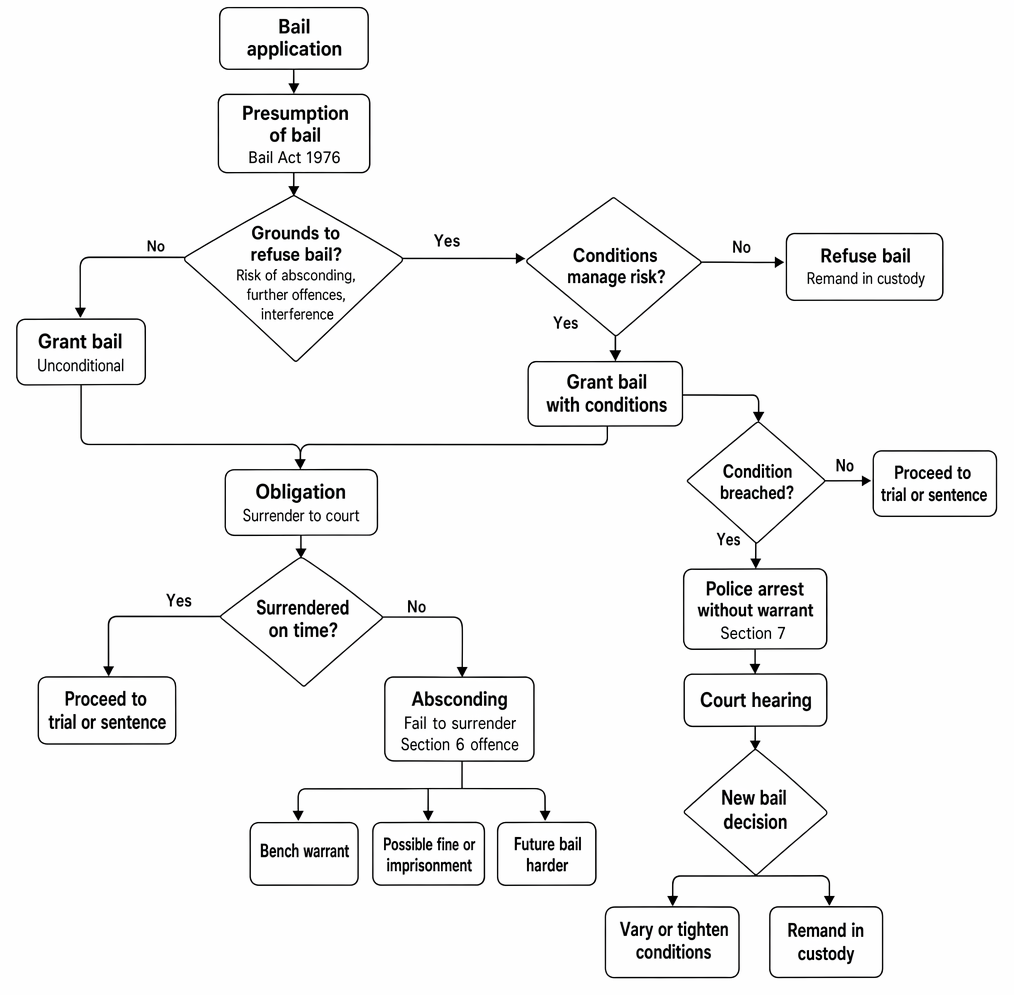
Bail Act 1976 decision-making on bail, surrender obligations, failure to surrender under s 6, and breach consequences under s 7.
Crucially, two distinct events can occur after bail is granted:
- a failure to surrender to custody (absconding), which is a criminal offence; and
- a breach of a non-appearance bail condition, which is not itself a criminal offence but carries procedural consequences, including arrest and a court review.
Understanding the legal consequences of each, the burdens of proof, and the proportionality limits on detention is essential to advising effectively at court and anticipating the impact on future applications, sureties, and sentencing.
Key Term: bail
Bail is the grant of liberty to an accused (or convicted) person pending trial or sentence, subject to their duty to surrender to custody at the time and place required and, where justified, to comply with conditions designed to mitigate identified risks. Key Term: bail condition
A bail condition is a specific, necessary, and proportionate requirement attached to a grant of bail to address risks (e.g. failure to surrender, further offending, interference with witnesses), such as residence, reporting, curfew, non-contact, exclusion zones, or surety/security.
Bail: The Legal Framework
The Bail Act 1976 establishes a presumption in favour of bail for unconvicted individuals, reflecting the presumption of innocence and Article 5 ECHR. Bail may be refused if there are substantial grounds for believing that, if released, the defendant would fail to surrender, commit further offences, or interfere with witnesses/obstruct justice. Statutory guidance directs courts to consider the nature and seriousness of the offence, the strength of the evidence, the defendant’s character and antecedents, bail record, community ties, and any risk of harm to others.
Where necessary, conditions may be imposed instead of withholding bail, provided each condition is:
- necessary to address a specific statutory risk;
- effective and proportionate to that risk; and
- clearly explained so the defendant understands the requirement and consequences of non-compliance.
Bail exclusions apply in limited categories (e.g. murder and certain serious offences with relevant previous convictions), altering the test for release and sometimes routing the decision to the Crown Court. Even then, the focus remains on concrete risk and proportionality; detention is not punitive and must be demonstrably necessary.
Key Term: procedural fairness
Procedural fairness requires timely, reasoned decisions; disclosure of essential information; an opportunity to be heard; and impartial adjudication, ensuring bail decisions and subsequent reviews comply with Article 5 and domestic procedural safeguards.
Unconditional and Conditional Bail
Unconditional bail requires only attendance at court. Conditional bail adds targeted requirements to neutralise identified risks. Typical conditions include:
- residence at a specified address, including approved premises;
- reporting at a police station on set days/times;
- curfew (with or without electronic monitoring);
- non-contact with named individuals (e.g. witnesses, co-defendants);
- exclusion zones;
- surrender of travel documents;
- restrictions on activities or places; and
- provision of surety or lodgement of security.
Courts must articulate why each condition is necessary and proportionate for one of the statutory purposes. Conditions must be realistic, enforceable, and tailored to the defendant’s circumstances—overly onerous conditions may be counterproductive and are susceptible to challenge.
Risk, Evidence, and Reasons
Courts should interrogate the factual basis for any asserted risk. Conclusory assertions (e.g. “flight risk”) must be anchored to evidence such as a prior failure to surrender, lack of ties, or recent non-compliance. Decisions must include concise reasons and, if remand is ordered, demonstrate that lesser measures (conditional bail) could not adequately manage risk.
Sureties and Security
A surety undertakes to secure the defendant’s compliance, typically attendance, and risks forfeiture of a specified sum if the defendant fails to surrender. Security involves money or property paid or lodged to guarantee compliance, also liable to forfeiture upon absconding. Properly selected and advised sureties can be a powerful risk-management tool; courts should test their understanding, means, and ability to influence the defendant.
Key Term: surety
A surety is a person who promises to the court to ensure the defendant’s surrender (or compliance) and who may forfeit a specified sum if the defendant absconds. Key Term: security
Security is money or property lodged with the court as a financial guarantee of the defendant’s attendance/compliance, subject to forfeiture if the defendant absconds.
Worked Example 1.1
A defendant of previous good character is charged with a low-level either-way offence arising from a one-off incident. He has strong ties and a stable job. The prosecution objects to bail, citing seriousness and public concern, without further particulars.
Answer:
Seriousness alone is insufficient. Absent evidenced risk (failure to surrender, further offending, interference), the presumption in favour of bail prevails. Unconditional bail (or minimal conditions) should be granted with reasons.
Worked Example 1.2
A defendant with two previous failures to surrender is charged with burglary. The defence proposes residence at an approved premises and daily reporting.
Answer:
The court must evaluate whether the proposed conditions sufficiently address the risk of absconding. If satisfied they do, conditional bail is appropriate. If not, and no combination of conditions is adequate, remand may be justified, with reasons.
Absconding: Failure to Surrender
Definition and Elements
Every person on bail has an absolute duty to surrender to custody at the time and place required. A failure to surrender, without reasonable excuse, constitutes a criminal offence (commonly called absconding) under the Bail Act.
Key Term: abscond
To abscond in the bail context is to fail—without reasonable excuse—to surrender to custody at the appointed time and place, or to fail to surrender as soon as reasonably practicable after any reasonable excuse ceases.
To prove the offence, the prosecution must establish beyond reasonable doubt that the defendant:
- was on bail to surrender to custody at a specified time and place; and
- failed to surrender as required.
If the defendant asserts a reasonable excuse, the defendant bears the legal burden of proving that excuse on the balance of probabilities. Two distinct questions then arise:
- Was there a reasonable excuse covering the entire period of absence?
- If so, did the defendant surrender as soon as reasonably practicable after that excuse ceased?
The duty to surrender is strict. Forgetfulness, casual delay, or misunderstanding that could reasonably have been clarified in advance usually falls short of a reasonable excuse. Genuine emergencies may constitute reasonable excuse, but only for as long as they persist.
Key Term: reasonable excuse
A reasonable excuse is a genuine and credible justification (e.g. medical emergency) that made surrender impossible or unreasonable, proven on the balance of probabilities by the defendant and covering the full period of absence; the defendant must then surrender promptly once the excuse ends.
Burdens and Standards of Proof
- Prosecution: absence and the bail requirement—beyond reasonable doubt.
- Defence: reasonable excuse—balance of probabilities.
- Prosecution rebuttal (if necessary): may test credibility and scope; court assesses whether the excuse is logically consistent, supported by evidence, and covers the whole period.
Issuing Warrants
When a defendant fails to surrender, the court will ordinarily issue a warrant for arrest. A warrant may be backed with bail (allowing further release by the police) or not backed with bail (defendant held to appear at the next available court session). The choice turns on risk and the nature of the case.
Sentencing for Failure to Surrender
Failure to surrender is treated seriously because it disrupts the administration of justice, wastes resources, and can prejudice trials (e.g. witness availability). Sentencing takes account of:
- motivation (deliberate evasion vs panic or misjudgment);
- duration of absence;
- impact on proceedings (e.g. aborted trial, witness inconvenience);
- steps taken to notify authorities; and
- personal mitigation and previous record.
Sentences range from fines to custody (up to statutory maxima depending on the court), with custody more likely where there is deliberate flight, repeated absconding, or significant disruption. The court may sentence promptly or defer until the substantive case concludes.
Sureties and Security upon Absconding
Absconding typically triggers forfeiture proceedings against any surety or security. The court will allow the surety to show cause why forfeiture should be remitted or reduced, considering:
- what reasonable steps the surety took to ensure attendance (e.g. reminders, accompaniment to court);
- the surety’s means and relationship to the defendant;
- any factors genuinely beyond the surety’s control; and
- proportionality of the proposed forfeiture to blameworthiness.
The aim is to incentivise effective supervision without imposing punitive hardship where the surety acted responsibly.
Evidential and Future-Case Consequences
An established failure to surrender:
- may be relied on at later bail hearings as evidence of flight risk;
- can be admissible as bad character in appropriate circumstances to show a propensity to flout court orders, subject to fairness safeguards; and
- may aggravate sentence for the index offence (e.g. offending while unlawfully at large).
Worked Example 1.3
On the morning of trial, a defendant is involved in a serious road traffic collision and is admitted to hospital. He is discharged at 2pm but does not attend court until the following day.
Answer:
Medical evidence may establish a reasonable excuse until discharge. The delay thereafter requires justification. Absent credible explanation, the court may find the offence proved because surrender did not occur “as soon as reasonably practicable” after discharge.
Worked Example 1.4
A defendant says she missed court due to illness. She recovered two days later but waited a further three days to contact the court.
Answer:
Even if illness initially provided a reasonable excuse, the failure to surrender promptly after recovery will normally defeat the defence. The court is likely to convict, subject to any credible justification for the additional delay.
Breach of Bail Conditions
Definition and Legal Nature
A breach of a non-appearance bail condition is not a criminal offence (unless the conduct also constitutes a separate offence, e.g. harassment or intimidation). It is a procedural default that engages police powers of arrest and triggers a court review.
Key Term: breach of bail
Breach of bail is the failure to comply with a non-appearance condition attached to bail. It is not in itself a criminal offence, but it permits arrest and a prompt court review of bail.
Arrest Powers and Time Limits
Any constable may arrest, without warrant, a person on bail if there are reasonable grounds to believe the person has broken, is breaking, or is likely to break a bail condition, or is unlikely to surrender. A person arrested for breach must be brought before a magistrates’ court as soon as practicable and, in any event, within 24 hours; otherwise, they must be released.
Court’s Two-Stage Approach on Breach
The court adopts a structured approach:
- Determine whether a breach has occurred—on the balance of probabilities—after hearing both parties and any evidence.
- If breach is found (or admitted), reconsider bail: continue with the same terms, vary (tighten or relax) the terms, or revoke bail and remand in custody.
The court must give reasons, identify the risk(s) that remain, and explain why any variation is necessary and proportionate.
The “No Real Prospect of Custody” Principle
A court must not remand a defendant in custody following breach unless there is a real prospect that the defendant would receive a custodial sentence for the substantive offence in due course. This proportionality limit reflects Article 5 ECHR and ensures that pre-trial detention is not imposed where a non-custodial outcome is the likely disposal.
Graduated Responses to Breach
- Minor, technical, or one-off breaches may be addressed with warnings, reminders, or targeted adjustments (e.g. changing reporting days).
- Serious, repeated, or defiant breaches indicate that conditions may be ineffective and support remand if the “real prospect of custody” threshold is met.
- Where breach suggests risk escalation (e.g. approaching witnesses), protective conditions (non-contact, exclusion zones) may be strengthened or re-crafted with clarity and enforceability.
Key Term: recidivist breach
Recidivist breach is repeated non-compliance with bail conditions. It is a strong indicator that conditions may be ineffective and that remand may be necessary if a custodial sentence is realistically in prospect.
Worked Example 1.5
A defendant with a curfew condition is found out during curfew hours and arrested. The next morning, she explains that she left to take her child to an emergency hospital visit and produces records.
Answer:
The court must assess credibility and scope. If persuaded, it may find no breach or treat it as excusable and continue bail with or without clarifications (e.g. emergency carve-out). If not persuaded, the court may vary or warn, bearing proportionality in mind.
Worked Example 1.6
A defendant on a no-contact condition has been arrested six times for contacting a named witness. There is no realistic prospect of a community or financial penalty being effective.
Answer:
Persistent breach strongly supports revocation of bail and remand, subject to the “real prospect of custody” principle and the court’s reasons demonstrating why less restrictive measures would be ineffective.
Common Procedural Distinctions
It is essential to separate:
- the criminal offence of failing to surrender; from
- the non-criminal breach of conditions.
Confusing the two undermines correct advice, submissions, and outcomes. Only the former results in a criminal conviction and sentence; the latter results in arrest and a bail review.
Exam Warning: Do not treat breach of a non-appearance condition as a criminal offence. Only failing to surrender engages criminal liability. Always identify the correct burden and standard of proof and the proportionality ceiling on remand decisions.
Legal Consequences of Absconding
Broader Impacts
Absconding (failing to surrender without reasonable excuse) carries consequences beyond the immediate warrant and prosecution:
- It powerfully militates against future bail; the court may conclude conditions cannot secure attendance without robust justification.
- It affects sentencing for the index offence, particularly where trials are disrupted, or the defendant was unlawfully at large when other offending occurred.
- It enables forfeiture proceedings against sureties/security.
- It may be admissible as bad character to show willingness to evade justice (subject to fairness safeguards).
- It generates collateral consequences (e.g. employment, regulatory, or immigration impacts), especially where periods unlawfully at large are significant.
Forfeiture and Show-Cause Procedures
When a defendant absconds, the court ordinarily initiates forfeiture proceedings. Any surety is given notice and an opportunity to demonstrate why forfeiture should be remitted or reduced, including by showing:
- they took all reasonable steps to secure attendance (e.g. transport arrangements, reminders, accompanying the defendant);
- the failure was beyond their influence or knowledge; and
- forfeiture in full would be disproportionate to their culpability and means.
The court’s goal is deterrence and effective risk management, not punishment of diligent sureties.
Bad Character and Evidential Use
Prior failures to surrender may be admissible as bad character where relevant to a matter in issue (propensity to obstruct justice or disobey court orders), subject to the statutory gateways and exclusion for unfair prejudice. Properly deployed, this evidence can be probative of risk in bail decisions and, in the trial context, of credibility or conduct—judicial directions must ensure fairness.
Worked Example 1.7
A defendant released with a £5,000 surety flies abroad during trial, claims a family emergency, and returns two weeks later without prior notification to court or police.
Answer:
Absent compelling evidence (e.g. documented emergency, attempts to notify), the court is likely to find an offence of failing to surrender, forfeit the surety (subject to the surety’s show-cause case), and consider remand on any re-application, given the risk of flight.
Legal Consequences of Breaching Bail Conditions
Procedural Consequences
Breaching a condition leads to:
- arrest (where justified);
- a prompt court hearing (within 24 hours or release);
- a factual determination of breach on the balance of probabilities; and
- reconsideration of bail (continue, vary, or revoke) with reasons.
No criminal record arises from the breach itself unless the conduct is independently criminal (e.g. witness intimidation). However, breach history is highly relevant to assessing risk and the effectiveness of conditions on future applications.
Graduated Management
Where a breach is technical or explicable, proportionate responses include clarifying conditions, altering logistics (e.g. realistic reporting times), or issuing a formal warning. Where breach is deliberate or persistent, escalation to tighter conditions or remand may be warranted, grounded in evidence and reasoned proportionality.
Financial Conditions
Where non-compliance reflects insufficient deterrent, the court may introduce or increase surety/security, provided it does not amount to unlawful “bail by price.” Any financial requirement must reflect means and be genuinely directed to securing compliance, not to excluding indigent defendants from bail.
Worked Example 1.8
A defendant breaches a residence-based curfew because the heating fails and temperatures are dangerously low overnight. She seeks temporary refuge at a neighbour’s house and calls the police from there.
Answer:
Prompt communication and a credible explanation count. The court is likely to accept the breach as reasonable in the circumstances, possibly refine the curfew condition, and issue guidance on emergency contact arrangements.
Procedure Following Breach or Absconding
Overview and Timeliness
Where breach or absconding occurs:
- Police may arrest without warrant for breach or likely breach, and must arrest where a warrant is issued for absconding.
- The defendant must be presented to a magistrates’ court as soon as practicable and within 24 hours of arrest for breach.
- The court first determines the relevant facts (breach or failure to surrender) with the correct burdens and standards.
- The court then moves to reconsider bail, applying the statutory criteria, proportionality, and the “no real prospect of custody” ceiling where applicable.
Key Term: procedural fairness
Procedural fairness (as applied to breach/absconding hearings) entails timely presentation to court, disclosure of the alleged breach/failure, an opportunity to be heard and present evidence, and reasoned decisions on breach findings and bail outcomes.
Evidence and Burdens
- Breach: balance of probabilities, typically supported by police evidence (e.g. EM breach report, officer observations) and any defence explanation.
- Failure to surrender: prosecution proves absence; defendant proves reasonable excuse on the balance of probabilities; overall guilt beyond reasonable doubt.
Outcomes and Reasons
Whatever the outcome, the court must give reasons that explain:
- any breach finding;
- why bail is continued, varied, or revoked; and
- how conditions are tailored to manage the identified risks.
This record supports transparency, accountability, and effective case management.
Worked Example 1.9
A defendant is alleged to have missed weekly reporting. He produces a police station queue ticket with a time stamp within the reporting window and a staff email confirming a system outage.
Answer:
On the balance of probabilities, he reported. No breach should be recorded. The court should continue bail unaltered, with apologies for the inconvenience and a note in the record to prevent repetition.
Impact on Sureties and Security
Forfeiture and Remission
When a defendant absconds, the court may forfeit any surety or security. The surety must be given notice and an opportunity to be heard. Relevant considerations include:
- the surety’s reasonable steps and diligence (reminders, supervision, transport, contacting authorities);
- relationship and influence over the defendant;
- means and proportionality of forfeiture; and
- any new information indicating the surety was misled or powerless.
Courts may wholly remit, partially remit, or enforce forfeiture, reflecting the surety’s blameworthiness and effectiveness. The object is to ensure reliable supervision of attendance, not to trap the unwary or punish the conscientious.
Withdrawing a Surety
A surety who becomes unable to continue (e.g. due to changed circumstances or loss of confidence) should notify the court promptly. The court may vary conditions to remove or substitute the surety. A surety who remains on the recognizance despite clear warning signs may find it harder to avoid forfeiture later.
Security Deposits
Cash or property lodged as security may be forfeited upon absconding, subject to any representations on remission. Courts should ensure any forfeiture decision is reasoned and proportionate, particularly where substantial sums are at stake.
Additional Practical Considerations and Human Rights
Proportionality and Article 5 ECHR
Article 5 protects liberty except where detention is lawful and necessary (e.g. to prevent absconding or to secure attendance at trial). Bail decisions, including responses to breach/absconding, must:
- pursue a proper aim (attendance, public protection, integrity of justice);
- be supported by relevant and sufficient reasons; and
- adopt the least intrusive measures capable of managing risk.
Detention cannot be punitive; it must be a last resort when conditions cannot reasonably mitigate the risks.
Presumption of Innocence
The presumption of innocence requires that pre-trial decisions do not treat an unconvicted person as if guilty. Conditions should not resemble sentence; they should be responsive to concrete risk. Detention during proceedings demands continuing justification and regular review.
Effective Communication
Clear, plain-language explanations of obligations, dates, times, and venues reduce inadvertent defaults. Written reminders and contact points for queries can materially reduce non-compliance and support procedural fairness, particularly for vulnerable defendants.
Vulnerability and Adjustments
Vulnerable defendants (e.g. mental health difficulties, learning disabilities, youth) may need tailored conditions (supportive reporting schedules, support worker involvement) and additional safeguards. Courts should adopt adjustments that make compliance realistic and meaningful without diluting necessary protection.
Revision Tip: On any scenario, ask three questions: (1) Is it a failure to surrender (criminal) or a breach (non-criminal)? (2) Who bears what burden and to what standard? (3) What are the proportionate options, and does the “no real prospect of custody” principle cap remand?
Worked Example 1.10
A single parent misses a police reporting appointment to take a child with acute asthma to A&E and attends the station first thing the next morning with medical confirmation.
Answer:
The court should treat the breach as excused by the emergency, continue bail, and, if appropriate, adjust reporting to avoid conflicts with childcare/medical needs, with explicit guidance on notifying the police if emergencies arise.
Expanded Practical Guidance: Managing Compliance and Risk
Drafting Clear, Enforceable Conditions
- Use concrete, unambiguous language (e.g. “Report to X Police Station each Monday between 9–12am”).
- Ensure logistics are realistic (e.g. travel time, mobility issues, work hours).
- Avoid duplication or internal conflict (e.g. curfew conflicts with reporting).
- Include escalation steps: e.g. clarify who to call if delayed or faced with an emergency.
Electronic Monitoring (EM)
EM can verify curfews and exclusion zones. It is not a panacea; technical glitches and false alerts occur. Accurate records, prompt notification, and a fair opportunity to explain alleged breaches are essential. Conditions should specify the EM window, contact protocols, and any emergency carve-outs.
Reporting Conditions
Reporting supports contact and reassurance. Courts should calibrate frequency to risk and practicality. Over-frequent reporting can undermine employment or caring responsibilities and may increase default risk. Judicious use supports compliance rather than failure.
Residence Conditions
Residence anchors a defendant. Approved premises or “bail hostels” may provide structured oversight. Residence should be chosen for suitability (location, support services) rather than habit or convenience.
Non-Contact/Exclusion
These protect witnesses and victims. Precision matters: name the individuals and delineate zones. Consider exceptions for incidental contact (e.g. shared family events) and include instructions on what to do if unplanned contact occurs.
Worked Example 1.11
A defendant subject to a non-contact order attends his child’s school performance, unaware the complainant (a teacher) will be present. They exchange words in a corridor; a breach is alleged.
Answer:
The court should examine whether the order contained a reasonable attendance carve-out or notice-of-presence protocol and whether the defendant took steps to avoid contact once aware. If incidental and promptly terminated, a warning or clarification may suffice; if deliberate, variation or revocation may be warranted.
Future Bail Applications After Breach or Absconding
Cumulative Assessment
Courts assess a defendant’s bail record cumulatively. A single, well-explained breach may carry modest weight; persistent breach or absconding strongly indicates that conditions may be ineffective. Defendants seeking renewed bail should propose concrete plans addressing the court’s concerns (e.g. new address, verified employment, family support, surety with real influence).
Offence-Related Customisation
The nature of the index offence can inform tailored conditions: e.g. in stalking or intimidation cases, robust non-contact and monitored exclusion zones are central; in acquisitive crime, EM curfews and residence at an approved premises may be appropriate.
“No Real Prospect” Across Proceedings
Where the likely sentence remains non-custodial, remember the proportionality limit on remand. The court should not remand solely because of breach unless the threshold is met and reasons explain why conditions cannot sufficiently mitigate risk.
Worked Example 1.12
A defendant convicted of a summary offence with a realistic prospect of a community order breaches a reporting condition twice but attended all hearings.
Answer:
The “no real prospect of custody” principle bites. The court should not remand in custody for the breach alone; instead, consider varied reporting times, warnings, or a proportionate alternative (e.g. fortnightly reporting supported by text reminders).
Police and Court Powers: Detail and Limits
Arrest for Breach or Likely Breach
Constables may arrest without warrant where there are reasonable grounds to believe a condition has been, is being, or is likely to be breached, or that the defendant is unlikely to surrender. The “likely breach” limb is preventive and must be justified by objective grounds (recent attempts, credible intelligence). Arrest must be necessary and proportionate.
Presentation to Court
After arrest for breach, the defendant must be brought before a magistrates’ court as soon as practicable and within 24 hours. If not, the defendant must be released. The custody record should document time of arrest, alleged breach, and steps taken.
Warrants for Failure to Surrender
Where a defendant fails to attend court, a warrant may be issued. Whether backed with bail depends on risk. If not backed with bail, the defendant is held to appear at the next available court sitting. Reasons should be recorded, and the warrant should specify the alleged failure.
Reasons and Records
Statutory and procedural requirements demand reasoned decisions. Courts should articulate the specific risks found, why conditions suffice or fail, and the proportionality calculus—particularly for remand decisions. Clear records assist review, appeals, and subsequent hearings.
Worked Example 1.13
Police receive reliable information the defendant intends to visit a prohibited area to confront a witness later that evening. They arrest for likely breach before the travel occurs.
Answer:
If objective grounds exist (e.g. messages or surveillance), preventive arrest is lawful and proportionate. The defendant must be brought promptly to court for a breach hearing; the court will then determine facts and reconsider bail.
Evidential Distinctions and Practical Proof
Breach Hearing Evidence
Common forms of evidence include EM breach logs, police statements, witness logs, CCTV, or body-worn video. The court applies the balance of probabilities. Defendants should bring documentary support (medical notes, travel disruption notices, emails) to corroborate explanations.
Failure to Surrender: Proof of Reasonable Excuse
Medical emergencies, sudden bereavement, or unavoidable transport disruption can amount to reasonable excuse—if supported by evidence and if the excuse covers the full period. Reasonable contingency planning is expected; for example, when a strike is announced in advance, alternative arrangements should be explored and documented.
Worked Example 1.14
A defendant misses court due to a tube strike announced days earlier. On the day, he took no alternative steps and arrived late by several hours.
Answer:
Absent evidence of reasonable efforts (earlier travel, alternative routes), the excuse is likely to fail. The court may find the offence proved and proceed to sentencing.
Worked Example 1.15
A defendant misrecords the venue and attends the wrong court building, but calls the correct court immediately, arrives late the same morning, and provides phone logs.
Answer:
While not an automatic defence, prompt action and credible evidence may mitigate or, in rare cases, amount to a reasonable excuse if surrender occurred as soon as reasonably practicable and no significant prejudice resulted.
Appeals and Re-Applications: Practical Points
Further Applications in the Magistrates’ Court
Following an initial refusal of bail, the court must keep bail under review at each subsequent hearing while the defendant remains in custody. A full further application is ordinarily available at the next hearing after refusal; subsequent full applications usually require a material change in circumstances or new information.
Appeals to the Crown Court
A defendant refused bail by the magistrates’ court may appeal to the Crown Court by written application (with the certificate of full argument). The appeal is a rehearing; the judge will hear both parties afresh and may grant bail (with or without conditions) or uphold refusal, giving reasons.
Prosecution Appeals Against Grant of Bail
The prosecution may appeal against the grant of bail only where the offence is imprisonable. Strict time limits and procedures apply. The power is used sparingly and must be justified by grave concerns.
Worked Example 1.16
A magistrates’ court revokes bail for breach and remands in custody. At the next hearing, new verified accommodation and a credible surety are offered.
Answer:
This is a material change in circumstances. The court should reconsider bail on its merits, assess the new package, and explain why it is or is not sufficient. If concerns remain, the court must articulate them and why no conditions suffice.
Sentencing Interaction and Aggravation
Index Offence Sentencing
Bail behaviour informs sentencing for the index offence. Persistent breach, offending on bail, or absconding can aggravate sentence. Conversely, excellent bail compliance and early voluntary surrender may mitigate. The Sentencing Council’s guidance for “offending on bail” and “failure to surrender” should be consulted for structured analysis.
Failure to Surrender Guideline
Sentencing considers:
- culpability (deliberate evasion vs panic or negligence);
- harm (disruption, cost, impact on witnesses);
- duration of absence; and
- mitigation (health issues, caring responsibilities, prompt surrender).
Short, unplanned absences with prompt surrender and minimal impact may attract a fine or conditional discharge; deliberate, prolonged evasion with serious disruption may attract custody.
Worked Example 1.17
A defendant flees on the morning of a multi-day trial, causing collapse and significant costs. He is arrested weeks later.
Answer:
This is likely to attract an immediate custodial sentence for failing to surrender, separate from any sentence for the index offence, reflecting deliberate evasion and substantial harm to the administration of justice.
Vulnerable Defendants: Tailored Responses
Identification and Safeguards
Where vulnerability is identified (youth, mental health, learning disability), courts should ensure:
- clear explanations of conditions;
- supportive structures (e.g. liaison and diversion services);
- realistic timetabling to avoid inadvertent breach; and
- proportionality in response to non-compliance.
Adjustments to Reduce Default
Practical adjustments include:
- aligning reporting with support-worker availability;
- use of reminders (texts, letters);
- accommodating predictable medical appointments; and
- providing a named contact for urgent notifications.
Worked Example 1.18
A youth breaches a 7pm curfew by arriving home at 7:10pm after a supervised sports session that overran due to transport delays. He called the supervising officer en route.
Answer:
The court should take account of the structured activity, supervision, and efforts to communicate. A warning and curfew adjustment may be proportionate. Custody would be excessive and unnecessary.
Rights, Reasons, and Records
Communication of Decisions
Every bail decision, including post-breach outcomes, must be communicated clearly, with reasons explained in accessible terms. Defendants should understand:
- what is required of them;
- how and when to attend or report; and
- who to contact in emergencies.
Record-Keeping
Accurate, contemporaneous records of alleged breaches, explanations, and decisions underpin fairness and accountability. They facilitate later review, appeal, and learning.
Worked Example 1.19
EM logs show a breach; the defendant’s explanation (device charging failure) is unsupported. The provider report indicates normal functioning during the period.
Answer:
On the balance of probabilities, breach is proven. The court should consider proportional variation (e.g. warning plus technical guidance) or, if persistent, escalation—always recording reasons and the factual basis.
Key Point Checklist
This article has covered the following key knowledge points:
- The presumption in favour of bail is subject to specified exceptions; conditions must be necessary and proportionate.
- Failure to surrender (absconding) is a criminal offence; the defendant bears the burden of proving reasonable excuse on the balance of probabilities.
- Breach of a non-appearance bail condition is not a criminal offence but permits arrest and requires a prompt court review.
- The court’s response to breach follows a two-stage process: determine breach (balance of probabilities) and then reconsider bail (continue, vary, or revoke).
- The “no real prospect of custody” principle limits custodial remand following breach where a non-custodial sentence is the realistic outcome.
- Absconding can lead to prosecution, adverse future bail decisions, admission as bad character, and forfeiture of surety/security.
- Sureties/security are at risk of forfeiture if the defendant absconds; remission depends on the surety’s diligence and proportionality.
- Article 5 ECHR requires detention to be necessary and proportionate; bail decisions must be reasoned and fair.
- Vulnerability requires tailored conditions and proportionate responses to non-compliance.
Key Terms and Concepts
- bail
- bail condition
- abscond
- breach of bail
- reasonable excuse
- surety
- security
- recidivist breach
- procedural fairness
Worked Example 1.20
A defendant with a history of punctual attendance misses a single hearing due to a snowstorm that closes local roads. He emails the court early that morning with photographs and council alerts, attends the following day, and apologises.
Answer:
The documentary record strongly supports a reasonable excuse and prompt surrender. The court should not convict for failing to surrender and should continue bail. This incident should carry little weight at future bail hearings.
Worked Example 1.21
A defendant repeatedly breaches a non-contact condition through indirect social media tagging and likes aimed at a complainant.
Answer:
Indirect contact may amount to breach where the condition prohibits any direct or indirect contact. Persistent breach suggests defiance; the court may tighten conditions (e.g. internet restrictions) or remand if custody is in realistic prospect, giving full reasons.
Exam Warning
In any problem question, isolate (a) the event (breach vs failure to surrender), (b) the applicable burden/standard, and (c) proportionality limits on remand. Treat surety/security as separate but parallel: what did the surety do, and is forfeiture proportionate?
Worked Example 1.22
A surety undertook to ensure attendance and provided regular transport. Unknown to the surety, the defendant secretly left the jurisdiction. The surety informed the police promptly upon discovery and assisted in locating the defendant.
Answer:
The surety acted diligently. The court should consider remitting forfeiture wholly or largely, recognising the surety’s prompt action and limited influence over clandestine behaviour.
Worked Example 1.23
A defendant on a curfew condition claims EM malfunction. The provider’s engineer confirms a fault affecting the unit that evening.
Answer:
Technical evidence corroborates the explanation. No breach should be recorded. The court should continue bail and ensure the equipment is replaced and the defendant is instructed on what to do if faults recur.
Worked Example 1.24
A defendant on reporting bail moves address without permission and misses two reports while relocating. He then attends court on time and provides tenancy paperwork.
Answer:
Failure to seek variation in advance and missed reports are breaches. The court may issue a warning, update the residence condition, and set realistic reporting aligned to the new location, explaining that future unauthorised moves will escalate consequences.
Worked Example 1.25
A prosecution witness reports being followed by the defendant despite an exclusion zone. CCTV shows the defendant inadvertently entered the zone due to a bus diversion and immediately left upon receiving an alert on his phone.
Answer:
The inadvertent entry and prompt exit mitigate. A warning and technical adjustment (e.g. larger buffer zone and route planning advice) may suffice. Deliberate following would have led to a very different outcome.
Worked Example 1.26
A defendant argues “I thought my solicitor would tell me if I had to come back” as the reason for non-attendance.
Answer:
This is generally insufficient. The duty to surrender is personal. Absent evidence of misleading advice, conviction for failing to surrender is likely.
Worked Example 1.27
Police arrest a defendant at 5pm for likely breach (threats to attend a witness’s home that evening). The court sits the next morning; he is brought at 10am.
Answer:
The 24-hour limit has been complied with. The court must determine breach on the balance of probabilities and reconsider bail, giving reasons and applying proportionality.
Worked Example 1.28
A youth misses a single EM curfew by returning home at 7:02pm due to a school bus delay documented by the school.
Answer:
The court should consider the de minimis and documented cause. A recorded warning and operational guidance (e.g. texting on delays) may be proportionate.
Worked Example 1.29
A defendant on a suspended sentence breaches bail by contacting a victim. The index offence carries a realistic prospect of custody on breach of the suspended sentence.
Answer:
The “no real prospect of custody” ceiling is likely crossed; remand may be justified if reasons show why conditions cannot adequately manage the risk of interference.
Worked Example 1.30
A defendant mistakenly attends a combined court centre’s civil building reception. Security sends him next door. He arrives 20 minutes late but before the case is called on.
Answer:
The court should take a pragmatic view. Attendance before call-on with a credible explanation is unlikely to attract sanction; clarity of venue signage and written directions can help prevent recurrences.