Learning Outcomes
This article outlines the law and procedure governing bail applications for SQE1 FLK2, including:
- the statutory presumption in favour of bail, key definitions, and the main grounds on which bail can be refused
- the structured approach to assessing risk factors (absconding, further offending, and interference) that exam questions commonly test
- the step‑by‑step procedure for making, opposing, and deciding bail applications in the magistrates’ and Crown Court
- how conditional bail operates, with typical conditions, enforcement mechanisms, and exam‑style scenarios involving breach or variation
- the “no real prospect of custody” restriction, its statutory basis, and how to apply it to multiple‑charge problem questions
- the special regime for murder and other specified serious offences, including restrictions on magistrates and exceptional‑circumstances tests
- the rules governing further applications for bail and defence appeals, along with prosecution appeal rights and strict time limits
- the consequences of failing to surrender or breaching bail conditions, including additional offences, forfeiture, and impact on future bail decisions
- practical exam strategies for analysing bail fact patterns, identifying relevant statutory provisions, and structuring concise, persuasive written answers
SQE1 Syllabus
For SQE1, you are required to understand the law and procedure relating to bail applications in criminal proceedings, with a focus on the following syllabus points:
- the statutory presumption in favour of bail and its exceptions
- the grounds for refusing bail and the factors the court must consider
- the process for making and opposing bail applications in court
- the use and purpose of conditional bail
- procedures for further bail applications and appeals against bail decisions
- the consequences of absconding or breaching bail conditions
- the “no real prospect of custody” restriction on remanding adults pre‑conviction
- the special position for murder charges and specified serious offences
- how prosecution appeals against bail operate and the time limits involved
Test Your Knowledge
Attempt these questions before reading this article. If you find some difficult or cannot remember the answers, look more closely at that area during your revision.
- What is the statutory presumption regarding bail for a defendant awaiting trial?
- Name three main grounds on which the court may refuse bail.
- What are common conditions that may be attached to a grant of conditional bail?
- What must a defendant show to make a further bail application after an initial refusal?
- When can the prosecution appeal against a grant of bail and what must it do immediately after bail is granted?
Introduction
Bail applications are a core feature of criminal procedure. The court must decide whether a defendant should be released from custody pending trial, and if so, on what terms. The law governing bail is primarily found in the Bail Act 1976, which sets out a presumption in favour of bail, the exceptions to that presumption, and the procedures for applying for bail and for imposing conditions. Bail decisions also engage the right to liberty under Article 5 of the European Convention on Human Rights and must be justified by law, proportionate, and accompanied by reasons.
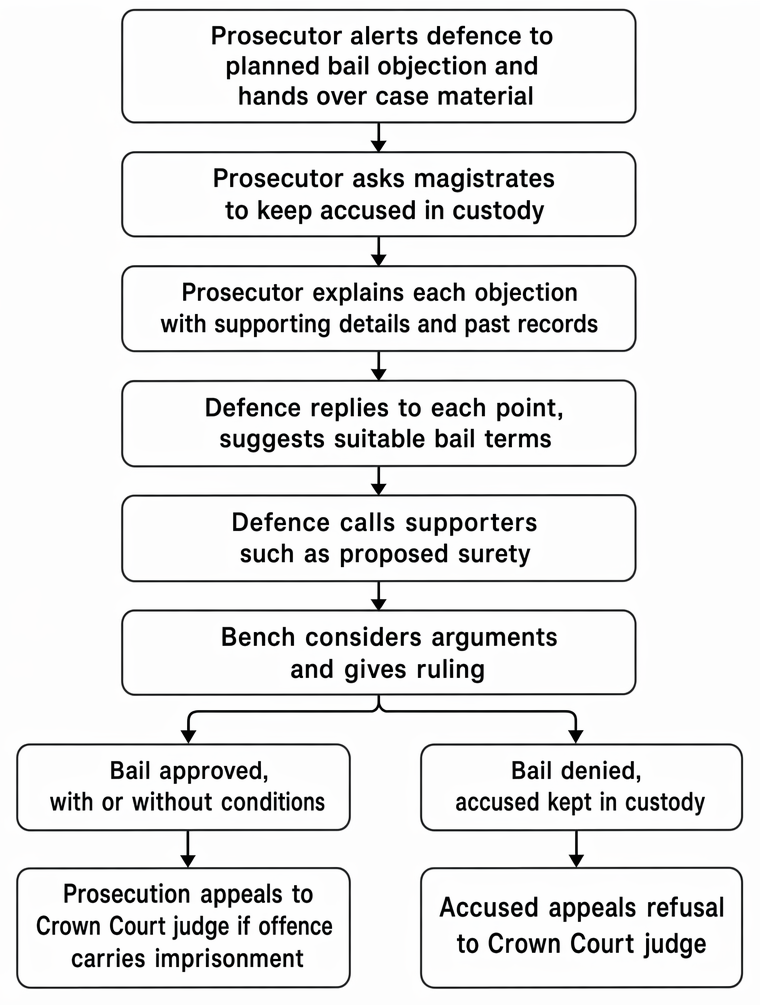
Contested bail applications in the magistrates’ court proceed through prosecution and defence submissions, bench determination, and any Crown Court appeal.
Key Term: bail
Bail is the release of a defendant from custody pending trial or another court hearing, subject to a duty to surrender to court and, if necessary, compliance with conditions.
In practice, at each adjournment the court will decide whether to remand the defendant in custody or remand on bail. This decision operates alongside remand and custody time limit rules, which ensure that cases where a defendant is in custody are progressed expeditiously.
Key Term: remand
Remand is the court’s decision to adjourn a case and determine whether the defendant will be kept in custody until the next hearing or released on bail.Test Tip: In SQE-style questions on Procedure for applying for bail, identify the legal test, the triggering fact, and the consequence before choosing between similar answer options.
Statutory Presumption and Exceptions
The Bail Act 1976 creates a general presumption that a defendant should be granted bail before conviction. This reflects the principle that a person is presumed innocent until proven guilty. However, the presumption operates subject to statutory exceptions.
Key Term: exceptions to bail
Exceptions to bail are statutory grounds that allow the court to refuse bail, such as risk of absconding, committing further offences, or interfering with witnesses.
The main grounds for refusing bail are:
- substantial grounds for believing the defendant would fail to surrender to custody
- substantial grounds for believing the defendant would commit further offences while on bail
- substantial grounds for believing the defendant would interfere with witnesses or obstruct the course of justice
Other exceptions include the need to protect the defendant, insufficient information to make a decision, or the defendant already serving a custodial sentence. The court can also refuse bail where the offence was allegedly committed while already on bail for another matter.
A key limitation applies to the most commonly used exceptions: where the defendant is an adult, has not yet been convicted in the proceedings, and the court considers there is no real prospect of a custodial sentence if convicted, bail should be granted and the core exceptions (including risk of absconding, further offending or interference) are disapplied. This prevents unnecessary pre‑trial custody in lower‑level cases.
In assessing whether “substantial grounds” exist, the Bail Act requires the court to have regard to statutory factors, such as:
- the nature and seriousness of the offence and the probable sentence if convicted
- the defendant’s character, antecedents, associations, and community ties
- the defendant’s record for fulfilling past bail obligations
- the strength of the evidence (where relevant pre‑conviction)
- any other factors appearing to be relevant
A distinct exception deals with harm in domestic or similar contexts:
Key Term: associated person
An associated person includes a spouse or civil partner (current or former), a cohabitant, a relative, or a person with parental ties. Bail can be refused where there are substantial grounds for believing the defendant would commit an offence on bail that would cause, or cause fear of, physical or mental injury to an associated person.
Special exclusions apply to specified serious offences. Where a defendant is charged with, or convicted of, murder, attempted murder, manslaughter, rape or attempted rape and has a previous conviction for one of those offences, bail will only be granted if there are exceptional circumstances. In murder cases specifically, magistrates cannot grant bail; only a Crown Court judge can do so and may only grant bail if satisfied there is no significant risk that the defendant would commit an offence on bail likely to cause physical or mental injury to another person. A Crown Court judge must decide the application promptly (generally within 48 hours, excluding non‑business days).
Worked Example 1.1
Question: A defendant is charged with burglary. He has no fixed address and three previous convictions for failing to surrender to bail. The prosecution objects to bail. What is the likely outcome?
Answer:
The court is likely to refuse bail on the ground that there are substantial grounds for believing the defendant would fail to surrender, given his lack of address and history of absconding. The risk is assessed using the statutory factors; a poor bail record and weak community ties weigh heavily against release.
Conditional Bail
If the court is not satisfied that unconditional bail is appropriate, it may grant bail subject to conditions designed to address specific risks. Conditions must be necessary to manage an identified risk, relevant to the case and defendant, proportionate, and capable of being enforced.
Key Term: conditional bail
Conditional bail is bail granted with requirements attached, such as residence, reporting, or curfew, to reduce risks identified by the court.
Common bail conditions include:
- residence at a specified address (including, in appropriate cases, a bail hostel)
- reporting to a police station at set intervals
- curfew (possibly with electronic monitoring)
- non-contact with named individuals (e.g., witnesses or victims)
- exclusion from specified areas
- surrender of passport or travel documents
- provision of a surety or security
Key Term: surety
A surety is a person who undertakes to ensure the defendant’s surrender to custody and agrees to forfeit a set sum if the defendant absconds. Suitability depends on their financial means, character, and closeness to the defendant. Key Term: security
Security is money or other cleared funds paid into court by or on behalf of the defendant, which will be forfeited if the defendant fails to surrender.
The court must explain why conditions are imposed and ensure that they directly address the risks relied upon. For example, a curfew and electronic tag might be necessary where there is a real risk of night‑time offending; a non‑contact condition will be appropriate where there is concern about interference with witnesses. A surety may be acceptable if they have sufficient means and influence to encourage compliance; the court will usually hear the proposed surety on oath to test suitability.
Worked Example 1.2
Question: A defendant is charged with assault and the prosecution fears he may contact the complainant. What condition could the court impose?
Answer:
The court could impose a condition prohibiting the defendant from contacting the complainant directly or indirectly, and, where necessary, restrict entry to an exclusion zone around the complainant’s home or workplace. These conditions are relevant, necessary, and proportionate to manage witness interference risks.
Procedure for Applying for Bail
When a defendant first appears in court, the issue of bail must be considered. The process is as follows:
- the prosecution states whether it objects to bail and on what grounds, and must provide material relevant to the bail decision (such as previous convictions and bail history)
- the prosecution outlines the facts, any risk factors, and proposed conditions (if bail is opposed only subject to conditions)
- the defence responds, addressing each ground for objection and may propose conditions to mitigate risks
- the court decides whether to grant bail (with or without conditions) or remand the defendant in custody
Bail hearings are necessarily flexible. Rules of evidence are relaxed, and the court may receive information not admissible at trial. Bail decisions are inquisitorial in nature: the court’s role is to ensure it has sufficient material to reach a fair decision.
The presumption in favour of bail is strong, but before remanding a defendant in custody the court should be satisfied that:
- a statutory exception applies on the facts; and
- there is a real prospect of a custodial sentence being imposed if convicted (where the adult, pre‑conviction restriction applies)
Key Term: certificate of full argument
A certificate issued by the court confirming that a fully argued bail application has been heard, required for an appeal against refusal of bail.
If bail is refused or conditions are imposed, the court must give reasons in open court and, if bail is refused, issue a certificate of full argument.
Worked Example 1.3
Question: The prosecution objects to bail on the ground of risk of witness interference. The defence proposes a condition that the defendant not contact any prosecution witnesses. What should the court consider?
Answer:
The court should consider whether the proposed condition is sufficient to address the identified risk and whether it is enforceable (for example, adding an exclusion zone or electronic monitoring if proportionate). If the risk can be managed by conditions, conditional bail should be granted. If the risk cannot be managed, bail may be refused.
Worked Example 1.4
Question: D is charged with grievous bodily harm arising from alleged gang‑related violence. Bail has twice been refused due to risks of further offending and interference. D secures a new address 200 miles away with a relative of good standing. Can D make another application?
Answer:
Yes. After one further full application has been determined, any additional application requires a change of circumstances or new information. A verified, suitable address far from the locus of offending, supported by a responsible resident, is a material change and may justify release on tailored conditions (e.g., residence, exclusion from the original area, reporting).
Further Applications for Bail
If bail is refused, the defendant is entitled to make one further full application at the next hearing. Any subsequent application may only be made if there is a change in circumstances or new information.
Key Term: further application for bail
A renewed application for bail after an initial refusal, permitted only if there is a new argument or change in circumstances.
Examples of a change in circumstances include:
- new evidence relevant to the risks (e.g., prosecution case weakens)
- securing appropriate accommodation
- verified employment or education commitments
- the passage of time where custody time limits and case progress make risks less acute
The court will not rehear the same arguments repeatedly; submissions must identify and explain what has changed and how it affects risk.
Appeals Against Bail Decisions
A defendant refused bail by the magistrates’ court may appeal to a Crown Court judge in chambers. The appeal is a rehearing; the judge may grant or refuse bail and may vary or impose conditions. The application must attach the certificate of full argument and set out the grounds and proposed conditions. Appeals are usually heard promptly, often within 48 hours.
The prosecution may also appeal against the grant of bail for imprisonable offences. This power is used sparingly and must be exercised responsibly. The prosecutor must:
- give oral notice of appeal immediately at the end of the hearing and before the defendant is released
- confirm the appeal in writing (typically within two hours) with reasons
- ensure the appeal is listed as soon as practicable and, in any event, within two business days
Pending determination of the appeal, the defendant will be remanded in custody.
Key Term: bail appeal
An application to a higher court to review a decision to grant or refuse bail.
Worked Example 1.5
Question: The magistrates grant conditional bail to D (an imprisonable either way offence). The prosecutor objects and wishes to appeal. What must be done immediately?
Answer:
The prosecutor must give oral notice of intention to appeal before D’s release, serve written notice promptly (normally within two hours) setting out reasons, and seek to list the appeal within two business days. D will be remanded in custody pending the Crown Court’s rehearing.
Absconding and Breach of Bail Conditions
A defendant who fails to surrender to bail without reasonable cause commits a criminal offence. Failure to surrender is charged under the Bail Act and is separate from the original offence. The court may issue a warrant for arrest; warrants may be backed with bail (allowing police to release after arrest) or not backed (requiring production before a court as soon as practicable). If an arrest occurs after the court has closed on a Friday, a Saturday remand court will usually sit; there are no Sunday court sittings.
Key Term: abscond
To fail to surrender to custody as required by bail, without reasonable excuse.
Sentences for failure to surrender vary according to the court to which the defendant failed to report (up to three months’ imprisonment or a fine in the magistrates’ court; up to 12 months’ imprisonment or an unlimited fine in the Crown Court). Where surety or security has been ordered, failure to surrender may lead to forfeiture.
Breach of bail conditions is not itself an offence, but may result in arrest and reconsideration of bail. Police may arrest without warrant if they reasonably believe the defendant has breached, or is likely to breach, any condition of bail. The defendant must be brought before the court as soon as reasonably practicable and within 24 hours.
On a breach hearing, the court typically proceeds in two stages:
- determine whether a breach occurred (the defence may accept or contest; if contested, brief evidence may be heard)
- if satisfied of a breach, reassess bail and decide whether to remand in custody or grant bail again (possibly with more stringent or different conditions)
The “no real prospect of custody” restriction applies here too: where there is no real prospect of a custodial sentence in the proceedings, the court should not remand an adult defendant in custody pre‑conviction, even after breach, unless another applicable exception allows custody.
Worked Example 1.6
Question: D is on conditional bail with a curfew and exclusion zone. Police arrest D for entering the exclusion zone. What happens next?
Answer:
Breach of conditions permits arrest without warrant. D must be brought before the court within 24 hours. The court will decide whether a breach occurred, then reconsider bail. If the risk can be managed, conditions may be tightened (e.g., electronic monitoring or a wider exclusion zone). If risks cannot be managed, bail may be refused, subject to the “no real prospect of custody” limitation.Exam Warning: If a defendant is refused bail and wishes to appeal, ensure that a certificate of full argument has been issued by the court. Without this, the Crown Court cannot hear the appeal.
Key Point Checklist
This article has covered the following key knowledge points:
- The Bail Act 1976 creates a presumption in favour of bail before conviction.
- The main exceptions to bail are risk of absconding, further offences, or interference with witnesses; the threshold is “substantial grounds”.
- The court must consider statutory factors when deciding whether exceptions apply.
- The “no real prospect of custody” restriction prevents pre‑trial custody for adults in appropriate cases.
- In murder cases, only a Crown Court judge can grant bail and must be satisfied there is no significant risk of injury‑causing offending on bail; in certain homicide/rape cases with previous convictions, bail requires exceptional circumstances.
- The court may impose conditions on bail to address specific risks; conditions must be necessary, proportionate, relevant, and enforceable.
- The procedure for applying for bail involves prosecution objections, defence responses, and a judicial decision; reasons must be given, and a certificate of full argument issued if bail is refused.
- One further full bail application may be made; thereafter, additional applications require a change of circumstances or new information.
- Defence appeals against refusal and prosecution appeals against grant are possible; both have specific procedural requirements and tight timeframes.
- Failure to surrender to bail is a criminal offence; breach of bail conditions is not an offence but permits arrest and reconsideration of bail.
Key Terms and Concepts
- bail
- remand
- exceptions to bail
- associated person
- conditional bail
- surety
- security
- certificate of full argument
- further application for bail
- bail appeal
- abscond