Learning Outcomes
This article examines the fundamental doctrines, statutory provisions, and procedural rules governing bail applications in criminal litigation under the Bail Act 1976. It covers the core principles forming the right to bail, the statutory purposes and structure of bail, and the exceptions and exclusions that limit the presumption in favour of bail. It details the preconditions and legal framework for refusing bail, the relevant considerations and grounds for conditional and unconditional release, and alignment with the European Convention on Human Rights (ECHR), particularly Article 5 and Article 6. It presents the 'substantial grounds' threshold for refusal, the 'real prospect of custody' restriction, and the Schedule 1 para 9 factors relevant to risk and release decisions. It reviews conditional bail — when and how conditions can be lawfully imposed — with practical examples of common conditions and their relationship to specific risks. It analyzes procedural aspects, clarifying the structure, order, and permissible scope of full and subsequent bail applications in the Magistrates’ and Crown Courts, the rights of appeal, and the requirements in respect of giving reasons and certificates of full argument. It outlines the consequences of absconding or breaching bail conditions, as well as differences in treatment between pre- and post-conviction stages and across offence categories. It introduces practical scenarios and worked examples that demonstrate how to interpret complex fact patterns and apply relevant statutory and judge-made law to bail decisions, ensuring alignment with current practice and law for SQE1.
SQE1 Syllabus
For SQE1, you are required to understand bail applications under the Bail Act 1976, with a focus on the following syllabus points:
-
The general right to bail under the Bail Act 1976 and its interaction with ECHR Article 5 (right to liberty) and Article 6 (right to a fair trial).
-
The scope and extent of the presumption in favour of bail, including procedural application and the status of the presumption at different stages in proceedings (pre- and post-conviction, on appeals and committals for sentence).
-
The main exceptions to the right to bail as detailed in the Bail Act 1976, Schedule 1, Parts 1–3 (imprisonable offences, non-imprisonable offences, and summary offences), including:
- Substantial grounds for believing the defendant would fail to surrender, commit further offences, or interfere with witnesses or obstruct justice.
- Ancillary exceptions: defendant already on bail, needing custody for own protection, re-arrest for absconding, inability to obtain adequate information, or already serving a custodial sentence.
- 'No real prospect of custody' limitation on refusing bail to unconvicted adults.
-
The scope of judicial discretion to impose conditional or unconditional bail, and the legal test for imposing conditions.
-
The statutory criteria and factors which must be considered when determining bail (Sch 1, para 9), such as the seriousness of the offence, defendant’s antecedents, community ties, character, previous bail record, and the strength of evidence.
-
The use and review of bail conditions, including:
- Types of common conditions (residence, reporting, curfew, non-contact, exclusion zones, surety, security, passport surrender).
- The principles of necessity and proportionality.
-
The procedure for making, opposing, and reviewing bail applications, and requirements for giving full reasons and certificates of argument.
-
Rights and limits on renewed applications and appeals — routes to the Crown Court, the mechanics and procedural steps for both defence and prosecution appeals.
-
The consequences and legal ramifications of non-compliance (absconding, failure to surrender, and breach of bail conditions), including criminal liability, arrest powers, and reconsideration of bail.
-
The alignment of bail practice with principles of professional conduct and the duty not to mislead the court.
Test Your Knowledge
Attempt these questions before reading this article. If you find some difficult or cannot remember the answers, look more closely at that area during your revision.
-
Under the Bail Act 1976, what is the general presumption regarding bail for a defendant awaiting trial?
- a) Bail should always be refused for serious offences.
- b) Bail should be granted unless specific exceptions apply.
- c) Bail is only granted if the defendant can provide a surety.
- d) Bail is entirely at the court's discretion with no initial presumption.
-
Which of the following is NOT a primary ground listed in Schedule 1, Part 1, para 2 of the Bail Act 1976 for refusing bail based on 'substantial grounds'?
- a) Believing the defendant would fail to surrender to custody.
- b) Believing the defendant would commit an offence while on bail.
- c) Believing the defendant would interfere with witnesses.
- d) Believing the defendant is likely to plead guilty at trial.
-
A court imposes a condition that a defendant must reside at a specific address while on bail. What risk is this condition primarily aimed at mitigating?
- a) Interference with witnesses.
- b) Committing further offences.
- c) Failing to surrender to custody.
- d) Obstructing the course of justice.
Introduction
When a person is charged with a criminal offence, their first contact with the court occurs at the magistrates’ court. If the case is not capable of immediate disposal, the court must decide if the defendant should be remanded in custody or released pending future hearings. This decision engages both statutory and human rights considerations. The Bail Act 1976 provides a foundational presumption in favour of bail for persons accused of an offence, reflecting the principle of innocence until proven guilty and the protection of the right to liberty pursuant to ECHR Article 5.
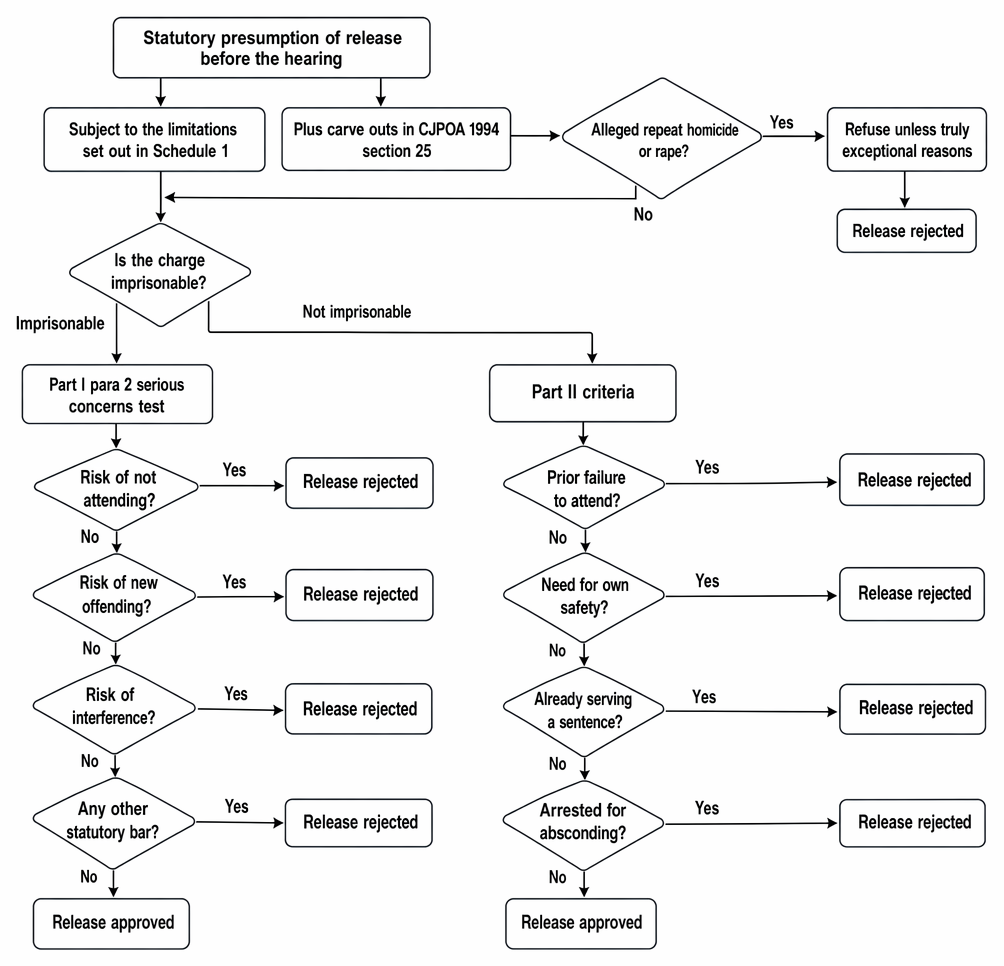
The statutory presumption of bail before trial, the Schedule 1 refusal criteria, and the s 25 CJPOA 1994 exclusion are summarised.
Key Term: Bail
The release of a person subject to a binding obligation to return to custody at a specified time and place. Bail may be granted either unconditionally or subject to a range of possible conditions, all intended to secure the proper administration of justice and public safety.
This right, however, is not absolute. The presumption in favour of bail is displaced or limited by both the statutory exceptions under the Bail Act 1976 and the further restrictions on certain offence categories and procedural stages. The full procedural context includes alignment with ECHR Article 5 (right to liberty) and Article 6 (right to a fair trial), as well as the duty on the courts to ensure non-arbitrary detention. Courts must balance the defendant’s rights with risks to public safety, interference with the process of justice, and risks to vulnerable parties. The structure and grounds of bail decisions, the framework for conditional bail, and the approach to remands and appeals form a critical part of criminal litigation practice.
Test Tip: In SQE-style questions on Right to bail and exceptions, identify the legal test, the triggering fact, and the consequence before choosing between similar answer options.
The General Right to Bail
Section 4(1) of the Bail Act 1976 establishes a general right to bail for persons accused of an offence. This statutory presumption is central in the English criminal justice system and must be applied unless one of the exception grounds in Schedule 1 applies. The presumption is retained except in specifically defined circumstances, such as:
- Defendants convicted and committed to the Crown Court for sentence.
- Appeals against conviction or sentence where the primary avenue is by way of case stated or to the Crown Court.
- Certain serious offences, where past convictions for specified crimes (murder, manslaughter, rape, attempted murder, attempted rape) are present.
- Cases involving homicide or sexual offences, where additional statutory restrictions apply.
The general right to bail persists at several junctures in criminal proceedings, including pre-trial hearings, during the period between conviction and sentence (where sentence is not passed immediately), and in proceedings prior to conviction for most offences. Defendants who plead or are found guilty but require reports before sentence also usually retain the right to bail.
The rationale for the presumption in favour of bail includes ensuring that pre-trial detention is used only as a last resort, upholding the right to liberty, and ensuring that those merely accused — not convicted — are only deprived of liberty where strictly necessary.
Exceptions to the Right to Bail
The presumption in favour of bail may be displaced where statutory exceptions under the Bail Act 1976, Schedule 1, apply. Schedule 1, Part 1, applies to imprisonable offences and details the main exceptions to the right to bail for both adult and youth defendants. The most common and significant 'statutory exceptions' require the court to be satisfied that there are substantial grounds for believing that, if released on bail (unconditionally or with conditions), the defendant would:
- Fail to surrender to custody (i.e., abscond).
- Commit an offence while on bail.
- Interfere with witnesses or otherwise obstruct the course of justice.
Key Term: Substantial Grounds
A rigorous and evidence-based threshold, requiring more than theoretical or speculative risk. The court must have rational and justifiable reasons, based on evidence or information available, to believe that the relevant risk — such as absconding, reoffending, or interfering with witnesses — is real and significant.
Other exceptions include, but are not limited to:
- The defendant being on bail for another offence at the time of alleged commission (para 2A).
- Maintaining custody for the defendant’s own protection (para 3), or, for youths, for welfare reasons.
- Sufficient information is unavailable due to shortness of time since proceedings began, or necessary inquiries or reports cannot be completed (para 5).
- The defendant is already serving a custodial sentence.
- The defendant has been arrested for failure to surrender to custody or for breaching bail (para 6).
- Substantial grounds for believing the defendant would commit an offence causing (or putting another in fear of) injury to an “associated person” (domestic violence context) (para 2ZA).
Key Term: Associated Person
Someone who has an intimate or familial link to the defendant, such as a current or former spouse, cohabitant, partner, parent or person with parental responsibility.
- In relation to summary only or non-imprisonable offences (Schedule 1, Parts 2 and 3), there is a still more limited set of bail exceptions. Generally, fewer grounds are available for denying bail in such cases, unless there is evidence of prior like offending or specific aggravating circumstances.
Exclusions to the Presumption
The presumption in favour of bail does not apply in some specific and limited situations, which are termed exclusions rather than exceptions. For example:
- Where a defendant appeals to the Crown Court or High Court following conviction or sentence in the magistrates’ court, or is committed to the Crown Court for sentence — in which case bail is at the discretion of the appellate or sentencing court and not presumed.
- Defendants charged with or convicted of murder, attempted murder, manslaughter, or rape, who have a previous conviction for the same or a related schedule offence — bail is only to be granted in exceptional circumstances.
- For homicide and specified sexual offences, only the Crown Court can grant bail, and only if satisfied there is no significant risk of serious harm to others.
Restriction: The ‘No Real Prospect’ Test
Section 1A of Schedule 1 importantly restricts the ambit of some exceptions (notably risk of absconding, further offences, or interference — paras 2, 2A, and 6) in relation to unconvicted adult defendants. If:
- the defendant is aged 18 or over,
- has not been convicted in those proceedings, and
- the court determines there is no real prospect of the defendant receiving a custodial sentence upon conviction, then the exceptions above do not apply and the general right to bail remains.
Key Term: Real Prospect
The real likelihood, on the facts and likely outcome of the proceedings, that a custodial sentence will be imposed upon conviction. The court must carefully consider sentencing guidelines and individual mitigation. For minor offences lacking aggravating features, with strong personal mitigation, the ‘no real prospect’ test may be satisfied and pre-trial detention is not to be used.
The operation of this restriction means that for infrequent or less serious offending, the presumption in favour of bail is especially robust.
Factors Considered by the Court (Schedule 1, Para 9 Factors)
In determining whether any statutory risk justifying the refusal of bail exists, the court must consider all matters relevant to the risk of absconding, committing further offences, or interfering with justice. These factors, detailed in para 9 of Schedule 1, include:
- The nature and seriousness of the offence and its likely disposal.
- Defendant’s character, antecedents (including previous convictions), associations (including criminal or anti-social peer groups) and community ties.
- Record of compliance with past bail or reporting obligations.
- Strength and quality of the evidence against the accused, which may affect the risk of absconding.
- Any history of harm or risk posed to associated persons, particularly in domestic settings.
- The likelihood of the defendant’s circumstances changing (such as job loss or new family ties which strengthen or weaken the risk profile).
The decision must take a complete view of all relevant information. The court is obliged to give proper reasons for their decision, with explicit reference to the relevant statutory factors.
Worked Example 1.1
David is charged with theft (an either-way offence). He has several previous convictions for theft, all committed recently to fund a drug habit. The prosecution objects to bail. On what grounds can the objection be made, and which statutory factors are relevant?
Answer:
The prosecution will object to bail under Sch 1, Pt 1, para 2(1)(b), arguing there are substantial grounds for believing David would commit further offences if released. The factors they would rely on include David’s antecedents (recent similar convictions), the seriousness of the present offence, and any ongoing associations or lifestyle factors suggesting a continuing risk of further offending. The fact that David’s drug habit is unresolved that may increase the perceived risk.
Legal Principles from the ECHR
English law on bail operates within the framework of the European Convention on Human Rights. Notably:
- Article 5 (Right to Liberty): Guarantees that no one shall be deprived of liberty except in strictly defined circumstances, including lawful detention for bringing a person before the competent legal authority on reasonable suspicion of having committed an offence. Pre-trial detention must be based on specific, clear and justified grounds, and continued detention must be the exception, not the rule.
- Article 6 (Right to a Fair Trial): Imposes obligations of fairness and equality of arms, and requires courts to give reasons for decisions affecting fundamental rights, including liberty on remand.
Exam Warning: For a lawful refusal of bail, the court must identify substantial grounds supported by robust evidence. Mere suspicion or surmise is not enough. Inadequate reasoning, or a failure to consider whether conditions could sufficiently address risks, may render a decision open to challenge on appeal or review.
Conditional Bail
The court may grant conditional bail where unconditional release may create risks that do not, however, justify outright refusal of bail. The imposition of conditions operates as a less restrictive alternative to immediate detention and must comply with the necessity and proportionality principles.
Key Term: Conditional Bail
The release of a person from custody subject to legal requirements (conditions) which may include geographical, behavioural or financial restrictions, imposed to address specific risks identified under the Bail Act.
Lawful Bail Conditions
The court may only impose conditions to:
- Prevent failure to surrender to custody.
- Prevent commission of further offences.
- Prevent interference with witnesses or the administration of justice.
- Ensure the defendant makes themselves available for reports or inquiries, or, for their own protection or welfare (especially in the case of children and vulnerable adults).
Statute and case law support the necessity and proportionality of conditions: the court must select the minimum level of interference required to address the identified risk and justify each condition. Indiscriminate or excessive use of restrictive conditions may render a bail decision unlawful or open to challenge.
Common bail conditions include:
- Residence at a specified address: Ensures a fixed location for monitoring and reducing absconding risk.
- Curfew: Requires the defendant to be at a specific address at designated times, sometimes with electronic monitoring.
- Regular reporting to police: Ensures frequent contact to reduce the risk of failure to surrender.
- Non-contact or association: Prevents direct or indirect contact with named persons — commonly used to prevent interference with witnesses or associated persons.
- Exclusion from specified areas (Exclusion zones): Prohibits entry into specified locations relevant to the alleged offence or to victims/witnesses.
- Surety: A financial guarantee by a third party (the surety) to ensure compliance; if the defendant absconds, the surety stands to lose the pledged sum.
- Security: A sum of money or property paid into court, returned if the defendant surrenders as required.
- Passport surrender: To prevent the risk of absconding overseas.
- Attendance at appointments: May require compliance with reporting or assessment schedules for pre-sentence or medical reports.
These conditions are tailored to the risks identified in an individual case and must be necessary and proportionate.
Further Guidance on Surety and Security
A surety is someone who guarantees that the defendant will surrender to custody at the appointed time. The surety must demonstrate sufficient means and be sufficiently close to the defendant to exert real influence. A security is a sum of money or property lodged with the court, which will be forfeit if the defendant absconds.
Courts may combine multiple conditions if necessary. They have no power to require a defendant to provide both a surety and a security unless justified by distinct risk factors.
Worked Example 1.2
Maria is charged with assaulting her neighbour. The prosecution objects to bail, claiming Maria may interfere with the neighbour, who is the main witness. Maria has no criminal record and strong community ties. What is the likely outcome?
Answer:
Although there may be concern that Maria would interfere with the witness, the court must consider whether suitable conditions could effectively mitigate the risk short of refusing bail. A non-contact condition coupled with an exclusion zone could be imposed to protect the witness and ensure compliance, in line with the court’s duty to consider proportionality and effectiveness of conditional bail. Unconditional refusal would be disproportionate absent more serious risk factors.
Practical Considerations for Imposing and Monitoring Conditions
Breach of a bail condition does not itself amount to a separate criminal offence, but it may trigger powers of arrest and form the basis for reconsidering the terms of bail, or for remanding the defendant in custody. The imposition and monitoring of strict, intrusive bail conditions must be justified by the particular facts, and excessive or unnecessary conditions should be avoided.
Procedure and Further Applications
The process of applying for bail is procedurally detail-oriented and governed by both statute and the Criminal Procedure Rules 2020. The bail application hearing is inquisitorial, allowing the court to gather and test information from both prosecution and defence. Substantive rules of evidence are relaxed in favour of speed and efficiency, but the court must reach a reasoned and justified decision.
- The prosecution presents the facts and any objections to bail, specifying the particular grounds of Schedule 1 relied upon and the statutory factors in play.
- The defence is then permitted to challenge these objections, submit evidence regarding the defendant’s ties, prospects, character, or other relevant facts, and may propose conditions to address the risks raised.
- If bail is refused, the court must give clear and sufficient reasons, referencing the relevant statutory criteria.
Key Term: Certificate of Full Argument
A formal memorandum issued by the magistrates’ court, confirming that a fully argued application has been heard. This is a necessary prerequisite to certain appeals against refusal of bail.
Rights on further applications
After an initial bail refusal, the defendant is usually entitled to one further full bail application, unless new circumstances arise or there are additional grounds which have not already been considered.
In further applications, the court may refuse to entertain arguments and evidence which have already been presented unless there is a genuine change of circumstances (such as new evidence, changes in risk, or substantial developments in the case).
A defendant refused bail may appeal to the Crown Court, which conducts a full rehearing. The prosecution also has rights of appeal (see below), but only in respect of certain decisions and offence categories.
Worked Example 1.3
A defendant appears at the magistrates’ court charged with wounding with intent (an indictable-only offence). The prosecution objects that the defendant may interfere with prosecution witnesses. The magistrates refuse bail on these grounds. What is the defendant’s right in this situation?
Answer:
The defendant has the right to a full and reasoned bail application at their first appearance (whether at the initial hearing or soon after if remanded). If bail is refused, the defendant may make one further full application at the next hearing or appeal to the Crown Court for a rehearing. The court must provide a certificate of full argument, which is required for any subsequent appeal. Absent a change in circumstances, further applications in the magistrates’ court may be refused.
Legal Representation and Conduct Principles
Defence solicitors advising on bail applications must consider both procedural and ethical duties. Professional rules require not misleading the court and not advancing speculative or frivolous bail arguments. If a defendant admits guilt to the solicitor but insists on a bail application, the solicitor must act within the limits of the duty to the court.
Appeals in Bail Applications
Defence Appeals: If refused bail by the magistrates’ court, a defendant may appeal to the Crown Court. This is by written application, supported by the certificate of full argument. The appeal should be heard promptly (typically within 48 hours), and the Crown Court judge will rehear the application de novo, allowing fresh argument and evidence.
Prosecution Appeals: The prosecution has a right of appeal against the grant of bail only in relation to imprisonable offences, and subject to strict notice and timeliness requirements. The prosecution must immediately notify the court orally of its intention to appeal and then serve a formal written notice with reasons. The defendant is usually remanded in custody until the determination of the appeal.
For especially serious offences (such as murder and associated homicide or sexual offences), statutory restrictions strictly limit the granting of bail. In such cases, only a Crown Court judge can grant bail — and then only if satisfied that there is no significant risk of further offence.
In the most serious cases, an unsuccessful bail application before the magistrates’ court must be sent forthwith to the Crown Court. The relevant judge must consider the application as soon as practicable, typically within two business days, excluding weekends and holidays.
Absconding and Breaching Bail Conditions
Failing to Surrender (Absconding)
Key Term: Abscond
The failure of a person released on bail to attend court at the specified time and place, without reasonable excuse. It is a criminal offence under s 6 of the Bail Act 1976.
Where a defendant fails to surrender to custody, the court may issue an arrest warrant. Absconding attracts further criminal liability, and — especially if repeated — will weigh heavily against any future bail application. A previous failure to surrender is always a material and adverse factor in subsequent bail decisions and may result in more restrictive bail or outright custody.
Where the defendant had a reasonable cause for non-attendance (e.g. hospitalisation or other unavoidable emergency), they must surrender as soon as is practicable and the onus is on the defendant to prove the excuse.
Sanctions for absconding:
- In the magistrates’ court: up to three months’ imprisonment and/or a fine.
- In the Crown Court: up to 12 months’ imprisonment and/or an unlimited fine.
Breaching Bail Conditions
Breach of a bail condition (other than failing to surrender) does not amount to a criminal offence but triggers police powers for immediate arrest without warrant. The defendant must then be brought before a court (usually within 24 hours), at which the court will determine whether or not there was a breach and whether bail should be revoked, left unchanged, or made more stringent.
Where the same risk persists, or where it is shown that the defendant cannot be managed at liberty or is likely to re-offend or interfere with justice, the court may remand in custody.
Worked Example 1.4
Ben is on bail with a condition not to contact prosecution witnesses. He sends a text message to a key witness telling them to “forget what they saw”. The witness informs the police, who arrest Ben. What outcome is likely?
Answer:
The police have grounds to believe Ben breached his bail condition. Upon arrest, Ben must be brought before the magistrates’ court. The court, finding a deliberate interference with a witness, is likely to revoke bail and remand Ben to custody, as the original concern is now clearly substantiated.
Consequences
- Sureties/security may be forfeited where a defendant absconds or seriously breaches bail.
- Repeated breaches, or a demonstrated inability or refusal to comply with conditions, make further bail less likely. Courts routinely treat repeated non-compliance as evidence that only custody suffices to address the risks.
Key Point Checklist
This article has covered the following key knowledge points:
- Defendants are presumed to have a right to bail under s 4 of the Bail Act 1976, unless exclusions or statutory exceptions apply.
- Exclusions apply to certain post-conviction and appeal stages, as well as serious cases with previous convictions for homicide or sexual offending.
- Bail can be refused under Schedule 1 BA 1976 if there are substantial grounds for believing the defendant would fail to surrender, commit further offences, or interfere with justice.
- Ancillary exceptions include the defendant’s need for custody for their own protection, being already on a custodial sentence, inability to obtain sufficient information, or arrest for prior bail breach or absconding.
- The 'no real prospect of custody' restriction means that pre-trial detention cannot be used unless a custodial sentence is a realistic likely outcome.
- Courts must consider all Schedule 1 para 9 factors, including the seriousness of the offence, defendant’s prior record, associations, community ties, and the evidence strength.
- Conditional bail may be imposed where concerns can be sufficiently addressed through appropriately tailored conditions — these must be necessary and proportionate.
- Usual bail conditions include residence, curfew, excluded locations, non-contact, regular reporting, surety/security, and passport surrender.
- Further and repeat bail applications are procedurally limited and typically only progress if substantive new circumstances arise; otherwise, appeal to the Crown Court is the recourse.
- Absconding is a criminal offence; breaching bail conditions is not, but can lead to arrest, remand in custody, and forfeiture of sureties/security.
- All bail decisions must comply with ECHR principles and Criminal Procedure Rules, and must be taken with consideration of legal professional conduct and the need for full, reasoned decisions.
Key Terms and Concepts
- Bail
- Substantial Grounds
- Real Prospect
- Conditional Bail
- Certificate of Full Argument
- Abscond
- Associated Person