Learning Outcomes
After reading this article, you will be able to explain how substantive procedures are linked to audit objectives and assertions. You will learn how to construct audit programmes that address specific objectives, select relevant substantive procedures for different financial statement areas, and demonstrate your understanding through unique exam-style examples. This knowledge is directly tested in ACCA Foundations in Audit (FAU) assessments.
ACCA Foundations in Audit (FAU) Syllabus
For ACCA Foundations in Audit (FAU), you are required to understand how substantive procedures support audit objectives. In particular, this article covers:
- The purpose and nature of substantive procedures in the audit process
- The relationship between audit programmes and specific audit objectives or assertions
- How to develop substantive procedures that address key assertions in different financial statement areas
- Examples of audit programmes for key balances such as inventory, non-current assets, receivables, payables, and bank
- The need to document and justify the link between procedures and objectives in the audit file
Test Your Knowledge
Attempt these questions before reading this article. If you find some difficult or cannot remember the answers, look more closely at that area during your revision.
- What is the main reason for developing an audit programme for each financial statement area?
- Which assertion is addressed when an auditor selects a sample of receivables and confirms balances with customers?
- True or false? All substantive procedures for one account are designed to achieve the same audit assertion.
- State two common substantive procedures that help confirm the valuation assertion for inventory.
Introduction
Designing effective audit programmes forms the backbone of the substantive testing phase in any audit. Substantive procedures are conducted to obtain direct evidence about financial statement assertions such as existence, completeness, accuracy, rights and obligations, and valuation. Each procedure must clearly link back to a specific audit objective or assertion, ensuring that the auditor's work is both efficient and sufficient to support the audit opinion.
What are Substantive Procedures?
Substantive procedures are audit tests performed to detect material misstatements at the assertion level. They allow the auditor to obtain direct evidence about financial statement balances and transactions.
Key Term: substantive procedures
Audit procedures designed to detect material misstatements at the assertion level by testing classes of transactions, account balances, and disclosures. Key Term: audit programme
A documented set of instructions detailing the nature, timing, and extent of audit procedures to be performed for a specific area.
Linking Substantive Procedures to Audit Objectives
Each financial statement item is subject to different audit objectives, usually framed as assertions. For each area—such as inventory, receivables, or bank—the auditor must identify which assertions are most at risk of material misstatement. The audit programme then outlines substantive procedures directly aimed at confirming or refuting those assertions.
Key Term: assertion
A statement about a transaction, balance, or disclosure made by management, which the auditor seeks to test. Examples include existence, completeness, and valuation.
Why Link Audit Programmes to Objectives?
Aligning each substantive procedure to a specific assertion or objective serves these purposes:
- Guides the auditor to design appropriate and sufficient work
- Provides a clear rationale for the inclusion of each test in the audit file
- Facilitates efficient use of audit resources by focusing on risk areas
- Supports professional judgement when forming conclusions
How to Construct an Effective Audit Programme
A typical audit programme for a financial statement area includes:
- Stating the audit objectives or assertions for that area
- Listing substantive procedures, each clearly linked to an assertion
- Specifying the sample size, source documents, and expected results
- Including space for documenting results, exceptions, and reviewer comments
Each substantive procedure within the programme should serve a direct purpose in gathering evidence for one or more assertions.
Examples of Linking Substantive Procedures to Objectives
The following table provides sample links between common procedures and their related assertions:
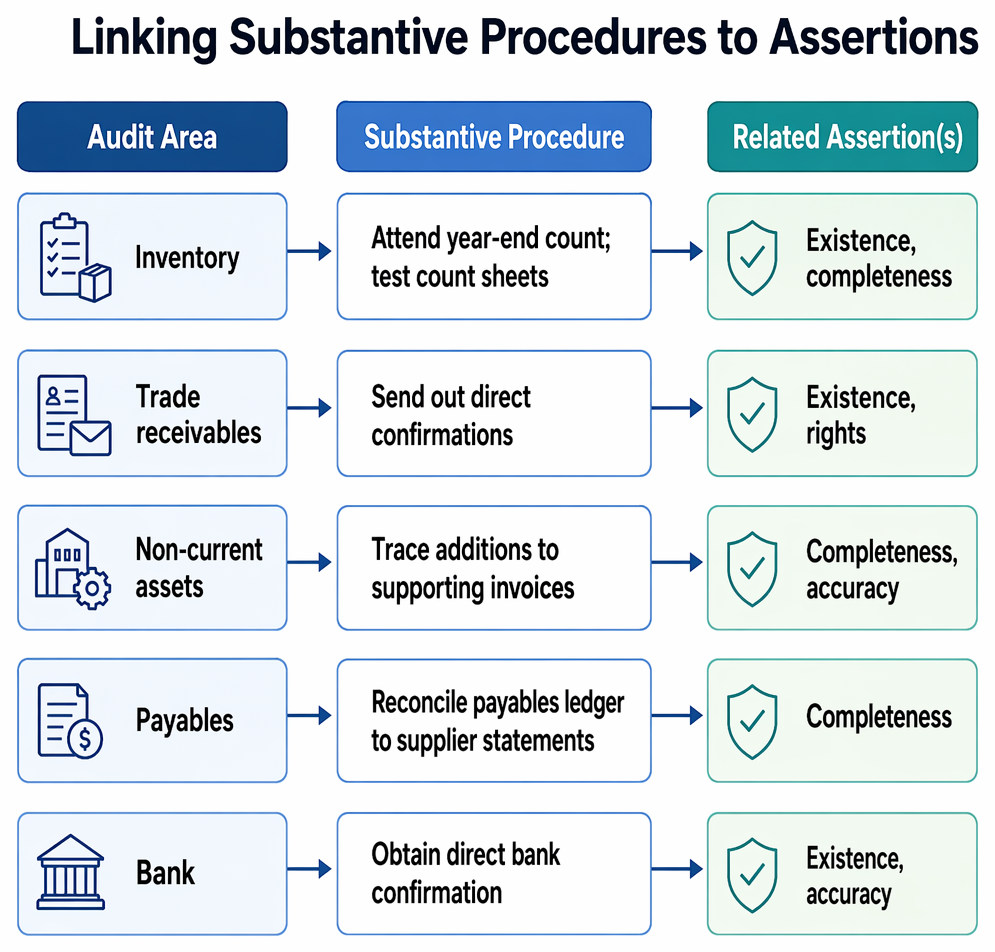
Audit assertions are mapped to substantive tests, including receivable confirmations, unrecorded liability searches, inventory valuation testing, title inspection, and recalculation.
| Audit Area | Substantive Procedure | Related Assertion(s) |
|---|---|---|
| Inventory | Attend year-end count; test count sheets | Existence, completeness |
| Trade receivables | Send out direct confirmations | Existence, rights |
| Non-current assets | Trace additions to supporting invoices | Completeness, accuracy |
| Payables | Reconcile payables ledger to supplier statements | Completeness |
| Bank | Obtain direct bank confirmation | Existence, accuracy |
Worked Example 1.1
Question: You are planning the audit of Z Ltd's year-end receivables. The assertion of existence is considered high risk. What substantive procedures should you include in your audit programme, and how do they address the audit objective?
Answer:
- Procedure: Select a sample of trade receivables and send confirmation letters directly to customers.
- Objective addressed: Existence – This procedure obtains third-party evidence that the balance recorded is actually due from a real customer at the reporting date.
- Procedure: Review subsequent cash receipts after year end for selected receivable balances.
- Objective addressed: Existence and rights – This confirms that the balances are collectible and that Z Ltd holds the rights to the amounts.
Worked Example 1.2
Question: An audit client, Smartgear, has significant inventory at year end. You are concerned about the valuation of this inventory. Which procedures should be in your audit programme, and which assertion does each one address?
Answer:
- Procedure: Select inventory items from count sheets and trace to recent purchase invoices to establish cost.
- Objective addressed: Valuation – Confirms that the inventory is recorded at the correct cost.
- Procedure: Examine after-date sales invoices to determine net realisable value for items with slow movement.
- Objective addressed: Valuation – Confirms that inventory is recorded at the lower of cost and net realisable value.
Worked Example 1.3
Question: The audit senior assigns you to test the completeness of trade payables for ABC Ltd. What specific substantive procedures would you perform, and why?
Answer:
- Procedure: Review post year-end payments and trace them to supporting invoices, ensuring liabilities existing at year end were recorded.
- Objective addressed: Completeness – Detects liabilities that were not recorded before the reporting date.
- Procedure: Compare the total of supplier statements to the payables listing and investigate differences.
- Objective addressed: Completeness – Helps identify omitted payables.
Exam Warning: It is a frequent exam error to link all procedures for a balance to the same assertion. Always identify the specific assertion tested by each procedure, e.g., confirmations test existence, not valuation.
Revision Tip: When constructing or reviewing an audit programme, write next to each procedure the related assertion (e.g., "existence," "valuation") to stay focused and avoid generic testing.
Summary
Effective substantive testing relies on structured audit programmes, each procedure clearly tied to relevant audit objectives or assertions. This approach increases audit efficiency, strengthens evidence for conclusions, and is an expected exam skill.
Key Point Checklist
This article has covered the following key knowledge points:
- Define substantive procedures and audit programmes
- State the relationship between audit programmes, substantive procedures, and audit objectives
- Explain the importance of linking each substantive procedure to a specific assertion
- Illustrate linking procedures to objectives for key financial statement areas (inventory, receivables, etc.)
- Recognise the risks of generic or unfocused testing
- Apply the linkage principle through unique, exam-relevant examples
Key Terms and Concepts
- substantive procedures
- audit programme
- assertion