Learning Outcomes
After reviewing this article, you will be able to describe the substantive procedures required for auditing inventory. You will be able to explain how auditors verify inventory existence, valuation, completeness, and rights, and understand the steps for attending inventory counts and testing valuation. This article will prepare you to approach inventory audit questions in the ACCA FAU exam with confidence and clarity.
ACCA Foundations in Audit (FAU) Syllabus
For ACCA Foundations in Audit (FAU), you are required to understand how auditors obtain and evaluate evidence relating to inventory balances in the financial statements. Inventory is a high-risk and material area for many audits. This article addresses the following syllabus points:
- The importance of substantive procedures as applied to inventory
- How auditors verify the existence and completeness of inventory quantities at year end
- Procedures for attending inventory counts and reviewing clients’ count instructions
- Audit work on inventory valuation, including testing cost and net realisable value
- Evaluating risks unique to inventory, such as obsolescence and cut-off errors
- Verification of rights and obligations over inventory holdings
Test Your Knowledge
Attempt these questions before reading this article. If you find some difficult or cannot remember the answers, look more closely at that area during your revision.
-
Which assertion is directly tested when an auditor attends a client’s year-end inventory count?
- a) Rights and obligations
- b) Existence
- c) Accuracy
- d) Classification
-
What audit procedure best confirms the cost of raw materials in inventory?
- a) Inspecting purchase invoices
- b) Observing the inventory count
- c) Reviewing after-date sales invoices
- d) Analytical procedures
-
True or false? The primary responsibility for arranging and running the inventory count lies with the auditor.
-
List two audit procedures used to check for inventory obsolescence.
Introduction
Inventory is a key element of the financial statements of many entities. Its valuation impacts both the statement of financial position and reported profits. For this reason, auditing inventory is often considered a high-risk area. Substantive procedures for inventory audit focus on obtaining sufficient, appropriate evidence that inventory quantities exist, are owned by the entity, are complete, and are properly valued at the lower of cost and net realisable value.
Key Term: substantive procedure
An audit procedure designed to detect material misstatements at the assertion level, including tests of details and substantive analytical procedures.Test Tip: When revising Procedures for inventory audit, connect each definition, method, or rule to the kind of question the assessment is likely to ask.
Substantive Procedures for Inventory Audit
Substantive procedures address the risk that inventory figures may be misstated in the financial statements. These procedures are performed after considering the adequacy of internal controls and are designed to obtain direct evidence about inventory assertions.
Key Assertions for Inventory
For inventory balances, the main assertions to be verified are:
- Existence: Inventory physically exists at the reporting date.
- Completeness: All inventories owned are recorded.
- Valuation: Inventory is recorded at the lower of cost and net realisable value.
- Rights and Obligations: Inventory belongs to the entity and is not held for or by third parties.
- Cut-off: Transactions around year end are recorded in the correct period.
Key Term: assertion
A representation by management—explicit or implicit—which relates to recognition, measurement, presentation, and disclosure of items in the financial statements.
Auditor Attendance at Inventory Count
Attendance at the client’s physical count is a key substantive procedure where inventory is material.
Auditor’s Objectives at the Count
When attending the count, the auditor is NOT responsible for counting inventory, but for:
- Observing whether the count procedures are properly followed
- Performing sample test counts
- Recording details of any damaged, slow-moving, or obsolete items
- Ensuring proper identification of inventory belonging to and held by the entity
- Checking that completed count sheets are controlled and reconciled
Key Term: test count
The act of the auditor independently counting a selection of inventory items to confirm the accuracy of the client’s recorded quantities.
Key Steps Before, During, and After the Count
Before the Count:
- Review the client’s count instructions for clarity and adequacy
- Identify locations to be visited and high-value or problem items
- Arrange for adequate staffing to attend all sites if needed
During the Count:
- Observe the count process and note compliance with procedures
- Perform test counts from floor to count sheet (completeness) and from sheet to floor (existence)
- Record notable issues (e.g., goods set aside, items not counted, damaged/obsolete stock)
- Query any inventory held for third parties or by the client at external locations
After the Count:
- Follow up recorded test counts to final inventory summaries
- Ensure all count sheets and adjustments are included in final inventory records
- Review final reconciliations of book and physical balances
- Ensure cut-off procedures are correct by noting the last goods received and despatched numbers
Key Term: cut-off test
A substantive procedure designed to ensure that transactions are recorded in the correct accounting period, especially around year end.
Audit Procedures for Inventory Valuation
The auditor must obtain evidence that inventory is valued in line with applicable financial reporting standards—usually the lower of cost and net realisable value.
Confirming Cost
For raw materials and goods for resale:
- Agree a sample of unit costs to recent purchase invoices
- Check calculations for arithmetical accuracy
For work-in-progress and finished goods:
- Review cost build-up including materials, labour, and overheads
- Confirm the basis of overhead allocation is reasonable and consistent with previous periods
Assessing Net Realisable Value (NRV)
- Review after-date sales to check if net selling price covers cost
- Discuss with management any aged or slow-moving items
- Inspect inventory for signs of obsolescence or physical damage—determine if such goods are valued appropriately
Obsolete and Slow-Moving Inventory
- Obtain a list of aged inventory from management
- Inquire about plans for disposal or price reductions
- Ensure necessary write-downs are made where NRV is below cost
Key Term: net realisable value
The estimated selling price of inventory in the ordinary course of business, less estimated costs of completion and costs necessary to make the sale.
Rights and Obligations Over Inventory
Inventory may not always be owned by the client—some stock may be on consignment or held for others.
- Review supporting documentation for inventory held at third-party warehouses
- Obtain confirmation letters from third parties holding the client’s inventory
- Inspect documents for consignment or goods-in-transit arrangements
Worked Example 1.1
Scenario: You attend the inventory count at a distribution warehouse. You notice several pallets marked as “customer goods—on hold.” How would you address this in your audit procedures?
Answer:
- Ask management to clarify the status and ownership of these goods
- Ensure quantities are excluded from the client’s own inventory records if they are not owned
- If included, seek supporting evidence for ownership
- Document your findings and adjust substantive tests if needed
Cut-off Procedures
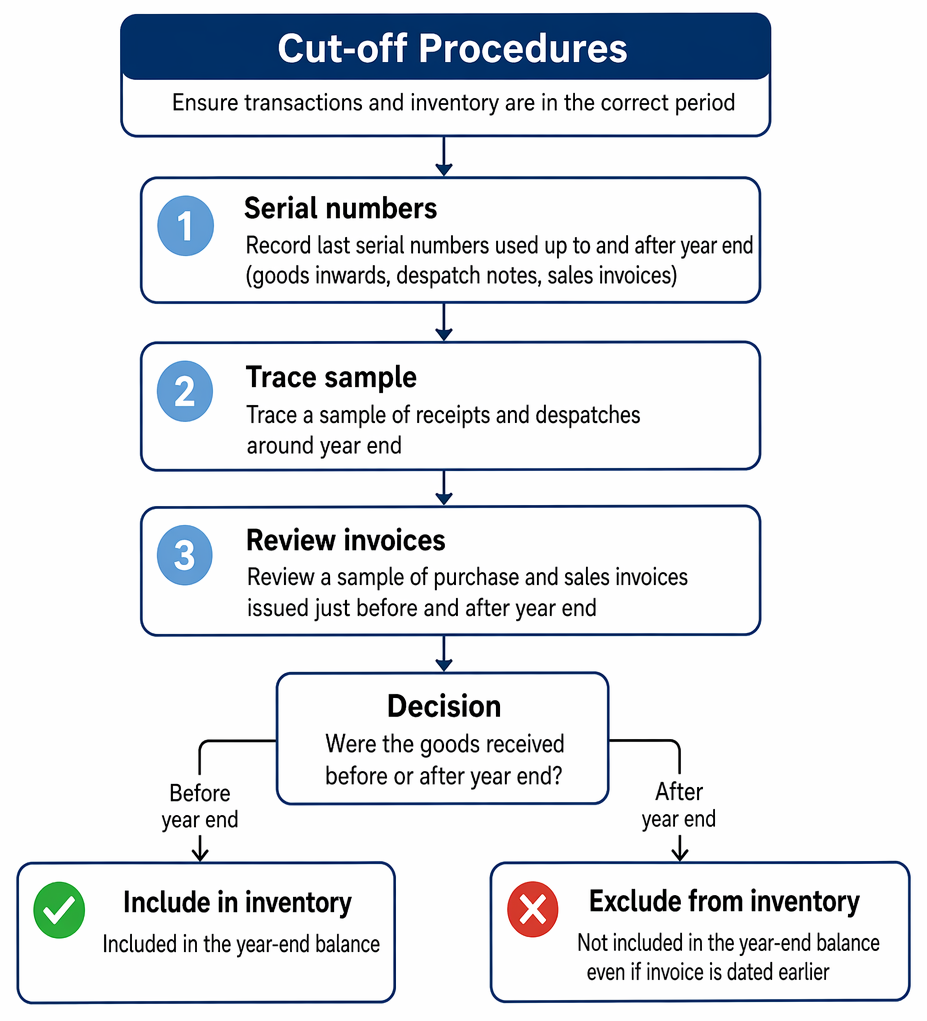
Audit work around year end ensures that purchases and sales are recorded in the correct period and inventory is complete and accurate.
Auditor actions at stocktake are organised into pre-count planning, on-site observation and testing, and post-count reconciliation and cut-off checks.
- Record the last serial numbers (goods inwards, despatch notes, sales invoices) used up to and after year end
- Trace a sample of receipts and despatches around year end to see if they are included in the correct period’s records
- Review a sample of purchase and sales invoices issued just before and after year end
Worked Example 1.2
Scenario: Goods totaling £20,000 were received on 2 January, but the invoice is dated 29 December. The receiving report is dated after year end. Should this inventory be included in the year-end balance?
Answer:
- If the goods were not received until after the year end, they should not be included in inventory at year end, even if the invoice is dated earlier. The auditor should check that these items are excluded from the count.
Analytical and Final Review Procedures
- Apply analytical procedures (e.g., compare inventory days to prior years and budget, examine gross margin trends)
- Investigate significant variations and discuss with management
- Consider whether additional substantive testing is necessary
Exam Warning: A frequent exam error is to assume that attending the inventory count replaces all other substantive testing. In reality, the auditor must perform valuation and cut-off checks regardless of count attendance.
Summary
Substantive procedures for inventory audit focus on verifying the existence, completeness, ownership, and valuation of stock. The auditor attends inventory counts, tests valuation to supporting records, assesses cut-off, and ensures that all assertions are supported by evidence. Inventory is a high-risk area that requires diligence and careful documentation.
Key Point Checklist
This article has covered the following key knowledge points:
- The auditor's substantive procedures for inventory focus on existence, completeness, valuation, rights, and cut-off
- Attendance at inventory counts is essential for existence but does not itself address valuation or ownership
- Key valuation work includes agreeing costs to invoices and reviewing NRV through after-date sales and condition checks
- Rights and obligations are checked via confirmations and document review, especially for goods held at third-party locations
- Cut-off procedures help ensure completeness and accuracy at year end
- Analytical procedures supplement detailed testing and help identify unusual variances
Key Terms and Concepts
- substantive procedure
- assertion
- test count
- cut-off test
- net realisable value