Learning Outcomes
After completing this article, you will be able to explain how auditors rely on the perpetual inventory system when performing substantive procedures. You will understand what evidence is required, how inventory records and controls are assessed, the need for physical count attendance, and the specific audit tests that confirm the existence, completeness, and valuation of inventory.
ACCA Foundations in Audit (FAU) Syllabus
For ACCA Foundations in Audit (FAU), you are required to understand the auditor’s role in verifying inventory using substantive procedures, especially when a client operates a perpetual (continuous) inventory system. During revision, focus on:
- The definition and importance of substantive procedures
- The distinction between tests of control and substantive procedures for inventory
- The reliability of perpetual inventory records and their audit implications
- Audit evidence required for inventory balances
- Procedures for observing and testing physical inventory counts
- Typical substantive procedures applied to inventory, including testing existence, completeness, and valuation
Test Your Knowledge
Attempt these questions before reading this article. If you find some difficult or cannot remember the answers, look more closely at that area during your revision.
-
What is the key audit objective addressed by attending a client's inventory count?
- a) To conduct system walkthroughs
- b) To test completeness and existence of inventory
- c) To review payroll controls
- d) To approve inventory write-offs
-
True or false? If a client maintains robust perpetual inventory records and has strong internal controls, the auditor does not need to observe any physical inventory counts.
-
Briefly describe one substantive procedure an auditor would perform to verify the valuation of inventory.
-
What is the main difference between a perpetual and a periodic inventory system, from an audit standpoint?
Introduction
Inventory is often one of the most material figures on a company’s statement of financial position and is subject to high audit risk. Many entities use a perpetual inventory system, where inventory records are continuously updated for receipts and issues. Auditors are often asked whether these records alone are sufficient for verification, or if further substantive procedures are required.
This article explains how reliance can be placed on a perpetual inventory system when performing substantive procedures, the audit evidence required, and the procedures used to confirm existence, completeness, and valuation of inventory.
Key Term: Substantive procedures
Audit tests designed to detect material misstatements at the assertion level. They include tests of details and substantive analytical procedures. Key Term: Perpetual inventory system
An inventory system that maintains continuous, real-time records of inventory movements and balances. Key Term: Audit evidence
Information obtained by the auditor that is used to support audit conclusions and the audit opinion. Key Term: Inventory count attendance
The auditor’s direct observation of the client’s physical inventory count, performed to obtain evidence regarding the existence and completeness of inventory.Test Tip: When revising Reliance on perpetual inventory system, connect each definition, method, or rule to the kind of question the assessment is likely to ask.
Substantive Procedures and Inventory: Overview
Auditors must always obtain sufficient appropriate evidence that inventory balances in the financial statements are free from material misstatement. Even where a client operates a well-controlled perpetual inventory system, substantive procedures remain essential to address the key assertions:
- Existence: Does the reported inventory physically exist?
- Completeness: Are all inventory items owned by the entity included in the accounting records?
- Valuation: Is inventory correctly stated at cost or lower of cost and net realisable value?
Key Term: Existence
The assertion that assets reported in the statement of financial position actually exist at the period end. Key Term: Completeness
The assertion that all transactions and balances that should be recorded have been included in the financial statements. Key Term: Valuation
The assertion that assets are recorded at appropriate amounts and any necessary adjustments for impairment or obsolescence are made.
Reliance on Perpetual Inventory Systems
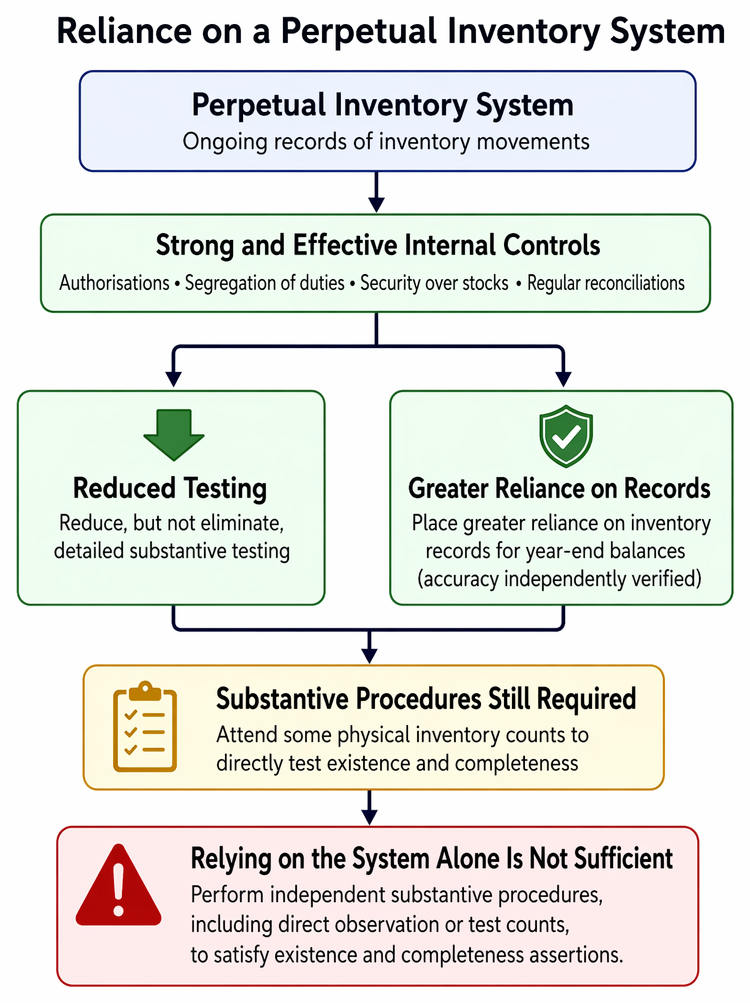
A perpetual inventory system provides ongoing records of inventory movements, preferably supported by internal controls such as authorisations, segregation of duties, security over stocks, and regular reconciliations. If these controls are strong and effective, the auditor may be able to:
Inventory substantive procedures are grouped by existence, completeness, and valuation, with checks from physical counts to lower-of-cost-and-NRV testing.
- Reduce, but not eliminate, the extent of detailed substantive testing
- Place greater reliance on inventory records for year-end balances, provided that the system's accuracy is independently verified
However, no inventory system—regardless of quality—removes the need for substantive procedures. Auditors must still attend some physical inventory counts to directly test the existence and completeness of inventory.
Exam Warning: Relying on a perpetual inventory system alone is not sufficient. Auditors must perform independent substantive procedures, including direct observation or test counts, to satisfy the existence and completeness assertions.
Audit Evidence Required
Auditors must gather evidence from different sources, including but not limited to:
- Physical attendance at inventory counts
- Inspection of inventory records and reconciliations
- Review of inventory movements around the period-end for cut-off
- Tracing a sample of recorded items to physical stock (and vice versa)
- Confirming the methodology and results of management's procedures for identifying obsolete, slow-moving, or impaired inventory items
Quality of audit evidence is increased when obtained from direct observation and independent sources, rather than solely from internal records.
Inventory Count Attendance and Substantive Procedures
Attendance at physical counts remains a core requirement, even with a perpetual system. The auditor should:
- Observe adherence to the client’s inventory counting instructions
- Perform independent test counts of selected items and trace results to the inventory records
- Verify that obsolete and damaged inventory is properly identified
- Test cut-off by reviewing the recording of receipts and dispatches around the period-end date
Worked Example 1.1
Scenario: Hazle Ltd operates a perpetual inventory system. The directors assert that, since records are meticulously maintained, auditor attendance at the annual inventory count is unnecessary.
Answer:
Auditing standards require independent verification of inventory. Attendance at the count allows the auditor to:
- Observe whether counting procedures are followed
- Perform test counts for sample items, comparing physical presence to records
- Confirm that inventory held by third parties is appropriately included or excluded Without this attendance, the auditor would lack direct evidence for the existence and completeness of inventory balances and would need to report a limitation of scope.
Worked Example 1.2
Scenario: An auditor notes a significant discrepancy between perpetual inventory records and the results of a surprise physical count on 31 March. Management asserts that the system is generally reliable.
Answer:
Upon discovery of discrepancies, the auditor must:
- Investigate causes with management and review adjustments made to records
- Assess whether the discrepancy is isolated or indicative of system-wide issues
- Consider expanding substantive procedures and reducing reliance on the system If errors are frequent, control reliance should be reduced and additional substantive testing performed to address the risk of material misstatement.
Valuation and Further Substantive Procedures
In addition to existence and completeness, the auditor needs to ensure that inventory is stated at the lower of cost and net realisable value. Substantive procedures may include:
- Checking pricing and extensions on inventory listings to source documents (invoices)
- Reviewing policies for identifying and writing down obsolete or slow-moving stock
- Comparing a sample of after-date sales to book values to confirm net realisable value
- Ensuring that allocations of overheads are reasonable, consistently applied, and in accordance with accounting standards
Summary
While a perpetual inventory system with strong controls enhances the reliability of inventory records, auditors must still perform substantive procedures—especially physical count attendance and test counts—to support the existence and completeness of inventory. The evidence obtained through observation and independent verification is indispensable for audit assurance.
Key Point Checklist
This article has covered the following key knowledge points:
- Define substantive procedures and explain their purpose for inventory audits
- Describe a perpetual inventory system and how it is used in audit testing
- Explain the limitations of relying solely on perpetual inventory records
- Identify the audit evidence required to support inventory balances
- Detail substantive procedures for verifying existence, completeness, and valuation of inventory
- Recognise the necessity of attending physical counts, even where a perpetual system operates
Key Terms and Concepts
- Substantive procedures
- Perpetual inventory system
- Audit evidence
- Inventory count attendance
- Existence
- Completeness
- Valuation