Learning Outcomes
After reading this article, you will be able to explain the substantive audit procedures relating to inventory. You will know what actions an auditor must take before, during, and after an inventory count to obtain sufficient audit evidence regarding existence, completeness, and valuation of inventory, and how these procedures link to the ACCA FAU exam requirements.
ACCA Foundations in Audit (FAU) Syllabus
For ACCA Foundations in Audit (FAU), you are required to understand inventory audit procedures at each key stage. Specifically, you should be able to:
- Describe the purpose and nature of substantive procedures over inventory.
- Outline actions required before, during, and after attending an inventory count.
- Identify typical problems and risks involved with inventory verification.
- Relate substantive procedures to the assertions of existence, completeness, and valuation.
- Apply International Standard on Auditing (ISA) 501: Audit Evidence – Specific Considerations for Selected Items to inventory.
Test Your Knowledge
Attempt these questions before reading this article. If you find some difficult or cannot remember the answers, look more closely at that area during your revision.
- What is the main audit objective for attending a physical inventory count?
- State two procedures an auditor should perform before the inventory count.
- During the inventory count, how does an auditor obtain evidence over completeness of recorded inventory?
- What substantive procedures should be performed after the inventory count to confirm valuation of inventory?
- True or false? The auditor is responsible for counting all inventory items themselves.
Introduction
Inventory is often a significant and high-risk figure in the financial statements. Errors or intentional misstatements in inventory can directly impact reported profit and financial position. For this reason, the auditor’s substantive procedures must be thorough, systematic, and well-documented at each stage: before, during, and after any physical inventory count.
Verification of inventory goes beyond physical existence—it also covers completeness (that all inventory is included), rights and obligations (the company owns the inventory), and valuation (correct figures per accounting standards). Auditors rely on ISA 501, which sets out specific requirements for obtaining audit evidence regarding inventory quantities and related matters.
Key Term: substantive procedures
Audit procedures designed to detect material misstatements at the assertion level, including tests of details and substantive analytical procedures. Key Term: inventory count
The physical counting and recording of inventory items at a specific point in time, usually at or near the period end. Key Term: cut-off
Ensuring that transactions are recorded in the correct accounting period, so that only those relating to the reporting period are included.Test Tip: When revising Procedures before, during and after inventory count, connect each definition, method, or rule to the kind of question the assessment is likely to ask.
Substantive Procedures: Planning Before the Inventory Count
Sound preparation enables the auditor to obtain reliable audit evidence from the inventory count. Proper planning also identifies areas of risk and allows the auditor to respond appropriately if problems arise.
Key procedures before the inventory count:
- Review prior years’ working papers to note issues or changes affecting inventory.
- Obtain and assess the client’s inventory count instructions for adequate controls and clarity.
- Identify the nature, location, and value of items to select material locations or lines for attendance.
- Discuss with management any unusual or problematic items, including consignment or third-party inventory.
- Arrange for attendance at inventory held at third-party locations (if material).
- Consider need for auditor’s expert if there are engineering stock, precious metals, or perishable inventory.
Worked Example 1.1
Question: You are planning the audit of Alpha Ltd, which has inventory at three warehouses and with one logistics provider. The prior year revealed differences between inventory records and physical counts at one site. What initial steps should you take before attending this year’s count?
Answer:
- Identify which warehouses held discrepancies last year.
- Review previous audit findings and client’s corrective actions.
- Obtain updated instructions on how the client will conduct the count.
- Confirm if third-party stock (with the logistics provider) is material and if so, either plan to visit or arrange for independent confirmation.
- Ensure all auditors attending the count are briefed on risk areas and specific procedures to perform.
Substantive Procedures: Actions During the Inventory Count
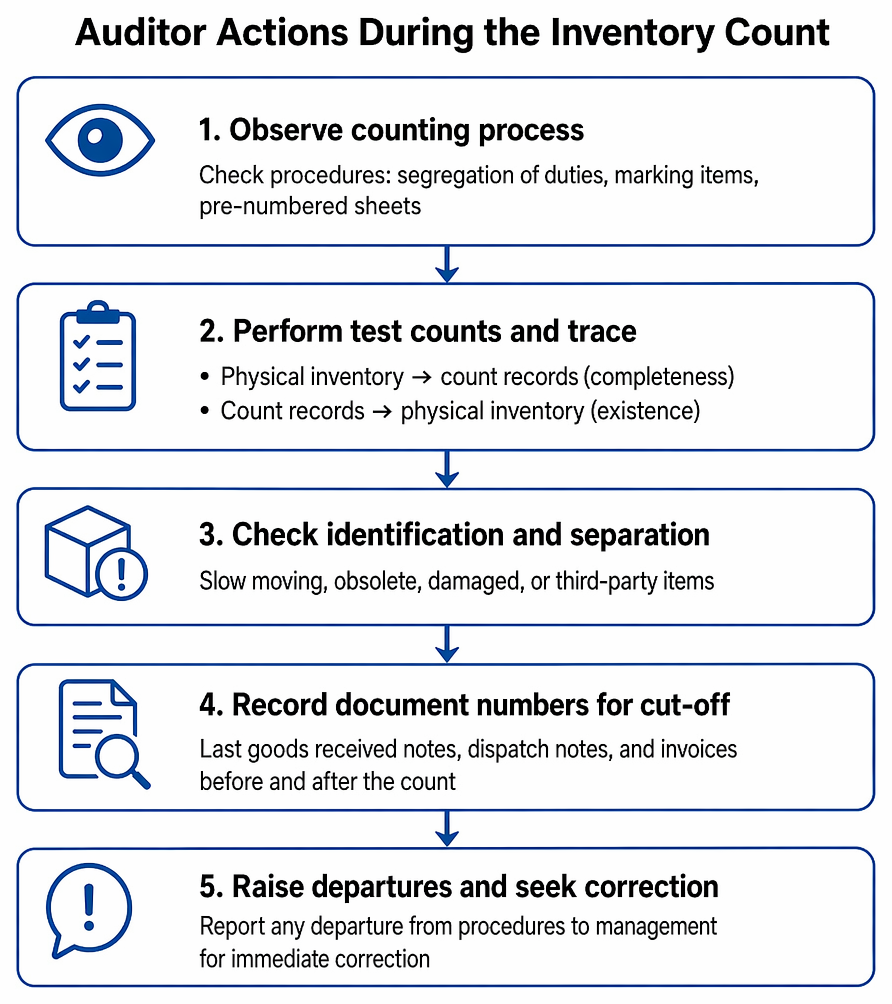
When attending the physical inventory count, the auditor’s primary objectives are to observe the process, make independent test counts, and assess whether controls ensure reliable results.
Purchases and dispatches near the reporting date are matched to GRN and GDN timing to allocate inventory and revenue correctly.
Key procedures during the count:
-
Observe whether the client’s staff follow documented counting procedures (e.g. segregation of duties, marking counted items, using pre-numbered count sheets).
-
Perform test counts and trace those figures:
- From physical inventory to count records (test for completeness).
- From count records to physical inventory (test for existence).
-
Check identification and separation of slow moving, obsolete, damaged, or third-party items.
-
Record numbers of last goods received notes, dispatch notes, and invoices before and after the count for cut-off testing.
-
Raise any departure from procedures with management for immediate correction.
Exam Warning: Failing to record cut-off information (such as last GRN numbers) during the count may result in insufficient evidence to support correct period-end inventory balances.
Worked Example 1.2
During the inventory count at Beta Ltd, you observe stock records not being updated until after the physical count. What should you do?
Answer:
- Raise the issue with the warehouse supervisor and management immediately.
- Assess whether the potential for double counting or omissions exists.
- Follow up with additional audit procedures (including after-date reconciliations) to address inventory completeness and existence.
Substantive Procedures: Work After the Inventory Count
Following the count, the auditor carries out further procedures to gain sufficient evidence over the completeness, existence, and especially valuation of inventory.
Key procedures after the count:
- Compare quantities recorded during the count with the final inventory listing to ensure all test counts are included.
- Trace sample items from count sheets to subsequent inventory records and financial statements.
- Perform cut-off testing by reviewing purchase and sales transactions around period end, verifying items were recorded in correct periods.
- Examine purchase invoices and delivery documentation to confirm inventory pricing.
- Test calculation of inventory valuation to ensure correct costing methods and adjustments for net realisable value.
- Inspect supporting evidence for write-downs of slow-moving or obsolete inventory.
- Obtain confirmation for inventory held by third parties and ensure not included if sold or pledged.
Worked Example 1.3
Question: Gamma Ltd counted inventory on 29 December. The year-end is 31 December. Several goods received on 30 December were not included in the count records. How should the auditor proceed?
Answer:
- Review goods received notes and purchase invoices for 30–31 December.
- Confirm that inventory received after the count but before year-end is added to final inventory records.
- Adjust audit tests to ensure all inventory owned at year end is included, even if not counted during the main stocktake.
Summary
To obtain reliable audit evidence on inventory, the auditor must design and perform substantive procedures at three key stages: planning before the count, observing and testing during the count, and verifying records and valuation after the count. Each step builds assurance over existence, completeness, accuracy, and valuation, and directly addresses assertions at risk in the audit of inventory.
Key Point Checklist
This article has covered the following key knowledge points:
- Explain the purpose and importance of substantive procedures over inventory.
- Describe audit actions required before, during, and after attending an inventory count.
- Identify key assertions and risks addressed by different inventory procedures.
- State the relevance of cut-off testing for completeness and accuracy.
- Understand how auditors test for proper identification, valuation, and existence of inventory balances.
Key Terms and Concepts
- substantive procedures
- inventory count
- cut-off