Learning Outcomes
This article examines the defence of consent, also known as volenti non fit injuria, in the context of negligence claims. It focuses specifically on how this defence operates in employment situations and rescue scenarios. After studying this material, you should understand the core elements required to establish consent, appreciate the significant limitations on this defence within the employment relationship due to factors like economic pressure and statutory duties, and recognise why consent is rarely applicable to rescuers acting out of duty or instinct. This understanding is essential for applying relevant legal principles to SQE1 assessment questions.
You should also be able to evaluate whether a claimant’s knowledge and conduct amount to free and informed acceptance of the legal risk of injury caused by the defendant’s negligence (not merely the ordinary risks of an activity), and distinguish carefully between consent (a complete defence) and contributory negligence (a partial defence reducing damages). Particular attention should be paid to the policy rationale behind the courts’ reluctance to find volenti in employment and rescue contexts, and to the impact of statutory provisions such as section 149 of the Road Traffic Act 1988, and contractual/statutory controls on exclusion of liability in consumer and business settings.
SQE1 Syllabus
For SQE1, you are required to understand the general defences available in negligence claims, including consent (volenti non fit injuria), and to apply the principles of the defence to specific factual scenarios, particularly those involving employment relationships and rescuers, with a focus on the following syllabus points:
- Identify the elements required to establish the defence of consent.
- Analyse the limitations on the defence of consent, especially concerning employees and rescuers.
- Distinguish consent from contributory negligence.
- Apply the legal principles relating to consent in employment and rescue situations to multiple-choice questions.
- Recognise when consent may succeed against an employee (rarely), for example where an experienced employee freely and knowingly ignores explicit safety instructions and undertakes a hazardous act for their own purposes.
- Assess the effect of statutory controls (e.g., Road Traffic Act 1988, s149) and the relevance of consumer/business fairness regimes (e.g., UCTA 1977 and CRA 2015) on attempts to rely on consent or exclude liability.
- Explain the “danger invites rescue” rationale and why the law is protective of rescuers.
Test Your Knowledge
Attempt these questions before reading this article. If you find some difficult or cannot remember the answers, look more closely at that area during your revision.
-
Which of the following is NOT an essential element for the defence of consent (volenti non fit injuria) to succeed?
- a) The claimant had full knowledge of the nature and extent of the risk.
- b) The claimant voluntarily agreed to accept the risk.
- c) The claimant received a benefit for accepting the risk.
- d) The claimant had the capacity to give valid consent.
-
In which famous case was it established that an employee's knowledge of a risk in the workplace does not automatically mean they have consented to that risk?
- a) Haynes v Harwood
- b) Smith v Baker & Sons
- c) ICI Ltd v Shatwell
- d) Baker v TE Hopkins & Son Ltd
-
True or False? The defence of consent is generally applicable to rescuers who are injured while attempting to save others from danger created by the defendant's negligence.
-
Section 149 of the Road Traffic Act 1988 primarily affects the defence of consent in which context?
- a) Employment relationships
- b) Medical treatment
- c) Sporting events
- d) Passengers in road traffic accidents
Introduction
When a claimant establishes the core elements of negligence – duty of care, breach, and causation – the defendant may still avoid liability by successfully raising a defence. One such complete defence is consent, known by the Latin maxim volenti non fit injuria (often shortened to volenti). This principle essentially states that no injury is done to one who consents. However, establishing consent requires more than simply showing the claimant knew of a danger. This article focuses on the application and limitations of this defence in two specific contexts frequently encountered: employment situations and rescue scenarios, highlighting why the defence often fails in these areas.
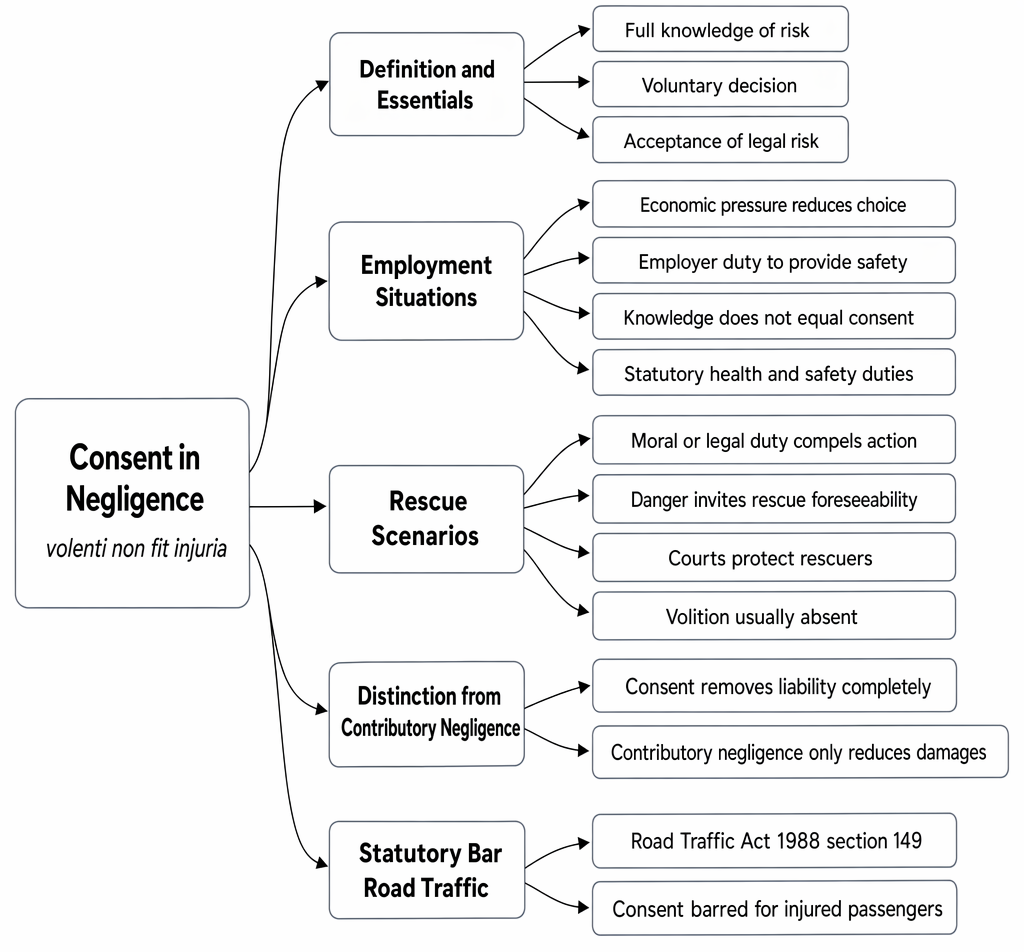
Consent in negligence, including its requirements, limits in employment and rescue cases, distinction from contributory negligence, and RTA 1988 s 149.
In negligence more generally, the courts insist that consent be proved with precision: the claimant must have subjectively appreciated the nature and extent of the risk and freely chosen to accept the legal consequences of that risk. The courts are wary of finding consent where the claimant’s position involves compulsion or duty, such as employees working to earn a living or rescuers acting from moral, professional or social obligation. A related policy theme is that defendants should not be absolved of responsibility where their negligence has created danger which foreseeably triggers rescue attempts.
Key Term: Consent (Volenti Non Fit Injuria)
A complete defence to negligence where the claimant, with full knowledge of the nature and extent of the risk, voluntarily agrees to accept that risk.
Elements of Consent
For the defence of volenti to succeed, the defendant must prove three elements:
- Knowledge of the Risk: The claimant must not only be aware that a risk exists but must also have full understanding of both the nature and the extent of the specific risk they are alleged to have accepted. A general awareness of danger is insufficient. The test is essentially subjective: did this claimant appreciate the precise risk? In practice, courts look at what a reasonable person in the claimant’s shoes would have apprehended, alongside evidence of the claimant’s actual understanding. In cases of intoxication, the issue is whether the claimant was so impaired that they could not appreciate the risk; otherwise, awareness can be found even where alcohol was consumed. In Morris v Murray, for example, the claimant who had been drinking was held to have appreciated the extreme danger in flying with a severely intoxicated pilot and accepted that risk.
- Voluntary Agreement: The claimant's agreement to run the risk must be entirely voluntary, made without compulsion or constraint. This involves having the freedom and capacity to choose whether or not to accept the risk. Mere knowledge is not consent (sciens is not volens). Dann v Hamilton illustrates this: although the passenger knew the driver was drunk, the court refused to treat that knowledge alone as free acceptance of legal risk. A true choice must exist; economic pressure or duty may undermine voluntariness.
- Acceptance of the Legal Risk: The claimant must have accepted the specific risk of injury caused by the defendant's breach of duty, not just the ordinary risks of an activity. This distinction is important in settings like sport or leisure. Consenting to the ordinary incidents of a vigorous sport is not consent to negligently inflicted injury. Judicial decisions in Smoldon v Whitworth (referee negligence in rugby) and Condon v Basi (football foul play) underline that consent does not extend to injuries caused by a failure to meet the requisite standard of care. Similarly, spectators may be taken to accept the risk of errors of judgment by participants, but not negligent conduct showing reckless disregard for their safety (Wooldridge v Sumner).
Key Term: Acceptance of the legal risk
Acceptance by the claimant of the risk of injury caused by the defendant’s negligence, not merely the ordinary risks inherent in an activity.
A high evidential bar applies: consent must be shown on the facts, not inferred from mere presence or participation. The defence is defeated if the claimant did not understand the risk, could not freely decide, or did not accept the legal risk of negligence. Courts are slow to find volenti where broader public policy points to protecting claimants whose choices were constrained or whose actions were socially desirable (e.g., rescuers).
Test Tip: In SQE1 questions, separate knowledge of danger from voluntary acceptance of the legal risk. A claimant may know something is risky without consenting to negligence.
Worked Example 1.1
Anya visits a paintball centre. Before playing, she signs a form acknowledging the risks of being hit by paintballs and agreeing not to sue if injured during the game. During play, faulty equipment provided by the centre malfunctions, causing a paintball gun to explode and injure Anya. Can the centre rely on the defence of consent?
Answer:
Likely no. While Anya consented to the risk of being hit by paintballs during normal play (ordinary risks), she did not consent to the risk of injury from faulty equipment caused by the centre's potential negligence (breach of duty). Her consent form likely wouldn't cover negligence unless very specifically worded and even then may be subject to statutory controls (like UCTA 1977/CRA 2015). Courts distinguish agreeing to ordinary risks from consenting to harm caused by a failure to exercise due care.
Consent in Employment
The application of volenti in the workplace is heavily restricted. While employees might be aware of risks associated with their jobs, courts are reluctant to find that they have voluntarily consented to injury caused by their employer's negligence.
Employees often act under economic compulsion and organisational control. They typically have limited freedom to choose tasks or refuse assignments without risking discipline or dismissal. Moreover, employers owe robust common law duties to staff: competent colleagues, adequate equipment, safe systems of work and safe premises. These duties are not lightly displaced by arguments that an employee “accepted” risks stemming from negligent breaches.
Key Term: Economic compulsion
Pressure arising from the need to keep a job or income, which may prevent an employee’s apparent acceptance of risk from being truly voluntary.
Limitations on Consent in Employment
Several factors limit the effectiveness of the consent defence against employees:
- Economic Pressure: Employees often face economic compulsion to continue working despite known risks. Fear of dismissal or lack of alternative employment means their acceptance of risk may not be truly voluntary.
- Employer's Duty of Care: Employers owe employees a common law duty (and, historically, statutory duties) to provide a safe workplace, safe equipment, and a safe system of work. This duty cannot easily be negated by arguing the employee consented to risks created by the employer's breach of this duty. Following the Enterprise and Regulatory Reform Act 2013, most civil actions for breach of health and safety regulations were removed, but the common law duty of care remains central and stringent.
- Knowledge vs. Consent: The principle established in Smith v Baker & Sons remains key: an employee's knowledge of danger does not equate to consent to the risk of injury arising from the employer's negligence. Continuing to work despite danger is not conclusive proof of voluntary assumption of the legal risk.
An important point arises from ICI Ltd v Shatwell. There, experienced quarry shotfirers deliberately disobeyed clear safety instructions and detonated explosives without proper precautions, causing injury. The House of Lords held that, on those facts, volenti could succeed against their employer, because the employees had freely and knowingly accepted the risk for their own purposes, contrary to express warnings and procedures. Shatwell is exceptional and reflects a scenario where employees acted outside the scope of the safe system, in full knowledge of the heightened risk they chose to run.
In practice, unless an employee’s conduct mirrors Shatwell (experienced worker, explicit warnings, conscious disobedience of safety rules for personal ends), volenti will rarely succeed. Even then, employers may still rely more appropriately on contributory negligence to reflect the employee’s share of responsibility.
Worked Example 1.2
Chen works in a factory where a machine guard is known to be defective. His employer, FastTrack Ltd, has been informed but has delayed repairs. Chen continues to operate the machine because he needs the job. He is subsequently injured due to the defective guard. FastTrack Ltd argues Chen consented to the risk by continuing to work. Is this defence likely to succeed?
Answer:
Unlikely. Chen's continuation of work was likely influenced by economic necessity. He knew the risk (defective guard) but did not voluntarily accept the legal risk of injury arising from his employer's negligence (failure to repair). The employer’s duty to provide safe equipment and a safe system of work overrides any implied consent. A court might, however, consider contributory negligence depending on Chen’s own care for safety while working.
Worked Example 1.3
Two experienced shotfirers at StoneWorks Ltd ignore explicit written safety instructions requiring remote detonation and protective screens. They choose a faster method, stand close to the charge, and one is injured. The employer had provided proper equipment, training, and clear warnings. Can the employer argue volenti?
Answer:
Potentially yes. This aligns with ICI Ltd v Shatwell, where volenti succeeded because experienced employees knowingly and freely disobeyed clear safety rules and accepted the risk for their own ends. The defence turns on proof of informed, voluntary acceptance of the specific legal risk created by their own disobedience. Such cases are unusual; courts will scrutinise the evidence closely.Exam Warning: Do not assume that an employee who keeps working despite obvious danger has consented. Smith v Baker & Sons shows that knowledge of risk is not enough.
Consent in Rescue Situations
Rescuers – those who intervene to help others in danger – are generally treated favourably by the law, and the defence of volenti is rarely successful against them.
Rationale for Limited Application
The courts recognise that rescuers often act out of impulse, moral duty, or social obligation rather than through calm, voluntary deliberation. Key reasons why volenti usually fails against rescuers include:
- Lack of True Volition: Rescuers often act instinctively or feel compelled by the situation ('danger invites rescue'). Their decision is not typically a free and voluntary choice in the sense required for consent.
- Duty/Moral Imperative: Many rescuers (e.g., police officers, firefighters, doctors, or even ordinary citizens) act under a perceived or actual duty to assist. The law does not penalise individuals for acting on such compulsions. In Haynes v Harwood, a police officer injured stopping runaway horses was held not to have consented. Courts recognise that stepping in to avert imminent danger is socially desirable and foreseeable.
- Foreseeability: It is generally foreseeable that someone might attempt a rescue if a defendant's negligence creates a dangerous situation. The defendant owes a duty to the rescuer. “Danger invites rescue” is a strong policy thread: a negligent act that creates danger extends duty to those who reasonably seek to mitigate its consequences.
The generous approach to rescuers extends to medical rescuers and others attempting to help in emergencies caused by negligence. Baker v TE Hopkins & Son illustrates this: a doctor who tried to rescue workers overcome by fumes was not treated as having consented. The law encourages rescue by refusing to bar claims on the basis of volenti in this context.
Key Term: Rescuer
An individual who intervenes to assist someone in danger due to the defendant's negligence or another cause. Key Term: Danger invites rescue
The principle that where negligence creates danger, it is foreseeable that others may attempt a rescue, and the law generally protects those rescuers.
Worked Example 1.4
David negligently starts a fire in his workshop. His neighbour, Eva, sees the flames spreading towards David's house, where she knows his children are sleeping. She rushes in to alert them and suffers burns. David argues Eva consented to the risk by entering the burning building. Will this defence succeed?
Answer:
Unlikely. Eva acted as a rescuer motivated by the immediate danger to the children. Her actions were likely driven by moral compulsion, not a free choice to accept the risk of being burned due to David's negligence. The defence of volenti would almost certainly fail. Courts foresee that rescue attempts follow from negligent creation of danger and do not penalise such conduct.
Worked Example 1.5
Two police officers arrive at a chaotic scene caused by a negligent organiser at a concert venue. While assisting trapped attendees, one officer sustains serious injuries. The organiser contends the officer consented to the risk typical of rescue work. Is volenti likely to succeed?
Answer:
No. Rescue interventions of this sort are recognised as compelled by duty and social necessity. The officer’s presence and actions were reasonably foreseeable responses to dangerous circumstances created by negligence. Volenti is rarely applicable to rescuers since their choices are not truly free in the relevant sense. Any blameworthy conduct by the rescuer is better addressed, if at all, by contributory negligence rather than a complete bar to recovery.Test Tip: If the facts involve a rescue attempt, start from the position that volenti is unlikely to succeed unless the rescuer acted wholly unreasonably outside the emergency.
Statutory Restriction: Road Traffic Act 1988
It is important to note that s 149 of the Road Traffic Act 1988 prevents the defence of volenti being used against passengers injured due to the driver's negligence in circumstances where insurance is compulsory (which covers most passenger scenarios). This reflects a policy decision to protect passengers, even if they accept a lift knowing the driver is, for example, intoxicated. Contributory negligence might still apply to reduce the passenger's damages.
This provision significantly curtails attempts to argue that a passenger consented to negligent driving. Earlier common law reasoning in Dann v Hamilton (finding that mere knowledge of intoxication is not consent) aligns with the statutory policy. In motor claims, defendants should consider contributory negligence where the passenger’s conduct contributed to injury (e.g., failing to wear a seatbelt, knowingly entering a vehicle driven recklessly), but volenti will be barred in the usual case by s149.
Exam Warning: In road traffic passenger questions, do not choose volenti where s 149 Road Traffic Act 1988 applies. The better answer is usually contributory negligence, if the passenger’s conduct helped cause the loss.
Contractual and Consumer Controls on Exclusion
Where defendants seek to rely on waivers or exclusion clauses to argue that claimants “consented,” fairness regimes restrict such clauses. The Unfair Contract Terms Act 1977 generally prevents exclusion or restriction of liability for death or personal injury caused by negligence in business-to-business contexts unless reasonable (and death/personal injury exclusions are void), while the Consumer Rights Act 2015 prohibits traders from excluding or restricting liability for negligence causing death or personal injury to consumers. Even where a disclaimer exists, courts test whether the claimant consented to the legal risk of negligent harm; broad boilerplate wording will rarely suffice.
Key Point Checklist
This article has covered the following key knowledge points:
- Consent (volenti non fit injuria) is a complete defence requiring the defendant to prove the claimant’s subjective knowledge of the nature and extent of the risk, a free and voluntary agreement to run that risk, and acceptance of the legal risk of injury caused by negligence (not merely the ordinary risks of an activity).
- Mere knowledge of danger is not consent; the claimant must have had a genuine choice. Economic pressure or duty (as in employment and rescue scenarios) typically undermines voluntariness.
- In employment, volenti is rarely successful due to economic pressures limiting free choice and the employer's overriding duties of care (Smith v Baker & Sons principle). Knowledge of risk by an employee does not equate to consent to the employer's negligence.
- A narrow exception exists (e.g., ICI Ltd v Shatwell) where experienced employees freely and knowingly disobey explicit safety instructions and accept the risk for their own purposes. This is unusual and heavily fact dependent.
- Rescuers are generally protected from the volenti defence as they often act out of duty or compulsion, not free choice (Haynes v Harwood; Baker v TE Hopkins & Son). “Danger invites rescue” supports imposing duties on those who create danger and discourages penalising rescuers.
- In motor claims, s149 Road Traffic Act 1988 precludes volenti against passengers; contributory negligence may still reduce damages.
- Distinguish consent (complete bar to recovery) from contributory negligence (partial reduction in damages). In many employment/rescue situations, contributory negligence is the appropriate lens for any share of responsibility by the claimant.
- Disclaimers and waivers do not automatically establish consent; UCTA 1977 and CRA 2015 restrict exclusion of liability for death or personal injury caused by negligence, and courts insist on proof of informed acceptance of the legal risk of negligence.
Key Terms and Concepts
- Consent (Volenti Non Fit Injuria)
- Acceptance of the legal risk
- Economic compulsion
- Rescuer
- Danger invites rescue