Learning Outcomes
This article explains the defence of necessity in the context of negligence and related tort claims, including:
- Core elements and evidential requirements of the defence of necessity in negligence and other torts
- Distinctions between necessity and related defences such as consent, self-defence, duress and statutory authority in SQE1-style questions
- Application of necessity principles to realistic SQE1 multiple-choice and scenario-based problems, focusing on issue-spotting, analysis and eliminating common distractors
- Typical factual circumstances in which otherwise tortious or negligent actions may be justified in order to prevent a greater and more imminent harm
- The difference between public and private necessity, and the weight given to protecting life and limb as opposed to safeguarding property or economic interests
- Limits on relying on necessity where the defendant created or contributed to the danger, delayed action, or ignored reasonable and less damaging alternatives
- Operation of necessity alongside statutory powers, lawful authority and police powers, and its interaction with medical treatment under the Mental Capacity Act 2005
- The role of objective reasonableness and proportionality in emergency decision-making, and how courts scrutinise the duration and scope of any interference
- Key case law illustrating necessity across negligence, nuisance, trespass to land and false imprisonment, and how to deploy these authorities succinctly in exam answers
SQE1 Syllabus
For SQE1, you are required to understand the fundamental principles of defences to negligence, including necessity, with a focus on the following syllabus points:
- identify the elements required to establish the defence of necessity
- distinguish necessity from other defences such as consent or self-defence
- apply the principles of necessity to specific factual situations presented in multiple-choice questions
- recognise the burden of proof on the defendant and the objective nature of the assessment
- appreciate the role of statutory authority and lawful powers compared with common law necessity, including in public order and medical contexts.
Test Your Knowledge
Attempt these questions before reading this article. If you find some difficult or cannot remember the answers, look more closely at that area during your revision.
-
Which of the following is an essential element for the defence of necessity to succeed?
- a) The defendant acted with the claimant's implied consent.
- b) The defendant acted to protect their own property interests exclusively.
- c) The defendant reasonably believed there was an immediate and real danger.
- d) The defendant's actions were authorised by statute.
-
In which situation is the defence of necessity most likely to be successfully pleaded?
- a) A driver exceeding the speed limit slightly to arrive at a meeting on time.
- b) A person damaging a neighbour's fence to retrieve their pet cat.
- c) A firefighter breaking down a door to rescue occupants from a burning building.
- d) A company polluting a river slightly to avoid the higher cost of proper waste disposal.
-
The defence of necessity requires the defendant's actions to be:
- a) Intentional and malicious.
- b) Reasonable and proportionate to the danger faced.
- c) Agreed upon by all parties involved beforehand.
- d) The least expensive option available.
Introduction
In certain limited circumstances, a defendant whose actions would otherwise amount to negligence (or another tort) may escape liability by pleading the defence of necessity. This defence applies where the defendant deliberately commits an act, potentially causing damage, in order to prevent a greater harm from occurring. It arises from situations of imminent danger where the defendant is forced to choose between two evils. Unlike defences such as consent or contributory negligence, necessity does not depend on the claimant's conduct but rather on the urgent circumstances facing the defendant.
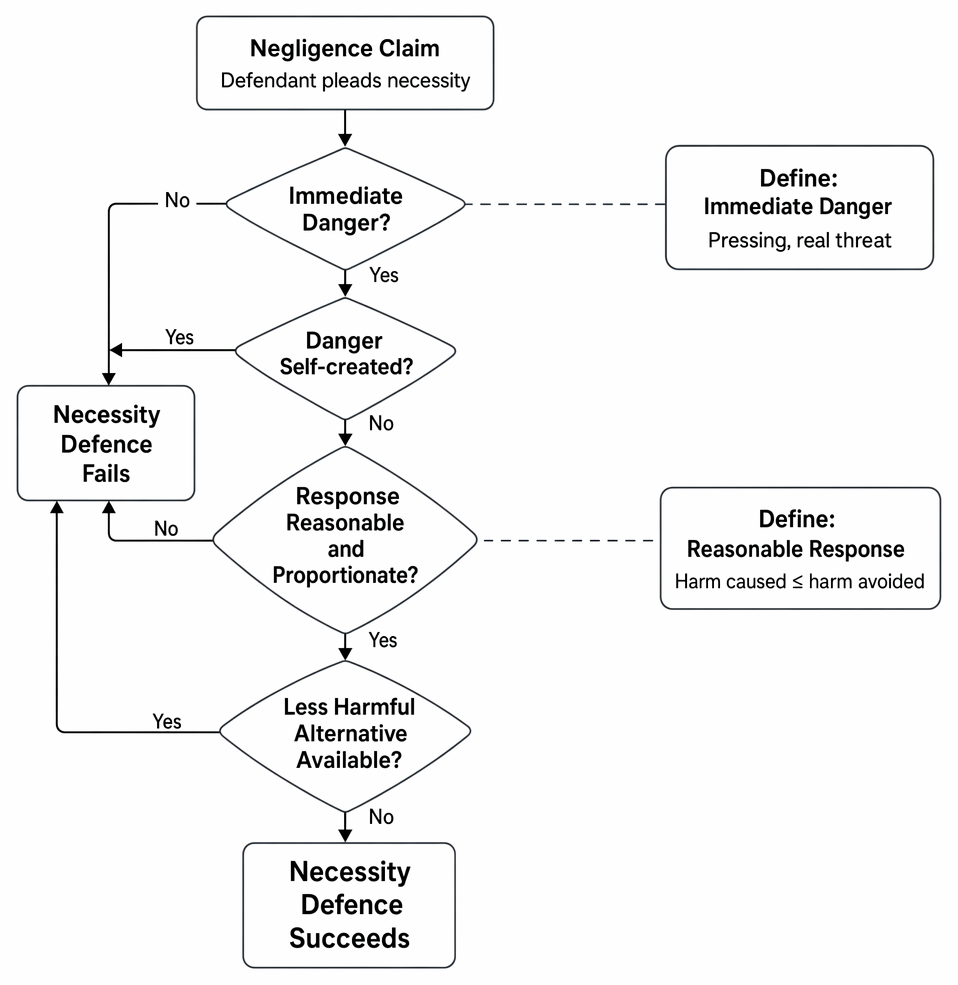
The elements of the necessity defence in negligence, including immediate danger, non-self-created risk, proportionality, and absence of a less harmful alternative.
Key Term: Necessity
A defence in tort law where the defendant argues their actions, although potentially harmful, were necessary to prevent a greater evil due to an imminent danger.
The defence is narrowly constructed by the courts to prevent its abuse as a justification for otherwise tortious conduct. Its successful application hinges on proving specific elements related to the danger faced and the reasonableness of the defendant's response. It operates across several torts, including negligence, trespass to land, nuisance, and false imprisonment. In some public protection scenarios, necessity overlaps with or is subsumed by lawful authority and statutory powers; in medical emergencies, the common law position has been supplemented by the Mental Capacity Act 2005.
Elements of the Defence
For the defence of necessity to succeed, the defendant must establish two primary elements on the balance of probabilities:
- Imminent Danger: There must have been an immediate and real danger or threat requiring urgent action. The threat must be directed towards the defendant, a third party, or the defendant's or another's property.
- Reasonable and Proportionate Response: The action taken by the defendant must have been reasonably necessary in the circumstances to avert the threatened harm, and the harm inflicted by the defendant's actions must not be disproportionate to the harm sought to be avoided.
These elements are assessed objectively: not what the defendant personally thought was reasonable, but what a reasonable person in the same position, with the same urgency and information, would have done.
Key Term: Proportionality
The requirement that the harm caused by the defendant's response must not be excessive when compared with the harm the defendant was trying to prevent.Test Tip: In SQE1 questions, first identify the danger, then ask whether it was truly immediate, and only then assess whether the response was necessary and proportionate.
Imminent Danger
The danger faced must be immediate and objectively real, not merely perceived or speculative. The defendant must reasonably believe that intervention is required to prevent harm. Genuine emergencies include threats to life and limb and, in more limited circumstances, serious threats to property. Courts demand cogent evidence of urgency; where the perceived threat is remote or unfolds over time, necessity is less likely to justify invasive conduct.
Proving imminence does not require that harm has already started to occur, but it must be impending. For example, a rapidly spreading fire, brake failure on a vehicle, a collapsing structure in a storm, or an escalating public order situation threatening serious violence may satisfy the requirement. By contrast, mere inconvenience, economic loss, or annoyance will not amount to imminent danger for necessity purposes.
Key Term: Imminent Danger
An immediate and pressing danger that requires urgent action to prevent harm occurring.
Worked Example 1.1
A lorry driver's brakes fail while descending a steep hill towards a crowded pedestrian crossing. To avoid hitting the pedestrians, the driver swerves into an empty shop front, causing significant property damage. Can the driver rely on necessity?
Answer:
Yes, likely. The driver faced an imminent danger (hitting pedestrians). Swerving into the shop, while causing damage, was arguably a reasonable and proportionate response to prevent loss of life or serious injury, which represents a much greater harm.
Reasonable and Proportionate Response
The courts assess the defendant's actions objectively: would a reasonable person in the same position have acted in the same way? The response must be necessary – meaning no reasonable alternative was available – and proportionate. Proportionality involves balancing the harm caused by the defendant's actions against the harm they were trying to prevent. Causing greater harm than the harm avoided will defeat the defence.
Practical considerations include:
- the time available for decision-making in the emergency and the information reasonably accessible to the defendant
- whether calling for assistance, warning affected parties, or taking less intrusive steps was realistic in the circumstances
- the gravity and likelihood of the threatened harm compared with the harm caused by the intervention
- whether the intervention was confined to what was essential to neutralise the danger.
The requirement of necessity is not satisfied where the defendant chooses a harmful course out of convenience or cost-saving when safer alternatives exist. For example, releasing pollutants to avoid loss of profits, absent any risk to life or limb, will not be justified.
Exam Warning: Do not confuse necessity with self-defence. Self-defence involves repelling an unlawful attack, often from the claimant. Necessity involves reacting to an imminent danger which may not stem from the claimant's actions, such as a natural event or a third party's conduct.
Worked Example 1.2
During a severe storm, a homeowner demolishes their neighbour's unstable garden shed, fearing it will collapse onto their own house and cause extensive damage. The neighbour sues for trespass and damage.
Answer:
The homeowner might plead necessity. They faced an imminent danger (potential damage from the collapsing shed). Demolishing the shed was the action taken. The court would assess if this was reasonable and proportionate. Factors include the actual likelihood of collapse, the potential damage to the homeowner's house versus the value of the shed, and whether less destructive alternatives existed (e.g., alerting the neighbour, temporary supports). If demolishing the shed caused disproportionate harm compared to the risk averted, the defence may fail.
Worked Example 1.3
Police contain a crowd for several hours at a large demonstration after receiving credible intelligence that a serious breach of the peace is imminent. Some peaceful attendees claim false imprisonment.
Answer:
Necessity may apply in a public protection context. The police must show imminent danger of serious disorder and that containment was a reasonable and proportionate response, confined to the minimum necessary to avert the threat. In Austin v Commissioner of Police for the Metropolis [2009] 1 AC 564, crowd containment was justified where an extreme situation required urgent action to prevent violence. The legality also turns on the existence of lawful powers and the proportionality of the measures used.
Worked Example 1.4
A surgeon performs an emergency procedure on an unconscious patient to stop internal bleeding without obtaining consent. The patient later alleges battery and negligence.
Answer:
Treatment may be justified by necessity where consent cannot be obtained and urgent intervention is required to prevent serious harm. Post-2005, acts in connection with care or treatment for a person lacking capacity are authorised if done in their best interests under the Mental Capacity Act 2005 (e.g., s.5), provided the intervention is necessary and proportionate. Necessity remains relevant where urgent treatment is required and statutory conditions are met, but the primary analysis is now under the MCA framework.
Worked Example 1.5
A factory owner vents a minimal amount of toxic gas into the atmosphere to prevent an explosion. There is no threat to life or limb but doing so saves significant repair costs. Neighbours claim in nuisance.
Answer:
Necessity is unlikely to succeed. Without an imminent danger to life and limb, and where the action primarily prevents financial loss, the response is not justified. The defence is strictly confined. By contrast, where life and limb are at risk, necessity can justify temporary harmful acts (as in Southport Corporation v Esso Petroleum Ltd [1956] AC 218, where discharging oil was held justified to avert the probable loss of life and the ship).
Scope and Limitations
The defence of necessity is tightly controlled and subject to several limitations:
-
Self-Created Danger: The defence is generally unavailable if the defendant's own negligence created the emergency situation in the first place. A party cannot manufacture an emergency and then rely on necessity to excuse harmful conduct. This reflects the requirement that the defendant must not be at fault in causing the danger.
-
Availability of Alternatives: If a reasonable, less harmful alternative course of action was available, the defence will likely fail. Courts expect defendants to take the least intrusive steps necessary to neutralise the danger, including warning affected persons where practicable or seeking assistance. Necessity does not justify convenience or cost-saving measures.
-
Public vs Private Necessity: Sometimes a distinction is drawn between 'public necessity' (acting to protect the public good) and 'private necessity' (acting to protect private interests). Public necessity may justify causing greater harm than private necessity, especially where the measures protect life and limb. In Southport Corporation v Esso Petroleum Ltd [1956] AC 218, the captain's decision to discharge oil to save the ship and crew exemplified actions taken to avert a serious danger to life and limb; a nuisance was committed but the defence succeeded. By contrast, claims of necessity to justify trespassing for shelter or convenience are treated cautiously. The defence will not excuse ongoing or indefinite invasions of property rights where the threat is not imminent and serious.
-
Statutory Powers and Lawful Authority: Where a statute authorises conduct (e.g., police powers under the Police and Criminal Evidence Act 1984, or statutory public order powers), the appropriate defence is lawful authority rather than necessity. Nonetheless, necessity has featured in public order cases to justify urgent containment measures to prevent violence. In Austin v Commissioner of Police for the Metropolis [2009] 1 AC 564, the House of Lords accepted that in extreme, time-critical situations involving public safety, containment can be justified if necessary and proportionate.
-
Medical Cases and Capacity: Necessity can be relevant in medical emergencies where a patient cannot consent (e.g., unconscious). Treatment necessary to save life or prevent serious harm may be justified under the best interests framework. The Mental Capacity Act 2005 provides a statutory basis for treating patients who lack capacity (notably s.5), requiring that interventions be in the patient's best interests and proportionate to the risk of harm. F v West Berkshire Health Authority [1990] 2 AC 1 recognised common law necessity in authorising treatment for those lacking capacity; subsequent practice is largely governed by the MCA. In extreme cases, courts may sanction measures to prevent a greater harm even where a tragic outcome is inevitable, as in Re A (Children) (Conjoined Twins: Surgical Separation) [2001] Fam 147.
-
Proportionality and Limitation: The defence will fail where the harm caused is disproportionate to the threatened harm. An intervention must be targeted and limited in scope and duration. Proportionality is judged against the seriousness and likelihood of the risk, the immediacy of the threat, and the feasibility of less intrusive measures.
-
Property Interests: Necessity is most secure where life and limb are at risk; it is more limited where only property is threatened. Courts may accept emergency acts to prevent serious property damage in limited, time-critical situations, but will scrutinise the imminence of the threat and the extent of the intrusion. General economic advantages or operational efficiencies will not suffice.
-
Burden and Standard of Proof: The defendant must prove necessity on the balance of probabilities, providing objective evidence of the danger and of the decisional constraints. Mere assertions of good intentions are insufficient.
Key Term: Self-Created Danger
A situation where the defendant caused or materially contributed to the emergency and therefore will usually be unable to rely on necessity.
-
Duration and Scope of the Response: Even where necessity applies, the response must last no longer than necessary to remove the danger. Continuing the interference after the emergency has passed undermines the defence.
-
Interaction with Other Defences: Necessity should be distinguished from consent, self-defence, duress, and statutory authority. While self-defence centres on repelling unlawful aggression (often from the claimant), necessity justifies harm done to prevent a greater harm from sources that may be natural, accidental, or third-party in origin. Consent requires the claimant's agreement, whereas necessity focuses on the emergency context irrespective of the claimant’s views (subject to capacity and best interests constraints in medical settings).
Test Tip: If a question mentions a statute expressly authorising the defendant's conduct, consider lawful authority first. Necessity is usually a residual common law defence for urgent situations not fully governed by statutory powers.
Key Point Checklist
This article has covered the following key knowledge points:
- Necessity is a defence in tort, applicable when a defendant acts to prevent greater harm due to imminent danger.
- Two core elements must be proven: imminent danger and a reasonable and proportionate response.
- The assessment of the defendant's actions is objective.
- The harm caused by the defendant must not be disproportionate to the harm avoided.
- The defence is generally unavailable if the danger was created by the defendant's own negligence.
- Necessity must be distinguished from self-defence and duress.
- Case law like Southport Corporation v Esso Petroleum and Re A (Children) illustrates its application and limitations.
- Necessity may justify urgent public protection measures (e.g., crowd containment), but statutory powers and proportionality are critical (Austin v Commissioner of Police).
- In medical cases, the Mental Capacity Act 2005 provides a statutory framework for treatment in the absence of consent; common law necessity informs urgent decision-making and extreme scenarios.
- Public necessity is more likely to succeed where life and limb are at risk; private necessity is strictly limited, particularly in relation to property-only threats.
Key Terms and Concepts
- Necessity
- Imminent Danger
- Proportionality
- Self-Created Danger