Learning Outcomes
This article examines the illegality defence in negligence, including:
- the core rationale for the defence, the ex turpi causa maxim, and its public policy foundations;
- the development of the modern, policy-based approach culminating in Patel v Mirza and the three-stage test;
- how courts assess the “close connection” requirement and distinguish central illegality from incidental unlawful conduct;
- the role of proportionality, coherence with criminal law, and competing policies such as compensation, deterrence, and protection of life;
- the treatment of the defence in leading authorities (e.g. Pitts v Hunt, Gray v Thames Trains, Revill v Newbery, Hounga v Allen) and how these cases are likely to feature in SQE1-style questions;
- the interaction between illegality and other defences, particularly consent and contributory negligence, and the impact of statutory provisions such as section 149 Road Traffic Act 1988;
- structured methods for analysing problem questions, selecting the correct defence, and clearly applying the Patel v Mirza factors to exam-style fact patterns;
- recognising typical traps in SQE1 questions, such as assuming any unlawful act bars recovery, and articulating reasoned conclusions on whether the defence should succeed.
SQE1 Syllabus
For SQE1, you are required to understand the operation and limits of the illegality defence in negligence, including identifying when the defence may apply, explaining the relevant policy considerations, and applying the correct legal test to factual scenarios, with a focus on the following syllabus points:
- the meaning and effect of the ex turpi causa non oritur actio maxim
- the public policy justifications for the illegality defence
- the three-stage test from Patel v Mirza and its application to negligence claims
- the requirement for a close connection between the illegality and the claim
- how the defence is treated in key cases and typical exam scenarios
- the distinction between illegality (complete defence) and contributory negligence (partial defence)
- how statutes interact with defences (e.g. section 149 Road Traffic Act 1988 affects consent, not illegality)
- the impact of serious criminal conduct versus incidental regulatory breaches
- how Gray v Thames Trains and related authorities inform proportionality and coherence with criminal law
Test Your Knowledge
Attempt these questions before reading this article. If you find some difficult or cannot remember the answers, look more closely at that area during your revision.
- What is the effect of a successful defence of illegality (ex turpi causa non oritur actio) in a negligence claim?
- Which case established the current three-stage test for the application of the illegality defence in civil claims?
- In which of the following situations is the illegality defence most likely to succeed?
- a) A claimant injured while committing a burglary sues the property owner for negligence.
- b) An undocumented worker injured at work sues their employer for unsafe conditions.
- c) A passenger not wearing a seatbelt sues a negligent driver.
- What are the three main factors a court must consider under the Patel v Mirza test?
Introduction
The illegality defence, known by the Latin maxim ex turpi causa non oritur actio, is a complete defence to a negligence claim in certain circumstances. If successful, it prevents a claimant from recovering damages where the claim is closely connected to the claimant’s own illegal or seriously immoral conduct. This defence is rooted in public policy and aims to protect the integrity of the legal system. It is distinct from contributory negligence (which reduces damages) and consent (another complete defence), and it is applied cautiously to avoid undermining compensatory principles where claims are not genuinely tainted by illegality.
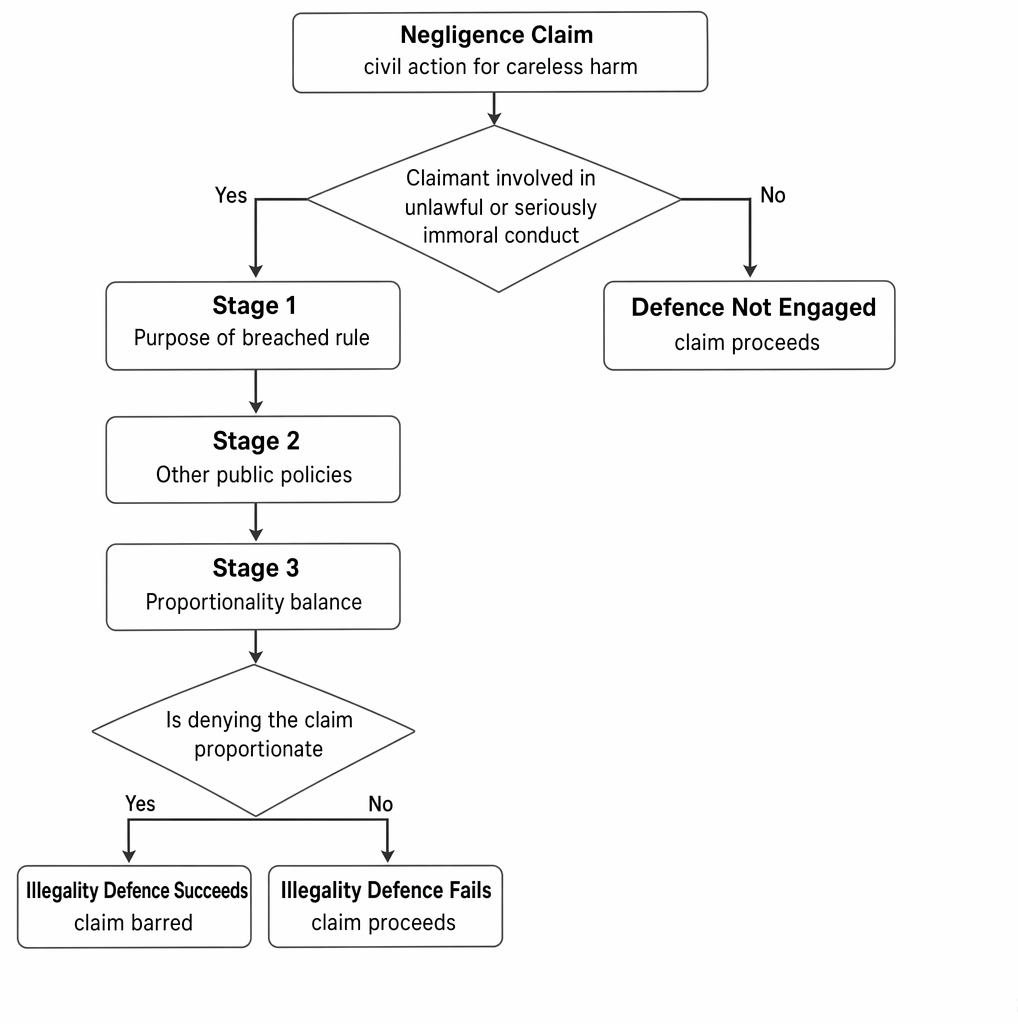
Illegality as a defence to negligence is presented through the Patel v Mirza three-stage approach and final proportionality assessment.
Key Term: ex turpi causa non oritur actio
The Latin maxim meaning "no action arises from a dishonourable cause." It bars a claim where the claimant must rely on their own illegal or seriously immoral act.
The rationale for the illegality defence
The illegality defence is based on several public policy reasons:
- The courts should not assist a claimant to profit from their own wrongdoing.
- The law should not condone or encourage illegal conduct.
- Civil remedies should not undermine criminal sanctions.
- The integrity of the legal system must be maintained.
These reasons appear in two strands throughout the case law. One focuses on coherence in the law (courts should not compensate a claimant for consequences of their own crime), exemplified in Grey v Thames Trains, where recovery for losses tied to a criminal conviction was barred. The other reflects concerns that courts should not have to set standards of care within joint criminal enterprises or seriously unlawful activities; in some circumstances, it is inappropriate for the court to adjudicate rights arising out of such conduct.
Key Term: public policy
The principle that courts may refuse to enforce rights or claims if doing so would harm the public interest or the integrity of the legal system.
The modern approach: Patel v Mirza
The Supreme Court in Patel v Mirza [2016] UKSC 42 set out the current approach to the illegality defence in civil claims, including negligence. The court rejected rigid rules (such as the former reliance principle) and instead adopted a flexible, policy-based test that aims to reach principled and fair outcomes by considering the core purpose of the legal prohibition, other relevant policies, and proportionality. This approach applies across private law and is sensitive to context, including tort claims.
Key Term: Patel v Mirza test
The three-stage approach requiring courts to consider: (1) the purpose of the law breached, (2) any other relevant public policies, and (3) whether denying the claim would be a proportionate response.
The three-stage test
When deciding whether to apply the illegality defence, the court must consider:
- The purpose of the legal prohibition: Would denying the claim strengthen or undermine the purpose of the law that was broken?
- Other relevant public policies: Are there competing policies (such as the need to compensate victims, protect life and safety, prevent unjust enrichment, or deter negligence) that should be weighed?
- Proportionality: Is denying the claim a proportionate response, considering the seriousness of the illegality, its centrality to the claim, whether it was intentional, and the relative culpability of the parties?
In practice, proportionality is assessed holistically. Factors commonly weighed include:
- the seriousness and nature of the illegal or immoral conduct (e.g. violent crime versus minor regulatory breaches)
- the closeness of the connection between the illegality and the harm claimed
- whether the claimant’s illegality was intentional, opportunistic, coerced, or incidental
- whether denying the claim would be coherent with other areas of law (e.g. criminal sentencing, statutory policies)
- the potential impact on vulnerable claimants and whether allowing or denying the claim would incentivise or deter harm
- the availability of alternative sanctions against the illegal conduct (e.g. criminal penalties) and whether civil denial is necessary to uphold the prohibition.
When does the defence apply?
The defence is not engaged by every unlawful act. The key question is whether there is a sufficiently close connection between the claimant’s illegal conduct and the claim. The more direct the link, the more likely the defence will succeed. Incidental illegality, such as minor parking contraventions, will generally not trigger the defence.
In negligence, the close connection requirement means:
- the illegality must be an essential part of the circumstances giving rise to the harm, rather than a background detail
- the harm typically occurs in the course of, or as a direct result of, the illegal enterprise
- courts avoid applying illegality to technical or trivial contraventions where the purpose of the breached law would not be advanced by denying civil redress.
Key Term: close connection
The requirement that the claimant’s illegal conduct must be sufficiently linked to the claim for the defence to apply.
Examples of application
- The defence is likely to succeed where the claimant seeks compensation for harm suffered while jointly committing a serious crime (e.g., burglary, violent crime, or reckless, unlicensed driving encouraged by the claimant).
- The defence is unlikely to succeed where the illegality is incidental or unrelated to the harm (e.g., an undocumented worker injured due to employer negligence; a vehicle illegally parked but later struck by negligent driving).
- Where the defendant uses disproportionate force to repel crime, courts may refuse to apply illegality as a complete bar and instead consider the defendant’s negligence alongside contributory negligence by the claimant.
- Claims for losses that would undermine criminal sanctions or create inconsistency with criminal law are at particular risk of being barred (e.g., seeking damages for imprisonment or loss of earnings directly attributable to a claimant’s criminal conviction).
Worked Example 1.1
Scenario: Ben and Carl jointly steal a car. Carl drives recklessly and crashes, injuring Ben. Ben sues Carl for negligence.
Answer:
The illegality defence will succeed. Ben’s claim arises directly from their joint criminal enterprise. Allowing the claim would undermine public policy and the integrity of the legal system.
Worked Example 1.2
Scenario: Maria is working illegally in the UK. She is injured at work due to her employer’s failure to provide safety equipment. Maria sues her employer for negligence.
Answer:
The illegality defence is unlikely to succeed. Maria’s illegal status is not central to the employer’s breach of duty. Public policy favours workplace safety and does not justify denying her claim.
Worked Example 1.3
Scenario: Adriana parks in a restricted zone in breach of parking regulations. Later, Janet negligently collides with Adriana’s parked car.
Answer:
The illegality defence will fail. Adriana’s minor illegality is incidental and not closely connected to Janet’s negligent driving. Denying the claim would be disproportionate and would not advance the purpose of parking regulations.
Worked Example 1.4
Scenario: Following a traumatic incident caused by a defendant’s negligence, Chris develops PTSD and later commits a serious criminal offence for which he is convicted and imprisoned. Chris sues the original defendant for losses including loss of earnings during imprisonment and damages for the sentence.
Answer:
The illegality defence will succeed in relation to losses that flow from Chris’s criminal conviction (e.g., imprisonment and its consequences). It would be incoherent for civil law to compensate for sanctions imposed due to Chris’s own crime. However, Chris may still recover for the original injury and its direct consequences not tainted by the later offence.
Worked Example 1.5
Scenario: A pillion passenger, who knows the rider is unlicensed, uninsured, and drunk, actively encourages reckless riding. The motorcycle crashes, injuring the passenger, who sues the rider’s estate.
Answer:
The illegality defence is likely to succeed. The injury arose directly from a joint illegal enterprise in which the claimant was a knowing participant and encourager. The close connection and policy concerns justify denying the claim.
Worked Example 1.6
Scenario: A property owner, fearing repeated break-ins, lies in wait and shoots at a suspected burglar entering the shed, causing serious injury. The injured trespasser sues in negligence.
Answer:
The illegality defence is unlikely to bar the claim entirely. While the claimant was committing a crime, public policy strongly protects life and bodily integrity. The court will assess whether the defendant’s response was negligent or disproportionate; any damages may be reduced for contributory negligence by the claimant.
Key cases and exam scenarios
- Pitts v Hunt [1991] 1 QB 24: Claimant injured while participating in a joint illegal activity (joyriding). Claim failed due to the close connection between the illegality and the claim; the court declined to impose a duty of care within the context of a joint criminal enterprise.
- Revill v Newbery [1996] QB 567: Burglar injured by excessive force from a property owner. Claim succeeded because denying all claims would be disproportionate and contrary to the policy of protecting life; damages were reduced to reflect contributory negligence.
- Hounga v Allen [2014] UKSC 47: Undocumented worker allowed to claim for discrimination despite her illegal status, as public policy against trafficking and exploitation outweighed the illegality. Illustrates how competing policies can displace illegality in appropriate contexts.
- Ashton v Turner [1981] QB 137: Claim by a participant injured during escape from burglary barred; a classic application of illegality where the injury arose directly from the criminal enterprise.
- Gray v Thames Trains [2009] UKHL 33: Following negligent injury and subsequent PTSD, claimant’s losses derived from his own later criminal conduct (including detention under the Mental Health Act) were barred for incoherence with criminal law; but recovery for the original injury remained possible.
- Cummings v Granger [1977] QB 397: Burglar injured by a guard dog could not recover; strong application of illegality in the context of criminal trespass.
- Vellino v Chief Constable of Greater Manchester Police [2002] 1 WLR 218: Claim against police for injuries suffered while attempting to escape lawful custody failed; courts refused to impose duties that would be incoherent with criminal justice and public policy surrounding arrest and detention.
- Les Laboratoires Servier v Apotex [2014] UKSC 55: Although not a negligence case, the Supreme Court emphasised that seriousness of wrongdoing, rather than criminal labels alone, may engage illegality. This informs the broader policy-based approach under Patel.
Two further authorities refine the scope of the defence. In Delaney v Pickett [2011] EWCA Civ 1532, the Court of Appeal held that the criminal activity should cause the accident or should be incidental to the negligent activity for the illegality defence to apply; the fact that illegal drugs were carried in the vehicle did not bar the passenger's claim for personal injuries arising from negligent driving, because the illegality was not causally connected to the harm. In Henderson v Dorset Healthcare University NHS Foundation Trust [2020] UKSC 43, the Supreme Court emphasised the need for consistency between criminal law and tort law: a claimant who had been convicted of manslaughter by reason of diminished responsibility could not recover in negligence for the consequences of the killing, as allowing the claim would create an incoherent conflict between her criminal liability and her civil recovery.
These authorities demonstrate how courts balance the purpose of the prohibition, other public policies, and proportionality. In joyriding and burglary cases, illegality tends to bar claims. Where defendants use disproportionate force, protecting life may outweigh illegality, with damages adjusted for contributory negligence. Where recovery would be inconsistent with criminal sanctions, illegality applies to avoid incoherence.
Exam Warning: The illegality defence is a complete defence. If successful, the claimant’s entire claim fails and no damages are awarded, regardless of the defendant’s fault. Do not confuse illegality with contributory negligence; contributory negligence only reduces damages and is assessed by the claimant’s failure to take reasonable care for their own safety.
Revision Tip: For SQE1, focus on the Patel v Mirza test and the need for a close connection between the illegality and the claim. Not every unlawful act will bar a negligence claim. Apply the test explicitly:
- identify the purpose of the breached law;
- weigh competing policies (compensation, safety, deterrence, coherence with criminal law);
- evaluate proportionality, including seriousness, centrality, intention, and relative culpability.
Application of Patel v Mirza in negligence
To apply the modern test effectively in negligence problem questions:
-
Purpose of the prohibition: Consider the law breached (e.g., theft, violent crime, immigration rules, road traffic offences). Denying claims arising directly from serious crime generally upholds those laws. However, in workplace safety or discrimination contexts, denying a claim may undermine protective policies.
-
Other public policies: Identify policies such as preventing unjust enrichment, compensating victims of negligence, deterring excessive self-help or disproportionate force, protecting life and limb, and ensuring coherence with criminal sentencing. In employment settings, the policy of promoting safe workplaces will often prevail over incidental immigration illegality. In policing and criminal contexts, courts are reluctant to impose duties that assist evasion of arrest or diminish criminal accountability.
-
Proportionality and close connection: Ask whether the illegal conduct is central to the harm and whether denying the claim is fair and proportionate. Joint criminal enterprises typically satisfy centrality; incidental infractions (e.g., parking in a restricted zone) do not. Evaluate the claimant’s intentional participation, any coercion or vulnerability, and the defendant’s culpability. If denial would be disproportionate (e.g., severe injury from disproportionate force), the claim may proceed with a reduction for contributory negligence.
Differentiating illegality from other defences
- Illegality versus consent: Consent (volenti non fit injuria) requires knowledge and voluntary acceptance of risk; it is excluded by statute for passengers in road traffic accidents (section 149 Road Traffic Act 1988). Illegality can still apply to joint criminal enterprises involving dangerous driving (as in Pitts v Hunt), because the policy basis is different and not curtailed by that statutory provision.
- Illegality versus contributory negligence: Contributory negligence is a partial defence under the Law Reform (Contributory Negligence) Act 1945. It reduces damages where the claimant failed to take reasonable care for their own safety. Courts often prefer contributory negligence to avoid total denial where illegality is incidental or where denial would be disproportionate. For example, a trespasser injured by excessive force may recover with a reduction in damages.
Practical exam pointers
- Identify the illegal conduct clearly and determine whether the harm arose directly from it.
- Do not assume that any illegality defeats the claim; test centrality and proportionality.
- If the defendant’s negligence is serious and the claimant’s illegality is incidental, illegality should not bar recovery.
- Where the claim seeks compensation for consequences of the claimant’s crime (e.g., imprisonment), illegality likely bars those heads of loss to preserve coherence with criminal law.
- Consider whether contributory negligence provides a fairer, proportionate response where illegality is present but not central.
Key Point Checklist
This article has covered the following key knowledge points:
- The illegality defence (ex turpi causa non oritur actio) is a complete defence to negligence in some cases.
- The defence is based on public policy and aims to protect the integrity of the legal system.
- The current test is set out in Patel v Mirza: purpose of the prohibition, other public policies, and proportionality.
- There must be a close connection between the claimant’s illegal conduct and the claim.
- The defence is most likely to succeed where the claim arises directly from serious criminal conduct or would be incoherent with criminal law.
- Courts may refuse to apply illegality where denial would be disproportionate, especially where life and safety are at stake; contributory negligence may be used instead to reduce damages.
- Illegality is distinct from consent and contributory negligence; understand when each defence is engaged and how statutes (e.g., section 149 Road Traffic Act 1988) affect their availability.
- If the defence applies, the claim fails entirely, regardless of the defendant’s negligence.
Key Terms and Concepts
- ex turpi causa non oritur actio
- public policy
- Patel v Mirza test
- close connection