Learning Outcomes
This article explains voluntary assumption of risk (volenti non fit injuria) as a complete defence in negligence, including:
- Core requirements: the claimant’s complete, subjective knowledge of the specific risk and genuine, free consent to accept that risk
- Operation as a complete defence and the courts’ strict approach to proof of consent
- The distinction between volenti and contributory negligence, and their different consequences and legal rationales
- Policy limits in employment and rescue contexts where true voluntariness is doubtful
- Statutory constraints: Road Traffic Act 1988 s149, Consumer Rights Act 2015, and Unfair Contract Terms Act 1977
- Volenti under the Occupiers’ Liability Acts 1957 and 1984, including the effect of adequate warnings and the specificity of the risk
- Sports and recreation scenarios for participants and spectators, and the boundary between ordinary, consented risks and injuries arising from negligence or conduct outside acceptable risks
- Waivers, disclaimers and warnings as evidential (not determinative) indicators of consent and their interaction with statutory controls
- Voluntariness, true choice, and the impact of pressure or compulsion on the availability of the defence
- Application to realistic problem scenarios involving waivers, warnings and statutory prohibitions
SQE1 Syllabus
For SQE1, you are required to understand voluntary assumption of risk (volenti non fit injuria) as a complete defence in negligence, with a focus on the following syllabus points:
- the meaning and effect of volenti non fit injuria as a complete defence to negligence
- the legal requirements for establishing the defence: knowledge of the risk and voluntary acceptance
- the distinction between volenti and contributory negligence and their consequences
- the operation and limits of the defence in employment, rescue, road traffic, sporting and consumer scenarios
- statutory exclusions and prohibitions on the use of volenti (e.g. Road Traffic Act 1988 s149, Consumer Rights Act 2015, UCTA 1977)
- the role and effectiveness of waivers and exclusion notices, and the effect of warnings
- volenti under the Occupiers’ Liability Acts 1957 and 1984 for both visitors and trespassers
- public policy considerations and the burden of proof on the defendant
Test Your Knowledge
Attempt these questions before reading this article. If you find some difficult or cannot remember the answers, look more closely at that area during your revision.
- What are the two essential elements a defendant must prove to establish the defence of voluntary assumption of risk in negligence?
- In which of the following situations is the defence of volenti non fit injuria least likely to succeed?
- a) A passenger in a car accident who knew the driver was drunk
- b) An employee injured at work after being told of a risk
- c) A spectator at a football match injured by a stray ball
- d) A skydiver who signs a waiver and is injured during a jump
- How does the defence of volenti non fit injuria differ from contributory negligence?
- What is the effect of section 149 of the Road Traffic Act 1988 on the defence of volenti in road traffic accident claims?
Introduction
The defence of voluntary assumption of risk—volenti non fit injuria—operates as a complete defence to negligence, extinguishing liability entirely, even if the defendant is otherwise shown to have owed and breached a duty of care causing the claimant’s loss. However, the strict requirements for this defence mean it is rarely upheld in practice.
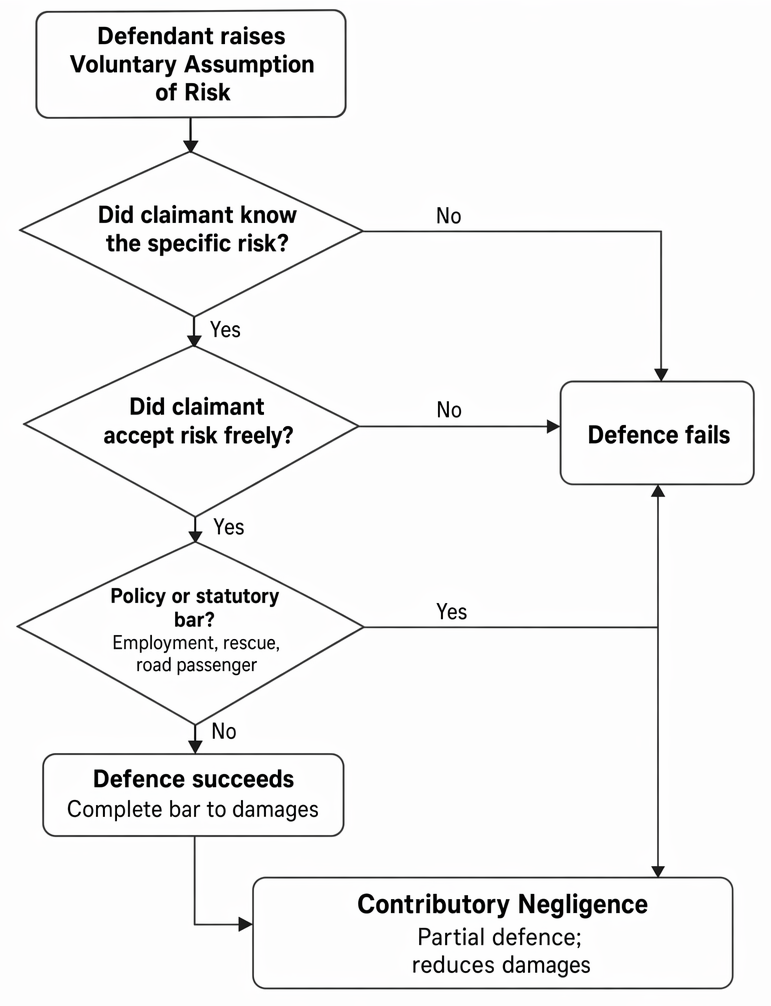
Voluntary assumption of risk in negligence is assessed by reference to knowledge, free consent, policy or statutory bars, and contributory negligence.
The principle of volenti non fit injuria
Key Term: volenti non fit injuria
A complete defence to negligence where the claimant freely and voluntarily accepts the risk of harm, barring recovery for resulting injury.
Derived from the Latin maxim "no injury is done to one who consents," this principle ensures that where an individual chooses to accept the risk of harm—even when the risk is created by another’s negligence—the law will not grant a remedy. However, the defendant must establish both full knowledge and true voluntary consent by the claimant for the defence to succeed.
Legal requirements for the defence
To establish voluntary assumption of risk as a defence, the defendant bears the burden of proving:
- the claimant had full knowledge of both the nature and extent of the specific risk, and
- the claimant voluntarily and freely agreed to accept that risk.
Both limbs must be satisfied for the defence to apply. Courts scrutinise the evidence for both, due to the potentially harsh consequence of denying any recovery to an injured claimant.
Key Term: knowledge of the risk
The claimant must fully understand the specific risk involved, not just be generally aware of possible harm. Key Term: voluntary acceptance
The claimant must freely choose to accept the risk, without pressure, compulsion, or lack of real choice.
Strictness and Subjectivity
The requirement for knowledge is subjective and exacting: did the particular claimant actually comprehend the specific risk and its degree? Simply being aware of some chance of harm does not suffice. The courts will not lightly infer acceptance absent clear evidence of both elements.
Knowledge of the risk
In order for the defence to operate, the claimant must have a real, subjective appreciation of the precise risk, not merely a generic awareness that danger exists. For example, knowledge that someone is driving under the influence may not suffice; the claimant must be subjectively aware of the magnitude and character of the risk posed by the particular circumstances.
Key Term: sciens non volens
Knowledge alone does not amount to consent. A claimant who is merely aware of a risk is not, without more, taken to have accepted it.
A high threshold is imposed: did the claimant truly understand what could happen, and its likelihood, before deciding to proceed? The courts focus on whether the claimant’s knowledge was specific as to the risk, not simply an appreciation that the situation was potentially dangerous.
Voluntary acceptance of the risk
Knowledge, however, is not enough. The claimant must also act voluntarily, with a free, uncoerced choice to accept the risk. Genuine freedom of choice may be compromised by economic pressures, the parties’ relationship (such as employee/employer), social or moral compulsion, or the absence of a practical alternative.
Acceptance of risk can be express (in writing, such as waivers and disclaimers) or implied from the context and facts. However, courts are cautious in finding implied consent, especially where vulnerability, lack of choice, or public policy limits are at play.
The presence of a written waiver is persuasive but not absolute. The court will examine the clarity, accessibility, and specificity of wording; the manner in which it was presented or signed; and whether statutory controls restrict its effect (e.g., consumer protection laws).
The burden of proof falls squarely on the defendant, who must show both actual knowledge and genuine, free acceptance. The relationship between the parties and any evidence of pressure or compulsion will be highly relevant to voluntariness.
Distinguishing volenti from contributory negligence
It is essential to distinguish the complete defence of volenti from the partial defence of contributory negligence.
- Volenti non fit injuria: A total bar to recovery if both elements are proven—no damages are awarded.
- Contributory negligence: A partial defence where the claimant’s carelessness contributed to the injury—damages are reduced by a just proportion under the Law Reform (Contributory Negligence) Act 1945.
If the claimant has not consciously accepted the risk but has, through a lack of due care, increased the likelihood or severity of injury, the more appropriate finding is usually contributory negligence. This is especially so where the policy of the law seeks to avoid penalising claimants too harshly for risk-taking when another party’s negligence has caused loss.
Key Term: contributory negligence
A partial defence reducing damages where the claimant’s own lack of care contributed to their injury.
Worked Example 1.1
A passenger accepts a lift from a friend who is obviously drunk. The car crashes and the passenger is injured. Can the driver rely on the defence of volenti?
Answer:
No. Although the passenger knew the driver was drunk, section 149 of the Road Traffic Act 1988 prevents the use of volenti as a defence by drivers to claims by passengers in motor vehicles. The driver may, however, argue contributory negligence.
Worked Example 1.2
A football player is injured by a late tackle during a match. The player knew football carries a risk of injury. Can the defendant rely on volenti?
Answer:
No. While the claimant accepted the ordinary risks of the game, they did not consent to negligent or reckless fouls. Volenti does not apply to injuries caused by conduct outside the normal rules of the sport.
Worked Example 1.3
A skydiver signs a waiver acknowledging the risks of jumping and is injured during a routine jump. Can the skydiving company rely on volenti?
Answer:
Yes, if the waiver was clear, the risks were explained, and the claimant freely consented. The company may be able to rely on volenti as a complete defence, provided there was no negligence outside the accepted risks.
Worked Example 1.4
A photographer at a horse show is struck when a rider momentarily loses control and veers off the track. The event carried prominent notices warning of ordinary risks to spectators. Can the organiser rely on volenti?
Answer:
Likely yes, if the incident amounted to an error of judgment within the ordinary hazards of the event. Spectators are taken to accept ordinary risks of the sport; however, if the rider acted with reckless disregard for safety or the organiser negligently failed to manage obvious dangers, volenti would not apply.
Worked Example 1.5
An employee is injured by falling material from overhead lifting equipment. The employer says the worker knew overhead lifting was dangerous and continued working. Can the employer raise volenti?
Answer:
No. Employees generally do not have a real choice to avoid workplace risks, and continuing to work with knowledge of danger does not amount to voluntary consent. The proper analysis is the employer’s common law duty of care; contributory negligence may be considered depending on the facts.
Worked Example 1.6
An adult trespasser ignores clear signs stating “No entry—danger” and falls on steep steps behind the door. Can the occupier rely on volenti?
Answer:
Possibly, if the trespasser knew and accepted the specific risk identified by the warnings. Under the Occupiers’ Liability Act 1984, adequate warnings can discharge the duty where the danger is obvious; volenti may operate alongside where the trespasser knowingly runs the risk. Each case turns on the clarity of the warning and the nature of the danger.
Application and limits of the defence
Employment situations
The courts treat consent in the context of employment with marked caution. Employees are often not in a position to make a truly free choice about dangerous work due to economic necessity or the risk of losing their job. The law recognises this imbalance and, in the interest of safeguarding workers, is reluctant to uphold volenti as a defence to employer negligence.
Key Term: common law duty of care (employment)
Employers owe employees a non-delegable duty of care to provide competent staff, adequate plant and equipment, a safe system of work, and safe premises.
It is insufficient for an employer to point to the employee’s awareness of danger or participation in a risky task. The court distinguishes between a claimant’s knowledge and voluntary acceptance, particularly where there is an element of pressure or where the worker lacks alternatives.
Policy considerations weigh heavily against the application of volenti in the work context, ensuring that employees are protected from being forced—directly or indirectly—into waiving their right to safety. As such, contributory negligence might provide a fairer solution when the claimant’s own actions have played a part in the damage.
Rescuers
The law strongly favours the encouragement of rescue, viewing rescuers as acting under a compelling moral, social, or in some cases legal, obligation, rather than out of pure free choice. Courts are extremely reluctant to find that rescue amounts to true consent to risk—professional status as a police officer or firefighter, or status as a bystander acting in an emergency, does not generally negate the defendant’s duty of care through a finding of volenti.
Key Term: rescuer
A person who acts in response to an immediate emergency to help others or property in danger. For volenti, their actions are not considered entirely voluntary.
For the volenti defence to be available, the rescuing claimant would need to have acted in a way that was entirely unreasonable or recklessly indifferent to their own safety, which is rare. In most cases, the more appropriate route is consideration of contributory negligence, and even this is rarely found unless the rescuer’s actions went beyond what was reasonable in the circumstances.
Sports and recreational activities
Participation in sports is a classic example of implied acceptance of certain risks. Both competitors and spectators are taken to accept the ordinary risks of the sport in question, but not risks caused by conduct outside the accepted norms, such as negligent fouls or reckless disregard for safety.
Key Term: risk (sport)
The risk naturally entailed in the ordinary conduct and rules of a sport, accepted by participants and spectators.
Where a player is injured in the ordinary course of play, volenti might apply; where the harm results from a dangerous or intentional foul or grossly negligent disregard for safety, it does not. Spectators who place themselves in harm’s way (e.g., standing in a high-risk area) may also be regarded as accepting the risk, provided adequate warnings are in place and the risk is foreseeable and not created by extraordinary negligence.
Organisers, for their part, are expected to take reasonable steps for safety, including crowd management, adequate barriers, and suitable warnings. Failure to do so can negate the availability of volenti as a defence.
Occupiers’ liability and consent
Volenti is directly relevant under both the Occupiers’ Liability Act 1957 (for visitors) and the Occupiers’ Liability Act 1984 (for trespassers). Under the 1957 Act, a visitor who fully knew and accepted the relevant risk—often by way of clear warning—may be barred from claiming against the occupier, provided the warning was sufficiently specific to the risk that eventuates.
Key Term: Occupiers’ Liability Act 1957
Statute imposing a duty on occupiers to keep lawful visitors reasonably safe for the purposes for which they are invited or permitted to be on the premises.
Under the 1984 Act, the occupier’s duty is more limited, owed only where they are aware of the danger and the likelihood of people coming into the vicinity. The duty may be discharged by taking reasonable steps, such as providing adequate warnings. Volenti operates in tandem, especially for adult trespassers who encounter obvious, warned dangers and proceed regardless.
In both visitor and trespasser scenarios, the sufficiency and clarity of warnings, the nature of the danger, and the likelihood of true appreciation of the risk are significant. Children and those lacking capacity may not be able to appreciate and accept relevant risks, meaning volenti will be unavailable.
Statutory exclusions and disclaimers in consumer contexts
In non-business scenarios, a disclaimer or exclusion clause can, in principle, underpin a defence of volenti—if it provides clear evidence of both knowledge and acceptance. In commercial or consumer situations, however, statute intervenes to regulate, restrict, or prohibit such clauses.
Key Term: Consumer Rights Act 2015 (CRA 2015)
Statute protecting consumers from unfair contract terms, preventing traders from excluding or restricting liability for death or personal injury resulting from negligence, including the common duty of care under OLA 1957.
The Consumer Rights Act 2015 applies to business-to-consumer contracts and makes it unlawful for a trader to exclude or restrict liability for death or personal injury resulting from negligence (including breaches of the Occupiers’ Liability Act 1957). Other limitations are subject to a “fairness” test.
Similarly, the Unfair Contract Terms Act 1977 governs attempts by businesses to restrict or exclude liability for negligence in business-to-business contracts. Any attempt to exclude or restrict liability for death or personal injury is void under UCTA 1977, and attempts to restrict other forms of liability must pass a reasonableness test.
These provisions do not abolish volenti per se; rather, they limit the legal effect of waiver documents or exclusion notices in regulated contexts. Even if a claimant has signed a waiver, the court will disregard it to the extent that statute mandates.
Waivers and warnings: evidential status
Written waivers and exclusion notices, especially in sporting, recreational, or leisure contexts, may support evidence of informed consent to risk, but they are interpreted strictly against the party seeking to rely upon them. The court considers the nature and accessibility of the clause, the sophistication of the parties, and the statutory controls highlighted above.
Oral or informal warnings have less force, but may still evidence knowledge, e.g., warnings from an instructor prior to undertaking a dangerous activity.
Notices such as "Enter at your own risk" may be persuasive through establishing awareness of danger, but unless also establishing that the claimant freely accepted the risk, volenti may still fail. Notices and disclaimers are of no effect to defeat statutory liability for death or personal injury in the contexts covered above.
Road traffic accidents: statutory exclusion of volenti
Key Term: Road Traffic Act 1988, section 149
Provision that precludes the use of consent (volenti) as a defence by drivers facing civil claims by passengers in insured vehicles.
This policy-driven statutory bar recognises the social importance of driver insurance and passenger protection, further illustrating the policy reluctance to allow volenti to defeat liability where road user relationships are involved. Even where the claimant is fully aware of the defendant’s negligence (e.g., by knowingly riding with a drunk driver), volenti cannot be used to defeat the claim.
Worked Example 1.7
A painter enters a premises to hang pictures and slips on a wet floor clearly signposted "Danger—Floor Wet." The painter had previously been told to avoid that area after cleaning. Can the occupier rely on volenti as a defence?
Answer:
Possibly, if it is clear that the painter both appreciated and voluntarily accepted the risk, despite warnings. However, the court will scrutinise whether the claimant's actions reflected genuine acceptance or simply a failure to heed safety advice, in which case contributory negligence may be a more appropriate partial defence.
Worked Example 1.8
A mountaineer attends an adventure centre for climbing, signs a disclaimer acknowledging all risks, is briefed on the dangers, and subsequently is injured due to loss of grip (not faulty equipment). Is the centre protected by volenti?
Answer:
Yes, assuming the centre did not cause the injury through negligence outside the ordinary risks, the clear waiver and evidence of knowledge and free acceptance of the risk should be sufficient for volenti to succeed. However, if the equipment was faulty or the centre was negligent beyond the risk, the defence would fail.
Worked Example 1.9
At a trampoline park, a parent signs a waiver on behalf of their 7-year-old child, who is subsequently injured during use. Can the park rely on volenti as a defence if sued by the child?
Answer:
Unlikely. The law is slow to accept that minors can fully appreciate risks, and parental consent may not suffice where the activity is highly dangerous or statutory protection is engaged (e.g., under the Consumer Rights Act 2015).
Policy considerations
Courts are mindful of the policy aims supporting negligence and its defences. They restrict volenti in contexts where operation of the defence would run counter to social welfare (employment and rescue), compromise statutory objectives (road traffic and consumer law), or defeat wider public protection. The judicial approach reflects the need to ensure that valid claims for safety are not excessively curtailed by paper waivers or employer pressure.
The defendant’s burden to demonstrate both actual knowledge and real voluntariness is strictly applied, with a tendency to prefer contributory negligence where there is doubt. The courts also consider whether allowing volenti would undermine statutory duties or wider legal policy—such as promoting safety in hazardous industries or protecting passengers against the consequences of reckless driving.
Special care is taken in cases involving children, consumers, and those under compulsion or dependency. The availability and effectiveness of statutory exclusions and policy limits (such as the mandatory insurance regime in road traffic claims) is a recurring theme.
Exam Warning: The defence of volenti is rarely successful. Courts require clear evidence of both specific knowledge and genuine, voluntary acceptance of the risk. Where there is any real doubt as to voluntariness or understanding, contributory negligence is a more likely conclusion.
Revision Tip: Always check for statutory bars (such as the Road Traffic Act 1988, section 149 and the Consumer Rights Act 2015) before analysing whether volenti could apply. Consent must always be specific, informed, and genuinely voluntary. Pay particular attention to whether warnings or disclaimers are legally sufficient in light of statutory controls.
Key Point Checklist
This article has covered the following key knowledge points:
- Volenti non fit injuria is a complete defence to negligence when both full knowledge and genuine, voluntary acceptance of the risk are present.
- The defendant bears the burden of proof for both requirements—specific, subjective knowledge and true volition.
- Mere knowledge of risk is not enough: "sciens non volens"—awareness does not equal consent.
- Volenti is unavailable in most employment and rescue situations, as free acceptance cannot be established due to compulsion or lack of real alternative.
- Section 149 of the Road Traffic Act 1988 bars volenti as a defence for drivers facing civil claims by passengers in insured vehicles, regardless of passenger knowledge or conduct.
- The defence is limited or negated in many consumer and trader situations by statutory protections, especially the Consumer Rights Act 2015 and Unfair Contract Terms Act 1977.
- Sporting participants and spectators are deemed to accept only ordinary risks, not those arising from recklessness or significant breaches of the rules.
- Volenti may operate under the Occupiers’ Liability Acts 1957 and 1984, with particular emphasis on the adequacy of warnings, clarity of exclusion notices, and the nature of the risk accepted.
- Written waivers, exclusion notices, and warnings have probative value but are subject to overriding statutory and policy constraints.
- Volenti is distinct from contributory negligence, which reduces, rather than eliminates, damages—and is more commonly found where the claimant’s actions contributed to their injury.
Key Terms and Concepts
- volenti non fit injuria
- knowledge of the risk
- voluntary acceptance
- contributory negligence
- Road Traffic Act 1988, section 149
- sciens non volens
- Occupiers’ Liability Act 1957
- rescuer
- risk (sport)
- common law duty of care (employment)
- Consumer Rights Act 2015 (CRA 2015)