Learning Outcomes
This article outlines how sentencing courts determine the seriousness of criminal offences in England and Wales, including:
- systematic assessment of seriousness by reference to culpability and harm, and how these factors place an offence within a guideline category;
- identification, explanation, and application of statutory and guideline-based aggravating and mitigating factors, distinguishing mandatory, presumptive, and discretionary considerations;
- structured use of Sentencing Council guidelines, including starting points, category ranges, and justified movement within or outside those ranges;
- operation of the totality principle when sentencing for multiple offences, and correct selection of concurrent or consecutive sentences so overall punishment remains proportionate;
- impact of previous convictions, offences taken into consideration, personal mitigation, and reductions for guilty pleas on the final sentence imposed;
- role and evidential value of pre-sentence reports, and the requirement for transparent sentencing remarks that articulate the court’s reasoning;
- interaction between burden and standard of proof at sentencing, statutory maximum sentences, relevant minimum terms, and leading case law (such as R v Hodgin) in constraining sentencing discretion.
SQE1 Syllabus
For SQE1, you are required to understand the legal framework for determining the seriousness of offences in sentencing, with a focus on the following syllabus points:
- the statutory and guideline-based aggravating and mitigating factors, including mandatory considerations for certain types of offending
- how courts assess culpability in the context of intention, recklessness, and negligence, as well as harm covering physical, psychological, financial, and community impacts
- the structure and application of the Sentencing Council guidelines, including starting points, category ranges, and how aggravating/mitigating factors are weighed
- the totality principle when sentencing for multiple offences: when and how concurrent or consecutive sentences are imposed
- the effect of guilty pleas on sentence reduction, including the timing and procedural rules that affect maximum reductions
- the use and purpose of pre-sentence reports in informing the choice of sentence, including the role of probation services and relevant statutory requirements
Test Your Knowledge
Attempt these questions before reading this article. If you find some difficult or cannot remember the answers, look more closely at that area during your revision.
- Name three statutory aggravating factors that a court must consider when sentencing.
- What is the totality principle and when does it apply?
- Give two examples of personal mitigation that may reduce a sentence.
- How does an early guilty plea affect sentence length?
Introduction
When a sentencing court considers a criminal case in England and Wales, it must determine the seriousness of the offence before passing sentence. This is a statutory requirement under the Sentencing Code 2020 (also known as the Sentencing Act 2020), which consolidates the substantive law on sentencing. The seriousness of the offence is assessed principally with reference to two elements: the level of the offender’s culpability and the degree of harm caused, intended, or risked.
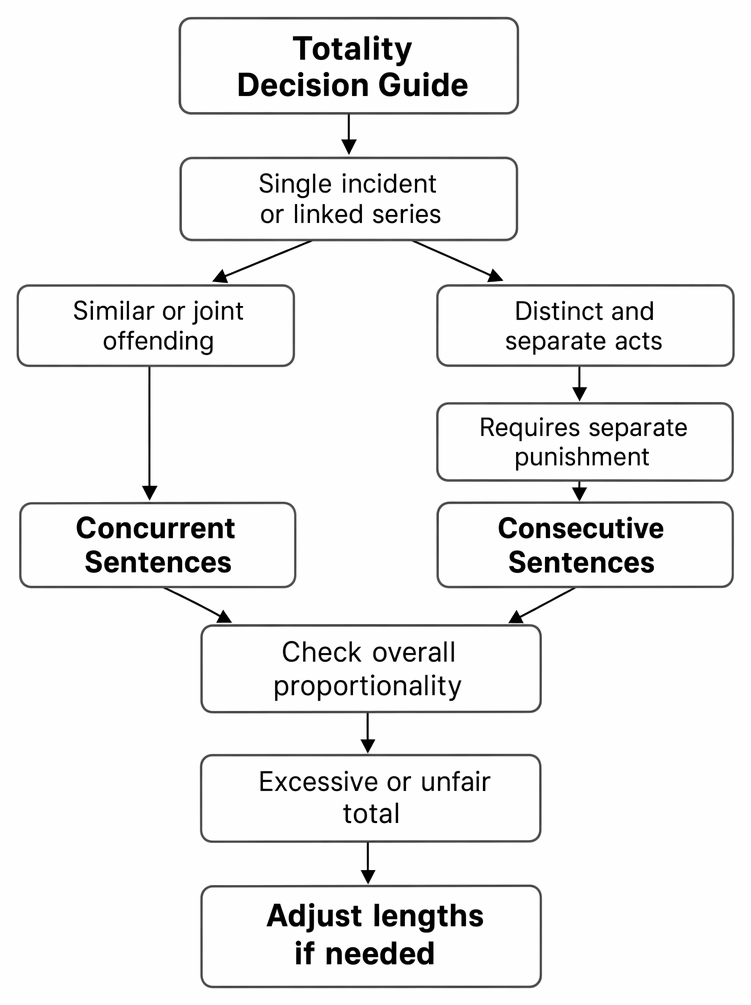
The totality principle directs concurrent sentences for linked offending, consecutive sentences for distinct acts, and review of overall proportionality.
Key Term: aggravating factor
A circumstance or feature that increases the seriousness of the offence, justifying a more severe sentence. Aggravating factors may be statutory (mandated by law) or non-statutory (arising from case law or sentencing guidelines). Key Term: mitigating factor
A feature of the offence, or the personal circumstances of the offender, that reduces the seriousness of the offence or supports the imposition of a less severe sentence. Key Term: culpability
The blameworthiness of the offender, assessed by their role, motivation, intent, planning, and state of mind at the time of the offence. Key Term: harm
The extent of injury, loss, or risk of harm resulting from the offence, whether physical, psychological, financial, or affecting the community. Key Term: starting point
The initial suggested sentence in the relevant guidelines for an offence of a given level of seriousness, before consideration of aggravating or mitigating factors. Key Term: category range
The range of possible sentences for a particular category of offence under the guidelines, allowing adjustment for case-specific factors. Key Term: previous convictions
A record of a defendant’s past criminal behaviour. The court must consider both the nature and the timing of any previous similar or recent convictions. Key Term: offences taken into consideration (TICs)
Additional offences admitted by a defendant when sentenced for a principal offence, allowing the court to sentence for the additional behaviour without separate proceedings. Key Term: reduction for guilty plea
A decrease in sentence given in recognition of an early and unambiguous admission of guilt, with precise reductions set by guidelines depending on the timing and circumstances. Key Term: totality principle
The principle that requires the overall sentence for multiple offences to be just and proportionate to the total criminality, avoiding excessive punishments. Key Term: pre-sentence report
A report provided to the court by probation services, offering detailed information about the offender’s background, criminogenic needs, risk of re-offending, and recommendations for sentencing.Test Tip: In SQE-style questions on Determining seriousness (aggravating and mitigating factors), identify the legal test, the triggering fact, and the consequence before choosing between similar answer options.
Exam Warning: Do not rely on a familiar phrase from Determining seriousness (aggravating and mitigating factors) alone; check whether the facts satisfy every condition, exception, and timing requirement.
Sentencing Guidelines and the Statutory Framework
The Sentencing Council issues guidelines that courts are required to follow unless it is contrary to the interests of justice to do so. Sentencing guidelines provide offence-specific and overarching guidance, including:
- A step-by-step process for determining seriousness by reference to culpability and harm.
- Statutory and non-statutory lists of aggravating and mitigating factors that courts must consider in every case, supplemented by guidance for particular offence types.
- Prescribed starting points and category ranges for offences, promoting consistency but allowing judicial discretion for case-specific factors.
- The duty to consider reductions in sentence for early guilty pleas, and set out procedures for when and how such credit is given.
- Structured consideration of sentencing for multiple offences, ensuring the sentence is proportionate under the totality principle.
Courts must give reasons for departing from the guidelines and ensure that sentences passed are not manifestly excessive or wrong in principle. These duties are both statutory and constitutional, supporting public confidence in the justice system.
Assessing Seriousness: Culpability and Harm
The Sentencing Council guidelines and the Sentencing Code 2020 require courts to determine seriousness by reference to:
- the offender’s culpability
- the harm caused or risked by the offending
Culpability is assessed by considering the offender’s intent, planning, role (e.g. principal, leading, significant, minor), use of weapons, exploitation of vulnerability, degree of premeditation, and involvement of others. Four levels of culpability are identified in sentencing guidance: from highest, where there is clear preplanning and intent to cause maximum harm, to lowest, where there is little planning and the role is peripheral.
Culpability takes into account whether the offence was deliberate, reckless, negligent, or committed under duress or coercion. Intention is the most serious form, followed by recklessness, with negligence forming the least blameworthy basis for criminal responsibility.
Harm is equally central and is not restricted to physical harm. Sentencing guidelines direct the court to consider:
- the actual harm inflicted, including physical, psychological, sexual, or financial injury
- harm intended or risked by the offending, including where harm was fortuitously avoided
- the impact of the offence on the community, such as in cases involving public disorder, environmental offences, or large-scale financial fraud
The council distinguishes between greater and lesser harm to identify the appropriate category for the offence, setting a starting point within the relevant category range.
For some offences (e.g. non-fatal offences against the person), "harm" may include factors like sustained injury, psychological trauma, or lasting impact on the victim’s life. In regulatory offences, such as environmental pollution, courts may have regard to lasting community or ecological harm.
The court’s assessment of culpability and harm together will determine the category for sentencing and the applicable range. Sentencing may be adjusted within the range (the "category range") according to additional factors.
Aggravating Factors
Aggravating factors are circumstances that increase the seriousness of an offence and support a more severe sentence. They are set out in the Sentencing Code 2020 and by the Sentencing Council’s offence-specific guidelines. These factors reflect either wider public policy concerns or aspects of individual blameworthiness. The most significant statutory aggravating factors are:
- Previous convictions: Especially those that are recent or closely related to the offence being sentenced, as they evidence persistent offending or a failure to respond to previous interventions.
- Offence committed while on bail: As required by statute, the court must treat offending on bail as aggravating, reflecting both risk and defiance of court orders.
- Racial or religious aggravation: Where an offence is motivated by or demonstrates hostility based on race or religion, it attracts a statutory uplift under relevant hate crime legislation.
- Hostility based on disability, sexual orientation, or transgender identity: The court must increase sentence where the offence is motivated by or demonstrates such hostility.
- Offences against public servants: Assaults or threats against persons carrying out public service or duty are aggravating.
Key Term: previous convictions
Prior proven offending by the defendant, especially those of similar type or recent commission, which must be treated as aggravating provided the court considers it reasonable having regard to the nature and timing of previous offences.
Besides statutory aggravating factors, the Sentencing Council guidelines list a range of general aggravating factors to guide judicial discretion, including:
- Abuse of a position of trust or authority, such as offending by carers, teachers, or professionals against those dependent on them.
- Deliberate targeting of vulnerable victims, for example children, the elderly, or those with a disability.
- Offending as part of a group or with an element of organisation.
- Use of weapons, threats or intimidation, or violence—beyond what is necessary for commission of the offence.
- Premeditation or significant planning, including sophisticated schemes in fraud cases or thefts.
- High value or significant impact on the victim or the wider community, such as large-scale financial frauds or environmental harms.
- Repetition or persistence of offending, including persistent harassment or repeated abuse.
- Commission of the offence in a domestic context or in the presence of children.
- Commission of the offence while subject to court orders (suspended sentence, community order, bail conditions, post-sentence supervision).
Key Term: offences taken into consideration (TICs)
Offences admitted by an offender and formally taken into account in deciding sentence for the offence charged. TICs enable the court to address a pattern of offending but should be included only where appropriate and not result in a sentence unjustly higher than for the principal offence.
TICs increase overall sentence but are intended to incentivise full admissions and avoid piecemeal prosecution. However, they should not be accepted if doing so would result in a manifestly excessive or disproportionate sentence.
Various public policy objectives support the aggravating factors, such as protecting the vulnerable, upholding public order and confidence, addressing hate motivated offences, and deterring recidivism.
Mitigating Factors
Mitigating factors provide reasons for a court to reduce a sentence. These factors relate either to the circumstances of the offence or, more commonly, to the offender's personal situation or post-offence conduct.
Personal Mitigation
Courts may reduce seriousness based on the following:
- No previous convictions or previous good character: The accused has a clean record or can demonstrate prior exemplary behaviour.
- Genuine remorse: Where the defendant demonstrates remorse either through word, deed, or actions such as apology or letters to the victim.
- Youth or immaturity: Courts may show leniency to young adults and especially to children, recognising developmental factors and diminished capacity for responsibility.
- Mental disorder, learning difficulties, or physical disability: If these impact on culpability, capacity, or the ability to avoid offending.
- Primary caring responsibilities: For children, elderly, or disabled dependants.
- Participation in rehabilitation: Demonstrable efforts to address offending behaviour, such as participation in drug treatment, therapy, or compliance with bail conditions.
- Positive character evidence: Employment history, service to the community, or support from references.
Offence-Related Mitigation
Additionally, the offence itself may justify mitigation, including:
- Impulsive or opportunistic offending, rather than calculated, sophisticated, or planned schemes.
- Minor or peripheral role: Playing a lesser role in a group offence or under direction from others.
- Provocation or significant emotional distress: Provided this falls short of a partial defence such as loss of control or diminished responsibility.
- Cooperation with law enforcement: Early and full admissions, voluntary return of property, assistance given to the investigation.
- Voluntary reparation to the victim: Making restitution, compensation, or apology even before proceedings.
- Guilty plea at the earliest opportunity: See more detail below.
Courts will weigh the weight and relevance of mitigating factors against aggravating features, considering the totality of the circumstances.
Worked Example 1.1
Question: A defendant with no previous convictions pleads guilty at the first opportunity to theft from an employer. The theft was opportunistic and the defendant has repaid the money. What factors will the court consider in mitigation?
Answer:
The court will consider the lack of previous convictions, the early guilty plea (qualifying for full reduction), genuine remorse demonstrated by repayment, and the impulsive nature of the offence. These factors may support a sentence below the guideline starting point, possibly resulting in a non-custodial or suspended sentence depending on overall seriousness.
Additional Considerations
Courts will particularly consider whether mental health problems or learning difficulties played a role in the offending, following principle of individualised sentencing. The Sentencing Council guidance encourages courts to avoid criminalising mental illness wherever possible and to favour rehabilitation.
The court is also required to consider whether there are any other factors, not listed, that are relevant to reducing the sentence. This may include specific background circumstances, cultural factors, or significant evidence of efforts to make amends.
Mitigation is commonly supported by a plea in mitigation from the defence advocate, informed by pre-sentence reports and any available documentation or character evidence.
The Totality Principle
When sentencing a person for more than one offence (whether charged together or sequentially), the court must ensure the aggregate sentence is just and proportionate to the overall criminality. This is the totality principle.
Where the offences arise from the same incident or are closely linked (e.g. a theft and a related assault committed together), concurrent sentences—meaning sentences served at the same time—are usually imposed. Where offences are unrelated in terms of facts, victims, or circumstances (e.g. thefts on different occasions, or a string of unrelated burglaries), consecutive sentences—meaning one sentence served after the last—might be appropriate so that the overall penalty reflects the total offending.
Failure to observe the totality principle can result in a manifestly excessive sentence and potential appellate intervention.
Worked Example 1.2
Question: A defendant is convicted of two burglaries committed on the same night at neighbouring properties. Should the sentences be concurrent or consecutive?
Answer:
Because the offences form a connected series arising out of the same incident, the proper course is to impose concurrent sentences. This approach avoids double-counting the overall criminality and ensures proportionality as required by the totality principle. Where multiple offences are both of the same type and arise from different incidents, or where it is important for each offence to be reflected independently (for example, two assaults on unrelated victims), consecutive sentences may be imposed, albeit always keeping proportionality in mind.
Courts must also ensure that statutory maxima are not exceeded (in the case of magistrates' courts), and that minimum terms for certain repeat offending are not circumvented by concurrent sentences.
Reduction for Guilty Plea
A key method for reducing sentence severity is an early guilty plea. Under the Sentencing Council’s "Reduction in Sentence for a Guilty Plea" Definitive Guideline, credit is given where the defendant admits guilt at the first possible opportunity (usually at the first hearing). If a plea is entered at the earliest stage, the maximum reduction in sentence is one-third. Thereafter, the maximum reduction reduces to one quarter (if pleaded at a later stage: at the first hearing in the Crown Court) and then to one-tenth (on the first day of trial). If a plea is delayed until after evidence has begun, the reduction may be negligible.
Key Term: reduction for guilty plea
The statutory and guideline-based deduction in sentence available for admitting guilt at the earliest practicable stage, with a full reduction of one-third reserved for prompt pleas and a sliding scale for later admissions.
The rationale includes reducing the burden on witnesses and victims, saving court time, and demonstrating remorse or acceptance of responsibility.
However, the guideline indicates that the reduction is not dependent upon the strength of the evidence or the level of remorse shown, but strictly on the timing and circumstances of the plea. The reduction is only applicable to punitive elements (not to ancillary or rehabilitative orders).
Pre-Sentence Reports
Where there is a realistic prospect of custody or the case is otherwise complex, the court will usually require a pre-sentence report from the probation service. This investigation provides detailed information about offending behaviour, the risk of recidivism, and the suitability of various sentencing options (such as rehabilitation orders, suspended sentences, or community penalties). Courts are not bound to follow recommendations, but significant weight is ordinarily given to the assessment.
Key Term: pre-sentence report
A written evaluation prepared by probation services containing information about the offence, the defendant's personal background, previous criminal record, risk of reoffending, and proposals for sentence.
Where there are issues of mental health, addiction, or other needs, the pre-sentence report will comment on these and may recommend tailored interventions.
Application of Aggravating and Mitigating Factors
Sentencing is a structured process, requiring the court to balance all relevant aggravating and mitigating factors before determining the appropriate sentence within the guideline category range. Particular weight may be given to statutory factors, offences committed in breach of trust, or involving wider social harm.
Where aggravating factors outweigh mitigation, the final sentence may be placed toward the upper end of the category range, or may result in moving the case up one category in severity. Conversely, substantial mitigation may justify a sentence at the lower end or, in exceptional cases, below the range.
The court must provide clear reasons explaining how the findings of fact and the relevant factors have informed the sentence.
Worked Example 1.3
Question: A defendant with several previous convictions for similar offences is convicted of robbery involving a weapon and targeting an elderly victim. What is the likely effect on sentence?
Answer:
This involves multiple statutory aggravating factors: relevant recent previous convictions, use of a weapon, and targeting a vulnerable victim. As these are features of substantial seriousness, the court will move the sentence upwards, potentially above the guideline starting point. There is a strong presumption in favour of a custodial sentence, and a sentence towards the top of the guideline range would be likely.
Summary
| Factor Type | Examples (not exhaustive) |
|---|---|
| Aggravating | Previous convictions, offence on bail, weapon, planning, vulnerable victim, group action |
| Mitigating | No previous convictions, remorse, youth, mental health, minor role, early guilty plea |
Key Point Checklist
This article has covered the following key knowledge points:
- The seriousness of an offence is determined by assessing both culpability (level of blame) and harm (impact or risk).
- Aggravating factors increase the seriousness of an offence and may justify a harsher sentence, especially when mandated by statute.
- Mitigating factors reduce seriousness and may support a more lenient sentence, considering both personal and offence-specific circumstances.
- Statutory aggravating factors include previous convictions, offending whilst on bail, and hate-related motives.
- The totality principle ensures that, when sentencing for multiple offences, the total penalty is proportionate and not excessive in light of all the offending behaviour.
- Reductions for guilty pleas are determined by the timing and nature of the admission, with maximum credit reserved for the earliest possible plea.
- Pre-sentence reports are valuable tools that inform courts about risks, suitable interventions, and tailored sentencing options.
- Sentencing courts must explain reasons and how all identified aggravating and mitigating factors have shaped the outcome and apply the guideline principles consistently.
Key Terms and Concepts
- aggravating factor
- mitigating factor
- culpability
- harm
- starting point
- category range
- previous convictions
- offences taken into consideration (TICs)
- reduction for guilty plea
- totality principle
- pre-sentence report